AI search is changing how people discover brands, products, services, and information. Instead of clicking through a traditional list of links, users increasingly ask AI systems for direct recommendations, comparisons, summaries, and answers. This creates a new SEO challenge: being visible inside AI-generated answers, not just traditional search results.
The best AI visibility optimization tools help marketers monitor brand mentions, citations, competitors, prompts, and visibility across AI search experiences. Current platforms can track systems such as ChatGPT, Google AI Overviews, Google AI Mode, Gemini, Perplexity, and other answer engines.
These tools can improve productivity by automating repetitive monitoring and turning large amounts of AI-search data into useful insights. However, they do not replace traditional SEO, strong content, or human expertise. Google’s current guidance says established SEO practices remain relevant to its generative AI search features.
What Are the Best AI Visibility Optimization Tools?
AI visibility optimization tools are software platforms that measure how frequently and how prominently a brand, website, product, or organization appears in AI-generated search answers. They are sometimes described as AI search optimization, generative engine optimization (GEO), answer engine optimization (AEO), or AI search monitoring tools.
Traditional rank tracking asks, “Where does my page rank for this keyword?” AI visibility tracking asks a different question: “When a potential customer asks an AI system a relevant question, does my brand appear in the answer?”
Modern platforms can monitor prompts, brand mentions, citations, competitors, sources, and share-of-voice measurements. TechnologyAdvice’s 2026 overview identifies platforms such as Profound, OtterlyAI, Scrunch, AthenaHQ, Ahrefs Brand Radar, SE Ranking, and Semrush as part of this growing category.
The category is still developing, so tools measure different parts of AI visibility. Some run your selected prompts repeatedly. Others use large prompt databases or connect AI visibility data with traditional SEO information. That means you should compare what each platform actually measures, rather than assuming every visibility score means the same thing.
How AI Visibility Optimization Works
AI visibility optimization begins by identifying the questions your target audience might ask AI systems. These questions can be informational, commercial, transactional, or comparison-focused.
For example, a software company might monitor prompts such as:
- “What are the best project management tools for small businesses?”
- “Which SEO tools should a new website use?”
- “Compare popular AI writing platforms.”
- “What should a freelancer use for keyword research?”
An AI visibility platform then checks selected prompts across supported AI search systems and records whether your brand appears, how competitors appear, and which sources receive citations.
The basic workflow is:
Define important prompts → monitor AI answers → measure mentions and citations → analyze competitors → identify content gaps → improve relevant pages → monitor changes.
This process is different from traditional SEO because AI-generated answers can change depending on the prompt, model, location, context, freshness, and sources available to the system.
That is why AI visibility should be treated as a measurement process, not as a single permanent ranking position.
Key Features of AI Search Visibility Platforms
A strong AI visibility platform usually combines several types of monitoring. The most important feature is prompt tracking, which lets you define the questions that matter to your audience and observe how AI systems respond.
Another important feature is citation analysis. Instead of only telling you whether your brand appeared, a tool can show which websites or pages AI systems used as supporting sources.
Competitor monitoring can reveal when another brand appears in answers where your company does not. Some platforms also measure share of voice, sentiment, cited domains, prompt categories, and changes over time. Current market comparisons show that these capabilities vary significantly between products.
Useful features include:
Prompt tracking: Monitor important customer questions.
Brand mentions: Identify when your company appears.
Citation tracking: See which pages and domains AI systems reference.
Competitor analysis: Compare visibility with competing brands.
Share of voice: Measure how often your brand appears relative to competitors.
Engine coverage: Track multiple AI search experiences.
Historical monitoring: Identify changes over time.
Alerts and reporting: Notify teams when important visibility changes occur.
Choose features according to your actual business needs instead of buying a tool simply because it has a long feature list.
Benefits of Using AI Visibility Optimization Tools
The biggest advantage is visibility intelligence. Traditional analytics can tell you how many people visit your website, while AI visibility monitoring can reveal whether AI systems are mentioning your company before a user ever reaches your website.
These tools can also reduce manual research. Checking dozens of prompts across multiple AI systems every week would take considerable time. Automated monitoring turns that process into a repeatable workflow.
Another benefit is competitor discovery. You may discover that your competitor frequently appears in AI answers even when your traditional search rankings are similar. That can reveal opportunities to improve content, third-party mentions, product information, or topical authority.
AI visibility tools can also help content teams understand what sources AI systems trust. If certain pages, publications, communities, or industry resources repeatedly appear as citations, that information can guide future content and digital PR strategies.
However, visibility metrics should not become an isolated goal. The ultimate objective remains better discovery, stronger trust, qualified traffic, and meaningful business outcomes.
Best AI Visibility Tools for Brand Mentions and Citations
Different platforms emphasize different parts of AI visibility. Current 2026 market guides commonly discuss Semrush, Ahrefs Brand Radar, Profound, Peec AI, OtterlyAI, and Scrunch among the established or emerging options.
Semrush combines AI visibility monitoring with a broader SEO ecosystem. Its current AI visibility features are designed to monitor brand presence across several AI search environments while connecting those insights with traditional SEO workflows.
Ahrefs Brand Radar connects AI visibility with Ahrefs’ broader SEO data. Current descriptions include AI mentions, citations, competitor benchmarking, and prompt-related research.
Dedicated platforms such as OtterlyAI and Profound focus more heavily on AI-search monitoring. TechnologyAdvice describes OtterlyAI as covering prompt research, AI search analytics, content audits, and GEO optimization, while Profound focuses on answer-engine insights, prompt volumes, citations, and visibility.
Because the market changes quickly, always verify current engine coverage and plan limits before subscribing.
AI Visibility Tools for Google AI Overviews and AI Mode
Google’s search experience now includes generative features such as AI Overviews and AI Mode, making AI visibility increasingly relevant to SEO teams.
Google’s current documentation explains that AI features use supporting links and can surface information from multiple sources. It also states that the same fundamental SEO practices remain important for appearing in these experiences.
This means website owners should not treat AI visibility as a replacement for normal SEO.
Your website still needs to be crawlable, indexable, useful, technically sound, and capable of satisfying search intent. Google also emphasizes unique, non-commodity content in its guidance for generative AI search experiences.
AI visibility monitoring can add another measurement layer. For example, you can track whether your brand appears for questions related to your products and whether Google AI experiences cite your pages or competitor pages.
The best workflow combines:
Technical SEO + useful content + strong topical coverage + credible sources + AI visibility monitoring.
AI Visibility Optimization for ChatGPT, Gemini, and Perplexity
AI visibility extends beyond Google. People may ask ChatGPT, Gemini, Perplexity, Claude, Copilot, and other systems for recommendations or research.
Different platforms can produce different answers to the same question. This happens because they may use different models, retrieval systems, sources, indexes, and update processes.
That makes multi-engine monitoring valuable for brands whose customers use several AI platforms. Current AI visibility tools increasingly offer coverage across multiple engines, although the exact platforms and limits depend on the provider and subscription.
For example, you might discover that your brand appears regularly in Perplexity but rarely appears in ChatGPT for the same category of questions. Instead of assuming one platform is “wrong,” investigate the sources behind each answer.
Look for patterns:
- Which websites are cited?
- Which competitors are mentioned?
- Which topics produce visibility?
- Which questions exclude your brand?
- Which pages receive citations?
- Does visibility change after publishing new content?
This creates a much more useful optimization process than checking whether your company appears in one isolated AI response.
Free vs Paid AI Visibility Optimization Tools
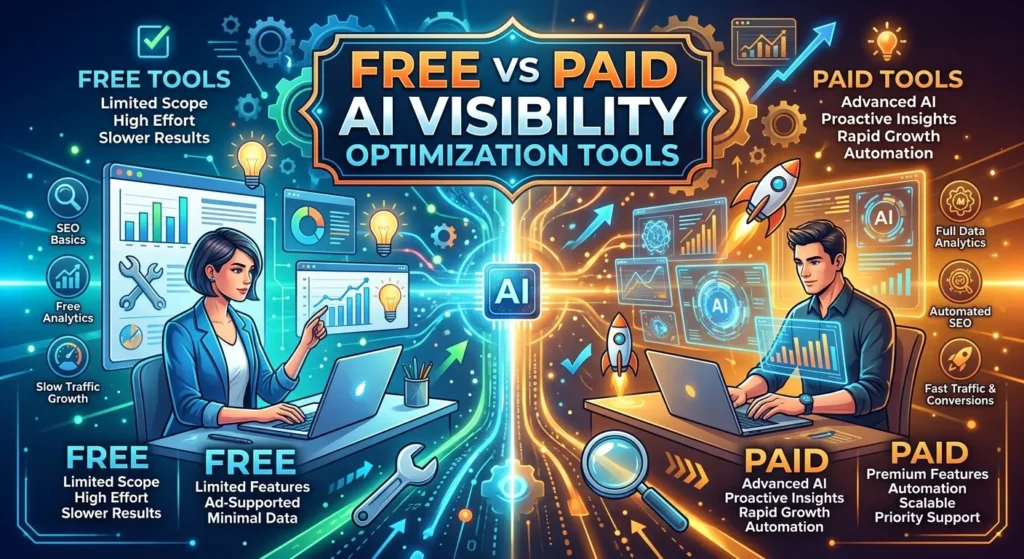
Free methods can work when you are just beginning. You can create a small set of important prompts and manually check how AI systems answer them. Recording the results in a spreadsheet gives you a simple baseline.
This approach is especially useful for a small website with a limited number of important topics. You can monitor a handful of prompts each month and record mentions, competitors, and citations.
Paid platforms become more useful when monitoring becomes difficult to manage manually. Current market pricing ranges from relatively low-cost entry plans to several hundred dollars per month or more, depending on prompt capacity, engines, reporting, and enterprise features.
For example, current published comparisons list entry-level options around $29 per month for OtterlyAI and higher-priced offerings from platforms such as Ahrefs and Scrunch. Prices and packages can change, so treat these figures as snapshots rather than permanent pricing.
Before paying, calculate:
How many prompts do I need? How many engines matter? How frequently should I monitor them? How many brands or websites will I track?
Those factors usually matter more than the headline subscription price.
Pricing, Integrations, and Scalability
AI visibility software often uses usage-based limits. Instead of simply paying for unlimited monitoring, plans may restrict the number of prompts, tracked domains, AI engines, reports, or historical data.
This matters because prompt volume is effectively part of the measurement capacity. A tool monitoring 15 prompts provides a much narrower view than one monitoring hundreds of carefully selected questions.
Current market comparisons show significant differences in pricing and monitoring capacity among tools such as Profound, Peec AI, OtterlyAI, Scrunch, Semrush, and Ahrefs.
Integrations are also important. An SEO team may want AI visibility data alongside keyword rankings, website analytics, content performance, and competitor research.
Look for integrations or exports that fit your existing workflow. If your team already uses a major SEO platform, an integrated AI visibility feature may reduce the need to move between several dashboards.
For agencies, scalability becomes especially important. You may need separate projects, client reports, scheduled exports, user permissions, or API access.
How to Choose the Right AI Visibility Optimization Tool
Start by defining your objective. Do you want to know whether your brand appears in AI answers? Do you need competitor research? Are you trying to understand citations? Or do you need a complete SEO and AI-search platform?
A small business may only need a simple prompt tracker. An SEO agency may need multi-client reporting. A large enterprise may need deeper monitoring, governance, integrations, and API access.
Use these questions when evaluating a platform:
Which AI engines does it monitor?
How many prompts can I track?
Can I analyze citations?
Can I monitor competitors?
Does it show historical changes?
Can I export the data?
Does it integrate with my existing SEO workflow?
What geographic and language coverage is available?
How frequently does it collect data?
Does the price match my actual monitoring requirements?
Do not rely only on vendor marketing or a proprietary visibility score. Different tools observe different samples of AI behavior, so a score from one platform may not be directly comparable with a score from another.
AI Visibility Optimization Best Practices
The strongest AI visibility strategy starts with useful content, not with trying to manipulate an AI model.
Create pages that answer real questions clearly. Use descriptive headings, concise explanations, original examples, trustworthy references, and relevant supporting information.
Google’s current guidance for generative AI features emphasizes established SEO fundamentals and useful, distinctive content.
Another best practice is to build a prompt library based on actual customer questions. Do not monitor only your company name. Include category questions, comparison questions, problem-solving questions, product questions, and industry-specific searches.
For example, instead of tracking only:
“Brand X”
also monitor:
“best tools for small business SEO”
“SEO software for ecommerce websites”
“AI SEO tools for content optimization”
This reveals whether your brand is visible before the user already knows your name.
Finally, review the sources that AI systems cite. If competitors receive citations from authoritative industry websites while your company receives few external mentions, your strategy may need to include digital PR, partnerships, original research, expert contributions, or stronger informational resources.
Common AI Visibility Mistakes to Avoid
One common mistake is assuming that a single AI response represents permanent visibility. AI systems can produce different answers at different times, so one manual test is not enough to establish a trend.
Another mistake is tracking too few prompts. A brand may appear for one question but disappear for another closely related question. A useful monitoring set should cover multiple customer intents and topics.
Do not optimize solely for mentions, either. A brand mention without context may be less valuable than a useful citation from a trustworthy source.
Other mistakes include:
- Focusing only on brand-name prompts
- Ignoring competitors
- Monitoring only one AI engine
- Treating proprietary scores as universal standards
- Publishing generic AI-generated content
- Ignoring traditional SEO
- Measuring visibility without business outcomes
- Changing content after every small fluctuation
- Assuming citations automatically create conversions
Another important issue is over-optimization. Google’s current guidance makes clear that generative AI search features remain subject to its broader Search policies, including spam policies.
The goal should be earning visibility through useful information, not manufacturing signals.
Latest AI Visibility Trends and Future Developments
AI visibility is developing rapidly. Current platforms increasingly monitor not just brand mentions but also citations, prompt categories, competitors, share of voice, sentiment, AI crawlers, and referral activity.
Another major trend is the movement from simple monitoring toward optimization recommendations. Tools increasingly attempt to explain why a competitor appears, which sources are being cited, and what content opportunities may improve visibility.
AI search is also becoming more multimodal. Search experiences increasingly combine text, images, products, videos, local information, and conversational interactions. Google’s 2026 guidance specifically discusses optimizing for generative AI features across content types including local, shopping, image, and video experiences.
In the future, AI visibility platforms may become more connected to the complete marketing stack. Instead of simply showing that a brand lost visibility, tools may connect that change with content updates, competitor activity, technical changes, third-party mentions, and referral behavior.
However, measurement will remain imperfect. AI answers are dynamic, and different tools observe different samples. The best strategy is therefore to look for sustained patterns rather than reacting to individual answers.
How to Build an AI Visibility Strategy for 2026 and Beyond

Start with a clear list of the questions your audience actually asks. Divide them into categories such as informational, commercial, comparison, transactional, and brand-specific prompts.
Next, create a baseline. Record whether your brand appears, which competitors appear, which sources are cited, and which pages receive attention.
Then improve the underlying content. Make your pages more comprehensive, accurate, original, and useful. Add evidence, examples, expert perspectives, clear explanations, and information that competitors do not provide.
After making changes, continue monitoring instead of expecting immediate results.
A strong long-term process looks like this:
Research → monitor → analyze → improve → publish → measure → update.
Connect AI visibility data with traditional SEO metrics whenever possible. Search impressions, organic clicks, conversions, referral traffic, leads, and revenue provide important context.
Most importantly, remember that AI visibility is a means, not the final goal. The real objective is to become a trusted and useful source that people discover through both traditional and AI-powered search.
Conclusion
The best AI visibility optimization tools give marketers a new way to understand how brands appear inside AI-generated answers. They can monitor prompts, mentions, citations, competitors, share of voice, and changes across AI search platforms.
Tools such as Semrush, Ahrefs Brand Radar, Profound, Peec AI, OtterlyAI, and Scrunch represent different approaches to this emerging category, from complete SEO platforms to dedicated AI visibility monitoring systems. Current market comparisons show that pricing, engine coverage, prompt limits, and reporting capabilities vary significantly.
The right tool depends on your website, audience, budget, number of prompts, and business objectives. A small website may start with manual monitoring, while an agency or enterprise may benefit from automated tracking.
Most importantly, do not treat AI visibility as a replacement for SEO. Google’s current guidance continues to emphasize technical accessibility, useful content, established SEO practices, and distinctive information for generative AI search experiences.
The future belongs to brands that combine strong content, trustworthy sources, technical SEO, continuous measurement, and smart use of AI tools.
FAQs
What are AI visibility optimization tools?
AI visibility optimization tools monitor how brands, websites, products, and organizations appear in AI-generated answers. They can track mentions, citations, competitors, prompts, and other visibility signals across supported AI search systems.
Why is AI visibility important for SEO?
AI systems increasingly provide direct answers and recommendations. Monitoring AI visibility helps marketers understand whether their brand is being discovered and cited when users ask relevant questions.
What is the difference between SEO and AI visibility?
Traditional SEO focuses heavily on visibility in search-engine results. AI visibility focuses on how brands and sources appear inside AI-generated answers. The two approaches overlap because technical SEO and high-quality content remain important for AI search experiences.
Which AI engines can visibility tools monitor?
Coverage varies by provider. Current platforms may monitor systems such as ChatGPT, Google AI Overviews, Google AI Mode, Gemini, Perplexity, Claude, and Copilot. Always check the current plan because engine availability can change.
Are AI visibility tools free?
Some tools offer limited free access, while others require paid subscriptions. You can also manually monitor a small set of prompts without specialized software. Paid platforms become more useful when you need automated tracking, larger prompt sets, historical data, competitor monitoring, or reporting.
How often should AI visibility be monitored?
For an active SEO program, regular monitoring is useful. Weekly or daily tracking can help identify trends, while smaller websites may only need periodic checks. The right frequency depends on how quickly your content and market change.
Can AI visibility tools guarantee that my brand will appear in AI answers?
No. These tools measure and analyze AI visibility; they cannot guarantee that an AI system will mention a brand. AI-generated answers can vary based on prompts, systems, sources, and other factors.
How can I improve my brand’s AI visibility?
Create accurate, original, useful, well-structured content that directly answers audience questions. Strengthen technical SEO, develop authoritative resources, earn credible third-party mentions, and monitor which sources AI systems cite.
Should small businesses use AI visibility tools?
They can, but they do not always need an expensive platform. A small business can begin with a focused set of customer questions and manual monitoring. As the number of prompts, competitors, and markets grows, automated software can become more valuable.
What is GEO in AI search?
GEO commonly means Generative Engine Optimization. It refers to efforts designed to improve a brand’s visibility within generative AI and answer-engine experiences. The terminology is still evolving, and different platforms use terms such as AI SEO, AEO, and AI search optimization.
Will AI visibility replace traditional SEO?
No. Google’s current documentation explicitly says that SEO best practices continue to be relevant for its generative AI search features. AI visibility should therefore complement—not replace—technical SEO, useful content, and normal search optimization.