
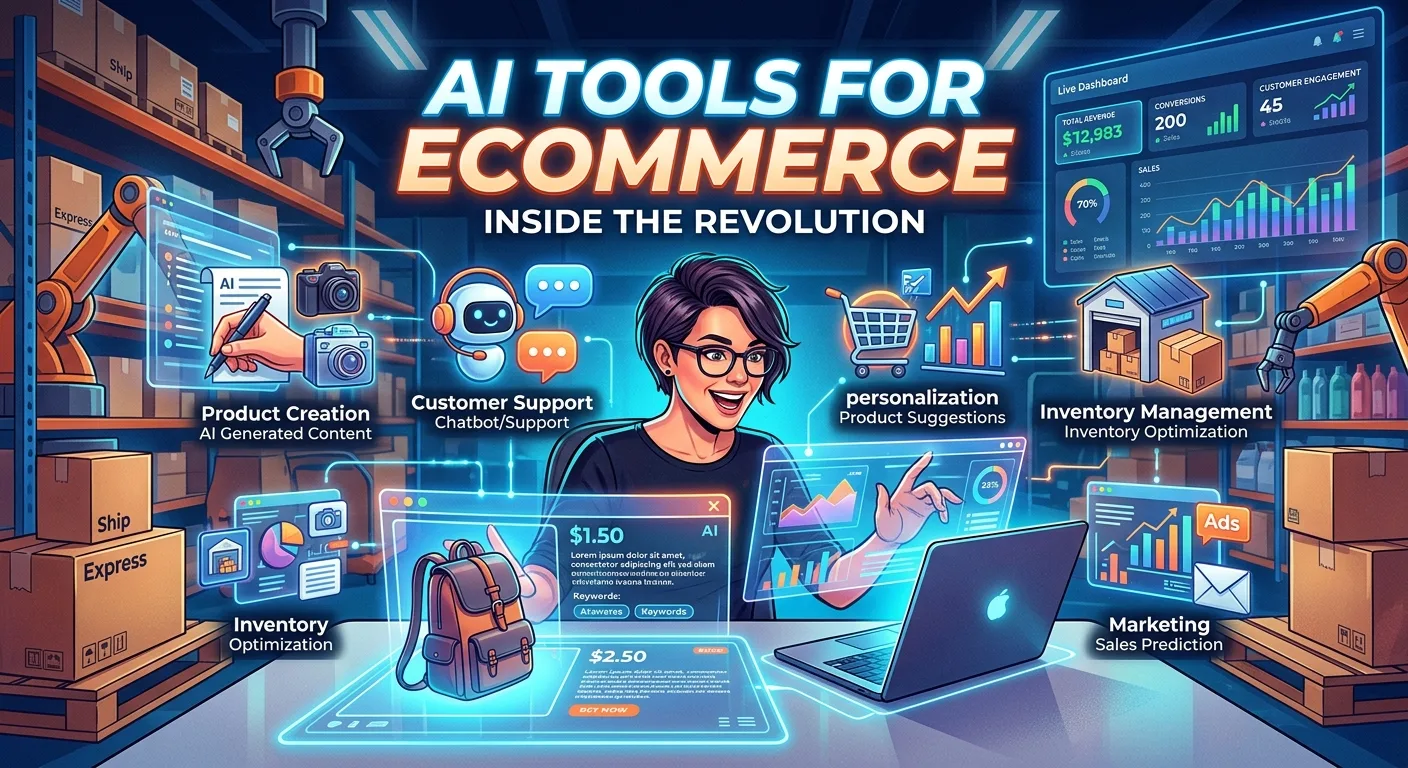
AI tools for ecommerce are transforming how online stores attract shoppers, manage products, personalize experiences, and increase operational efficiency. Instead of relying entirely on manual research and repetitive tasks, ecommerce businesses can use artificial intelligence to analyze customer behavior, generate product content, optimize marketing campaigns, improve customer support, forecast demand, and automate routine workflows. From a small online shop to a large retail operation, AI can help teams make faster, data-informed decisions while creating more relevant shopping experiences.
The technology can support product discovery, SEO, personalization, inventory management, customer service, advertising, analytics, and conversion optimization. However, choosing the right tools requires more than selecting the platform with the most AI features. Businesses should consider their store size, budget, ecommerce platform, data quality, and specific goals. This guide explains how AI ecommerce tools work, where they provide the most value, their advantages and limitations, pricing considerations, integrations, common mistakes, current trends, and future developments.
What Are AI Tools for Ecommerce?
AI tools for ecommerce are software applications that use artificial intelligence to improve different parts of an online retail business. They can support activities ranging from product research and content creation to customer service, marketing, sales forecasting, and business analytics.
Traditional ecommerce operations often require teams to perform repetitive tasks manually. Someone may need to write hundreds of product descriptions, answer similar customer questions, analyze sales reports, organize products, research competitors, and create advertising variations.
AI can accelerate many of these activities.
For example, an online clothing store could use AI to create an initial product description from specifications, suggest relevant search terms, classify products into categories, and recommend related items to shoppers. A human can then review the output before publishing it.
The best AI ecommerce workflows combine automation with human oversight. AI handles repetitive analysis and production, while people remain responsible for brand decisions, accuracy, customer relationships, and strategic choices.
How Do AI Ecommerce Tools Work?
AI ecommerce software typically combines machine learning, natural language processing, predictive analytics, recommendation systems, computer vision, and generative AI.
The system receives data such as product information, customer interactions, purchase history, website behavior, inventory levels, search queries, and marketing performance. AI models then identify patterns and generate predictions, recommendations, or content.
For example, a recommendation engine may analyze products a shopper viewed and compare that behavior with patterns from other customers. It can then suggest products that the shopper may find relevant.
Generative AI works differently. It can create text, ideas, images, summaries, emails, advertisements, or other content based on instructions and available information.
A typical AI ecommerce workflow might look like this:
- Collect reliable store and customer data.
- Define a specific business objective.
- Connect the AI tool to relevant systems.
- Analyze the available information.
- Generate recommendations or content.
- Review important outputs.
- Deploy the approved result.
- Measure performance and improve the workflow.
The quality of AI recommendations depends heavily on data quality, implementation, context, and human review.
Why Ecommerce Businesses Are Using AI
Online retail is highly competitive. Customers can compare products, prices, reviews, shipping options, and brands within seconds.
AI helps businesses respond to this environment by processing information faster and delivering more personalized experiences.
A store might use AI to identify products that are receiving increased interest, personalize recommendations, automate support responses, or create marketing content for different customer segments.
AI can also help small teams compete with larger businesses. A store with only a few employees can automate certain tasks that would otherwise require additional staff.
The objective should not be automation for its own sake.
The strongest ecommerce applications solve measurable problems such as reducing repetitive work, improving conversion rates, increasing customer satisfaction, reducing inventory waste, improving product discovery, or making marketing more efficient.
Key Features of AI Tools for Ecommerce
AI ecommerce platforms can offer a wide range of capabilities.
Product description generation helps merchants create initial descriptions from product specifications.
AI product recommendations suggest relevant products based on shopper behavior, product relationships, or purchase history.
Personalization engines can tailor content, offers, recommendations, or experiences to different shoppers.
Customer service assistants can handle common questions about products, orders, shipping, and store policies.
AI search and merchandising can improve how shoppers find products within a store.
Demand forecasting can analyze historical and current data to estimate future product demand.
Inventory intelligence can help merchants identify potential stock problems and replenishment opportunities.
Marketing automation can assist with email campaigns, advertising variations, customer segmentation, and campaign analysis.
Visual search and image recognition can allow shoppers to discover products through images or help merchants organize visual assets.
The right combination depends on the business model and operational needs.
Benefits of AI Tools for Ecommerce
The first major benefit is productivity. AI can automate repetitive tasks and reduce the amount of time employees spend on routine work.
Another major advantage is personalization. Online shoppers expect relevant experiences, and AI can analyze large amounts of behavioral information to help deliver them.
AI can also improve product discovery. Search and recommendation systems can help customers find products that match their interests.
Marketing teams can use AI to create variations of campaigns, analyze performance, identify customer segments, and prioritize opportunities.
Operations teams can benefit from demand forecasting and inventory analytics.
Customer service can also improve when AI handles simple questions quickly while human agents focus on more complex situations.
However, businesses should measure these benefits rather than assuming they will automatically occur. Useful metrics include conversion rate, average order value, repeat purchases, support response time, customer satisfaction, inventory turnover, and marketing return on investment.
AI Ecommerce Use Cases for Online Stores
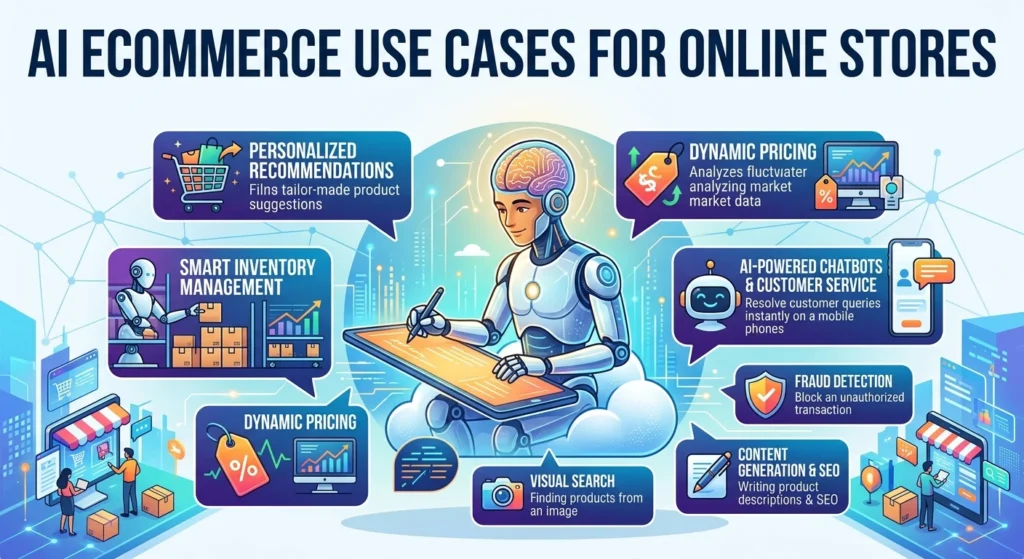
AI can support almost every major stage of an ecommerce journey.
Product content
AI can help generate product titles, descriptions, feature summaries, category text, and metadata. Human review remains important for accuracy.
Product recommendations
Recommendation systems can display related products, complementary products, or items that shoppers may prefer.
Customer support
AI assistants can answer routine questions and direct customers toward relevant information.
Marketing
AI can support email personalization, audience segmentation, ad copy, campaign ideas, and performance analysis.
SEO
AI can assist with keyword research, content briefs, product-page optimization, internal linking, and search visibility analysis.
Inventory
Predictive models can help merchants understand demand patterns and identify products that may require replenishment.
Pricing analysis
Some systems can help businesses analyze market conditions and historical sales data when making pricing decisions. Any automated pricing workflow should include appropriate controls.
Fraud and risk detection
AI can identify unusual transaction or account behavior that may require additional review.
The most valuable use cases are those connected to clear business outcomes.
AI Product Recommendations and Personalization
Product recommendations are among the most recognizable AI applications in ecommerce.
A recommendation system can use signals such as browsing behavior, previous purchases, product relationships, customer preferences, and aggregate shopping patterns.
For example, a shopper viewing a laptop might receive recommendations for compatible accessories. Another shopper who previously purchased running shoes could see related products.
Personalization can also extend beyond recommendations.
An ecommerce website might adjust content, product ordering, promotional messages, or email campaigns based on customer behavior.
However, personalization should feel useful rather than intrusive. Businesses should respect privacy expectations and applicable data-protection requirements.
The best personalization strategy answers a simple question:
Does this recommendation make shopping easier for the customer?
If it does, AI can create value for both the shopper and the store.
AI for Ecommerce SEO and Product Content
SEO remains important for ecommerce stores because customers continue to use search engines and AI-powered search experiences to discover products.
AI can assist with keyword research, product-page optimization, category content, FAQs, internal linking, content briefs, and competitive research.
For example, an AI SEO tool can analyze a product category and identify related questions shoppers may ask. A merchant can use these insights to create useful category content or improve product information.
AI can also help merchants identify duplicate or thin product descriptions.
However, generating hundreds of generic descriptions is not a complete SEO strategy. Product pages should include accurate specifications, unique benefits, useful information, customer-focused language, and details that genuinely help shoppers make decisions.
AI should accelerate content production without turning an ecommerce site into a collection of repetitive pages.
Free vs Paid AI Tools for Ecommerce
Free AI tools can be useful for small stores and businesses testing AI for the first time.
They may help with basic content generation, brainstorming, customer-response drafts, keyword research, or simple analysis.
Paid tools generally provide greater automation, larger usage limits, advanced personalization, integrations, analytics, team features, and ecommerce-specific functionality.
A small store should not assume that paid software is automatically better.
Start with the most important problem. If writing product descriptions consumes too much time, test a content tool. If customers repeatedly ask the same questions, investigate customer-service automation. If inventory planning is difficult, focus on forecasting.
Use trials where available and evaluate results with real store data.
The best AI investment is the one that improves an important workflow without creating unnecessary complexity.
AI Ecommerce Tool Pricing and ROI
AI ecommerce pricing varies considerably.
Some applications charge monthly subscriptions. Others use usage-based pricing, AI credits, transaction fees, number of products, number of customers, users, or revenue levels.
When comparing costs, look beyond the subscription price.
Consider the time saved, additional sales opportunities, reduced support workload, improved inventory management, and marketing efficiency.
For example, a tool that costs more but saves a team dozens of hours each month may provide stronger value than a cheaper tool that produces limited improvements.
Businesses should also watch hidden costs.
Check whether integrations cost extra, whether AI usage has limits, whether additional users require separate fees, and whether advanced features are restricted to higher plans.
Useful ROI measurements include:
- Conversion rate
- Average order value
- Customer retention
- Support resolution time
- Product-page production time
- Marketing efficiency
- Inventory turnover
- Return rate
- Revenue per visitor
- Customer satisfaction
Measure business outcomes rather than AI activity alone.
Integrations for AI Ecommerce Workflows
Integrations are critical because ecommerce operations rarely depend on one platform.
A typical online store may use an ecommerce platform, payment system, analytics solution, CRM, email marketing service, customer support system, inventory platform, advertising channels, and shipping software.
An AI tool becomes more useful when it can access the information required for its task.
For example, an AI customer service system may need order information to answer delivery questions. A recommendation engine may need product catalog and behavioral data. An analytics assistant may need sales and marketing information.
Before selecting a tool, check support for your ecommerce platform, APIs, webhooks, analytics systems, CRM, marketing software, inventory applications, and other critical services.
Data synchronization also matters.
Outdated product prices, incorrect inventory levels, or incomplete customer information can lead to poor AI recommendations.
Good integrations should therefore provide reliable, timely, and appropriately controlled data.
AI Ecommerce Tools vs Traditional Ecommerce Software
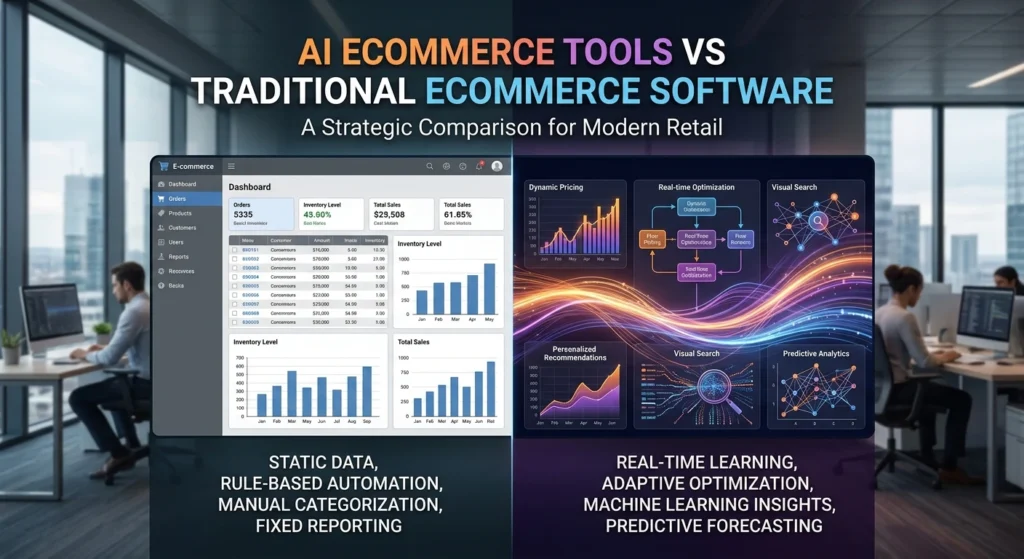
Traditional ecommerce software provides the basic infrastructure required to run an online store.
This includes product catalogs, shopping carts, checkout systems, payment processing, order management, inventory management, and customer accounts.
AI tools add intelligent analysis and automation to these workflows.
For example, traditional software may record customer purchases. An AI system can analyze those purchases to identify patterns and make recommendations.
Traditional software may store product descriptions. Generative AI can help create or optimize those descriptions.
Traditional analytics may display sales numbers. AI analytics can help summarize patterns and highlight potential areas that deserve investigation.
This does not mean traditional software is outdated.
AI works on top of strong ecommerce infrastructure. Businesses need accurate product information, reliable transactions, good analytics, and clear processes before AI can deliver its full value.
How to Choose the Best AI Tools for Ecommerce
Begin with your business objective.
Do you want more sales? Better customer support? Faster product content? Improved SEO? Better inventory forecasting?
Choose tools based on those goals.
Next, consider your store size. A small catalog may not need an enterprise personalization platform. A large retailer may require more advanced infrastructure.
Evaluate ease of use as well. If a tool takes weeks to configure and requires specialized technical knowledge, the implementation cost may be significant.
Check integrations carefully.
Then examine data privacy and security. Determine what customer information the platform needs and how that information is processed.
Finally, run a practical test.
Use a small group of products or a limited customer segment and compare performance before and after implementation.
A good AI tool should produce measurable improvements without making your ecommerce operation unnecessarily complicated.
Common AI Ecommerce Mistakes to Avoid
One of the biggest mistakes is trying to automate everything at once.
Start with one workflow. Prove that it works, then expand.
Another mistake is using inaccurate product data. AI-generated content cannot fix incorrect specifications.
Businesses should also avoid publishing AI-generated product descriptions without review. Incorrect dimensions, compatibility information, materials, or features can damage customer trust.
Privacy is another important consideration. Businesses should understand what customer data an AI provider receives and how that data is handled.
Another mistake is choosing tools based on hype rather than business value.
An AI feature may look impressive during a demonstration but provide little value in your actual store.
Finally, avoid measuring success solely through the number of automated tasks.
The purpose of ecommerce AI is better business performance, not more automation for its own sake.
Latest AI Ecommerce Trends in 2026
One major trend is the rise of AI shopping assistants. Customers increasingly expect digital experiences that can answer product questions, compare options, and help them navigate large product catalogs.
Conversational commerce is another important development. Instead of navigating dozens of filters, shoppers can describe what they need using natural language.
AI-powered product discovery is also becoming more sophisticated. Recommendation engines can increasingly use contextual signals instead of relying only on previous purchases.
Generative AI is expanding across ecommerce content production, including product descriptions, advertising concepts, email campaigns, images, and merchandising support.
Another important trend is AI-powered analytics. Businesses increasingly want software that explains what is happening rather than simply displaying charts.
AI search is also affecting product discovery. Ecommerce brands need to think about how their products are represented in AI-generated recommendations and answers.
The broader trend is clear: ecommerce AI is moving from isolated features toward connected, intelligent workflows.
Future of AI Tools for Ecommerce
The future of ecommerce AI will likely be more personalized, conversational, predictive, and automated.
AI shopping assistants may help customers discover products based on detailed requirements rather than simple keywords.
Merchandising systems may automatically identify changing demand patterns and recommend adjustments to product placement.
Customer service agents may handle increasingly complex conversations while transferring sensitive or unusual cases to human employees.
Marketing systems may coordinate customer segmentation, creative development, campaign testing, and performance analysis.
Inventory systems may combine historical sales, seasonality, product trends, and other signals to support more informed planning.
However, the future will also require stronger privacy, security, transparency, and governance.
Businesses will need to understand what AI systems are doing and maintain appropriate human oversight.
The most successful ecommerce companies will likely combine AI automation with strong product data, excellent customer service, thoughtful merchandising, and genuine brand value.
Conclusion
AI tools for ecommerce are becoming powerful resources for businesses that want to improve productivity, customer experiences, marketing efficiency, and operational decision-making. From product recommendations and personalization to SEO, customer support, inventory forecasting, and analytics, AI can support many parts of an online retail operation.
The best strategy is not to adopt every new AI feature. Instead, identify the areas where your business loses the most time, money, or opportunities and introduce AI where it can create measurable value.
Free tools can help small businesses experiment, while paid platforms can provide deeper automation, integrations, analytics, and scalability. Regardless of budget, data quality and human oversight remain essential.
As ecommerce becomes increasingly conversational and AI-driven, product discovery will continue to change. Customers may increasingly expect online stores to understand their needs and provide useful recommendations quickly.
Businesses that prepare now by improving their product information, customer data, content quality, analytics, and workflows will be better positioned to benefit from these developments.
The future of ecommerce AI is not simply about replacing human work. It is about helping people make better decisions, automate repetitive tasks, create better experiences, and grow online businesses more efficiently.
Frequently Asked Questions
What are AI tools for ecommerce?
AI ecommerce tools use artificial intelligence to help online stores with product recommendations, personalization, content creation, SEO, customer support, marketing, inventory forecasting, analytics, and automation.
How can AI help an ecommerce business?
AI can help businesses automate repetitive work, personalize shopping experiences, improve product discovery, analyze customer behavior, optimize marketing, and support better operational decisions.
Are AI ecommerce tools useful for small businesses?
Yes. Small businesses can use AI for practical tasks such as product descriptions, customer support, SEO research, marketing content, and analytics. The best approach is to start with a specific problem rather than adopting many tools simultaneously.
Can AI increase ecommerce sales?
AI can potentially improve sales by supporting personalized recommendations, better product discovery, targeted marketing, and improved customer experiences. However, results depend on implementation, product quality, pricing, customer demand, and other business factors.
Are there free AI tools for ecommerce?
Yes. Free tools and free plans can support content creation, brainstorming, SEO research, basic analytics, and other tasks. Advanced ecommerce features often require paid plans.
Can AI write product descriptions?
Yes. Generative AI can create product-description drafts from product information. Businesses should review every description for accuracy, originality, specifications, claims, and brand voice before publishing.
How does AI improve ecommerce personalization?
AI can analyze signals such as browsing behavior, purchase history, product interactions, and other approved data to provide more relevant recommendations and experiences.
Can AI help with ecommerce SEO?
Yes. AI can assist with keyword research, product-page optimization, content briefs, internal linking, competitor analysis, and content improvement. Human review remains important for quality and accuracy.
What AI tools are best for ecommerce?
The best tool depends on your objective. Product recommendation systems are useful for personalization, AI writing tools can support product content, customer-service AI can automate routine questions, and AI analytics platforms can help interpret business data.
Are AI ecommerce tools expensive?
Pricing varies. Some tools are free or inexpensive, while advanced platforms may charge based on users, products, customers, transactions, or usage. Businesses should evaluate ROI and workflow value, not price alone.
What are the risks of using AI in ecommerce?
Potential risks include inaccurate content, privacy issues, security concerns, poor recommendations, over-automation, and dependence on unreliable data. Human review and appropriate data governance can reduce these risks.
What is the future of AI in ecommerce?
The future is likely to include conversational shopping, smarter recommendations, AI shopping assistants, predictive inventory systems, automated merchandising, personalized marketing, and integrated AI workflows.
Should an ecommerce business automate everything with AI?
No. Businesses should automate repetitive, low-risk processes while maintaining human oversight for important decisions, customer relationships, brand communication, pricing policies, and sensitive operations.