AI search is changing how people discover brands, products, services, and information. Instead of relying only on traditional search results, users increasingly ask large language models (LLMs) for direct answers, recommendations, comparisons, and summaries. This creates a new opportunity for businesses: optimizing their content so AI systems can understand, trust, and reference their brand.
The best LLM optimization tools for AI visibility help marketers monitor how brands appear across AI-powered search experiences, identify content gaps, track mentions, analyze competitors, and improve the information available to language models. These tools can support innovation, productivity, efficiency, creativity, and automation while reducing the manual work involved in AI visibility research. Whether you run a small website, ecommerce store, SaaS company, or large enterprise, LLM optimization can become an important part of your modern search strategy.
What Are LLM Optimization Tools for AI Visibility?
LLM optimization tools are software platforms designed to help businesses understand and improve how their content and brands appear in AI-generated answers. They focus on large language models and AI search experiences rather than traditional rankings alone.
Traditional SEO often measures keywords, backlinks, rankings, impressions, and clicks. LLM optimization adds another layer. It examines whether an AI system recognizes your brand, understands your content, mentions your business, and uses your website or other trusted sources when generating answers.
AI visibility refers to how easily a brand, website, product, or organization can be discovered and represented in AI-generated responses. A company might rank well on Google but still receive limited visibility when someone asks an AI assistant for recommendations.
For example, a user might ask, “What are the best project management tools for small businesses?” An LLM could mention several companies without displaying a traditional list of ten blue links. LLM optimization tools help businesses monitor these appearances and discover ways to improve their presence.
How LLM Optimization Works Across AI Search
LLM optimization starts by testing how AI systems respond to relevant questions. A platform may create or analyze prompts related to a brand’s products, services, industry, competitors, and target customers.
The tool then measures different signals. These can include brand mentions, citation sources, recommendation frequency, competitor visibility, sentiment, and answer accuracy. Some platforms also identify which websites or publications AI systems commonly reference.
The process is similar to traditional SEO research but focuses on AI-generated answers.
A typical workflow looks like this:
Research → Prompt Testing → AI Answer Analysis → Citation Discovery → Competitor Analysis → Content Improvement → Monitoring
The goal is not to manipulate an AI model directly. Instead, businesses can make their publicly available information clearer, more accurate, authoritative, and useful.
For example, if an AI system repeatedly describes a software company incorrectly, the business can improve its product pages, documentation, company information, FAQs, and third-party references.
Key Features to Look for in LLM Visibility Tools
Different platforms provide different capabilities, so it is important to understand the features that matter most. A strong LLM optimization platform should provide more than a simple list of brand mentions.
One important feature is AI answer monitoring. This lets marketers test relevant prompts and see how different AI systems represent their brand.
Another useful feature is citation analysis. Citation tracking can reveal which domains AI systems use as supporting sources. This information can help marketers identify opportunities to create better first-party content or strengthen their presence across authoritative external websites.
Other valuable capabilities may include:
- Brand mention monitoring
- AI search visibility tracking
- Prompt tracking
- Citation monitoring
- Competitor comparisons
- Sentiment analysis
- Content gap detection
- Source discovery
- Share-of-voice analysis
- AI answer auditing
- Historical visibility tracking
- Reporting and dashboards
- API access
- Team collaboration
The best platform depends on your goals. A small website may need straightforward monitoring, while an enterprise marketing team may require advanced reporting, integrations, APIs, and large-scale prompt tracking.
Benefits of Using LLM Optimization Tools for AI Visibility
The biggest advantage of LLM optimization software is visibility into a search environment that traditional SEO tools may not fully measure.
AI-generated answers can influence how users discover brands. When an AI assistant recommends a company, summarizes a product, or compares several solutions, that response can affect awareness and consideration.
LLM visibility tools make this activity easier to monitor.
They can also save time. Instead of manually asking hundreds of prompts across different AI systems, marketers can use automated workflows to organize and analyze results.
Another major benefit is competitive intelligence. You can discover which competitors appear frequently for important questions and investigate the sources associated with those recommendations.
For example, imagine that your company sells accounting software. Traditional SEO might tell you that a competitor ranks for a particular keyword. An AI visibility platform could reveal that the same competitor is also frequently mentioned when users ask AI assistants for accounting software recommendations.
This creates a different type of competitive insight.
Best Use Cases for AI Visibility and LLM Optimization
LLM optimization tools can support many marketing and research activities. Their usefulness extends beyond checking whether a company receives AI mentions.
Content teams can use them to identify questions that AI systems answer about their industry. This can reveal opportunities for new articles, guides, FAQs, comparison pages, and educational resources.
SEO teams can combine traditional search data with AI visibility measurements. This creates a broader view of how content performs across both conventional and AI-powered discovery channels.
Brand teams can monitor how AI systems describe their company. This is particularly useful when product information changes or when inaccurate descriptions appear.
Product marketing teams can analyze how AI systems compare their products with competitors. They can then improve product documentation, positioning, feature explanations, and customer education.
Ecommerce businesses can monitor product recommendations and category-level visibility.
SaaS companies can test prompts such as:
- Which tools are best for remote teams?
- What software can automate customer support?
- What are alternatives to a particular platform?
- Which CRM is suitable for startups?
- What should a small business consider before choosing this type of software?
These use cases make LLM optimization useful across marketing, content, product, communications, and research teams.
AI Visibility Metrics That Matter Most
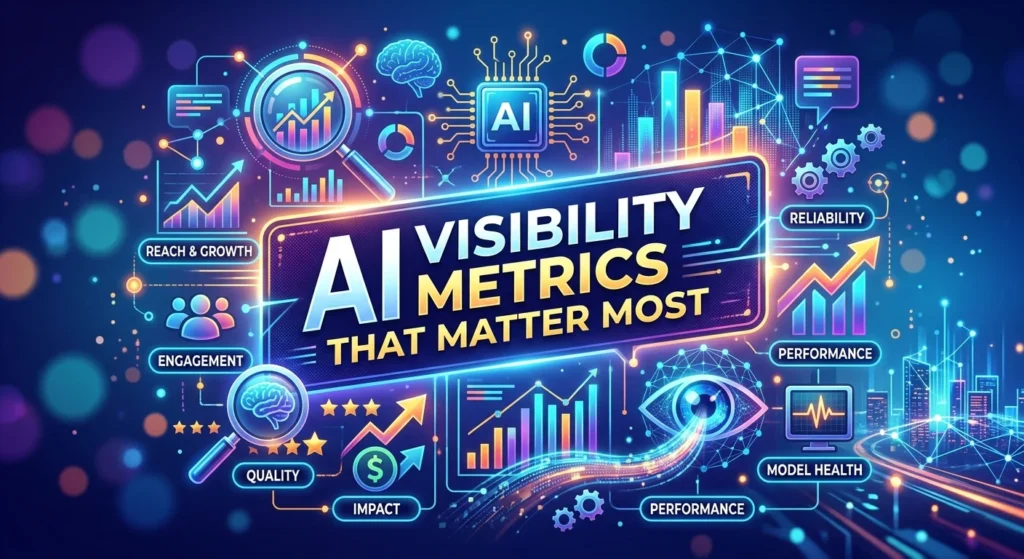
Measuring AI visibility requires different metrics from conventional SEO. Rankings still matter, but they do not tell the entire story.
One important metric is mention frequency. It measures how often a brand appears in relevant AI-generated answers.
Another is share of AI visibility, which compares how frequently your brand appears against competitors across a defined set of prompts.
Citation frequency is also valuable. It shows how often your website or other sources are referenced by AI-generated answers.
Another useful measurement is position or prominence within an answer. Being mentioned first in a recommendation can represent a different level of exposure than appearing at the end of a long response.
Businesses may also monitor:
- Brand mentions
- Citation rate
- Competitor mentions
- Sentiment
- Recommendation frequency
- Source frequency
- Prompt coverage
- Answer accuracy
- Visibility changes over time
- Product-level visibility
No single metric should be treated as a complete measure of success. A combination of metrics gives a clearer picture.
Free vs Paid LLM Optimization Tools
Free tools can be useful for beginners who want to understand AI visibility without making a large investment. You can manually test prompts across AI platforms and record mentions, citations, competitors, and recurring patterns.
This approach works well for a small number of prompts. However, manual monitoring becomes difficult as the number of queries increases.
Paid platforms typically add automation, historical tracking, dashboards, reporting, collaboration, and larger-scale monitoring. Some may also provide APIs or integrations with existing marketing systems.
Before paying for a platform, define what you actually need.
If you only monitor 20 prompts once a month, an expensive enterprise platform may provide more functionality than necessary. If you monitor thousands of prompts across multiple markets, manual tracking may become inefficient.
A sensible approach is to start small, establish measurable goals, and upgrade when the workflow requires greater scale.
Pricing and ROI Considerations for LLM Optimization Platforms
Pricing varies significantly between LLM visibility platforms. Costs may depend on factors such as the number of prompts, tracked brands, users, locations, AI platforms, reporting features, API access, and historical data.
Instead of choosing a platform solely because it has the lowest price, consider the value it provides.
For example, a tool that identifies an important content gap may help your team create a page that attracts new customers. A platform that saves several hours of manual research every week may also produce meaningful operational value.
A practical ROI framework can include:
Time saved + useful insights generated + visibility improvements + content opportunities identified
However, AI visibility should not be treated as a guaranteed traffic source. AI-generated answers and search experiences can change quickly, so businesses should evaluate tools based on measurable information and workflow efficiency rather than promises of guaranteed rankings.
Integrations With SEO, Analytics, and Marketing Platforms
Integrations can make LLM optimization much more useful. Instead of keeping AI visibility data in a separate system, marketers can connect it with other parts of their digital strategy where supported.
Useful integrations may include SEO platforms, analytics systems, content management systems, reporting tools, customer relationship management platforms, and business intelligence software.
For example, an SEO team could combine traditional organic search performance with AI visibility measurements. A content team could connect visibility insights with its editorial workflow.
APIs can be particularly useful for larger organizations. They allow businesses to move data between systems and create customized dashboards or reporting workflows.
Before choosing a tool, check whether it supports the platforms your team already uses. A powerful tool with poor integration can create unnecessary manual work.
LLM Optimization vs Traditional SEO
Traditional SEO and LLM optimization are related but not identical.
Traditional SEO focuses heavily on helping search engines discover, understand, index, and rank web pages. It commonly involves keywords, technical SEO, internal linking, backlinks, structured content, and user experience.
LLM optimization focuses more on how AI systems understand and represent information when generating answers.
There is significant overlap. High-quality content, clear structure, factual accuracy, strong topical coverage, useful references, and authoritative information can support both approaches.
The difference is in measurement and search behavior.
Traditional SEO might ask:
“Does this page rank for the target keyword?”
LLM optimization might ask:
“Does this brand appear when users ask AI systems questions related to this topic?”
A modern strategy can address both questions instead of treating them as competing disciplines.
How to Choose the Right LLM Optimization Tool
Start with your specific objective. Do you want to track brand mentions? Monitor citations? Analyze competitors? Measure AI search visibility? Find content opportunities? Track product recommendations?
Once the goal is clear, evaluate tools based on functionality.
Look for prompt coverage, AI platform support, reporting capabilities, historical data, competitor tracking, citation analysis, integrations, and ease of use.
Data quality also matters. A platform should make it easy to understand what it measured and how the results were produced.
Consider scalability as well. Your needs may change as AI search becomes more important.
A useful selection process is:
Define goals → Identify required metrics → Test platforms → Compare data quality → Check integrations → Review pricing → Choose based on workflow fit
Avoid choosing a platform only because it has a long feature list.
Common LLM Optimization Mistakes to Avoid
One common mistake is focusing entirely on the number of brand mentions. More mentions do not automatically mean better visibility if the information is inaccurate or irrelevant.
Another mistake is tracking too few prompts. A brand may appear frequently for one query but disappear completely for related questions.
Businesses should build a broad prompt set covering different stages of the customer journey.
Another mistake is treating AI visibility as a replacement for SEO. LLM optimization should complement established search, content, brand, and digital marketing practices.
Other mistakes include:
- Ignoring competitor visibility
- Tracking only one AI platform
- Failing to monitor citations
- Using vague prompts
- Ignoring factual inaccuracies
- Measuring results only once
- Publishing low-value content solely for AI visibility
- Overusing keywords
- Assuming every AI answer behaves the same way
AI search changes quickly. Regular monitoring is more useful than a one-time audit.
Strategies to Improve Brand Visibility in LLM Responses
Improving AI visibility starts with making your information easy to understand and verify.
Create detailed pages that clearly explain what your company does, who it serves, what products it offers, and how those products differ from alternatives.
Use descriptive headings, concise explanations, factual claims, FAQs, product documentation, comparison content, and relevant supporting information.
Strong first-party content is important, but external sources can also influence how a brand is represented. Industry publications, reputable directories, expert resources, reviews, and other trustworthy sources may contribute to the information available to AI systems.
Consistency matters too.
If your company describes a product differently across multiple websites, AI systems may have difficulty determining which information is current.
For example, keep product names, descriptions, pricing information, features, company details, and important terminology consistent wherever practical.
The objective should be clear, accurate, useful information, not attempts to manipulate AI answers.
Latest LLM Optimization Trends for 2026 and Beyond

AI search continues to develop rapidly. One major trend is the growth of answer-based discovery, where users receive synthesized information rather than simply a list of webpages.
Another important trend is the increasing importance of citations and source transparency. Users and businesses want to understand where AI-generated information comes from.
Multimodal search is also becoming increasingly important. AI systems can process combinations of text, images, audio, and other information, creating new optimization opportunities.
Another emerging area is entity-level optimization. Rather than optimizing only individual pages, businesses increasingly need to ensure that AI systems understand their organization, products, people, services, and relationships.
Prompt monitoring will likely become more sophisticated as well. Instead of tracking only simple keywords, businesses can monitor complete customer questions and conversational journeys.
The future of LLM optimization will likely involve a combination of SEO, content strategy, entity optimization, brand authority, structured information, and AI visibility measurement.
Best Practices for Building a Long-Term AI Visibility Strategy
A successful AI visibility strategy should be continuous rather than a one-time campaign.
Start by creating a prompt library based on real customer questions. Include informational, commercial, comparison, product, problem-solving, and brand-specific questions.
Track those prompts regularly and record how AI systems represent your brand.
Then identify patterns.
If competitors receive frequent recommendations while your brand rarely appears, investigate the underlying information landscape. Look at content quality, topical coverage, external references, product clarity, and brand information.
Create useful content based on genuine information gaps rather than trying to produce content simply because an AI platform might mention it.
Finally, connect AI visibility with broader business objectives.
A good strategy should help answer practical questions such as:
- Are more potential customers discovering our brand?
- Is AI describing our products accurately?
- Are important competitors appearing more frequently?
- Which topics need better content?
- Which sources influence AI answers?
- Are our content investments addressing real customer needs?
This approach keeps LLM optimization connected to measurable marketing and customer goals.
Frequently Asked Questions About LLM Optimization Tools
What are the best LLM optimization tools for AI visibility?
The best tool depends on your goals, budget, AI platforms, prompt volume, and required reporting features. Look for tools that support AI answer monitoring, brand mentions, citation tracking, competitor analysis, and historical visibility measurement.
What does AI visibility mean?
AI visibility describes how frequently and prominently a brand, website, product, or organization appears in AI-generated answers for relevant user questions.
Is LLM optimization the same as SEO?
No. LLM optimization and SEO overlap, but they measure different search experiences. Traditional SEO focuses heavily on search engine rankings, while LLM optimization examines how AI systems understand and represent information in generated answers.
Can small businesses use LLM optimization tools?
Yes. Small businesses can start with manual prompt testing or affordable monitoring platforms. The most important step is to track questions that potential customers actually ask.
Are free AI visibility tools useful?
Free tools and manual testing can provide valuable insights for small projects. Paid platforms become more useful when businesses need automation, historical tracking, large prompt sets, advanced reports, or team collaboration.
How often should AI visibility be monitored?
The ideal frequency depends on how quickly your industry and content change. Regular monitoring can help identify changes in brand mentions, citations, competitors, and AI-generated descriptions.
Can LLM optimization guarantee AI recommendations?
No. AI-generated responses depend on many factors and can change over time. LLM optimization tools provide measurement and insights, but they cannot guarantee that an AI system will recommend a particular brand.
Do backlinks still matter for AI visibility?
Backlinks can remain relevant to overall authority and discoverability, but AI visibility involves more than backlinks. Content quality, factual accuracy, source credibility, entity information, and broader online presence can also matter.
Should I optimize only for ChatGPT?
No. AI search is broader than one platform. Depending on your audience, it can be useful to monitor multiple AI search experiences and conversational systems.
What should I optimize first?
Start with your most important customer questions. Make sure your website clearly explains your brand, products, services, expertise, and key topics. Then use AI visibility monitoring to identify gaps and opportunities.
Conclusion
The rise of AI-powered search is creating a new layer of digital visibility. Businesses can no longer focus only on traditional keyword rankings if their customers also discover products, brands, and information through conversational AI.
The best LLM optimization tools for AI visibility help businesses monitor this changing environment. They can track brand mentions, analyze citations, compare competitors, identify content gaps, and measure changes over time.
However, technology alone is not enough. The strongest strategy combines monitoring with accurate information, useful content, clear brand communication, authoritative sources, strong SEO fundamentals, and continuous improvement.
For beginners, the best starting point is simple: identify the questions your customers ask, test how AI systems answer those questions, understand which sources they reference, and improve the information you control.
As AI search continues to evolve through 2026 and beyond, businesses that consistently measure and improve their digital presence will be better equipped to understand how customers discover them in an increasingly conversational search environment.
This version is structured for your SEO workflow with one H1, exactly 15 H2 sections, 2500+ words, semantic coverage, FAQs, and AI-search-focused content.