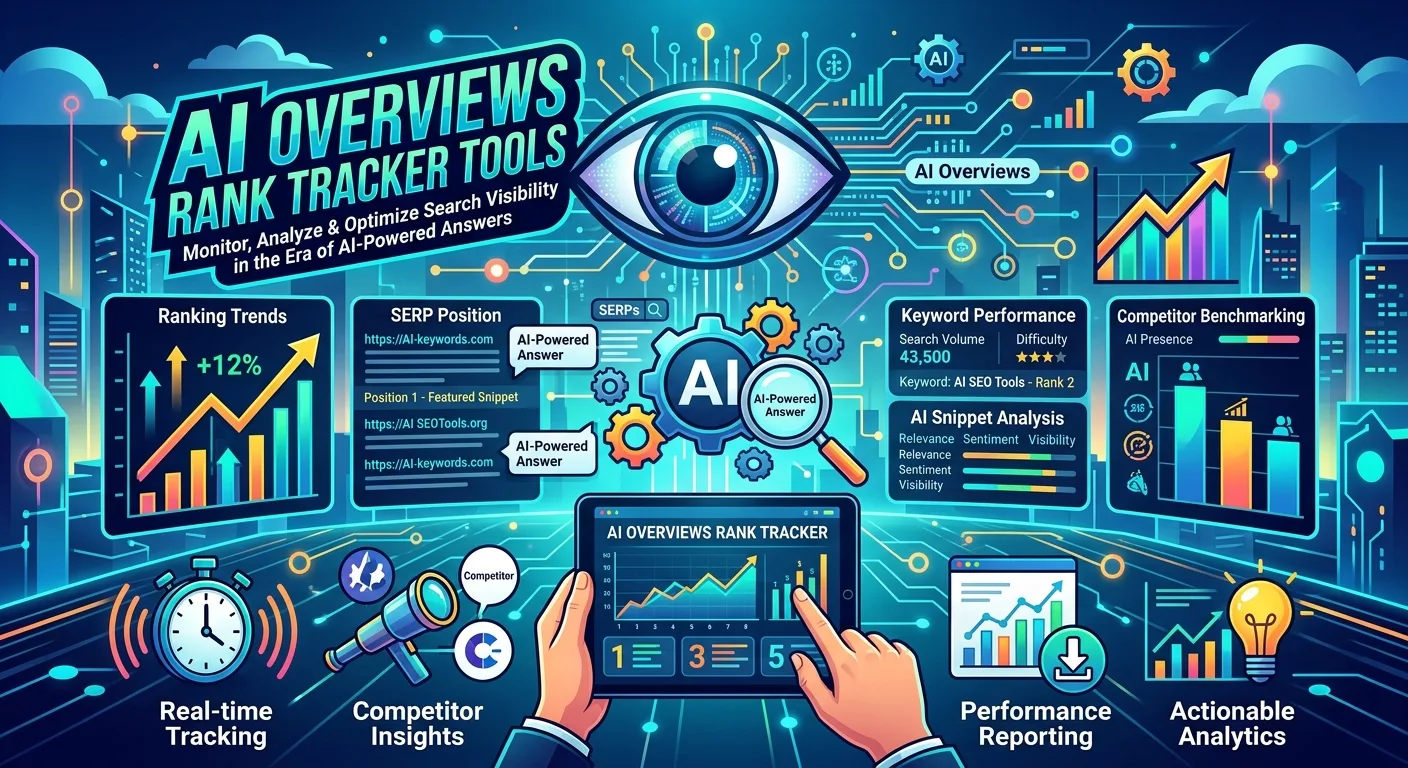
An AI visibility optimization tool helps businesses understand and improve how their brands, websites, products, and expertise appear in AI-powered search experiences. Traditional SEO focuses heavily on rankings, keywords, backlinks, and organic traffic. AI search adds another layer by considering whether AI systems mention a brand, cite its content, understand its expertise, and recommend its products or services.
These tools can automate monitoring, analyze AI-generated answers, identify content gaps, track competitors, and turn complex search data into practical insights. This creates real-world value for marketers, SEO professionals, agencies, publishers, and businesses that want to stay visible as search behavior evolves. Instead of manually checking hundreds of questions, teams can use automation to monitor important queries and focus their time on innovation, productivity, efficiency, creativity, and strategic optimization.
What Is an AI Visibility Optimization Tool?
An AI visibility optimization tool is software designed to help businesses measure, understand, and improve their presence in AI-generated search results and conversational answers.
Traditional search optimization asks questions such as, “Where does my website rank for this keyword?” AI visibility optimization asks broader questions: “Does an AI system mention my brand?” “Which sources does it cite?” “How does it describe my company?” and “Which competitors appear instead?”
These tools can monitor AI search experiences and organize the results into useful reports. Depending on the platform, they may track brand mentions, citations, competitors, sentiment, query coverage, source domains, and changes over time.
For example, a cybersecurity company could create prompts around questions such as “best cybersecurity software for small businesses.” An AI visibility platform could monitor whether the company appears in answers, which competitors are mentioned, and which websites are cited.
The goal is not simply to appear more often. The goal is to build a digital presence that AI systems can understand accurately and confidently.
How an AI Visibility Optimization Tool Works
Most AI visibility platforms start by creating a collection of relevant prompts. These prompts represent questions that customers, researchers, or other audiences might ask AI systems.
The platform then runs or collects AI-generated responses and analyzes them. It may look for brand mentions, product references, citations, competitor names, and descriptions associated with the target business.
The system can organize the information into dashboards. A marketing team might see that its brand appears frequently for beginner-focused questions but rarely for enterprise queries.
Some tools go further by identifying potential optimization opportunities. They may highlight topics where competitors receive citations, questions where a brand is missing, or pages that could provide stronger supporting information.
A simplified workflow looks like this:
Build query set → monitor AI answers → detect mentions → analyze citations → compare competitors → identify gaps → optimize content → monitor changes.
Because AI answers can change, businesses should use consistent queries and measurement methods when comparing results over time.
Key Features of AI Visibility Optimization Software
The exact features vary between platforms, but several capabilities are particularly useful.
AI brand mention tracking helps businesses determine how frequently their names, products, or services appear in relevant AI answers.
Citation monitoring shows which websites and pages AI systems reference. This can reveal what types of sources contribute to visibility.
Competitor analysis helps businesses understand which competing brands appear for the same topics and questions.
Prompt tracking allows marketers to build a structured collection of customer-focused queries and monitor them regularly.
Other useful capabilities can include:
- AI search monitoring
- Share-of-voice analysis
- Citation analysis
- Brand sentiment tracking
- Competitor monitoring
- Query clustering
- Historical reporting
- Content gap analysis
- Source-domain analysis
- AI answer snapshots
- Automated alerts
- Custom dashboards
- API access
- Agency reporting
When evaluating a tool, look beyond the number of features. The quality and usefulness of the data matter more than a long feature list.
Benefits of Using an AI Visibility Optimization Tool
The biggest benefit is visibility measurement. Businesses can see how they appear in AI search environments instead of relying only on traditional rankings.
Automation also saves time. Marketing teams do not need to manually repeat hundreds of AI queries every week. A monitoring platform can perform structured checks and organize the results.
Another benefit is competitor intelligence. Businesses can identify topics where competing brands receive frequent mentions or citations.
AI visibility tools can also improve content strategy. Suppose a company discovers that AI answers repeatedly cite research reports, detailed guides, and expert resources when discussing a particular topic. The company can use this insight to improve its own information resources.
These tools can also help identify inaccurate brand descriptions. If an AI system consistently misunderstands a product or uses outdated information, the business can investigate the sources contributing to that understanding.
The most useful outcome is better decision-making. Visibility data becomes valuable when it leads to practical improvements in content, authority, brand communication, and customer experience.
AI Visibility Optimization vs Traditional SEO
Traditional SEO and AI visibility optimization overlap, but they measure different aspects of digital presence.
Traditional SEO focuses on search engine results pages, keyword rankings, organic traffic, technical performance, backlinks, and webpage relevance.
AI visibility optimization focuses on how AI systems understand and represent information. A business may rank well for a conventional keyword while appearing rarely in conversational AI answers.
For example, a website could rank strongly for “CRM software” but not appear when users ask, “What CRM should a growing SaaS company choose?”
AI systems may also combine information from several sources. Instead of presenting ten webpages, an AI answer may synthesize information and cite only a few sources.
This means businesses should not abandon traditional SEO. Instead, they can use both approaches.
Traditional SEO helps build discoverability, while AI visibility optimization helps measure how a brand is represented within emerging AI search experiences.
AI Visibility Optimization Use Cases
AI visibility optimization can support different industries and business models.
For SaaS companies, it can monitor whether products appear when users ask for software recommendations, comparisons, or solutions to specific business problems.
For ecommerce brands, it can track product-related questions and determine whether AI-generated recommendations mention specific products or companies.
For publishers, it can reveal whether articles and research are cited in AI answers. This can help content teams understand which topics have strong visibility potential.
For marketing agencies, AI visibility tools can provide monitoring and reporting across multiple clients. Agencies can track brand mentions, citations, competitors, and query categories from a centralized system.
Professional service businesses can monitor questions related to their industries and identify how AI systems describe their expertise.
Across these use cases, the central question is the same: Can the target audience discover and understand this brand through AI-powered search?
AI Citation Tracking and Source Analysis
Citations are an important part of AI visibility analysis. When an AI system provides an answer, it may reference webpages, publications, research, documentation, or other sources.
An AI visibility optimization tool can identify these sources and help marketers understand patterns.
For example, suppose a technology company wants to improve visibility for a topic related to data security. If AI answers repeatedly cite government resources, respected industry publications, and detailed technical guides, those patterns can inform the company’s content strategy.
Citation analysis can also reveal opportunities. If competitors receive citations from authoritative websites while a company does not, the company may investigate whether stronger research, original data, expert commentary, or useful resources could improve its authority.
However, businesses should avoid assuming that getting one particular website to mention them will automatically improve AI visibility.
Authority is usually built through a broader ecosystem of trustworthy, relevant information.
AI Competitor and Share-of-Voice Analysis
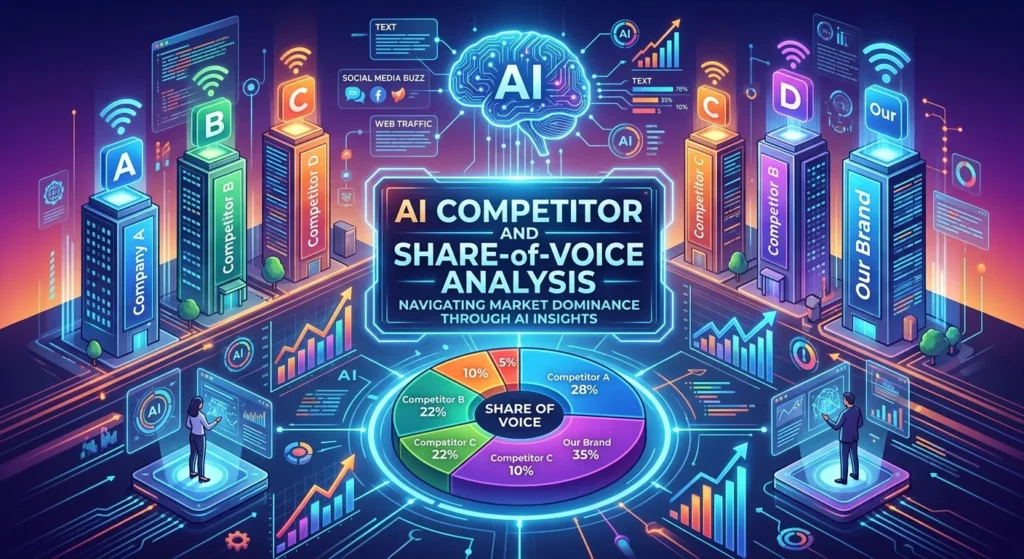
Competitor monitoring helps businesses understand how their visibility compares with other brands across a defined set of queries.
For example, a company might monitor 100 questions across three categories. It could discover that its brand appears frequently in category one, occasionally in category two, and rarely in category three.
The same analysis can reveal which competitors dominate specific topics.
Share-of-voice metrics can provide a useful directional signal. However, the methodology matters. Different tools may calculate visibility differently based on query selection, AI models, response length, brand position, and other factors.
For this reason, businesses should avoid treating one score as an absolute market measurement.
Instead, use competitor analysis to answer practical questions:
- Which topics generate competitor visibility?
- Which sources support competitor mentions?
- What customer questions are we missing?
- Which areas show an opportunity for better content?
- How does our brand positioning differ?
This turns competitor research into a content and brand intelligence process.
Free vs Paid AI Visibility Optimization Tools
Businesses can start measuring AI visibility without immediately purchasing specialized software. Manual testing can provide useful early insights.
For example, a marketer can create a list of important customer questions and periodically test them across relevant AI search platforms. Results can be recorded and compared over time.
This approach works for small experiments but becomes difficult at scale. Manual monitoring takes time and can make consistent measurement challenging.
Paid AI visibility platforms generally provide automation, larger prompt libraries, historical tracking, competitor monitoring, citation analysis, dashboards, alerts, and reporting.
Pricing varies significantly. Some services may charge based on tracked queries, models, users, brands, domains, or monitoring frequency.
A practical approach is to start with a small set of high-value queries. If the insights help improve your marketing decisions, expanding to a paid platform may make sense.
Do not choose a tool only because it has the highest number of tracked prompts. Choose the platform that provides information you can actually use.
Integrations With SEO, Analytics, and Marketing Tools
AI visibility data becomes more valuable when combined with existing marketing information.
Some platforms provide APIs, exports, dashboards, or integrations with analytics and reporting systems. These connections can help teams combine AI visibility data with traditional SEO and business performance data.
For example, a company could compare AI visibility trends with organic search traffic. If visibility rises but website engagement does not, marketers can investigate whether the AI answers are reaching the right audience.
Content teams can also combine citation data with website analytics. This can help identify which pages attract attention from both traditional search and AI-powered discovery.
Agencies may benefit from integrations that simplify client reporting. Instead of manually collecting screenshots and observations, teams can automate recurring reports.
Before selecting a platform, review API capabilities, data exports, integrations, security controls, user permissions, and reporting options.
The best integration is one that reduces manual work without making the marketing technology stack unnecessarily complicated.
Pros, Cons, and Limitations of AI Visibility Optimization
AI visibility tools offer several advantages.
Pros include:
- Automated AI search monitoring
- Faster brand analysis
- Competitor insights
- Citation tracking
- Historical comparisons
- Query-level reporting
- Content opportunity discovery
- Scalable monitoring
- Automated alerts
However, these tools also have limitations.
AI responses can vary. The same question may produce different answers depending on the model, timing, context, location, language, or other factors.
This means AI visibility should not always be treated like a fixed Google ranking.
Another limitation is incomplete coverage. A platform may monitor selected AI systems and queries but cannot necessarily represent every AI interaction happening across the internet.
Businesses should also remember that visibility does not equal revenue. A brand mention may increase awareness without producing a click, lead, or sale.
The best measurement strategy connects AI visibility with broader business metrics whenever possible.
Common AI Visibility Optimization Mistakes
One common mistake is tracking too few prompts. A brand may appear for one question but not another question with nearly identical intent.
Another mistake is changing the query set constantly. Without a stable group of tracked prompts, historical comparisons become less meaningful.
Some marketers also focus too heavily on a single visibility score. Scores can simplify complex information, but they cannot explain every reason behind a change.
Ignoring source quality is another mistake. Knowing that a competitor appears frequently is less useful than understanding which sources contribute to that visibility.
Businesses can also become overly focused on generating content. More content does not automatically create more authority.
A stronger strategy is to create fewer, more useful resources that directly address real customer needs and provide trustworthy information.
Avoid trying to manipulate AI answers through artificial repetition, misleading claims, or low-quality content. Long-term visibility depends on a strong information ecosystem.
Best Practices for AI Visibility Optimization
Begin with your audience. Identify the questions customers actually ask before creating a prompt-monitoring strategy.
Build a structured query set covering different stages of the customer journey. Include informational questions, comparisons, product searches, problem-solving queries, and industry-specific questions.
Create useful content that provides clear answers. Definitions, examples, original research, expert insights, statistics, comparisons, and practical guides can all contribute to a stronger information footprint.
Keep important information consistent across your website and other reputable sources. Brand names, product descriptions, company information, services, and expert credentials should remain accurate.
Monitor citations and investigate patterns. If AI systems consistently rely on certain types of sources, understand why those sources are useful rather than simply trying to copy them.
Finally, measure changes over time. Consistency is more valuable than isolated observations.
Use AI visibility data alongside traditional SEO, analytics, brand monitoring, and customer feedback for a more complete picture.
Latest Trends in AI Visibility Optimization
AI visibility optimization is developing alongside conversational search. Users increasingly ask detailed questions rather than entering short keywords.
This is encouraging marketers to monitor natural-language prompts and complete customer questions rather than relying exclusively on traditional keyword lists.
Another trend is greater focus on citations. Businesses want to understand not only whether they appear in AI answers but also which pages and domains influence those answers.
AI visibility tools are also becoming more focused on actionable recommendations. Instead of simply reporting low visibility, future platforms may identify missing topics, weak supporting evidence, or opportunities to improve content.
Brand reputation is another growing area. AI systems can summarize public information about companies, so businesses have a stronger reason to monitor how they are described across the web.
As AI search develops, optimization is likely to become increasingly connected with content strategy, digital PR, reputation management, technical SEO, and brand authority.
Future of AI Visibility Optimization Tools
The future of AI visibility optimization will likely involve more AI models, richer query monitoring, and more advanced analysis.
AI systems may increasingly personalize answers according to user context, location, interests, and previous interactions. This could make visibility more dynamic than traditional search rankings.
Future tools may therefore focus less on a single ranking number and more on visibility patterns across different contexts.
We can also expect stronger integration between AI visibility platforms and broader marketing systems. A single dashboard could eventually combine traditional search rankings, AI mentions, citations, brand searches, website traffic, conversions, and customer feedback.
AI-powered recommendations may become more sophisticated as well. Instead of simply identifying a missing mention, systems could analyze the information ecosystem and suggest specific areas for improvement.
The long-term goal is not to manipulate AI-generated answers. It is to create accurate, authoritative, useful, and well-connected information that AI systems can understand and confidently use.
FAQs About AI Visibility Optimization Tools
What is an AI visibility optimization tool?
An AI visibility optimization tool helps businesses monitor and improve how their brands, websites, products, and expertise appear in AI-powered search and conversational answers.
How is AI visibility different from traditional SEO?
Traditional SEO often measures rankings, organic traffic, keywords, and backlinks. AI visibility focuses on brand mentions, citations, representation, and presence within AI-generated answers.
Can AI visibility tools improve rankings?
They primarily measure and analyze AI search visibility. They may provide insights that support broader SEO and content strategies, but they cannot guarantee traditional or AI search rankings.
What should an AI visibility tool track?
Useful metrics include brand mentions, citation frequency, query coverage, competitor visibility, cited sources, sentiment, and visibility changes over time.
Are AI visibility optimization tools free?
Some manual and limited free options exist. Specialized platforms generally offer paid plans with automation, historical monitoring, larger query sets, competitor tracking, and reporting.
Why are AI citations important?
Citations can show which sources AI systems use when constructing answers. Analyzing them can help businesses understand the information ecosystem surrounding their topics.
Can AI visibility tools track competitors?
Yes, many platforms can monitor competitors across selected queries and compare brand mentions, citations, or other visibility metrics.
How often should AI visibility be monitored?
Businesses should monitor visibility regularly enough to identify meaningful changes. A consistent query set and methodology are more important than checking randomly every day.
How can a website improve AI visibility?
Create useful, accurate, authoritative content that answers real customer questions. Build topical depth, maintain consistent brand information, demonstrate expertise, and strengthen trustworthy sources.
Does AI visibility guarantee more traffic?
No. Visibility can increase awareness, but it does not automatically produce website visits, leads, or sales. Businesses should connect AI visibility with meaningful business metrics.
Conclusion
An AI visibility optimization tool provides a new layer of search intelligence for businesses operating in an increasingly AI-driven discovery environment. It can monitor brand mentions, analyze citations, track competitors, measure query coverage, and identify opportunities that traditional SEO reporting may miss.
The technology should not replace traditional SEO. Instead, it complements existing search strategies by showing how brands appear within conversational and AI-generated experiences.
The strongest approach combines AI visibility monitoring with helpful content, technical SEO, authoritative sources, consistent brand information, genuine expertise, and customer-focused resources.
As AI search continues to evolve, businesses that understand how AI systems discover, interpret, and cite information will have better data for making strategic decisions. The objective is not simply to appear more often. It is to build a trustworthy digital presence that provides real value to people and can be accurately understood by the AI systems they increasingly use.