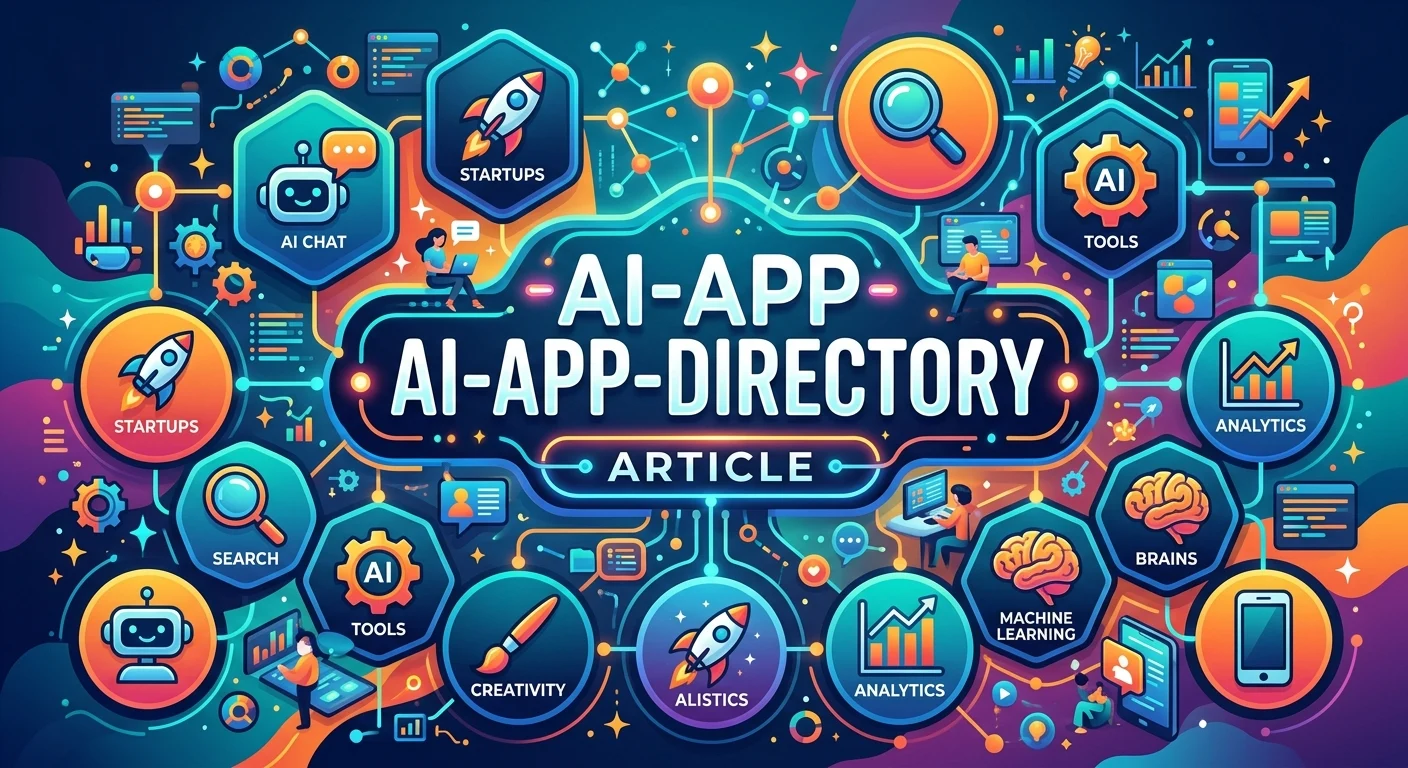
An AI app directory is a searchable online collection of artificial intelligence applications that helps people discover tools for work, business, education, creativity, marketing, productivity, automation, and everyday tasks. As the number of AI applications continues to grow, finding the right tool can become difficult. An organized directory makes this process easier by grouping AI apps into useful categories and providing information that helps users compare their options
. Whether someone needs an AI writing assistant, image generator, coding tool, research platform, video creator, or business automation solution, a well-designed AI app directory can reduce research time and improve decision-making. It also creates opportunities for innovation by helping users discover new technologies they may not encounter through traditional search. This guide explains how AI app directories work, their benefits, important features, pricing models, use cases, selection tips, common mistakes, and future trends.
What Is an AI App Directory?
An AI app directory is a website or digital platform that organizes artificial intelligence applications in one searchable location. Instead of visiting many websites individually, users can browse categories and discover tools designed for specific purposes.
Directories may include AI writing tools, image generators, video applications, coding assistants, research platforms, productivity software, marketing tools, customer service applications, education products, and automation solutions.
A directory can provide basic information such as the tool name, description, category, website, pricing model, features, and intended use. Some directories may also include ratings, reviews, screenshots, alternatives, or user-submitted information.
The main purpose is simple: help users discover and evaluate AI applications more efficiently.
How an AI App Directory Works
Most AI directories organize applications using categories, tags, search functions, and filters. A visitor can enter a term such as “AI writing” and receive a list of relevant tools.
Advanced directories may allow users to filter results by pricing, use case, industry, features, or access type. This makes it easier to narrow a large collection into a smaller group of relevant options.
For example, a freelancer looking for an AI design application could select categories related to graphic design, filter for free tools, and then review several options.
Some directories accept submissions from AI developers. Others research applications and add listings themselves. The quality of the directory depends partly on how carefully it verifies and updates these listings.
A simple directory workflow looks like this:
Discover tools → categorize apps → add useful information → allow search and filtering → update listings → help users compare options.
Because AI products change quickly, regular updates are important. A tool may change its pricing, features, availability, or business model over time.
Key Features of a Good AI App Directory
A useful directory should make discovery simple. Search and filtering are among the most important features because users often arrive with a specific problem rather than a specific product name.
Categories also matter. Clear categories can include writing, design, video, audio, coding, marketing, education, research, productivity, sales, customer support, and automation.
Detailed listings provide additional value. A good listing should explain what the application does, who it is for, its main capabilities, and where users can learn more.
Other useful features may include:
- Pricing information
- Free and paid labels
- User reviews
- Ratings
- Screenshots
- Tool alternatives
- Related applications
- Industry filters
- Use-case tags
- Recently added tools
- Trending tools
- Developer information
- Direct website links
Directories should also avoid misleading descriptions. Clear and accurate information builds user trust and improves the overall usefulness of the platform.
Benefits of Using an AI App Directory
The biggest advantage of an AI app directory is time savings. Users do not need to search through hundreds of individual websites to find potential solutions.
Directories can also improve discovery. A user may know what they want to accomplish but not know which AI application can help. Categories and recommendations can expose them to tools they would otherwise miss.
For businesses, directories can support technology research. A marketing team might search for AI content tools, while a customer service team could explore AI support applications.
AI directories can also encourage experimentation. Users can discover specialized tools for tasks such as transcription, presentation creation, data analysis, image editing, or workflow automation.
For AI developers, directories can provide another discovery channel. A well-presented listing can introduce an application to people actively looking for AI solutions.
Overall, the value comes from connecting users with relevant technology faster and with less research effort.
AI App Directory Categories and Use Cases

A comprehensive AI directory usually covers a wide range of categories because artificial intelligence now supports many types of digital work.
AI writing tools can help with drafting, editing, summarization, brainstorming, and content planning. AI image tools can generate graphics, edit photographs, and support creative workflows.
AI video tools can assist with video generation, editing, subtitles, animation, and content production. AI audio tools can support transcription, voice generation, noise reduction, and audio editing.
Other common categories include:
- AI coding tools
- AI research assistants
- AI SEO tools
- AI marketing platforms
- AI sales tools
- AI customer service software
- AI education tools
- AI productivity applications
- AI data analysis tools
- AI presentation makers
- AI meeting assistants
- AI automation platforms
- AI design tools
- AI translation tools
The best category structure depends on the audience. A general directory needs broad categories, while an industry-specific directory can use more specialized classifications.
AI App Directories for Businesses and Freelancers
Businesses can use AI directories to research tools for specific operational needs. A small company might search for AI applications that help with content marketing, customer support, accounting, project management, or sales.
Freelancers can use directories to discover tools that improve their services. A freelance writer might explore AI research and editing software, while a graphic designer could look for image generation and photo enhancement tools.
The key is to focus on the business problem rather than simply searching for the newest AI application.
For example, instead of searching only for “new AI tools,” a freelancer could search for AI tools for content research or AI tools for social media design. More specific searches usually produce more useful results.
Businesses should also consider security and data privacy before adopting an AI application. Sensitive customer, financial, or company information should not be uploaded without understanding how the platform handles that data.
Free vs Paid AI Apps in Directories
Many AI directories contain both free and paid applications. Some tools offer completely free access, while others use freemium models with optional upgrades.
A freemium AI app may provide basic functionality without payment but reserve advanced models, higher usage limits, or premium features for subscribers.
Paid tools may offer additional capabilities such as automation, larger limits, collaboration, API access, priority processing, or advanced analytics.
Users should not automatically choose a free application. The right choice depends on the task, quality, reliability, privacy requirements, and overall value.
Before signing up for a paid AI application, check its current pricing, usage limits, cancellation terms, and included features. Pricing can change, so directory information should be treated as a starting point rather than a permanent guarantee.
How to Choose the Right AI App
Start by identifying the exact problem you want to solve. This prevents you from choosing a tool simply because it is popular.
Next, examine the application’s core features. Ask whether they directly support your workflow.
Consider usability as well. A tool with advanced capabilities may not be useful if it takes too much time to learn or requires complicated setup.
Also evaluate:
- Output quality
- Accuracy
- Speed
- Pricing
- Privacy
- Integrations
- Export options
- Customer support
- Usage limits
- Platform compatibility
Testing an application with a realistic task is often more useful than relying only on its marketing description.
For example, if you need an AI writing tool, test it with the type of content you actually create. Real-world testing reveals strengths and weaknesses much faster than feature lists alone.
AI App Directory vs Traditional Search
Traditional search engines are useful for finding information about AI applications, but they may require users to examine many different pages before creating a shortlist.
An AI app directory focuses specifically on software discovery. Its categories, filters, and structured listings can make comparisons easier.
For example, someone searching for “AI video generator” through a general search engine may encounter articles, advertisements, tutorials, individual product pages, and social media discussions.
A specialized directory can organize AI video applications together and provide comparable information about each tool.
However, directories and search engines serve different purposes. A directory can help users discover options, while independent reviews, official documentation, user feedback, and hands-on testing can provide deeper information.
A strong research process can therefore use directories for discovery and primary sources for verification.
Pros and Cons of AI App Directories
AI directories offer several advantages.
Pros include:
- Faster tool discovery
- Organized categories
- Search and filtering
- Easier comparison
- Exposure to new applications
- Useful starting information
- Discovery of niche tools
- Potential developer exposure
There are also limitations. Some directories may contain outdated listings if they do not regularly verify information.
Another concern is the quality of descriptions. A listing may present an application in overly promotional language instead of providing balanced information.
Some directories may also prioritize sponsored or featured listings. Users should understand whether rankings or placements reflect editorial selection, advertising, popularity, or another factor.
The best approach is to use a directory as a research and discovery resource, then verify important information directly with the application’s official source.
Common Mistakes When Using AI App Directories
One common mistake is choosing a tool simply because it appears near the top of a directory. Placement does not necessarily mean that the application is the right fit for every user.
Another mistake is ignoring the date of the information. AI applications can change quickly, so pricing and features may become outdated.
Users may also select tools based on impressive demonstrations without testing their actual workflow.
Another issue is signing up for too many applications. Having numerous overlapping subscriptions can increase costs and create unnecessary complexity.
A better approach is to create a shortlist and test only the most relevant options.
Users should also check privacy policies, data handling, commercial-use rules, and account requirements before uploading important information or using generated content commercially.
AI App Directory SEO and Content Strategy

AI directories can also benefit from strong SEO strategies. Each tool listing should provide useful, original information rather than simply copying the application’s homepage.
Relevant details can include the tool’s purpose, key features, target audience, pricing model, use cases, limitations, and alternatives.
Structured category pages can help users discover groups of related applications. For example, an AI writing category could link to subcategories for copywriting, academic writing, editing, summarization, and content generation.
Long-tail search intent can also help directories attract targeted visitors. Searches such as “AI tools for small business marketing” or “free AI image editing tools” are more specific than broad terms such as “AI tools.”
For better search visibility, directory content should prioritize helpfulness, accuracy, original insights, clear organization, and regular updates.
This approach can support traditional search engines as well as AI-powered search systems that rely on clear, authoritative information.
Integrations and AI Tool Ecosystems
AI applications increasingly connect with other software. These integrations can make tools more useful by allowing users to incorporate AI into existing workflows.
For example, an AI writing application might connect with a content management system. An AI customer support platform could connect with a help desk. An AI automation tool could connect several business applications together.
When browsing an AI directory, integration information can help users understand how easily a tool fits into their existing technology stack.
API availability is also important for developers and businesses that want custom workflows.
A useful directory should therefore provide integration information whenever reliable details are available.
Compatibility can matter just as much as the AI model itself, especially for professional users who need AI to work within established systems.
Latest Trends in AI App Directories
AI directories are evolving as the number and variety of AI applications continue to increase.
One important trend is the growth of specialized AI tools. Instead of one general-purpose application, users can find tools designed for specific industries and workflows.
Another trend is better personalization. Future directories may recommend applications based on a user’s industry, job role, preferred workflow, budget, or technical requirements.
AI-powered search within directories is also becoming more useful. Instead of browsing categories manually, users may describe a problem in natural language and receive relevant tool suggestions.
For example, a user could search for “I need an AI tool that turns meeting recordings into organized notes and action items.” A directory could interpret the intent and recommend relevant applications.
Directories may also increasingly use AI to detect duplicate listings, categorize new applications, summarize product information, and identify outdated entries.
Future of AI App Directories
The future of AI app directories will likely move beyond simple lists of software.
Directories could become AI technology discovery platforms that understand user needs and recommend tools based on specific workflows.
Instead of asking users to search for an application category, future systems may allow natural-language requests. A user could describe a business problem and receive several possible solutions with explanations of their strengths, limitations, pricing, and integrations.
Personalized recommendations may also become more sophisticated. A directory could consider whether someone is a student, freelancer, marketer, developer, designer, or business owner when suggesting tools.
Trust will become increasingly important as well. Users will want reliable pricing information, transparent reviews, clear sponsorship disclosures, verified developer information, and accurate feature descriptions.
The strongest AI directories will likely combine discovery, comparison, verification, personalization, and workflow recommendations in one experience.
FAQs About AI App Directories
What is an AI app directory?
An AI app directory is an online collection of artificial intelligence applications organized by categories, use cases, features, pricing, or industries. It helps users discover relevant AI software.
Why use an AI app directory?
An AI directory can save research time, organize large numbers of applications, and help users discover specialized tools for writing, design, coding, marketing, productivity, research, and other tasks.
Are AI app directories free?
Many AI directories allow users to browse listings for free. However, individual AI applications listed in a directory may use free, freemium, subscription, or usage-based pricing.
How do I choose an AI app from a directory?
Identify your specific goal, review relevant features, check pricing and privacy information, compare alternatives, and test the tool with a realistic task before committing.
Can AI directories help businesses?
Yes. Businesses can use them to research applications for marketing, customer service, sales, productivity, automation, content creation, data analysis, and other workflows.
Are AI directory listings always accurate?
Not necessarily. AI tools frequently change their features, pricing, and availability. Important information should be verified through the application’s official website or documentation.
What categories can an AI directory include?
Common categories include AI writing, image generation, video, audio, coding, research, marketing, SEO, education, productivity, sales, customer service, automation, and data analysis.
Can developers submit AI apps to directories?
Many directories accept developer submissions, although submission requirements differ. Developers should provide accurate descriptions, current links, relevant categories, and useful product information.
What is the difference between an AI directory and an AI search engine?
An AI directory primarily organizes and catalogs AI applications. An AI search engine focuses more broadly on finding and answering questions using information from multiple sources.
Will AI directories become more personalized?
They may become increasingly personalized as AI-powered recommendations improve. Future directories could recommend tools based on user goals, industry, budget, workflow, and technical requirements.
Conclusion
An AI app directory provides a practical way to navigate the rapidly growing world of artificial intelligence software. Instead of searching for individual applications one by one, users can explore organized categories, compare options, discover specialized tools, and identify solutions for specific tasks.
The most useful directories go beyond simple lists. They provide accurate descriptions, helpful categories, useful filters, transparent information, current links, and practical context.
For users, the key is to start with a real problem and then evaluate tools based on features, quality, pricing, privacy, integrations, and workflow fit. For developers, a directory can provide another channel for product discovery.
As AI continues to expand into business, education, creativity, productivity, research, and automation, AI directories are likely to become increasingly valuable. Their future may combine intelligent recommendations, natural-language discovery, verified information, and personalized tool selection.
The goal is simple: make AI discovery easier, faster, and more useful so people can spend less time searching for tools and more time using the right technology.