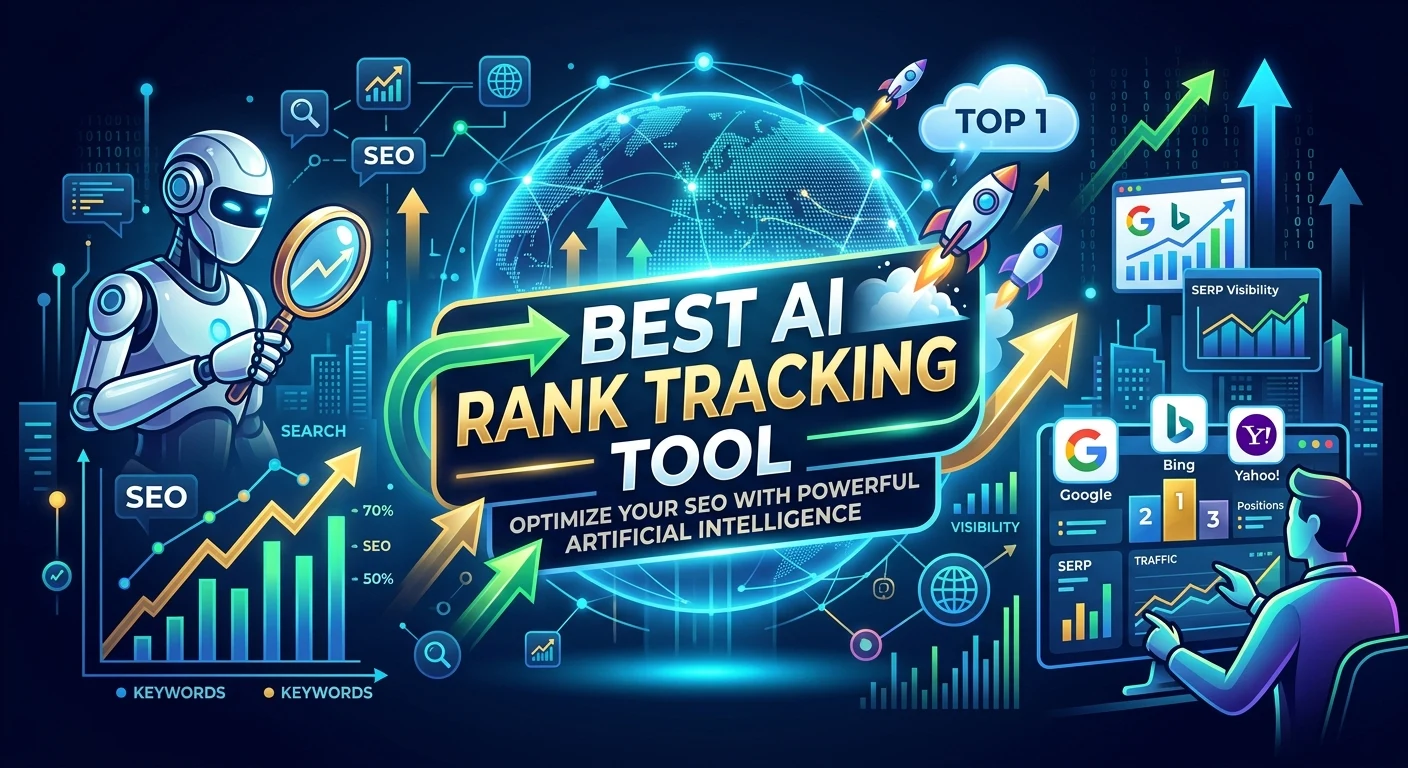
Search rankings are changing quickly as traditional search engines introduce AI-generated answers, AI Overviews, and conversational search experiences. The best AI rank tracking tool can help SEO professionals understand these changes while still monitoring traditional keyword positions. Instead of checking rankings manually, modern tracking platforms automate data collection, identify trends, compare competitors, and provide actionable insights.
AI-powered rank tracking can improve productivity, efficiency, automation, and decision-making for businesses, agencies, freelancers, and content teams. It can also make large SEO campaigns easier to manage by bringing keyword rankings, search visibility, competitor movements, and AI search signals into one workflow.
However, choosing the right platform requires more than looking at a feature list. Accuracy, location tracking, update frequency, reporting, integrations, pricing, and support all matter. The right tool should match your website size, SEO goals, budget, and reporting requirements.
What Is the Best AI Rank Tracking Tool?
An AI rank tracking tool is software that monitors where webpages appear for selected search queries and uses automation or artificial intelligence to analyze ranking data. Traditional rank trackers usually focus on organic search positions, while newer platforms may also examine AI-powered search visibility.
The main purpose is simple: help you understand how your website performs in search results over time. A tracker can record keyword positions, identify ranking changes, compare competitors, and help you discover pages that need improvement.
AI features can make this information easier to interpret. Instead of reviewing thousands of ranking changes manually, an AI-powered system may highlight significant movements, group related keywords, identify patterns, or summarize performance.
There is no universal best platform. The right choice depends on whether you need basic keyword tracking, local SEO monitoring, agency reporting, enterprise-scale tracking, or broader AI search visibility analysis.
How AI Rank Tracking Tools Work
Rank tracking begins with a list of keywords. You tell the platform which search queries matter to your website, then specify details such as search engine, country, language, device, and sometimes location.
The software checks the search results and records where your target pages appear. It repeats this process according to its update schedule, allowing you to compare rankings across days, weeks, or months.
AI can add another layer of analysis. For example, if 40 related keywords suddenly decline, an AI system may identify the pattern instead of treating each keyword as an unrelated event.
A useful workflow is:
Choose target keywords → configure locations and devices → collect ranking data → analyze changes → investigate causes → optimize pages → track results again.
This creates a continuous SEO measurement cycle rather than a one-time ranking check.
Key Features to Look for in AI Rank Tracking Software
Accuracy should be your first consideration. A rank tracker is only useful if its data closely represents the search environment you care about.
Look for support for desktop and mobile rankings, multiple search engines, local search, different countries, and language-specific tracking when those features matter to your audience.
Important features can include:
- Daily or frequent ranking updates
- Keyword position tracking
- SERP feature monitoring
- Competitor tracking
- Local rank tracking
- Mobile and desktop results
- Search-volume information
- Ranking history
- Keyword grouping
- Automated alerts
- AI-powered analysis
- Custom reports
- Data exports
- API access
- Integrations with analytics platforms
SERP feature tracking is particularly valuable. A keyword can remain at position three while AI answers, featured snippets, videos, maps, shopping results, or other features change the amount of attention available to traditional organic listings.
Benefits of Using an AI Rank Tracking Tool
The biggest benefit is automation. Instead of manually searching keywords every morning, a tracking platform collects and organizes ranking information for you.
This saves time for SEO professionals and freelancers. That saved time can then go toward content creation, technical optimization, competitor research, or client strategy.
Another benefit is trend detection. A single ranking change may not mean much. A consistent decline across hundreds of related keywords can signal a more important problem.
AI analysis can help prioritize these situations. Rather than treating every movement equally, a system can help identify the changes that deserve human investigation.
Rank tracking also improves communication. Agencies can use historical data to explain progress to clients, while businesses can connect SEO improvements with broader marketing goals.
Good rank tracking turns search data into decisions. The value comes from what you do with the information, not simply from collecting numbers.
AI Rank Tracking for Keywords and Search Intent
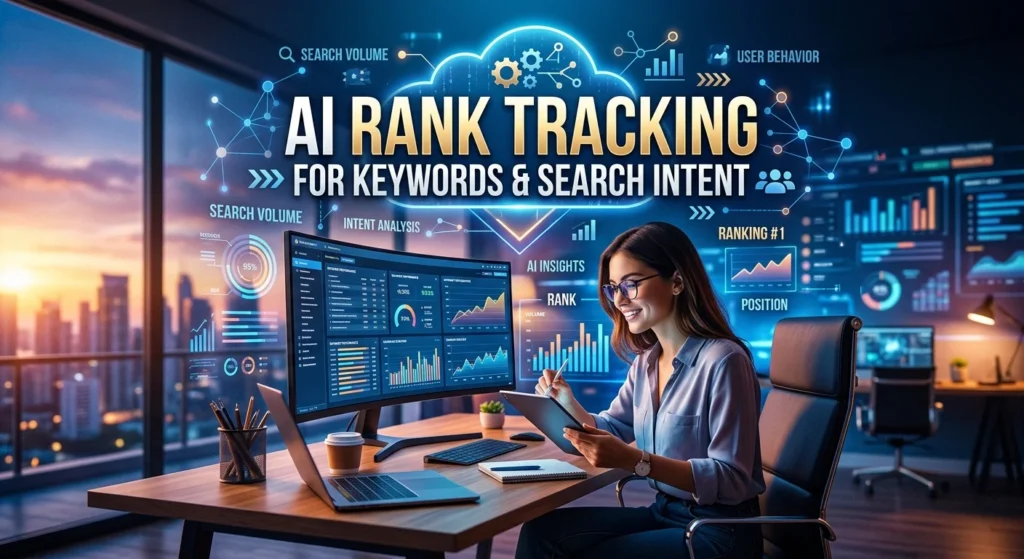
Modern keyword tracking should go beyond short, high-volume terms. Search intent is equally important.
For example, a website selling accounting software might track broad keywords such as “accounting software.” It should also monitor queries such as “accounting software for freelancers,” “small business accounting software,” and comparison-focused searches.
Grouping keywords by intent makes rank data easier to understand. You can create groups for informational, commercial, transactional, local, branded, and comparison searches.
AI can help organize large keyword sets. It may identify semantic relationships between terms and group queries around common topics.
This can reveal an important SEO pattern. You might discover that your website ranks well for informational searches but poorly for commercial queries. That insight can guide your content strategy.
Track keywords according to business value, not just search volume.
AI Rank Tracking for Google AI Overviews and AI Search
Traditional rankings are no longer the only search visibility signal. AI-powered search experiences can summarize information and recommend sources without displaying a conventional list of ten results.
This creates a new measurement challenge. A website may rank organically but receive limited visibility in an AI-generated answer. Another site might gain visibility because its content is cited or referenced by an AI system.
Modern AI visibility platforms can help monitor some of these signals. Depending on the provider, they may track brand mentions, citations, prompts, competitors, or appearances across AI search experiences.
However, AI search results can vary by query wording, model, location, and other factors. Do not treat one AI response as a permanent ranking position.
Instead, monitor groups of relevant prompts over time. Combine AI visibility information with traditional rankings, organic traffic, conversions, and content performance.
Free vs Paid AI Rank Tracking Tools
Free rank tracking options can work well for beginners and small websites. If you only need to monitor a few important keywords, a basic tool may provide enough information to get started.
Manual checks can also provide occasional insights, but they become inefficient as the keyword list grows. Search results can also vary by location, device, personalization, and other factors.
Paid platforms usually provide greater scale. Depending on the product, you may get larger keyword limits, historical data, automated reporting, competitor tracking, local search features, and more frequent updates.
Before purchasing a subscription, estimate how many keywords you actually need to track. More tracked keywords do not automatically mean better SEO.
Start with keywords connected to your most important pages, products, services, and business goals. Expand the tracking set when the additional data will help you make better decisions.
Pricing, ROI, and Choosing the Right Rank Tracker
Rank tracking prices can vary widely. Some platforms target individual SEO professionals, while others focus on agencies and large businesses.
When comparing pricing, examine keyword limits carefully. A low monthly price may become expensive if the platform charges heavily for additional keywords, locations, users, or projects.
Also consider reporting and automation. An agency that spends several hours creating client reports every month may gain significant value from automated reporting.
ROI should be measured through time saved, better decisions, improved visibility, and business outcomes rather than ranking increases alone.
A simple selection process is:
Define your SEO goals → estimate tracking requirements → identify required features → test data quality → compare pricing → evaluate reporting → choose the best workflow.
This approach prevents you from buying software simply because it has the largest feature list.
AI Rank Tracking Tools vs Traditional SEO Platforms
A rank tracker and an all-in-one SEO platform are not necessarily the same thing.
Dedicated rank trackers often focus deeply on keyword positions, SERP changes, competitor rankings, and historical data. Broader SEO platforms may combine rank tracking with keyword research, backlinks, site audits, content tools, and competitive analysis.
AI capabilities are also becoming more common across both categories. These features can help summarize data, identify patterns, generate insights, and reduce repetitive analysis.
The best setup depends on your workflow. A small business may prefer one integrated platform. An SEO specialist may prefer a dedicated rank tracker alongside separate technical and content tools.
Choose depth or breadth according to your needs. A platform with fewer features but excellent ranking data may be more valuable than a large platform with mediocre tracking accuracy.
Integrations and AI SEO Automation Workflows
Integrations make rank tracking more useful because SEO data rarely exists alone. Marketers often combine rankings with website analytics, search performance, content data, and conversion information.
For example, ranking data can show that a keyword moved from position eight to position four. Analytics data can then help determine whether organic traffic increased. Conversion data can reveal whether that additional traffic produced business value.
Automation can connect these steps. A team might schedule ranking updates, receive alerts about major changes, and send regular reports to stakeholders.
An effective workflow can look like this:
Track rankings → identify important changes → analyze traffic → inspect affected pages → make improvements → monitor results.
AI can assist with the analysis stage, but human review remains important. Automated recommendations may miss business context or technical details.
Best Use Cases for AI Rank Tracking Tools
AI rank tracking is useful for many types of SEO projects.
Freelancers can use it to monitor client keywords and demonstrate progress. Agencies can track multiple websites and automate recurring reports.
Ecommerce websites can monitor product and category rankings. SaaS companies can track commercial keywords, comparison searches, and informational topics.
Local businesses can benefit from location-specific tracking. A company may rank strongly in one city while performing poorly in another nearby area.
Publishers can use rank tracking to identify which topics are gaining or losing visibility. Content teams can compare ranking movements with publication dates and content updates.
Other common applications include:
- Competitor monitoring
- Local SEO
- International SEO
- Ecommerce SEO
- Content marketing
- Enterprise SEO
- Reputation management
- New website monitoring
- SEO experiments
- Algorithm-change analysis
The most useful application is one where ranking information leads to a clear action.
Pros, Cons, and Limitations of AI Rank Tracking Tools
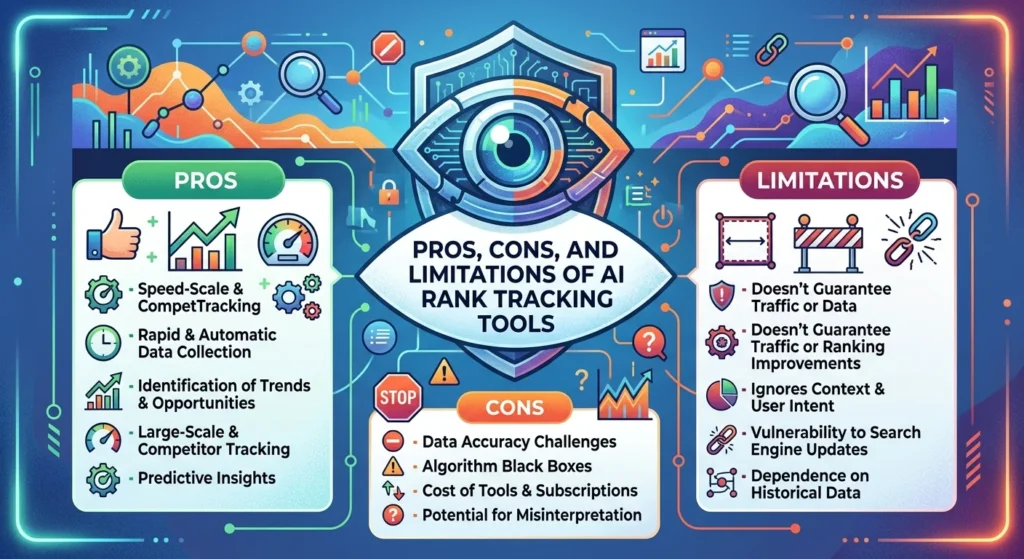
AI rank tracking provides several advantages. It saves time, organizes large datasets, identifies trends, supports competitor research, and makes recurring reporting easier.
AI analysis can also reduce the amount of manual data interpretation required. This becomes especially useful when an SEO campaign contains thousands of keywords.
However, rank tracking has limitations. Search results are dynamic, and rankings can vary depending on location, device, search engine, language, and other factors.
AI-generated analysis also requires caution. An AI system may identify a possible explanation for a ranking change, but that explanation is not necessarily correct.
For example, a ranking decline could relate to competition, content changes, technical issues, search-intent changes, algorithm updates, or normal SERP fluctuations.
Use AI recommendations as starting points for investigation, not unquestionable conclusions.
Another limitation is that rankings do not equal revenue. A keyword can rank number one and generate very little business value, while a lower-volume commercial keyword can produce highly valuable customers.
Common AI Rank Tracking Mistakes and How to Avoid Them
One common mistake is tracking too many irrelevant keywords. Large numbers can make a report look impressive while providing little useful information.
Focus on keywords connected to your actual audience and business goals. Include important commercial terms, informational topics, branded searches, and strategic long-tail queries.
Another mistake is checking rankings without checking traffic. A ranking improvement does not always produce more clicks.
Also avoid making major SEO changes after one daily fluctuation. Search results naturally move. Look for meaningful patterns before changing important pages.
Other mistakes include:
- Ignoring mobile rankings
- Ignoring local search
- Tracking only branded keywords
- Forgetting competitors
- Focusing only on position one
- Ignoring SERP features
- Treating AI visibility as traditional ranking
- Assuming AI explanations are always correct
- Failing to connect rankings with conversions
A strong SEO process uses ranking data as one part of a larger measurement system.
How to Improve SEO Performance Using Rank Tracking Data
Rank tracking becomes powerful when you turn observations into actions. Start by finding keywords that rank on the second page or near the top of the first page.
These terms may represent practical opportunities. A page ranking around positions four through fifteen may need stronger content, better internal linking, clearer search intent alignment, improved page experience, or stronger authority.
Next, examine competitors. Look at what they cover that your page does not. Do not copy them. Instead, identify information gaps and create something more useful.
You can also monitor newly published pages. Track their rankings from the beginning and compare performance over time.
Use AI to accelerate analysis, but maintain human judgment. The goal is not to manipulate rankings; it is to create better search experiences and more useful content.
After making changes, continue tracking. SEO improvements need measurement because not every optimization produces the expected result.
Latest AI Rank Tracking Trends and Future Developments
Rank tracking is moving toward a broader definition of search visibility. Instead of focusing only on ten blue links, SEO professionals increasingly need to understand organic rankings, SERP features, AI-generated answers, citations, brand mentions, and conversational search.
AI will likely play a larger role in interpreting this data. Future platforms may automatically identify unusual ranking patterns, connect ranking changes with website events, and prioritize opportunities based on estimated business value.
Another major trend is cross-search visibility measurement. Businesses may want one view that combines traditional search rankings with visibility across different AI search environments.
The technology will also become more conversational. Instead of requiring users to understand complicated SEO reports, platforms may allow marketers to ask questions such as which pages lost visibility, which competitors gained rankings, or which content areas deserve attention.
However, better automation does not remove the need for SEO expertise. Human judgment will remain essential for evaluating content quality, search intent, technical issues, business priorities, and brand strategy.
The future of rank tracking is therefore likely to move from simple position monitoring toward intelligent search visibility intelligence.
Conclusion
The best AI rank tracking tool should do more than display keyword positions. It should help you understand ranking trends, search visibility, competitors, SERP features, and—where supported—AI-powered search appearances.
When choosing a platform, focus on the factors that actually matter to your workflow: data accuracy, keyword limits, update frequency, location tracking, competitor analysis, reporting, integrations, AI capabilities, and price.
Free solutions can be enough for small projects, while paid platforms become more valuable when you manage large keyword sets, multiple websites, or client campaigns.
Most importantly, do not measure SEO success through rankings alone. Combine ranking data with organic traffic, conversions, content quality, and broader search visibility.
Used correctly, an AI rank tracker can save time and turn complicated search data into practical decisions. As AI search continues to evolve, businesses that measure both traditional and AI-driven visibility will be better prepared for the future of SEO.
Frequently Asked Questions
What is an AI rank tracking tool?
An AI rank tracking tool monitors keyword positions and uses automation or AI to analyze ranking changes, competitors, SERP features, and other search visibility signals.
What is the best AI rank tracking tool?
There is no single best tool for everyone. The best option depends on your keyword volume, locations, reporting needs, SEO workflow, budget, and whether you also need AI search visibility tracking.
Can AI rank trackers monitor Google AI Overviews?
Some modern SEO and AI visibility platforms provide features for monitoring AI-generated search experiences. Availability and measurement methods vary by provider, so check the platform’s current capabilities before choosing it.
Are free rank tracking tools worth using?
Yes. Free tools can work well for beginners and small websites with limited tracking requirements. Paid platforms become more useful when you need greater scale, automation, historical data, and advanced reporting.
How often should I check keyword rankings?
Automated tracking can collect data daily or according to your chosen schedule. For decision-making, focus on trends rather than reacting to every small daily movement.
Should I track competitor rankings?
Yes. Competitor tracking can help you identify changes in the search landscape, content opportunities, and areas where competing websites are gaining visibility.
Do higher rankings always mean more traffic?
No. Traffic depends on factors such as search volume, click-through rate, SERP features, search intent, and the attractiveness of the result. A higher position is useful, but it does not guarantee more valuable traffic.
Can AI rank tracking improve SEO automatically?
AI tracking can automate data collection and analysis, but it cannot guarantee better rankings automatically. Human expertise is still needed to evaluate recommendations and implement appropriate SEO improvements.
What keywords should I track?
Track keywords that connect to your business goals. Include important product or service terms, informational queries, long-tail searches, branded keywords, commercial searches, and strategic topics.
Is rank tracking still important in the age of AI search?
Yes. Traditional rankings remain an important SEO signal, while AI search introduces additional visibility signals. Tracking both can provide a more complete picture of modern search performance.