Search is changing quickly, and SEO professionals now need to understand more than traditional keyword rankings. AI-powered search experiences can summarize information, compare websites, answer questions, and recommend sources without always sending users to a standard list of blue links. This makes AI Mode SEO analysis tools increasingly useful for businesses that want to understand how their content performs in modern search.
The best AI mode SEO analysis tools help marketers analyze search visibility, content quality, keywords, competitors, entities, citations, and AI-generated search results. They can improve productivity by automating repetitive research and help teams make faster, data-informed decisions. These tools also support innovation by showing new opportunities for content optimization, technical SEO, and AI search visibility.
This guide explains how AI Mode SEO analysis works, which features matter, how to compare tools, and how to build a practical SEO workflow for 2026 and beyond.
What Are the Best AI Mode SEO Analysis Tools?
AI Mode SEO analysis tools are platforms designed to help marketers understand and optimize website performance in AI-powered search environments. They combine traditional SEO analysis with newer methods for examining AI-generated answers, search intent, entities, citations, mentions, and content visibility.
Traditional SEO tools usually focus on metrics such as rankings, backlinks, keywords, organic traffic, and technical issues. AI-focused tools add another layer by helping businesses understand how their content and brand may appear in conversational search and AI-generated responses.
For example, a traditional SEO platform might tell you that your page ranks for a particular keyword. An AI visibility platform may additionally help you understand whether AI systems mention your brand when users ask related questions.
The best solution depends on your goals. SEO agencies may need advanced competitor and reporting features, while small businesses may prefer simple content and visibility analysis.
How AI Mode SEO Analysis Works
AI Mode SEO analysis combines several types of data to evaluate how a website performs in modern search. Depending on the platform, the analysis may include keyword rankings, content relevance, technical SEO, search intent, competitor information, brand mentions, citations, and AI search responses.
A typical workflow starts with a keyword or topic. The platform analyzes search results and related content. More advanced systems may also test prompts or questions in AI search environments and track how brands or pages appear.
AI analysis can identify patterns that would take a marketer much longer to discover manually. It can highlight content gaps, missing topics, weak pages, competitor advantages, and opportunities for better optimization.
However, AI analysis should not be treated as a perfect prediction. AI search results can change depending on the query, model, location, language, context, and time. Use tool data as evidence that supports your strategy rather than as an absolute guarantee.
Key Features to Look for in AI Mode SEO Tools
The strongest AI mode SEO tools combine several important capabilities. Look for keyword research, search intent analysis, content optimization, competitor research, technical SEO auditing, AI visibility monitoring, citation tracking, and reporting.
Content analysis is particularly important. A good platform should help you understand whether a page answers the user’s question clearly and completely. Some tools can identify related concepts and topics that strengthen topical coverage.
Competitor analysis is another valuable feature. You should be able to compare your content with competing pages and identify areas where competitors provide stronger information.
Integration can also make a major difference. Tools that connect with analytics, search performance data, content systems, or reporting platforms can reduce manual work.
Finally, check usability. A tool with fewer features but clear recommendations can be more valuable than a complicated platform that your team rarely uses.
Benefits of Using AI Mode SEO Analysis Tools
One major advantage is speed. AI can process large amounts of information and identify patterns much faster than manual analysis. This allows SEO professionals to spend more time on strategy and less time collecting data.
These tools can also improve content planning. Instead of guessing what users want, marketers can examine search intent, related questions, competitor coverage, and content gaps.
AI analysis can support better decision-making by combining multiple signals. For example, a page may have good keyword rankings but weak visibility in conversational search. That difference can reveal an opportunity for improvement.
Another benefit is scalability. An agency managing many websites can use automation to monitor important SEO signals across multiple projects.
AI tools can also help beginners understand complex SEO concepts. Clear recommendations can provide a starting point for improving content, although users should learn the reasoning behind each recommendation rather than following automated suggestions blindly.
AI Mode SEO Analysis for Keywords and Search Intent
Keyword research remains important, but modern SEO requires more than matching exact phrases. Search engines increasingly understand topics, entities, context, and user intent.
AI-powered analysis can group related keywords into topic clusters. It can also identify informational, commercial, navigational, and transactional intent.
For example, someone searching for “best running shoes” may want comparisons and recommendations. Someone searching for “how to clean running shoes” has a different intent. Creating the same type of page for both searches would not provide the best experience.
AI analysis tools can help identify these differences and recommend appropriate content formats.
Focus on the question behind the keyword. Ask what the searcher wants to accomplish, what information they need, and what would make your page genuinely useful.
This approach also helps with long-tail searches and conversational queries. AI search users may ask complete questions instead of entering short keyword phrases.
AI Content Analysis and Optimization
AI content analysis tools can evaluate whether your page covers the subject thoroughly and clearly. They may examine headings, related concepts, keyword usage, readability, content structure, and competing pages.
A useful content optimization process starts with search intent. Once you understand the intent, create a clear structure that answers the most important questions early.
Use related terms naturally. If your topic is AI marketing, relevant concepts might include content automation, marketing analytics, customer segmentation, personalization, campaign optimization, and AI search.
Do not force every related keyword into the article. Semantic SEO is about context and usefulness, not keyword stuffing.
Human expertise also matters. Add original examples, practical advice, firsthand experience, expert opinions, and trustworthy sources where appropriate. These elements make content more valuable than generic AI-generated text.
AI Search Visibility, Citations, and Brand Mentions
AI search visibility refers to how often and how prominently a business, website, product, or brand appears in AI-generated search experiences.
Some AI-focused platforms monitor brand mentions and citations across different AI search environments. They can help marketers understand which questions trigger brand references and which competitors appear instead.
Citations are especially interesting because AI-generated answers may rely on information from external sources. A website can therefore benefit from being a reliable source for information that AI systems use or reference.
Marketers should monitor more than simple mentions. Look at which topics generate visibility, what sources are cited, which competitors appear, and whether the information about your brand is accurate.
This can reveal content and digital PR opportunities. If competitors consistently appear in answers about a topic, examine why their information may be considered useful and identify legitimate ways to strengthen your own authority.
Free vs Paid AI Mode SEO Analysis Tools
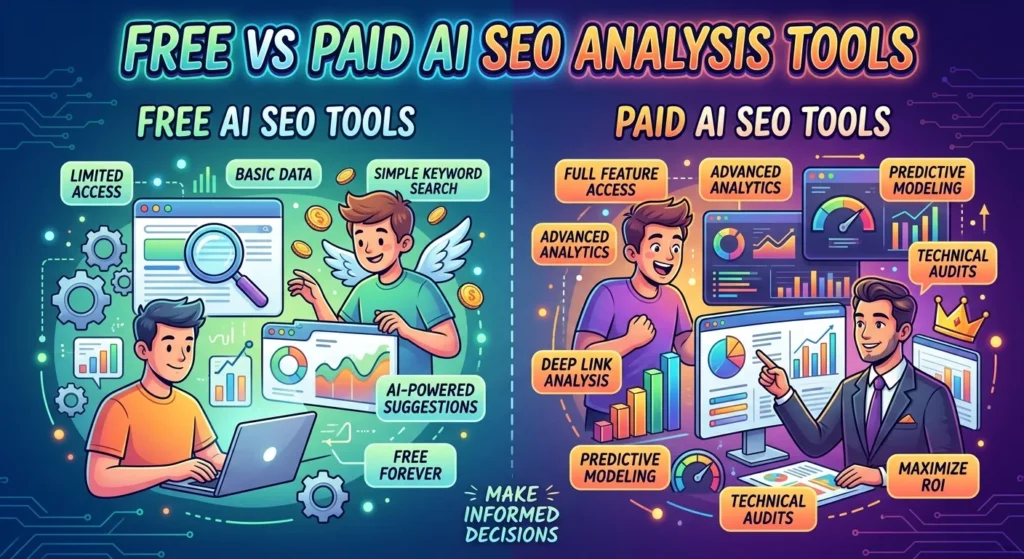
Free SEO tools can be useful when starting out. They may provide keyword research, basic audits, content analysis, or limited AI visibility information.
The main advantage is low financial risk. Beginners can learn SEO concepts and experiment with different workflows before paying for advanced software.
Paid platforms generally offer more data, higher usage limits, automation, competitor monitoring, advanced reporting, integrations, and team features.
However, paid does not automatically mean better for every user. A freelancer working on one website may not need an enterprise platform.
A practical approach is to start with the smallest toolset that solves your current problem. Upgrade when your workload, reporting needs, or SEO goals justify the additional cost.
Pricing, ROI, and Choosing the Right AI SEO Platform
AI SEO software can use different pricing models. Some platforms offer monthly subscriptions, while others use usage limits, credits, user seats, projects, or custom enterprise pricing.
When comparing costs, look beyond the subscription price. Consider how much manual research the platform saves and whether its recommendations improve measurable results.
For example, if a tool saves several hours every week, helps identify valuable content opportunities, and improves reporting efficiency, its practical value may be much higher than its monthly price suggests.
Track useful business metrics such as organic traffic, qualified leads, conversions, rankings, content production time, and AI search visibility.
Avoid paying for features your team will never use. Choose software based on your actual workflow rather than an impressive feature list.
AI Mode SEO Tools vs Traditional SEO Platforms
Traditional SEO platforms remain valuable. They provide essential information about keywords, backlinks, rankings, technical issues, traffic, and competitors.
AI mode SEO tools add another dimension by focusing on AI-powered search experiences and conversational discovery. The two categories should not necessarily compete with each other.
A modern SEO strategy can combine both. Traditional tools can help you understand Google rankings and website health. AI visibility tools can help you understand brand mentions, citations, and AI-generated answers.
For example, your traditional SEO platform may show that an article ranks well for a target keyword. AI analysis may reveal that your competitors receive more visibility when users ask conversational questions about the same subject.
The strongest approach is usually a combined SEO and AI visibility workflow.
Integrations and AI SEO Automation Workflows
Integrations can turn individual tools into a connected marketing system. Useful connections may include analytics platforms, search performance data, content management systems, CRM software, reporting tools, and project management platforms.
Automation can reduce repetitive tasks. A team might schedule regular keyword monitoring, receive alerts about ranking changes, review content opportunities, and generate recurring reports.
AI can also help prioritize tasks. Instead of presenting hundreds of possible improvements, an advanced workflow can organize opportunities according to potential impact.
Start small. Automate simple monitoring and reporting first. Once the process works reliably, expand into more advanced workflows.
Always keep human review for important SEO decisions. Automated changes to large numbers of pages can create unexpected problems if the recommendations contain errors.
Best Use Cases for AI Mode SEO Analysis Tools
AI mode SEO analysis tools can support many marketing scenarios. SEO teams can use them for competitor research, content optimization, keyword analysis, and search visibility monitoring.
Content teams can use AI analysis to identify topics that deserve new articles, update outdated pages, and discover questions that existing content does not answer.
Agencies can use these platforms for client reporting and ongoing monitoring. AI-powered reports can make large amounts of data easier to interpret.
Small businesses can use AI analysis to find opportunities without hiring a large SEO team. For example, a local business could analyze common customer questions and create helpful pages that answer them directly.
AI visibility analysis is also useful for brand management. Companies can monitor how AI systems describe their products, services, competitors, and industry topics.
Pros, Cons, and Limitations of AI Mode SEO Analysis Tools
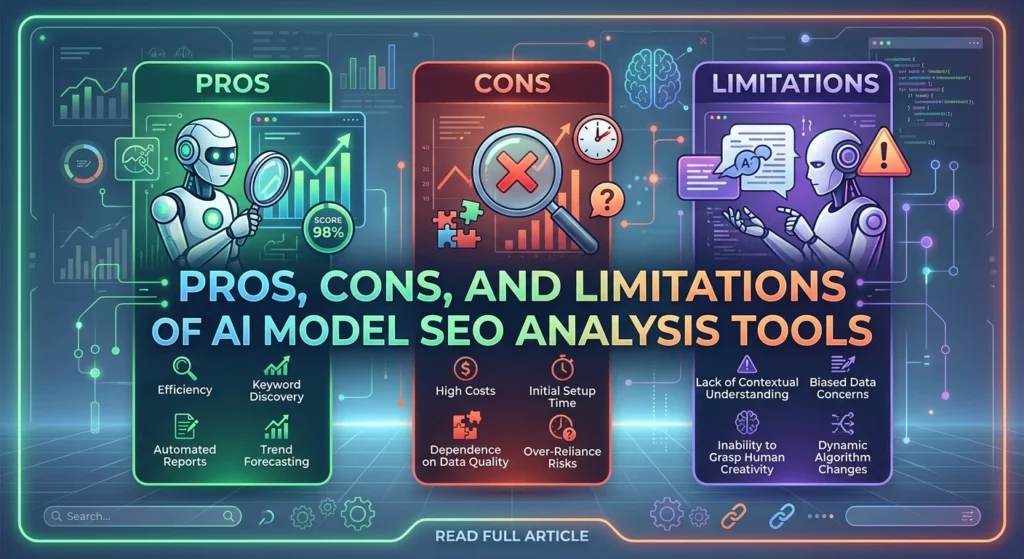
AI mode SEO tools offer several advantages. They can save time, process large datasets, identify patterns, support content optimization, monitor competitors, and provide insights into emerging search behavior.
They can also help marketers adapt to changes in search. As users increasingly interact with conversational AI, understanding these experiences can become another part of digital visibility management.
There are limitations, too. AI search results can vary significantly. Different models may provide different answers, and the same system may change its response over time.
Some tools may also simplify complex SEO issues into automated scores. A score can be useful, but it does not tell the whole story.
Never optimize only for a tool’s score. Optimize for users, search intent, useful information, technical quality, trust, and measurable business outcomes.
Common AI SEO Analysis Mistakes and How to Avoid Them
One common mistake is assuming that AI optimization means adding more keywords. Modern search is much more sophisticated than exact keyword matching.
Another mistake is publishing large amounts of AI-generated content without adding original value. More pages do not necessarily mean better visibility.
Some marketers also monitor only rankings and ignore conversions. A page can attract traffic without generating meaningful business results.
Ignoring technical SEO is another problem. Excellent content cannot compensate for major crawling, indexing, performance, or usability problems.
Finally, avoid making decisions from a single AI search result. Monitor patterns across multiple queries and time periods before changing your strategy.
A better workflow combines technical SEO, content quality, search intent, traditional rankings, AI visibility, analytics, and human expertise.
Latest AI Mode SEO Trends and Future Developments
AI-powered search is becoming an increasingly important part of the digital discovery process. Search experiences are moving toward conversational answers, summaries, recommendations, follow-up questions, and more personalized interactions.
This means SEO professionals need to think beyond traditional rankings. Entity optimization, topical authority, structured information, trustworthy sources, content freshness, and brand visibility are becoming increasingly relevant.
Multimodal search is another important development. Users can increasingly combine text, images, voice, and other forms of information when searching. Businesses may need content that works across multiple discovery formats.
AI automation will also become more sophisticated. SEO platforms may increasingly identify opportunities, monitor changes, prioritize tasks, and assist with content workflows.
However, human expertise will remain important. Search technology can automate analysis, but marketers still need to understand customers, industries, business goals, and brand positioning.
Frequently Asked Questions
What are AI Mode SEO analysis tools?
AI Mode SEO analysis tools help marketers evaluate website performance across traditional search and AI-powered search experiences. They may analyze keywords, content, competitors, citations, mentions, search intent, and AI visibility.
Why are AI Mode SEO tools important in 2026?
Search is becoming more conversational and AI-driven. These tools help marketers understand new forms of visibility that traditional ranking reports may not fully capture.
Can AI SEO tools improve Google rankings?
They can support SEO by identifying keyword opportunities, content gaps, technical issues, and optimization opportunities. However, no tool can guarantee a specific Google ranking.
Are free AI SEO analysis tools useful?
Yes. Free tools can be helpful for beginners and smaller projects. Paid platforms generally provide more advanced monitoring, automation, reporting, and data.
What should I look for in an AI SEO tool?
Look for accurate analysis, keyword research, search intent insights, content optimization, competitor research, AI visibility monitoring, reporting, integrations, usability, and transparent pricing.
Can AI SEO tools replace SEO experts?
No. AI can automate research and analysis, but SEO still requires strategy, judgment, creativity, technical understanding, and knowledge of the business and audience.
How do AI SEO tools analyze content?
They may examine topics, keywords, headings, readability, search intent, related concepts, competitors, and other signals to identify potential strengths and weaknesses.
What is AI search visibility?
AI search visibility describes how often and how prominently a brand, website, product, or source appears in AI-generated answers and conversational search experiences.
Should I use traditional SEO tools and AI SEO tools together?
Yes. Traditional tools provide important ranking, backlink, technical, and traffic data, while AI-focused platforms can provide additional insight into AI-generated search experiences.
What is the future of AI SEO?
The future is likely to include deeper AI search integration, conversational discovery, multimodal search, automated analysis, entity-based optimization, personalized results, and stronger focus on trustworthy content.
Conclusion
The best AI mode SEO analysis tools can help marketers understand a rapidly changing search environment. They combine traditional SEO insights with emerging data around AI search visibility, content relevance, competitors, citations, entities, and conversational queries.
The right platform can improve productivity by reducing repetitive research and reporting. It can also help teams discover content gaps, understand search intent, monitor competitors, and identify new opportunities.
However, technology alone does not create successful SEO. The strongest results come from combining AI analysis with human expertise, original content, technical SEO, trustworthy information, and a clear understanding of the audience.
Start with your most important SEO challenge. Choose a tool that directly addresses it, test the results, and measure real business outcomes. As AI-powered search continues to evolve, a flexible and user-focused SEO strategy will be more valuable than chasing every new tool or trend.