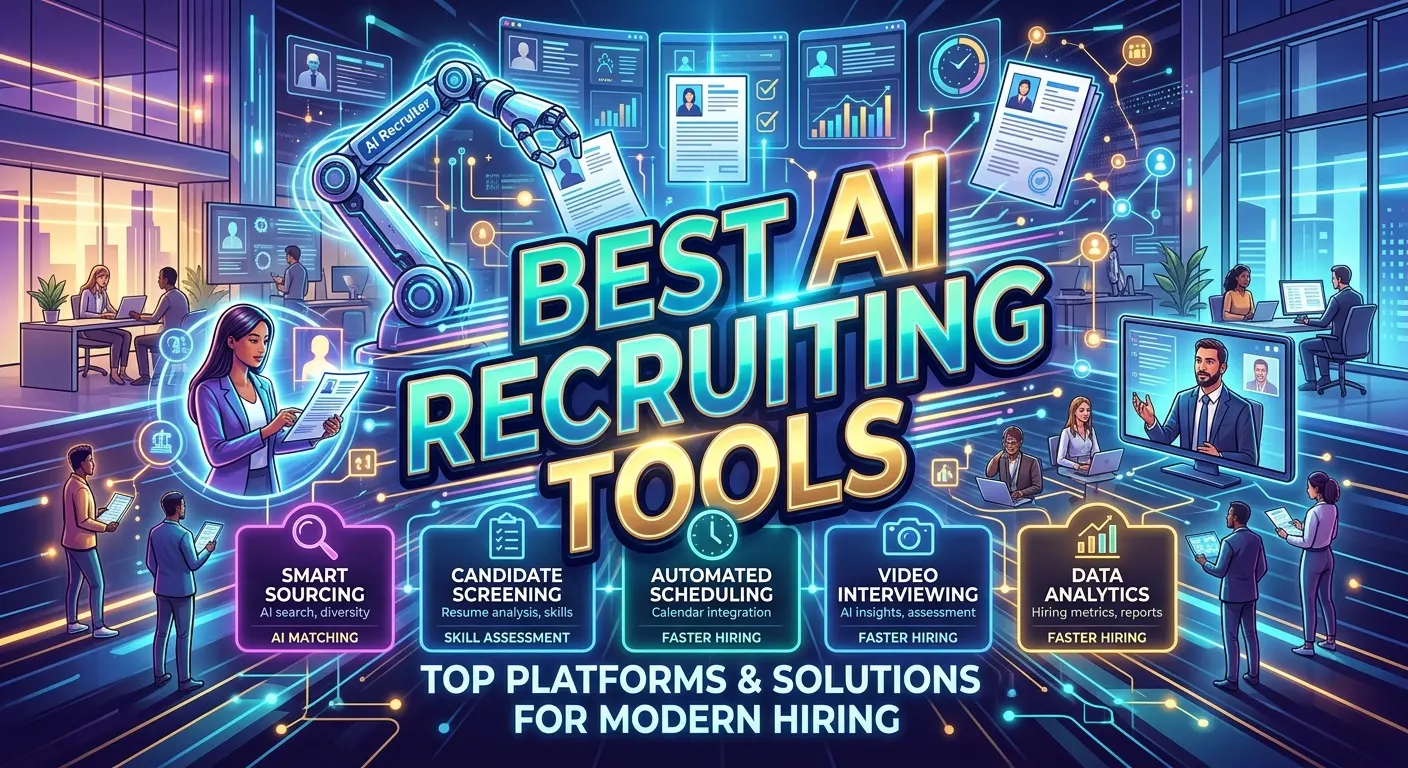
Recruiting is changing quickly as companies use artificial intelligence to find, evaluate, and engage candidates more efficiently. The best AI recruiting tools can automate repetitive hiring tasks, improve candidate matching, organize applications, and help recruiters make faster decisions. Instead of spending hours reviewing resumes or writing job descriptions, hiring teams can use AI to handle time-consuming work while recruiters focus on communication and relationship building.
AI recruiting software can support many stages of the hiring process, including candidate sourcing, resume screening, interview scheduling, job description creation, recruitment marketing, and hiring analytics. However, the right tool depends on company size, hiring volume, budget, privacy requirements, and workflow.
This guide explains how AI recruiting tools work, their key features, benefits, limitations, pricing considerations, and practical ways to use them effectively in modern hiring.
What Are the Best AI Recruiting Tools?
AI recruiting tools are software applications that use artificial intelligence, machine learning, natural language processing, automation, or related technologies to support recruitment activities. They can help recruiters identify candidates, organize applications, analyze resumes, create job descriptions, communicate with applicants, and manage hiring workflows.
The best AI recruiting tools do not simply automate everything. Instead, they help recruiters reduce repetitive work while keeping humans involved in important decisions. For example, an AI system may help identify resumes that match a job’s requirements, but a recruiter can still review the candidates before moving them forward.
Different tools focus on different parts of recruitment. Some specialize in applicant tracking, while others focus on sourcing, interviews, candidate engagement, skills assessment, or recruitment analytics. Businesses should therefore choose software based on their specific hiring problems rather than choosing a tool simply because it has the most AI features.
How AI Recruiting Software Works
AI recruiting software typically processes information from job descriptions, resumes, candidate profiles, applications, interview responses, and other recruitment data. Algorithms can identify patterns and similarities between candidate information and job requirements.
For example, suppose a company needs a software developer with experience in Python, databases, and cloud technologies. An AI recruiting system can analyze candidate profiles and identify people whose skills and experience appear relevant. This can help recruiters create a smaller and more manageable candidate pool.
Modern systems can also automate communication and workflow tasks. A recruiter might create a hiring workflow that sends application confirmations, schedules interviews, updates candidate statuses, and reminds hiring managers about pending decisions.
However, AI recommendations are not automatically correct. Recruiters should review important decisions, check for unfair filtering, and ensure that job requirements accurately represent the position.
Key Features to Look for in AI Recruiting Tools
A strong AI recruiting platform should solve real recruitment problems rather than simply adding AI terminology to traditional software. Start by looking for features that match your hiring workflow.
Important features can include:
- AI resume screening
- Candidate matching
- Applicant tracking
- Automated candidate sourcing
- Job description generation
- Interview scheduling
- Candidate communication
- Skills-based search
- Interview assistance
- Recruitment analytics
- Hiring workflow automation
- Talent-pool management
- Collaboration features
- HR and recruiting integrations
Another important factor is usability. Recruiters should be able to understand why a system recommends a candidate instead of receiving an unexplained score. Transparency and explainability can make AI-assisted hiring easier to review and manage.
Security also matters. Recruiting systems can process sensitive personal information, so organizations should examine data handling, access controls, retention policies, and administrative permissions before adopting a platform.
Benefits of Using AI Recruiting Tools
The biggest advantage of AI recruiting software is time savings. Recruiters often spend significant amounts of time searching for candidates, reviewing applications, updating records, scheduling interviews, and writing repetitive messages. Automation can reduce this administrative workload.
AI tools can also improve consistency. For example, recruiters can use structured criteria to search candidate databases rather than manually reviewing every profile from scratch. This can make large hiring campaigns easier to manage.
Another benefit is scalability. A small recruiting team may struggle when hundreds or thousands of applications arrive for a single position. AI-powered workflows can help organize that volume and prioritize tasks.
AI can also support better candidate experiences when used carefully. Faster communication, simpler scheduling, clearer job descriptions, and timely updates can make the recruitment process more convenient.
Still, AI should support recruiters rather than replace human judgment. Hiring involves skills, experience, communication, motivation, cultural context, and many other factors that automated systems may not fully understand.
AI Tools for Resume Screening and Candidate Matching
Resume screening is one of the most common applications of AI in recruitment. Instead of requiring recruiters to manually read every resume, AI systems can extract information such as skills, job history, education, certifications, and experience.
Candidate matching systems can then compare this information with job requirements. A recruiter searching for a marketing specialist, for example, could use skills, experience, location, industry background, or other job-related criteria to narrow the candidate pool.
Skills-based matching can be especially useful because job titles can vary between companies. One organization might call a position “Growth Marketing Manager,” while another uses “Digital Marketing Lead” for a similar role.
Recruiters should avoid treating an AI match score as a final hiring decision. A candidate who receives a lower score may still possess valuable skills that the system failed to recognize. Human review remains important, particularly for nontraditional career paths.
AI Recruiting Tools for Candidate Sourcing and Engagement
Candidate sourcing involves finding potential applicants who may be suitable for open positions. AI can help recruiters search talent pools, identify relevant profiles, and organize potential candidates according to predefined requirements.
AI can also support candidate engagement by helping recruiters create personalized outreach messages. Instead of writing every message from scratch, recruiters can generate a first draft and then customize it based on the candidate’s background.
For example, a recruiter looking for a graphic designer could create different outreach messages for candidates with experience in branding, product design, or social media content. The recruiter can then review each message before sending it.
Personalization is more important than sending a huge number of automated messages. Candidates are more likely to respond when communication clearly explains why the opportunity is relevant to their skills and career goals.
Recruiters should also respect communication preferences and applicable privacy requirements. Automation should never become spam.
AI Recruiting Tools for Job Descriptions and Recruitment Marketing
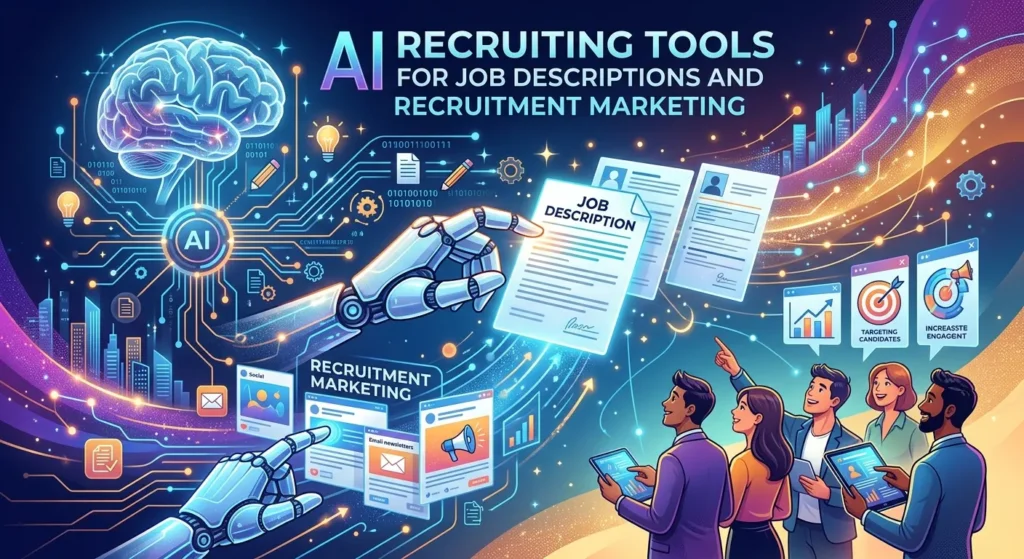
Writing an effective job description can take considerable time. AI writing tools can help recruiters create initial drafts based on a job title, responsibilities, required skills, qualifications, and company information.
A good AI-generated job description should be reviewed by a human before publication. Recruiters should remove unnecessary requirements, clarify responsibilities, avoid confusing language, and make sure the description accurately represents the actual position.
AI can also assist with recruitment marketing. Teams can use it to generate social media content, career-page copy, email campaigns, employer-branding ideas, and candidate communication templates.
The key is to use AI as a drafting and optimization assistant. Authentic company information, accurate expectations, and a clear description of the employee experience should come from the organization itself.
AI Recruiting Tools for Interviews and Assessments
Interviews generate valuable information, but recruiters and hiring managers may struggle to organize that information consistently. AI-powered interview tools can assist with scheduling, note organization, transcription, question generation, or structured evaluation workflows.
For example, an interview assistant might help a recruiter create role-specific questions based on the required skills. A technical position could have questions focused on problem-solving and technical knowledge, while a customer-service position could emphasize communication and situational judgment.
Skills assessments can also help organizations evaluate job-related abilities. However, assessment design matters. A poorly designed automated test can create misleading results or unfairly disadvantage certain candidates.
The best approach is to keep assessments relevant to actual job requirements. Recruiters should also explain the process clearly and provide candidates with reasonable opportunities to demonstrate their abilities.
AI should not be used as an unquestionable judge of personality, intelligence, or suitability. Hiring teams need clear criteria and human oversight.
Free vs Paid AI Recruiting Tools
Free recruiting tools can be useful for freelancers, small businesses, startups, and teams that are experimenting with AI. They may provide limited resume assistance, job-description generation, candidate organization, or basic automation.
Paid platforms generally provide more advanced capabilities, larger usage limits, integrations, analytics, administration controls, and enterprise features. Pricing can vary significantly depending on the number of recruiters, job postings, candidates, automation features, or organization size.
Before choosing a paid solution, calculate the expected return. For example, if recruiters spend many hours every week on repetitive screening and scheduling, automation may provide meaningful value.
However, the cheapest tool is not always the most affordable option. A low-cost system that creates inaccurate matches or requires significant manual correction can increase workload rather than reduce it.
Consider the total cost of ownership, including subscriptions, implementation, training, integrations, and ongoing administration.
AI Recruiting Tool Pricing, ROI, and Value
AI recruiting software can use different pricing models. Some platforms charge per recruiter, while others use plans based on hiring volume, job postings, candidates, features, or organization size.
When evaluating ROI, look beyond subscription price. Consider how much time the software saves, whether it improves candidate response rates, how quickly positions are filled, and whether recruiters can manage more hiring activity without adding equivalent administrative work.
For example, imagine a recruiting team spends several hours each week manually organizing applications. If an AI workflow reduces that administrative workload substantially, the time saved may justify the software cost.
A useful evaluation formula is:
Recruiting ROI = Value Created − Total Tool Cost
Value can include saved recruiter hours, faster hiring, improved candidate engagement, and better workflow efficiency. It is difficult to measure every benefit perfectly, but tracking a few consistent metrics can make software decisions more objective.
AI Recruiting Integrations and Automation Workflows
Integrations can determine whether an AI recruiting tool fits smoothly into an existing HR technology stack. Modern recruiting workflows may involve applicant tracking systems, calendars, email platforms, HR information systems, assessment tools, communication platforms, and analytics software.
For example, a recruiting workflow could connect an applicant tracking system with scheduling software. When a candidate reaches a particular stage, the system could automatically offer available interview times.
AI can also help organize information across different systems. However, organizations should verify what data moves between platforms and who can access it.
Automation should simplify a workflow, not make it more complicated. Start with one repetitive process, measure the result, and then expand automation gradually.
Common integrations to evaluate include:
- Applicant tracking systems
- HR platforms
- Calendar applications
- Email systems
- Assessment platforms
- Video interview software
- Background-check systems
- Analytics tools
- Communication platforms
- Identity and access systems
AI Recruiting Tools for Small Businesses, Agencies, and Enterprises
Small businesses often need simple recruiting software that can reduce administrative work without requiring a large HR technology budget. For these organizations, easy setup and straightforward pricing can be more valuable than complex enterprise functionality.
Recruitment agencies may need different features. Agencies often manage multiple clients, large talent pools, candidate pipelines, communication campaigns, and placement activity. Search capabilities and workflow automation can therefore become especially important.
Large enterprises usually need advanced permissions, integrations, reporting, security controls, and support for multiple teams or regions. They may also require stronger governance around AI-assisted hiring decisions.
There is no single best AI recruiting tool for every organization. The right solution depends on hiring volume, workflow complexity, budget, industry requirements, and internal HR capabilities.
Start by identifying the biggest recruitment bottleneck. Then choose technology that addresses that specific problem.
Pros, Cons, and Limitations of AI Recruiting Tools
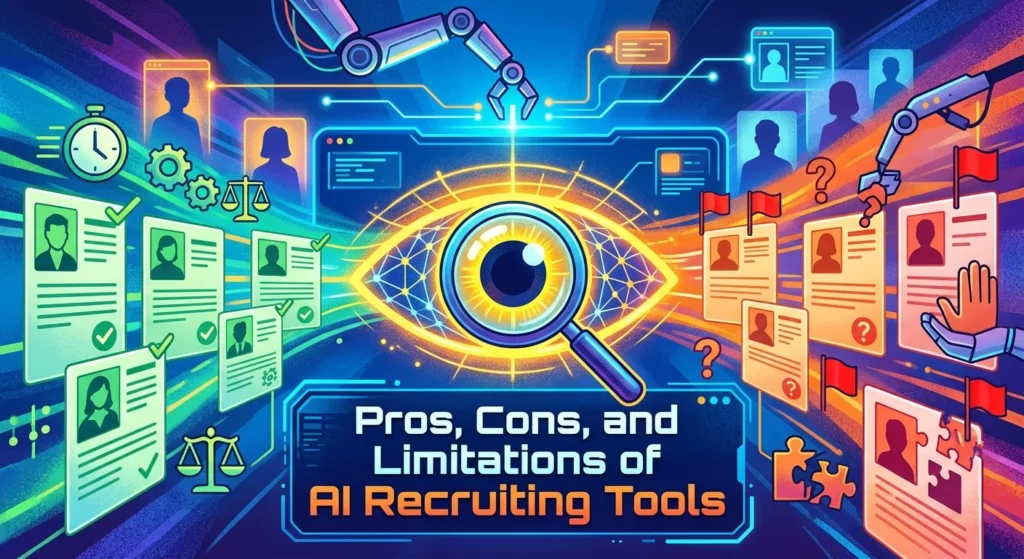
AI recruiting tools can provide significant advantages. They can automate repetitive work, organize large candidate pools, improve search efficiency, support communication, and help recruiters spend more time on high-value activities.
But AI recruitment also has limitations. Algorithms can make mistakes, candidate data can be incomplete, and automated systems may reproduce biases present in historical data or poorly designed rules.
Privacy is another important concern. Recruitment platforms can process names, contact information, resumes, employment histories, education details, and other personal data. Organizations should understand how vendors collect, store, process, and protect this information.
There is also a risk of over-automation. Candidates may become frustrated when they cannot reach a human recruiter or when automated communication feels generic.
The best strategy is human-in-the-loop recruiting. Let AI handle suitable repetitive tasks while recruiters remain responsible for important decisions, communication, fairness, and candidate experience.
Common AI Recruiting Mistakes and How to Avoid Them
One common mistake is choosing a recruiting platform based only on the number of AI features. More features do not necessarily mean better results. A simple system that solves a major workflow problem can be more valuable than a complicated platform that recruiters rarely use.
Another mistake is trusting AI recommendations without review. AI-generated rankings, candidate matches, summaries, and interview suggestions should be treated as decision-support information rather than unquestionable conclusions.
Poor data quality can also reduce performance. If job descriptions contain unclear requirements or candidate profiles are incomplete, an AI system may produce weak recommendations.
Avoid these problems by following a structured process:
- Define the hiring problem.
- Identify measurable goals.
- Test the tool with realistic recruitment data.
- Review AI recommendations manually.
- Monitor results for errors and unfair patterns.
- Train recruiters on responsible use.
- Protect candidate information.
- Regularly evaluate the workflow.
Human oversight should remain part of the recruitment process, especially when AI influences candidate evaluation.
Latest AI Recruiting Trends and Future Developments
AI recruiting is moving toward more integrated and skills-focused workflows. Instead of using AI for only one task, organizations increasingly want systems that connect sourcing, screening, scheduling, communication, assessment, and analytics.
Another important trend is the move toward skills-based recruiting. Companies can focus more closely on demonstrated skills and capabilities rather than relying only on traditional job titles, degrees, or rigid career histories.
Recruitment teams are also paying more attention to explainability and responsible AI. As AI becomes more involved in employment decisions, organizations need clearer processes for human review, data governance, privacy, and fairness.
Generative AI will likely continue improving recruiter productivity. It can help summarize information, create drafts, organize workflows, and support communication. However, the strongest systems will likely combine automation with strong human judgment.
The future of recruiting is therefore unlikely to be simply “AI replaces recruiters.” A more realistic direction is AI-augmented recruiting, where technology handles repetitive information work while people focus on judgment, relationships, interviewing, negotiation, and candidate experience.
Conclusion
The best AI recruiting tools can help organizations make hiring more efficient by automating repetitive tasks, improving candidate search, supporting resume screening, simplifying scheduling, and strengthening recruitment workflows. They can provide real value when teams use them to solve clear problems rather than adopting AI simply because it is popular.
Choosing the right platform requires careful evaluation of features, pricing, integrations, security, usability, scalability, and human oversight. Small businesses may prioritize simplicity and affordability, while agencies and enterprises may need advanced automation and integrations.
Most importantly, AI should support responsible hiring rather than replace human judgment. Recruiters who combine AI-powered efficiency with human expertise, transparency, and thoughtful candidate communication can build faster and more effective hiring processes.
FAQs About
What are AI recruiting tools used for?
AI recruiting tools can help with candidate sourcing, resume screening, candidate matching, job descriptions, interview scheduling, recruitment communication, skills assessment, and hiring analytics.
Are AI recruiting tools suitable for small businesses?
Yes. Small businesses can use AI recruiting software to automate repetitive recruitment tasks and manage candidates more efficiently. The best choice depends on hiring volume and budget.
Can AI recruiting tools screen resumes?
Yes. Many AI recruiting systems can analyze resumes and compare candidate information with job requirements. Recruiters should still review important recommendations before making decisions.
Are free AI recruiting tools available?
Some recruiting tools offer free plans, trials, or limited AI functionality. Paid platforms generally provide more advanced features, higher usage limits, integrations, and administrative capabilities.
How much do AI recruiting tools cost?
Pricing varies by provider and may depend on recruiters, job postings, candidates, usage, or features. Businesses should compare total cost with expected productivity and hiring benefits.
Can AI recruiting tools replace recruiters?
AI can automate many repetitive recruitment tasks, but it does not replace the human judgment, communication, relationship building, and decision-making required in effective hiring.
What features should I look for in an AI recruiting tool?
Look for features such as candidate matching, resume screening, sourcing, workflow automation, scheduling, analytics, integrations, security controls, and human-review capabilities.
Are AI recruiting tools accurate?
Accuracy varies by tool, data quality, job requirements, and implementation. AI recommendations should be reviewed by qualified recruiters rather than treated as final decisions.
How can companies use AI recruiting responsibly?
Companies should use clear job-related criteria, protect candidate data, monitor AI outputs, provide human oversight, check for unfair outcomes, and regularly review how the technology affects candidates.
What is the future of AI recruiting?
The future is likely to focus on AI-assisted recruiting, skills-based hiring, integrated workflows, responsible AI governance, better automation, and stronger collaboration between recruiters and intelligent software.