AI music generation has changed how creators turn ideas into songs, instrumentals, soundtracks, and audio experiments. The top AI music generation tools in 2026 can help users create music faster without needing years of formal production experience. From text-to-music platforms to AI songwriting assistants and advanced audio generators, these tools make creativity more accessible.
AI music software can support innovation, productivity, efficiency, automation, and creative experimentation. A beginner can describe a mood and generate an initial musical idea, while an experienced producer can use AI to explore arrangements, melodies, harmonies, or background tracks. Businesses can also use AI-generated audio for videos, games, advertisements, podcasts, and social media content.
However, every platform works differently. Some focus on complete songs, while others specialize in instrumental music, sound effects, vocals, or editing. Understanding their features, limitations, pricing, licensing, and best use cases can help you choose a tool that matches your creative goals.
What Are the Top AI Music Generation Tools in 2026?
The top AI music generation tools in 2026 are software platforms that use artificial intelligence to create or assist with music from text prompts, musical inputs, lyrics, references, or production instructions. Depending on the platform, users may generate melodies, harmonies, vocals, instrumental tracks, arrangements, or complete songs.
Modern AI music generators typically combine machine learning with large collections of musical patterns. The system analyzes a user’s instructions and produces audio that attempts to match the requested style, mood, instrumentation, tempo, or structure. This can dramatically reduce the time needed to create an initial musical concept.
For example, a creator might enter a prompt describing an upbeat electronic instrumental with energetic drums and a cinematic atmosphere. Instead of starting with an empty digital audio workstation, the creator can receive an initial idea and then refine it.
The important point is that AI music tools are not all designed for the same audience. Some are beginner-friendly, while others offer more control for producers. Your best choice depends on whether you want songwriting, background music, commercial production, experimentation, or learning.
How AI Music Generation Tools Work
Most AI music generators begin with a prompt or another form of creative input. The input can describe genre, mood, tempo, instruments, vocals, theme, or intended use. The AI then processes those instructions and generates an audio result.
Some platforms focus on text-to-music generation, while others offer more detailed controls. Depending on the tool, you may be able to provide lyrics, select a genre, choose an instrumental approach, adjust song structure, or upload musical material for transformation.
The generated audio is usually created through sophisticated machine-learning systems trained to understand musical relationships. These systems can model patterns involving rhythm, melody, harmony, arrangement, and other characteristics of audio.
A typical workflow looks like this:
Prompt → AI generation → Listen → Refine → Edit → Export
The first generation does not always perfectly match the user’s idea. Strong results often come from refining the prompt, regenerating sections, adjusting musical direction, or combining AI generation with traditional editing software.
Key Features to Look for in AI Music Generators
One of the most important features is prompt control. A good AI music platform should make it reasonably easy to describe the type of audio you want. Useful controls may include genre, mood, tempo, instruments, vocals, duration, and structure.
Another valuable feature is variation generation. Instead of producing only one result, some platforms allow users to explore multiple versions. This helps creators compare different arrangements and select an idea that fits their project.
Audio quality also matters. If you are creating content for professional projects, check whether the platform supports high-quality exports and whether it provides appropriate control over the final audio.
Other useful features can include:
- Text-to-music generation
- AI vocals
- Instrumental generation
- Lyrics assistance
- Song extension
- Audio transformation
- Background music creation
- Stem or track separation
- Commercial licensing options
- Downloadable audio
- Editing controls
- API or software integrations
Do not choose a platform based only on how impressive its demo sounds. Check whether its workflow fits your actual project.
Best AI Music Tools for Beginners
Beginners often need a simple interface more than advanced production controls. A good beginner platform should let you create music without requiring deep knowledge of music theory, audio engineering, or digital audio workstations.
Text prompts can make the learning process easier. Instead of manually selecting every instrument, a beginner can describe a concept and experiment with different results. This turns music creation into a practical learning experience.
For example, a new creator could start with:
“Create a calm instrumental track for a technology tutorial, with soft electronic textures and a modern atmosphere.”
The creator can then listen to the output and decide what works. Repeating this process teaches useful concepts such as instrumentation, mood, arrangement, pacing, and musical structure.
Beginners should also learn basic audio editing alongside AI generation. AI can provide the starting material, but understanding trimming, volume, transitions, file formats, and timing will make the final project more polished.
AI Music Generators for Professional Creators
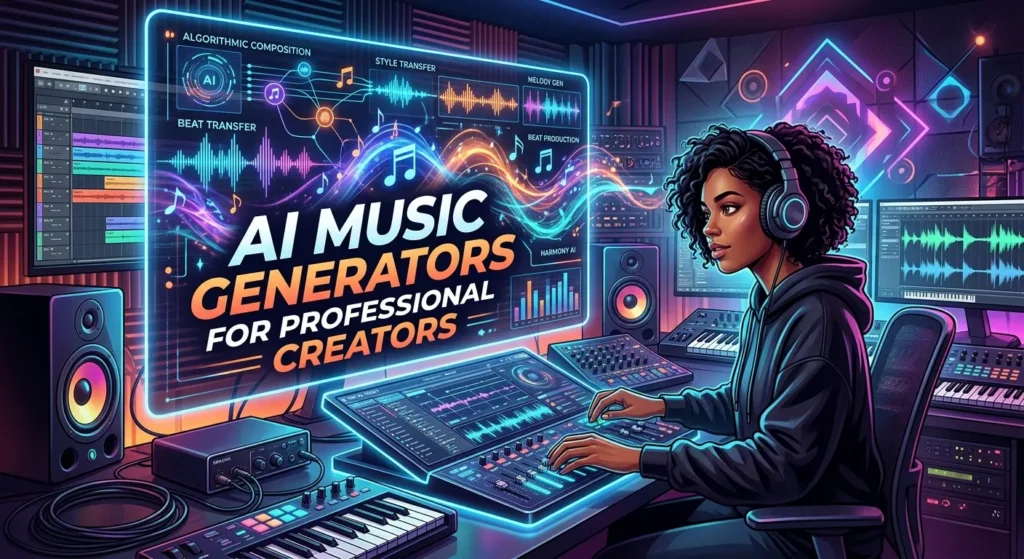
Professional musicians, producers, video editors, game developers, and agencies may need more than simple text-to-song generation. They often require control, consistency, editing flexibility, licensing clarity, and reliable export options.
Advanced creators may use AI as a creative assistant rather than a complete replacement for production software. For example, AI can help generate a musical sketch that a producer later rearranges and edits manually.
This approach can save time during ideation. A producer who normally spends hours searching for the right musical direction can generate several concepts and then develop one of them further.
Professional users should pay particular attention to commercial rights. Before using AI-generated music in advertising, client projects, monetized videos, games, or commercial releases, carefully review the platform’s current license terms.
Best AI Tools for Songwriting, Lyrics, and Vocals
Some AI music platforms focus heavily on complete songs. These systems may combine lyrics, vocals, melody, instrumentation, and arrangement into one generation process.
This can be useful for creators who want to experiment with songwriting ideas quickly. A user can develop a concept, describe the emotional direction, and generate a rough musical interpretation.
AI songwriting tools can also support brainstorming. Instead of asking AI to create a final song immediately, you can use it to explore themes, song structures, hooks, or lyrical concepts and then rewrite the material yourself.
For serious songwriting, human creativity remains important. AI-generated ideas are most useful when the creator actively evaluates, edits, and develops them. Personal storytelling and original artistic decisions can make the final work more distinctive.
AI Music Tools for YouTube, TikTok, Podcasts, and Social Media
Content creators constantly need music for videos. AI music generators can help produce background tracks for tutorials, travel videos, explainers, short-form content, podcasts, and promotional clips.
The main advantage is speed. Instead of searching through large music libraries, a creator can describe the desired mood and generate an original starting point.
For example, a YouTube technology channel might need energetic background music for an introduction. A creator could request a short electronic instrumental with a modern, futuristic feel.
However, licensing is critical for online content. A track being AI-generated does not automatically mean that you can use it anywhere without restrictions. Always review the specific usage rights attached to your plan and generated audio.
Creators should also avoid making music so loud that it competes with spoken narration. Background music should support the content rather than distract from it.
AI Music Generation for Games, Film, and Creative Projects
Game developers and filmmakers can use AI music tools to explore atmosphere and emotion during development. A game might require different musical concepts for exploration, action, menus, suspense, or emotional scenes.
AI can help teams prototype these ideas quickly. Instead of waiting until the final production stage, developers can experiment with musical direction during early development.
Independent filmmakers can similarly use AI-generated music for temporary scoring and creative exploration. A director can test different musical moods against a scene and discover which direction works best.
For commercial productions, teams should document where the audio came from, what license applies, and how the music may be used. This creates a clearer production workflow and reduces uncertainty later.
Free vs Paid AI Music Generation Tools
Many AI music platforms offer free access, trials, limited credits, or restricted generations. These plans can be useful for learning and experimentation.
Free plans often come with limitations. These may include fewer generations, shorter audio, lower export limits, watermarks, slower processing, or restrictions on commercial usage. The exact terms can change, so users should always check the current pricing and license information before publishing content.
Paid plans generally provide more generation capacity and additional features. Depending on the service, users may also receive better export options, commercial rights, advanced editing, or priority processing.
If you are a beginner, start with a free or low-cost option when possible. Do not pay for a large subscription before confirming that the tool fits your workflow.
Pricing and Commercial Licensing Considerations
AI music pricing can vary considerably. Some platforms charge monthly subscriptions, while others use credits or usage-based systems.
When comparing prices, look beyond the headline subscription fee. Consider how many generations you receive, audio length, export quality, commercial rights, unused-credit rules, and available features.
Licensing is especially important for freelancers and businesses. A platform may allow personal use on one plan while requiring a different subscription for commercial projects.
Before using a track for a client, advertisement, monetized video, game, or business campaign, read the current license agreement. Keep a record of the plan you used and the applicable terms at the time of creation.
This is particularly important because AI-generated content licensing can be complex and may evolve as technology, platform policies, and legal frameworks develop.
Pros and Cons of AI Music Generation
AI music generation offers several practical advantages. The biggest is speed. Creators can explore musical concepts in minutes instead of starting every project from scratch.
It also lowers the technical barrier to experimentation. Someone with limited production knowledge can describe an idea and hear an approximate musical result.
Key benefits include:
- Faster music ideation
- Rapid experimentation
- Lower production barriers
- More creative variations
- Useful background music options
- Support for video and social content
- Assistance with songwriting
- Faster prototyping
There are also limitations. AI-generated music may not always follow instructions perfectly. Results can vary between generations, and some outputs may sound less distinctive than music created through a highly personal production process.
Other concerns include licensing, originality, consistency, editing control, and the evolving legal environment around AI-generated content.
The practical solution is to treat AI as one part of the creative workflow rather than assuming it can solve every musical requirement automatically.
AI Music Tools Compared With Traditional Music Production
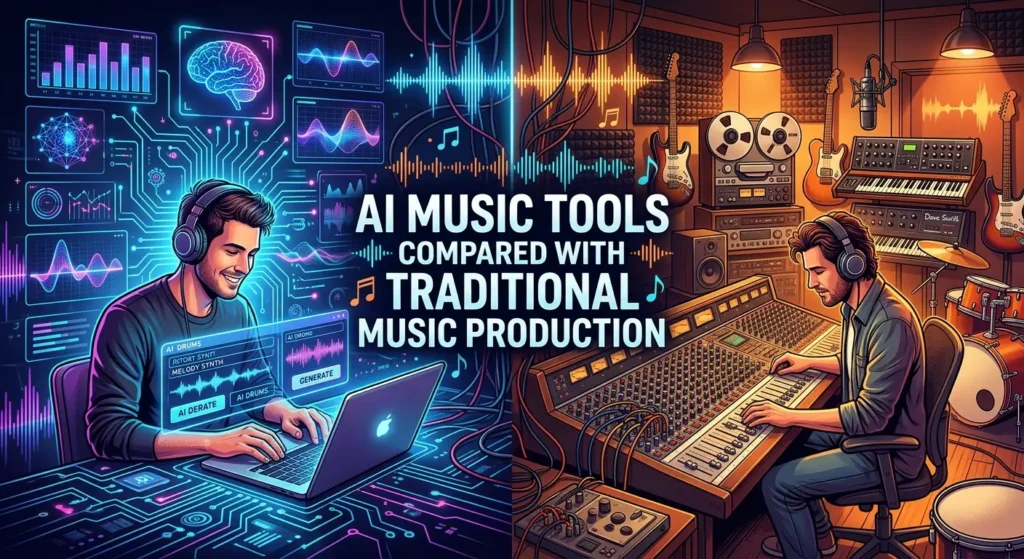
Traditional music production gives creators extensive control over instruments, recording, mixing, arrangement, performance, and sound design. AI music generation focuses more heavily on speed and automation.
This does not necessarily make one approach universally better. They solve different problems.
A traditional producer may spend significant time building a track from individual components. An AI system can provide an initial concept rapidly. The producer can then refine that idea using a digital audio workstation.
A hybrid workflow can be especially useful:
AI idea → Human selection → Manual editing → Mixing → Final production
This approach combines automation with human judgment. It can help creators move faster while maintaining control over the final creative direction.
For beginners, AI can also serve as a learning tool. Listening to generated arrangements can help users understand how different instruments and structures affect a track.
How to Write Better Prompts for AI Music Generation
Prompt quality can strongly influence AI music results. Instead of writing a vague request such as “make good music,” provide useful creative information.
Mention the intended mood, genre, instrumentation, energy, tempo, purpose, and structure when the platform supports those controls.
For example:
“Create an atmospheric electronic instrumental for a futuristic technology video, with soft synth textures, steady percussion, gradual progression, and an uplifting ending.”
You can also experiment with different prompt lengths. A detailed prompt may provide more direction, while a shorter prompt can leave more room for creative interpretation.
Avoid adding too many conflicting instructions. If you request a calm acoustic track with aggressive electronic drums and extremely fast pacing, the system may produce an inconsistent result.
The best workflow is iterative. Generate, listen, identify the problem, adjust one or two elements, and generate again.
Common Mistakes When Using AI Music Generators
One common mistake is expecting the first generation to be perfect. AI music creation is often an iterative process.
Another mistake is ignoring licensing. A creator may find an excellent track and immediately publish it without checking whether their subscription allows the intended use.
Users also sometimes choose tools based purely on popularity. A famous platform may not provide the exact controls needed for a particular project.
Other mistakes include:
- Using vague prompts
- Ignoring export quality
- Forgetting commercial-use restrictions
- Overusing background music
- Not checking generated audio
- Failing to organize project files
- Depending completely on AI
- Publishing without reviewing the final mix
Creators should listen carefully before publishing. Check timing, unwanted artifacts, transitions, vocals, volume, and overall suitability for the project.
Latest AI Music Generation Trends in 2026
AI music generation continues to move toward more controllable and interactive workflows. Instead of generating one complete track from a single prompt, modern systems increasingly aim to give creators greater control over individual musical elements.
Another important trend is multimodal creation. Music tools can increasingly fit into broader creative workflows involving text, images, video, voice, and other forms of media.
Personalization is also becoming more important. Creators want AI systems that understand a specific mood, brand identity, content style, or production requirement.
Integration is another major area. AI music features can become more useful when they connect with editing software, content creation platforms, game development workflows, and broader creative applications.
The future will likely involve more collaboration between humans and AI. Rather than simply pressing a generate button, creators may guide, edit, remix, rearrange, and refine AI-generated material throughout the entire production process.
How to Choose the Right AI Music Generation Tool
Start by identifying your actual goal. If you need background music for YouTube, your priorities may differ from those of a songwriter or professional producer.
Consider these questions:
Do you need complete songs or instrumentals? Complete-song generators may be more useful for songwriting, while instrumental-focused tools can work well for video backgrounds.
Do you need commercial rights? If you plan to monetize your work, check the licensing terms before choosing a platform.
How much control do you need? Beginners may prefer simplicity, while experienced producers may want editing, stems, variations, and detailed controls.
What is your budget? Test free options first when possible, then upgrade if the additional features provide real value.
What output quality do you need? Social media content may have different requirements from professional film, advertising, or music production.
The right choice is ultimately the platform that fits your workflow, budget, creative goals, and usage requirements.
Future of AI Music Generation and What Creators Should Expect
AI music technology is likely to become more interactive, controllable, and integrated into creative software. Future systems may provide finer control over individual instruments, musical sections, vocal characteristics, arrangements, and sound design.
We can also expect stronger connections between AI music and video creation. A creator may be able to develop visual scenes and automatically generate music that matches their pacing, emotion, and style.
At the same time, questions around copyright, licensing, artist rights, training data, originality, and ownership will remain important. Technology may develop faster than regulations, so creators should continue checking the current rules and platform policies.
The most valuable skill will not simply be knowing how to generate music. Creative direction, editing, critical listening, storytelling, and responsible use of AI will become increasingly important.
For freelancers, marketers, YouTubers, developers, and independent artists, learning how to combine AI generation with human creativity can create a practical competitive advantage.
Frequently Asked Questions
What are the top AI music generation tools in 2026?
The top AI music tools vary according to the user’s needs. Some focus on complete songs, while others specialize in instrumentals, vocals, sound design, or production assistance. Compare features, output quality, pricing, and licensing before choosing.
Can AI generate a complete song?
Yes. Some AI music platforms can generate songs that combine vocals, lyrics, melodies, instrumentation, and arrangements. The level of control and editing available depends on the platform.
Are AI-generated songs free to use?
Not necessarily. Some platforms provide specific usage rights under free plans, while others restrict commercial use. Always read the current license terms before publishing or monetizing AI-generated music.
Can I use AI-generated music on YouTube?
Potentially, depending on the platform’s license and your subscription. Check whether your plan permits commercial or monetized use before adding the music to a YouTube video.
Are AI music generators good for beginners?
Yes. They can make music experimentation easier because users can start with natural-language prompts instead of manually creating every musical element.
Can AI music replace human musicians?
AI can automate parts of music creation, but it does not eliminate the value of human creativity, performance, storytelling, artistic direction, and production judgment. Many creators use AI as an assistant rather than a complete replacement.
How can I create better AI-generated music?
Use specific prompts, describe the mood and instrumentation, experiment with multiple versions, and refine your instructions based on the results. Human editing can further improve the final output.
What should I check before paying for an AI music tool?
Check generation limits, audio quality, export formats, commercial licensing, available editing features, pricing, and whether the tool supports your intended workflow.
Are AI music generators useful for freelancers?
Yes. Freelancers can use them for creative prototypes, social media videos, advertisements, podcasts, presentations, game projects, and other audio-related work, provided the relevant licensing permits the intended use.
What is the future of AI music generation?
The technology is moving toward greater creative control, personalization, multimodal workflows, and integration with other creative applications. Human-AI collaboration is likely to remain an important part of the future music-production process.
Conclusion
The top AI music generation tools in 2026 give creators faster ways to explore musical ideas, produce background audio, experiment with songwriting, and support video and multimedia projects. Their biggest advantage is not simply automation. It is the ability to turn an idea into an audible starting point quickly.
For beginners, these platforms can make music creation less intimidating. For experienced creators, they can accelerate brainstorming and prototyping. For businesses and freelancers, they can support efficient content production when the appropriate licensing is in place.
The smartest approach is to combine AI efficiency with human creativity. Use AI to generate possibilities, then listen critically, edit carefully, and shape the final result around your project’s goals. As the technology continues to develop, creators who understand both the tools and the creative process will be better prepared to use AI music generation effectively.