AI SEO tools for small business are changing how entrepreneurs, local companies, online stores, agencies, and startups approach search engine optimization. Instead of spending hours researching keywords, auditing pages, analyzing competitors, writing content briefs, and checking technical issues manually, small teams can use AI to automate many repetitive SEO tasks. The result can be better productivity, faster content planning, smarter decision-making, and more efficient use of limited marketing resources.
Modern AI SEO platforms can help with keyword research, content optimization, technical SEO, competitor analysis, local search, link opportunities, search visibility, and performance reporting. However, choosing the right tool matters. Small businesses often have smaller budgets and fewer people, so an expensive platform with unnecessary features may not deliver good value. This guide explains what AI SEO tools do, how they work, which features matter, how to evaluate pricing, common mistakes, and how small businesses can build a practical SEO workflow for 2026 and beyond.
What Are AI SEO Tools for Small Business?
AI SEO tools for small business are software platforms that use artificial intelligence, machine learning, natural language processing, and automation to help smaller organizations improve their search visibility.
Traditional SEO often involves many separate tasks. A business owner may need to find keywords, analyze search intent, examine competitors, optimize website pages, identify technical errors, create content, monitor rankings, and review analytics.
AI can simplify parts of this process.
For example, an AI SEO platform might analyze a webpage and suggest missing topics, identify relevant keywords, recommend improvements to headings, or generate a content brief based on search intent. Another tool might examine competitors and highlight topics they cover that your website does not.
The purpose is not to make SEO completely automatic. AI works best as a productivity assistant that helps people research, prioritize, and execute SEO tasks more efficiently.
Small businesses can use these tools to compete more effectively without building a large in-house marketing department.
How Do AI SEO Tools Work?
AI SEO tools usually combine multiple technologies.
First, they collect and analyze data from sources such as search results, websites, keyword databases, analytics platforms, and user-provided information.
Next, AI models interpret that data. Natural language processing helps the software understand relationships between topics, entities, search intent, and content.
The platform then produces recommendations. Depending on the tool, these recommendations may involve keywords, content structure, internal links, technical improvements, competitor gaps, or local SEO opportunities.
A basic AI SEO workflow might look like this:
- Choose a target topic or business goal.
- Research relevant search queries.
- Analyze competitors and search intent.
- Create or improve content.
- Optimize technical elements.
- Publish the page.
- Monitor rankings and traffic.
- Use performance data to make improvements.
The quality of the recommendations depends heavily on the data available to the platform. AI can accelerate analysis, but business owners still need to review suggestions and apply human judgment, industry knowledge, and real customer understanding.
Why Small Businesses Need AI SEO Tools
Small businesses face a unique SEO challenge: they often compete with larger companies while operating with fewer resources.
A large company may have dedicated SEO specialists, content writers, developers, analysts, and marketing managers. A small business may have one person handling most of these responsibilities.
AI can reduce that workload.
A business owner can use AI to create an initial keyword list, organize content ideas, identify optimization opportunities, and summarize technical issues. This does not eliminate the need for expertise, but it can reduce repetitive research.
AI SEO tools can also improve consistency. Instead of optimizing pages randomly, a business can use a repeatable process for researching, writing, optimizing, publishing, and measuring content.
For small businesses, the biggest advantage is often doing more meaningful SEO work with limited time and budget.
Key Features to Look for in Small Business AI SEO Software
Not every AI SEO platform provides the same capabilities. Small businesses should prioritize features that solve their actual problems.
AI keyword research can help discover related queries, long-tail keywords, questions, and search-intent variations.
Content optimization can evaluate a page and suggest improvements related to topical coverage, structure, readability, and relevance.
Competitor analysis can show which topics and pages competing websites use to attract search traffic.
Technical SEO auditing can identify issues such as broken links, missing metadata, indexing problems, duplicate content, or performance concerns.
Local SEO features are especially valuable for businesses that serve a specific city or region.
Rank tracking helps monitor how important pages perform for target queries.
Content brief generation can help writers understand the topics, questions, and structure that a useful page should cover.
Reporting and analytics allow businesses to connect SEO activity with traffic and business outcomes.
The best platform is usually not the one with the longest feature list. It is the one that makes your most important SEO tasks simpler, faster, and more measurable.
Benefits of AI SEO Tools for Small Businesses
The most obvious benefit is time savings.
AI can process large amounts of information much faster than a person manually reviewing hundreds of search results or competitor pages. This allows small teams to spend more time on strategy and customer-focused activities.
AI can also improve productivity. A business owner can use a content assistant to create an outline, an SEO platform to identify optimization opportunities, and analytics software to evaluate results.
Another benefit is accessibility. SEO can seem complicated because it involves technical concepts, search behavior, content strategy, and data analysis. AI interfaces can make some of these tasks easier to understand.
AI tools can also encourage experimentation. A small business can test different content topics, page structures, titles, and internal-linking strategies without requiring a large marketing operation.
However, the goal should not be publishing more content simply because AI makes content creation faster. Quality, relevance, originality, and usefulness remain more important than volume.
AI SEO Use Cases for Small Businesses
AI SEO tools can support many different types of businesses.
Local service businesses
Plumbers, electricians, repair companies, salons, restaurants, and other local providers can use AI to identify location-based search queries and create useful service pages.
E-commerce stores
Online retailers can use AI for product keyword research, category optimization, product descriptions, internal linking, and competitor analysis.
Professional services
Consultants, agencies, accountants, designers, and other professionals can use SEO tools to identify questions potential customers ask before purchasing.
SaaS startups
Software companies can use AI SEO platforms to discover comparison keywords, alternative searches, product-related topics, and educational content opportunities.
Bloggers and publishers
Small publishing teams can use AI for topic research, content briefs, optimization, and performance analysis.
Freelancers
Freelancers can use AI SEO software to manage client projects more efficiently and provide data-driven recommendations.
The best use case is one where AI removes repetitive work while the human remains responsible for strategy, accuracy, expertise, and final quality.
Free vs Paid AI SEO Tools for Small Business
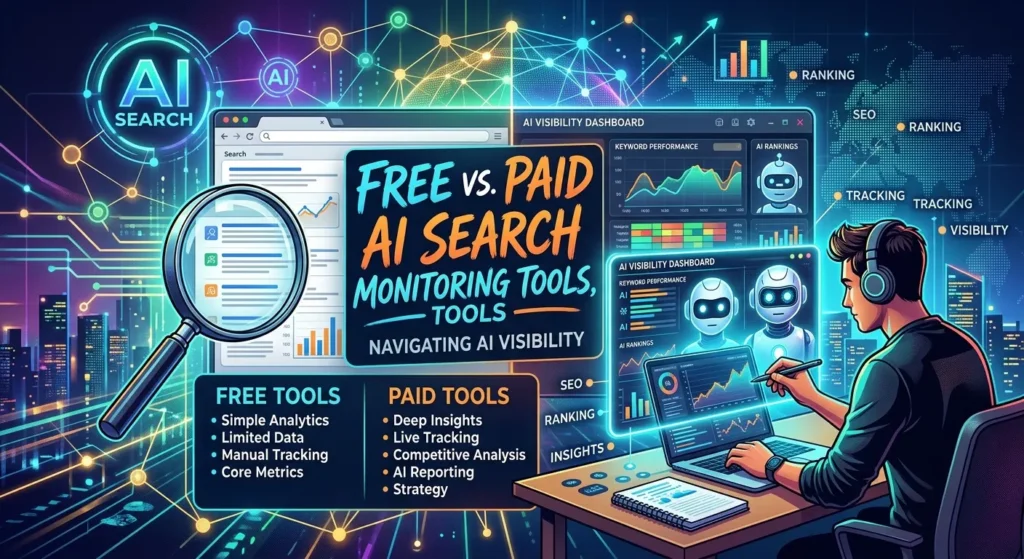
Free AI SEO tools can provide useful capabilities for businesses with limited budgets.
A free plan may offer basic keyword suggestions, content assistance, simple audits, or limited usage. These features can be enough for a new website or a business just beginning SEO.
Paid platforms generally offer broader data access, larger usage limits, advanced reporting, competitor research, automated audits, rank tracking, and integrations.
A small business should not automatically choose the cheapest option. Instead, calculate how the tool fits into the marketing workflow.
For example, if a paid platform saves several hours every week and helps identify valuable opportunities, its cost may be justified.
On the other hand, if a business only publishes a few pages each month, an expensive enterprise SEO platform may provide capabilities that never get used.
Start small. Use free trials when available. Test the tool on real pages and real keywords before committing to a long-term subscription.
AI SEO Tool Pricing and Budget Considerations
AI SEO pricing varies significantly.
Some tools use monthly subscriptions. Others charge according to tracked keywords, websites, projects, users, AI credits, content volume, or API usage.
Small businesses should calculate the total cost rather than looking only at the advertised starting price.
Consider whether you need:
- Keyword research
- Content optimization
- Technical audits
- Local SEO
- Rank tracking
- Competitor research
- Automated reports
- Multiple users
- API access
- AI content credits
- Integrations
Also examine usage limits. A tool may appear inexpensive until you discover that the plan includes only a small number of tracked keywords or content analyses.
The best investment is usually the tool that solves a specific business bottleneck.
For example, if content planning takes too long, prioritize keyword and content intelligence. If technical problems are limiting organic performance, prioritize auditing and monitoring.
AI SEO Tools vs Traditional SEO Software
Traditional SEO software remains highly valuable. AI does not automatically make older SEO technologies irrelevant.
Traditional platforms often excel at structured data, keyword databases, backlink analysis, technical crawling, rank tracking, and historical reporting.
AI adds another layer of interpretation.
For example, traditional software might tell you that a competitor ranks for hundreds of keywords. An AI-powered system might summarize the competitor’s topical strategy and identify content themes worth investigating.
Similarly, traditional tools can identify technical problems, while AI can help explain those problems in simpler language and suggest possible next steps.
The strongest approach is often a combination.
Use structured SEO data for measurement and verification, then use AI to accelerate analysis, planning, and execution.
This reduces the risk of blindly trusting AI-generated recommendations.
How to Choose the Best AI SEO Tool for Your Business
Begin with your primary goal.
If you need more organic traffic, look for keyword research, content optimization, and competitor analysis. If you run a local company, prioritize local SEO features. If technical problems are your biggest issue, choose a platform with strong site auditing and monitoring.
Next, identify your website’s size.
A small website with 20 pages does not need the same infrastructure as an e-commerce store with 20,000 product pages.
Consider your technical skill level as well. A beginner-friendly interface can be more valuable than an advanced platform filled with features you do not understand.
Check integrations with tools you already use, such as analytics, website platforms, content management systems, and reporting software.
Finally, evaluate the quality of recommendations.
Do not ask only, “How many AI features does this platform have?”
Ask instead:
Does it provide accurate information? Does it save me time? Can I verify its recommendations? Does it help me make better decisions?
Those questions provide a much stronger basis for choosing SEO software.
Integrations and AI SEO Workflows
Integrations can turn an AI SEO tool from an isolated application into part of a complete marketing system.
For example, a small business might connect its website analytics with SEO software to compare rankings and traffic. A content team could connect its CMS with optimization tools. An agency might connect reporting software to automatically prepare client reports.
Useful integrations may include Google Analytics, Google Search Console, content management systems, CRM platforms, website builders, spreadsheets, reporting tools, and marketing automation software.
The exact integration options vary by provider, so verify compatibility before purchasing.
Automation can also reduce repetitive work.
A business could create a workflow where SEO performance is reviewed regularly, important ranking changes are identified, and content opportunities are prioritized for human review.
The goal should be a simple system:
Research → Create → Optimize → Publish → Measure → Improve.
AI can support each stage without taking control of the entire process.
How to Use AI SEO Tools Effectively
Start with search intent rather than keywords alone.
A keyword tells you what people type. Search intent helps explain why they are searching.
For example, someone searching “best accounting software” may be comparing products, while someone searching “how to calculate business expenses” may want educational information.
Create content that matches the underlying need.
Use AI for research and organization, but add original knowledge from your business. Include practical examples, first-hand experience, expert insights, product details, and information that generic AI systems cannot easily provide.
Review AI-generated content carefully. Check facts, statistics, names, product information, and claims before publication.
Also use AI to improve existing content. Sometimes updating an important page can provide more value than publishing several new articles.
A smart small-business SEO strategy focuses on quality, relevance, consistency, and measurable outcomes.
Common AI SEO Mistakes Small Businesses Should Avoid
One major mistake is publishing large quantities of AI-generated articles without adding meaningful value.
AI can produce text quickly, but search users still need accurate, original, useful information. Low-value content can waste resources and weaken a site’s reputation.
Another mistake is blindly following AI recommendations.
A tool might suggest a keyword because it appears relevant, but the business owner may know that the keyword attracts customers who are unlikely to buy.
Human judgment remains essential.
Small businesses should also avoid focusing only on rankings. A keyword ranking improvement matters more when it contributes to qualified traffic, leads, sales, bookings, or other business goals.
Another mistake is ignoring technical SEO. Great content cannot perform as effectively if a website has serious indexing, speed, mobile usability, or internal-linking problems.
Finally, avoid changing strategies too frequently. SEO often requires consistent effort and enough time to evaluate results.
Latest AI SEO Trends for Small Businesses
One of the biggest trends is the integration of AI search visibility and traditional SEO.
Businesses increasingly want to know not only whether their website ranks but also whether AI-powered search systems mention their brand when customers ask relevant questions.
Another trend is AI-assisted content optimization. Instead of simply generating articles, tools increasingly analyze existing content and identify topical gaps, intent mismatches, and opportunities for improvement.
Local SEO is also becoming more conversational. Customers can ask AI systems for nearby businesses, services, and recommendations, increasing the importance of accurate business information across the web.
Automation is another major trend. Small teams can use AI to reduce repetitive research and reporting tasks.
At the same time, search engines continue to place importance on helpful content, trust, expertise, and user experience. This means small businesses should avoid treating AI as a shortcut around quality.
AI is most powerful when it improves good SEO practices rather than replacing them.
Future of AI SEO Tools for Small Business
AI SEO software will likely become more integrated and proactive.
Instead of waiting for a marketer to open a dashboard, future systems may monitor websites continuously, identify important changes, explain potential problems, and recommend prioritized actions.
AI may also connect more closely with content management systems, analytics, CRM platforms, customer data, and AI search monitoring.
This could allow a business to understand the full journey from search discovery to customer conversion.
Natural-language interfaces will likely become more common. Instead of learning complicated SEO software, business owners may be able to ask questions such as, “Which pages should I improve this month?” or “What topics could attract customers looking for this service?”
However, human expertise will remain important.
SEO involves changing search behavior, competition, customer psychology, business priorities, and evolving technology. AI can analyze patterns, but people still need to decide which opportunities align with their business.
The future therefore looks less like AI replacing SEO professionals and more like AI helping small teams operate with greater intelligence and efficiency.
Conclusion
AI SEO tools for small business can make search optimization more accessible, efficient, and manageable. They help smaller teams perform tasks that once required significant amounts of manual research, including keyword discovery, content planning, competitor analysis, technical auditing, optimization, reporting, and search visibility monitoring.
The best results come from using AI as a strategic assistant rather than an automatic content machine. Businesses should combine AI-powered recommendations with real customer knowledge, industry expertise, original insights, and careful fact-checking.
Free tools can be useful for beginners, while paid platforms can provide more comprehensive data, automation, integrations, and reporting. The right solution depends on website size, marketing goals, budget, technical skills, and workflow requirements.
As search becomes more conversational and AI-driven, small businesses will need to think beyond traditional rankings. They should build websites and digital brands that provide genuinely useful information, establish authority, and answer customer questions clearly.
The most effective long-term strategy is simple: use AI to save time, use SEO data to make decisions, and use human expertise to create value. When these three elements work together, even a small business can build a stronger and more sustainable search presence.
Frequently Asked Questions
What are AI SEO tools for small business?
AI SEO tools are software platforms that use artificial intelligence to assist with keyword research, content optimization, technical SEO, competitor analysis, local SEO, rank tracking, and reporting.
Are AI SEO tools worth it for small businesses?
They can be worthwhile when they solve a real marketing problem. If a tool saves time, identifies useful opportunities, or improves SEO decision-making, it can provide strong value for a small business.
Can small businesses use free AI SEO tools?
Yes. Free tools can help with basic keyword research, content ideas, optimization, and analysis. Businesses with larger websites or more advanced requirements may benefit from paid platforms.
Can AI SEO tools write SEO content?
Many AI SEO platforms can help create outlines, briefs, drafts, and optimization recommendations. However, businesses should review and improve AI-generated content with original expertise, accurate information, examples, and useful insights.
Will AI SEO tools replace SEO professionals?
AI can automate repetitive SEO tasks, but it does not eliminate the need for strategic thinking. SEO professionals and business owners still need to understand customers, evaluate opportunities, verify information, and make decisions.
What features should a small business prioritize?
Prioritize features that match your goals. Keyword research, content optimization, technical audits, local SEO, competitor analysis, rank tracking, and reporting are commonly useful.
Are expensive AI SEO platforms better?
Not necessarily. An expensive platform may contain features a small business never uses. The best tool is the one that provides reliable data and useful functionality at a cost that matches your actual needs.
How can AI improve local SEO?
AI can help identify local search queries, service topics, content opportunities, and competitor patterns. Businesses should also maintain accurate local information and provide useful location-specific content.
How often should a small business use AI SEO tools?
SEO should be an ongoing process. Businesses can perform regular technical checks, monitor important keywords, review content performance, and periodically analyze competitors. The exact schedule depends on website size and business goals.
Can AI SEO tools guarantee higher Google rankings?
No. No legitimate SEO tool can guarantee specific rankings. AI SEO platforms provide data, recommendations, and automation, but search performance depends on many factors, including content quality, relevance, competition, technical health, authority, and user experience.
What is the future of AI SEO for small businesses?
The future will likely include more automated SEO analysis, AI search visibility tracking, predictive recommendations, natural-language interfaces, deeper integrations, and personalized optimization workflows. Small businesses may gain access to increasingly sophisticated SEO capabilities without needing large marketing teams.