Search is changing faster than ever. Traditional SEO tracking once focused mainly on keyword rankings, organic traffic, and clicks. Today, businesses also need to understand how their brands and content appear across AI-powered search experiences, AI Overviews, AI search engines, conversational answers, and generative search platforms. This has created growing demand for an effective AI search tracking tool.
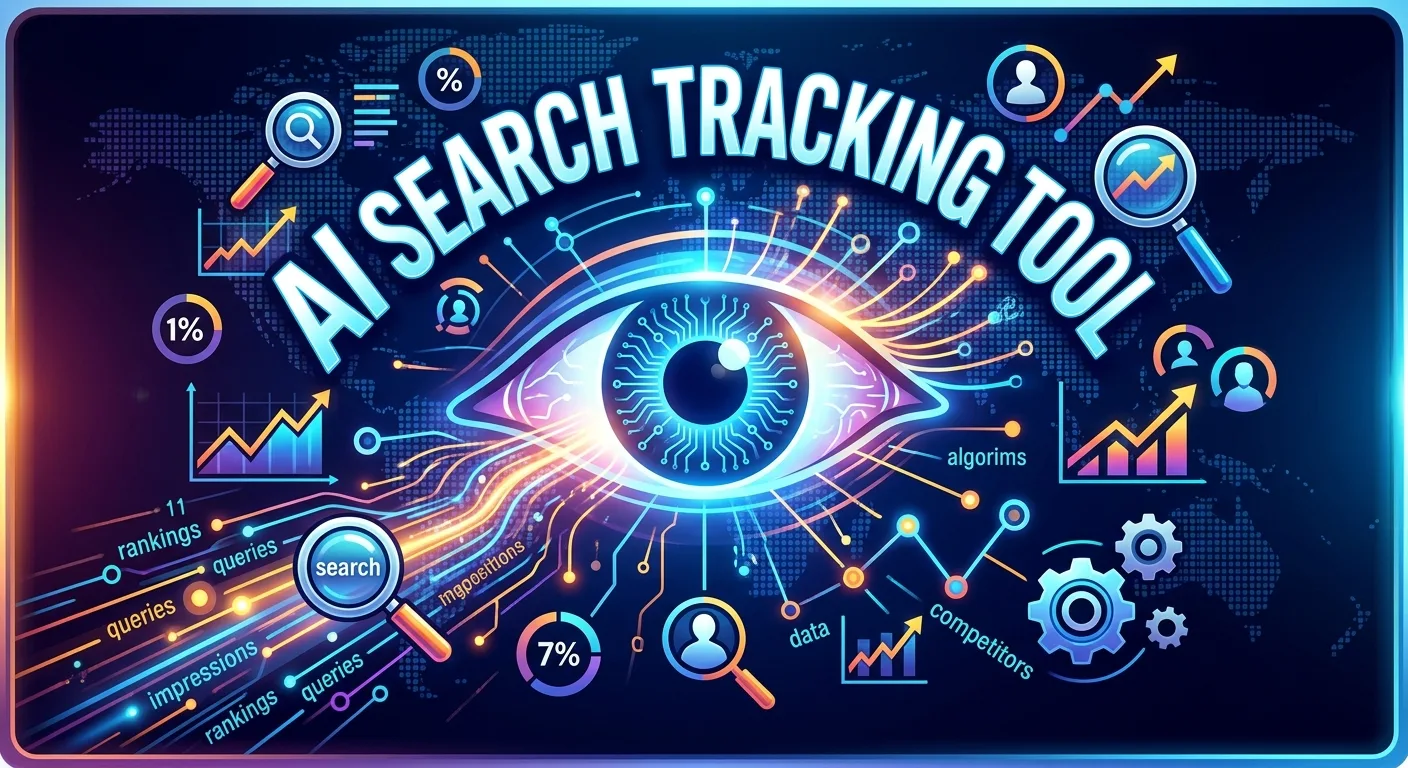
An AI search tracking tool helps marketers monitor search visibility beyond traditional blue links. It can reveal how often a brand appears in AI-generated answers, which pages receive citations, what competitors are being mentioned, and which topics create visibility opportunities. These insights can improve productivity, efficiency, automation, creativity, and SEO decision-making.
For businesses, agencies, publishers, and freelancers, AI search tracking provides a practical way to understand the new search landscape. Instead of manually checking hundreds of questions, marketers can automate monitoring and focus their time on improving content, authority, and overall search performance.
What Is an AI Search Tracking Tool?
An AI search tracking tool is software designed to monitor how a website, brand, product, or content appears across AI-powered search experiences. Instead of focusing only on traditional Google rankings, it measures visibility inside AI-generated answers and other generative search environments.
Traditional rank tracking answers a simple question: Where does my page rank for a keyword? AI search tracking asks a broader question: How visible is my brand when people ask AI-powered search systems questions related to my business?
Depending on the platform, an AI search tracking tool may monitor AI Overviews, AI Mode, ChatGPT, Google AI experiences, Microsoft-powered search experiences, Perplexity, Gemini, or other generative search systems. The exact platforms supported vary by provider.
Modern tracking systems can also identify citations, mentions, linked URLs, competitors, prompts, topics, and visibility trends. This gives SEO professionals more context than a single traditional ranking position.
For example, an online store selling running shoes may track questions such as “best running shoes for beginners” or “best shoes for daily running.” The tool can show whether the store’s brand or product pages appear in AI-generated answers.
How Does an AI Search Tracking Tool Work?
Most AI search tracking platforms begin with a collection of keywords, prompts, questions, topics, or brand terms. You select the searches that matter to your business and add them to the tracking system.
The tool then monitors those queries across supported AI search environments. When an AI-generated response appears, the system analyzes the answer for brand mentions, citations, links, competitors, and other visibility signals.
For example, imagine you operate a website about AI software. You could track questions such as:
- What are the best AI SEO tools?
- Which AI tools help small businesses?
- What is the best AI writing software?
- How can businesses improve AI search visibility?
The tracking platform records what happens when these searches are performed.
The system may then organize the information into dashboards and reports. Instead of manually checking every query, you can see visibility trends, citation changes, competitor activity, and content opportunities in one place.
Some advanced platforms also allow scheduled monitoring. This adds automation to the SEO process and makes it easier to detect changes over time.
The important point is that AI search results can change frequently. A single manual search represents only one moment. Continuous tracking provides a more useful picture of visibility.
Key Features of an AI Search Tracking Tool
The features available depend on the software, but a strong AI search tracking platform usually includes several important capabilities.
AI visibility monitoring helps determine whether your brand or website appears in AI-generated responses. This is one of the core functions of an AI search tracking system.
Citation tracking shows which websites and URLs AI systems reference. Citations can provide valuable information about the type of content that AI systems consider useful for particular questions.
Brand mention tracking monitors whether your company, product, website, or other important entity appears in generated answers.
Competitor monitoring lets you see which competing brands receive visibility for the same topics.
Other useful features can include:
- Prompt tracking
- Keyword tracking
- AI Overview monitoring
- AI Mode monitoring
- URL-level analysis
- Topic clustering
- Geographic tracking
- Historical data
- Visibility trends
- Automated reports
- API access
- Data exports
- Search Console integrations
- Analytics integrations
Some platforms also provide share-of-voice metrics. These attempt to estimate how frequently a brand appears compared with competitors.
However, always check how a platform calculates its metrics. Different tools may use different methodologies, databases, prompts, and sampling systems.
Benefits of Using AI Search Tracking Software
One of the biggest benefits is time savings. Checking AI search results manually across dozens or hundreds of prompts can become repetitive. Automation allows marketers to monitor more searches without performing every check themselves.
AI search tracking can also improve content strategy. If competitors repeatedly appear in AI answers while your website does not, you can investigate what information those competing pages provide.
Another benefit is better visibility into changing search behavior. Traditional SEO reports may show that a keyword moved from position five to position four. AI search tracking can add another layer by showing whether your brand is also being mentioned in AI-generated responses.
This broader view can support smarter decisions.
For example, suppose an article ranks well for a popular query but never appears in AI-generated answers. You could review the article and ask:
Does it answer the main question directly?
Does it provide trustworthy evidence?
Does it cover important related questions?
Does it include original information or useful examples?
Is the content easy for search systems and readers to understand?
AI tracking does not automatically fix these problems. Instead, it provides data that helps you decide where to investigate.
AI Search Tracking Use Cases for Businesses and SEO Teams
AI search tracking has applications across many industries.
SEO agencies can use it to monitor client visibility and create more detailed reports. Instead of reporting only traditional rankings, agencies can explain how client brands appear across emerging AI search experiences.
Freelancers can use AI visibility tracking as part of content optimization services. A freelancer might monitor a client’s most valuable commercial questions and identify areas where competitors receive AI citations.
Ecommerce companies can track product-related questions. For example, a skincare business could monitor questions about product categories, ingredients, comparisons, and buying decisions.
SaaS companies can monitor software comparison questions. They can discover when competitors appear in AI-generated recommendations and identify topics where their own brand has limited visibility.
Publishers and bloggers can monitor informational queries connected to their content. This can help identify topics that deserve better coverage.
Local businesses can also benefit when AI search platforms answer questions about local services, businesses, products, and destinations.
The key is to track searches connected to real business goals. Tracking thousands of random prompts may produce large amounts of data without creating useful insights.
AI Search Tracking vs Traditional Rank Tracking
Traditional rank tracking and AI search tracking measure different aspects of search visibility.
Traditional rank tracking focuses on organic search positions. It tells you where a specific page appears for a keyword in a particular search environment.
AI search tracking focuses on visibility within AI-generated responses. It can tell you whether your brand, page, or website becomes part of the answer.
These measurements should not be treated as identical.
A website can rank number one organically but receive no AI citation for a particular query. Another website might rank lower in traditional results but appear as a cited source in an AI-generated answer.
This difference makes combined tracking valuable.
A modern SEO dashboard may therefore include:
Organic rankings + organic clicks + impressions + AI mentions + AI citations + competitor visibility.
This broader measurement approach gives SEO teams more context.
It is also important not to assume that an AI mention automatically creates traffic. A mention can contribute to brand awareness even when a user does not click a link. Therefore, AI visibility should be evaluated alongside actual website performance and business outcomes.
Free vs Paid AI Search Tracking Tools
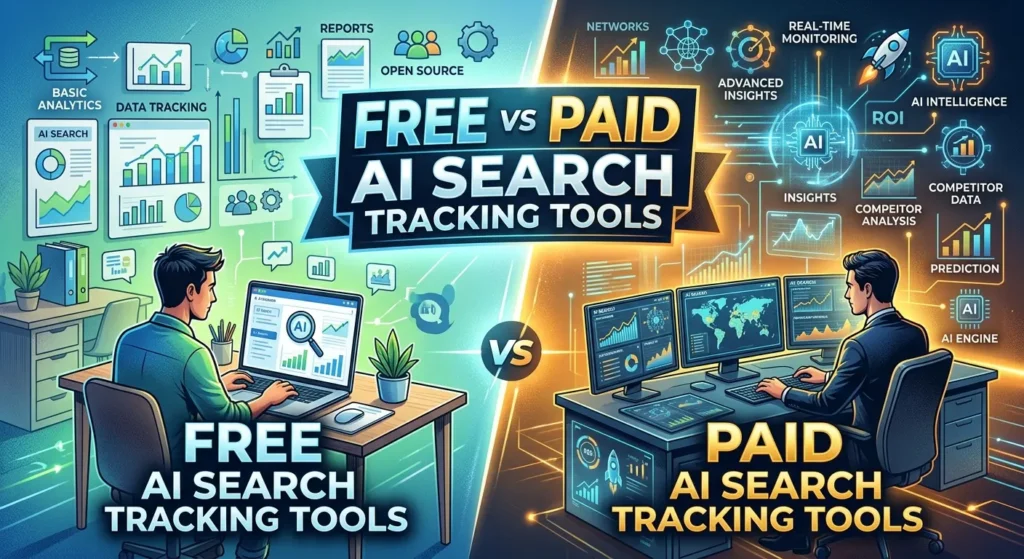
Free options can be useful when you are learning AI search optimization or managing a small website.
Google Search Console is particularly valuable because it provides first-party search performance information for websites. Google has expanded Search Console reporting to include performance information related to generative AI experiences, including AI Overviews and AI Mode.
Free or limited tools can help with basic monitoring, but they may restrict the number of queries, historical data, competitors, locations, or AI platforms you can track.
Paid tools generally provide broader capabilities. Depending on the provider, a subscription may include:
- Larger keyword limits
- More tracked prompts
- Competitor analysis
- Historical visibility
- Multiple AI platforms
- Automated reporting
- API access
- Team collaboration
- Advanced filtering
- Scheduled updates
The right choice depends on your workload.
If you manage one small website, a free or low-cost approach may be enough. If you manage multiple websites or hundreds of important queries, automation and scale become much more valuable.
Before buying, check the current pricing, limits, supported platforms, refresh frequency, and data methodology.
Pricing and Value of AI Search Tracking Tools
AI search tracking software can use several pricing models. Some platforms include AI monitoring as part of a broader SEO subscription. Others offer dedicated AI visibility packages.
Pricing may depend on the number of keywords, prompts, domains, competitors, locations, users, or tracked AI platforms.
Instead of looking only at the monthly price, consider the business value of the information.
Suppose a manual AI search audit takes several hours every week. An automated tool could reduce that work significantly. The time saved can then be used for content creation, technical SEO, link development, research, or client work.
For agencies, reporting efficiency can also affect profitability.
Before choosing a plan, ask:
- How many queries can I track?
- How frequently does the data refresh?
- Which AI search platforms are supported?
- Can I monitor competitors?
- Does the tool track citations?
- Can I export data?
- Is API access available?
- How long is historical data stored?
- Are reports automated?
- Can multiple team members access the platform?
The cheapest tool is not always the most efficient tool, and the most expensive platform is not automatically the best fit. Match the features to your actual requirements.
AI Search Tracking Integrations and SEO Workflows
Integrations make AI search tracking more powerful because they connect visibility data with other marketing information.
Google Search Console can provide first-party search performance information. When combined with AI visibility data, marketers can compare traditional search performance with generative search exposure.
Google Analytics can help measure what happens after users reach the website. This makes it possible to connect search visibility with engagement and conversions.
SEO platforms can also connect keyword research, site auditing, backlink analysis, content optimization, and AI visibility into a larger workflow.
A practical workflow could look like this:
Research → Track → Analyze → Optimize → Measure → Repeat.
First, identify important search questions.
Next, monitor them using an AI search tracking tool.
Then analyze citations and competitor visibility.
After that, improve relevant pages based on genuine content gaps.
Finally, monitor the results and compare changes over time.
This workflow combines automation with human expertise. The software collects and organizes information while the SEO professional interprets it and decides what action makes sense.
How to Choose the Best AI Search Tracking Tool
Start by identifying your goals.
If you mainly want to monitor your own brand, choose a platform with strong brand mention and citation tracking.
If you work for an agency, prioritize multi-project management, reporting, competitor tracking, and automation.
If you run an international website, geographic and language support becomes important.
The number of supported AI platforms also matters. Some products focus heavily on Google AI search, while others monitor multiple generative platforms.
Look closely at data quality. Ask how the platform collects results, how often it refreshes them, and whether the metrics represent direct observations or modeled estimates.
Also evaluate usability.
A technically powerful tool can still create problems if its reports are difficult to understand. A clean dashboard can save time when you need to review hundreds of prompts.
Finally, look at historical capabilities. AI search is dynamic, so historical data can help you understand whether visibility changes are temporary or part of a longer trend.
Best Practices for AI Search Visibility Tracking
Start with your most important search questions instead of tracking everything.
Group prompts into meaningful categories such as informational, commercial, navigational, comparison, and transactional searches.
For example, an AI software website might create groups for:
- AI SEO tools
- AI writing tools
- AI marketing tools
- AI productivity tools
- AI design tools
This makes the resulting data easier to interpret.
Track competitors as well. If another brand repeatedly appears for your most valuable topics, study the content and information that support its visibility.
Do not focus exclusively on mentions. Look at which pages receive citations and what those pages do well.
Keep content accurate and current. Provide direct answers where appropriate, use descriptive headings, support important claims with reliable evidence, and demonstrate genuine expertise.
Also review AI visibility alongside traditional SEO metrics.
A decline in AI mentions does not automatically mean your entire SEO strategy is failing. Likewise, more AI mentions do not automatically mean more revenue.
Use multiple signals to understand performance.
Common AI Search Tracking Mistakes
One of the most common mistakes is tracking too many irrelevant prompts.
More data does not automatically mean better insights. A smaller list of high-value searches can often produce more useful information.
Another mistake is treating an AI visibility score as an exact measurement of traffic. Different platforms calculate visibility differently, so scores should be interpreted within the tool that generated them.
Another problem occurs when marketers check results only once. AI-generated answers can change, so one observation cannot describe long-term visibility.
Some marketers also make the mistake of copying competitor content after seeing a competitor citation. That approach can produce repetitive content without adding real value.
Instead, investigate the underlying reason for the citation. Perhaps the competing page provides original research, a clearer explanation, stronger examples, updated information, or better topical coverage.
Avoid optimizing only for machines.
The strongest strategy is to create content that is genuinely useful to people and technically accessible to search systems.
AI search tracking should support that goal rather than replace it.
Latest AI Search Tracking Trends and Future Developments
AI search tracking is moving toward a broader concept of search visibility intelligence.
Instead of measuring only rankings, platforms are increasingly interested in brand mentions, citations, AI-generated answers, prompts, topics, competitors, and multiple search environments.
Another important trend is prompt-based tracking. People often search AI systems using complete questions rather than short traditional keywords. This means SEO teams need to understand natural-language search behavior.
AI search tracking is also becoming more competitive. Businesses increasingly want to know not only whether they appear but why competitors appear instead.
Another emerging area is cross-platform visibility. Marketers may need to monitor Google AI experiences alongside conversational AI systems and other generative search platforms.
Automation will likely become more sophisticated as well. Future tools may identify visibility losses, group related prompts automatically, detect important competitor changes, and recommend content areas for human review.
However, AI search measurement still has limitations. Different platforms can produce different answers, and search experiences can vary by location, personalization, device, language, and timing.
For that reason, AI tracking data should be treated as a decision-support signal rather than an absolute truth.
The future of SEO measurement will likely combine traditional rankings with AI visibility, brand authority, citations, user behavior, and business outcomes.
Frequently Asked Questions About AI Search Tracking Tools
What is an AI search tracking tool?
An AI search tracking tool monitors how brands, websites, products, and content appear in AI-powered search experiences. Depending on the platform, it can track mentions, citations, URLs, competitors, prompts, and visibility trends.
Why do businesses need AI search tracking?
AI-powered search can change how people discover information. Tracking helps businesses understand whether their content and brand appear in AI-generated answers and where competitors receive visibility.
Is AI search tracking the same as rank tracking?
No. Traditional rank tracking focuses on organic search positions. AI search tracking focuses on visibility inside AI-generated answers and related generative search experiences.
Can AI search tracking tools monitor competitors?
Many platforms offer competitor monitoring. They can show which competing domains or brands appear for the same questions or topics.
Are there free AI search tracking tools?
Yes. Some platforms offer free or limited features, while Google Search Console provides first-party search performance data. Paid platforms usually offer larger tracking limits and more advanced competitive and historical features.
How often should I track AI search results?
Important commercial queries can benefit from regular monitoring. Daily or frequent tracking helps identify changes, while weekly or monthly analysis can help reveal broader trends.
Can AI search tracking improve Google rankings?
The tracking tool itself does not improve rankings. It provides information that can help you identify content opportunities, understand competitors, and improve your SEO strategy.
What should I track in an AI search tool?
Start with important brand searches, commercial questions, informational topics, product comparisons, and questions related to your main services. Track competitor visibility and cited URLs where possible.
Do AI mentions always generate website traffic?
No. An AI-generated answer may mention a brand without producing a click. AI visibility should therefore be evaluated alongside impressions, clicks, engagement, conversions, and other business metrics.
What is the most important feature of an AI search tracking tool?
There is no single feature that works for every business. For many SEO workflows, reliable visibility monitoring, citation tracking, historical data, competitor analysis, and useful reporting are especially valuable.
Conclusion
An AI search tracking tool gives businesses a broader way to understand search visibility in an increasingly AI-driven environment. Traditional rankings remain important, but they no longer tell the entire story.
AI search tracking can reveal brand mentions, citations, competing websites, important prompts, and changes in generative search visibility. When combined with Google Search Console, analytics, keyword rankings, and conversion data, these insights can create a much more complete view of search performance.
The best approach is to start small. Select your most valuable keywords and questions, monitor them consistently, study competitor visibility, and use the findings to improve genuinely useful content.
Avoid chasing every new AI metric. Focus on accuracy, relevance, authority, helpful information, and measurable business outcomes.
As AI-powered search continues to evolve through 2026 and beyond, businesses that combine traditional SEO with AI visibility tracking will have more information available for making informed content and search strategy decisions. The tool provides the data, but human expertise remains essential for turning that data into meaningful action.