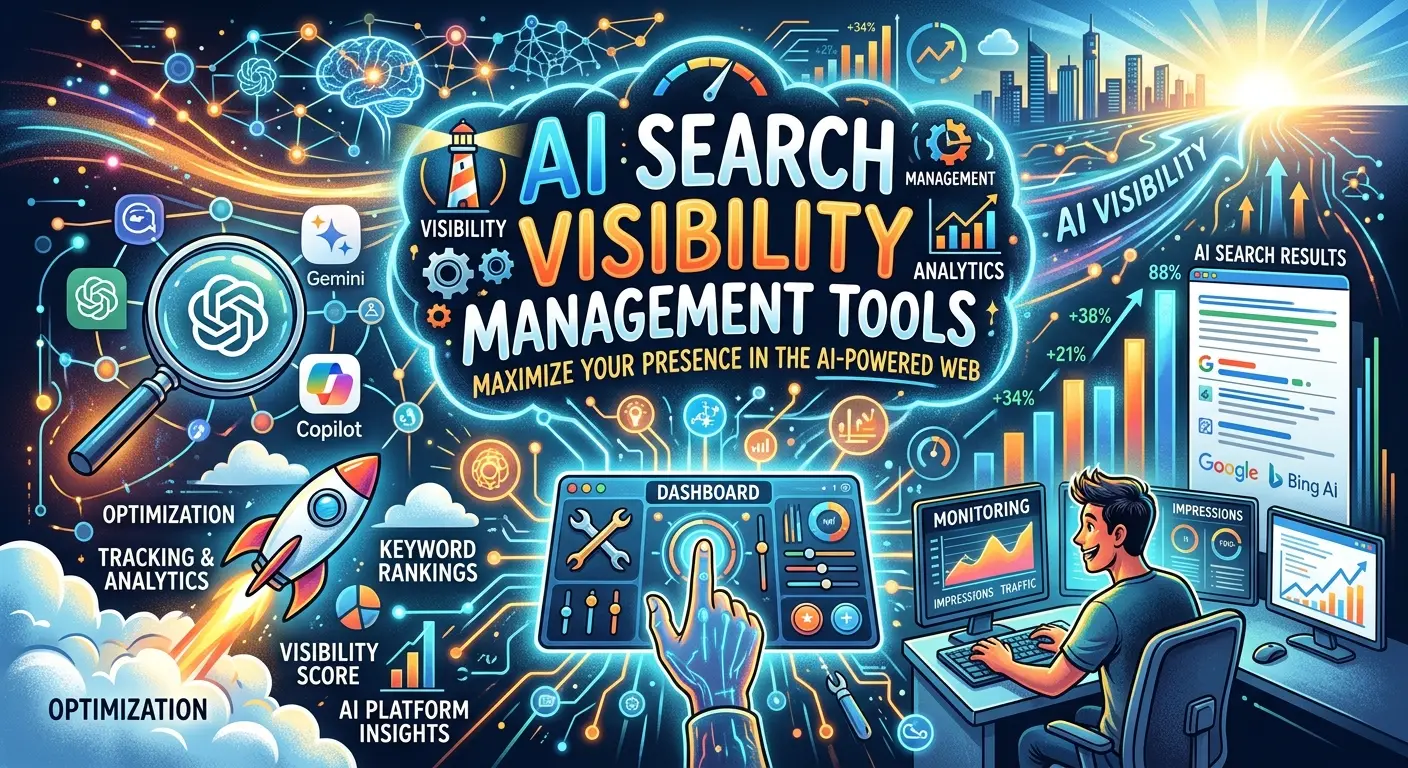
AI search visibility management tools help businesses understand, improve, and manage how their brands appear across AI-powered search experiences. Traditional SEO focuses on rankings, keywords, backlinks, and organic traffic. AI visibility management adds a newer layer: understanding whether systems such as ChatGPT, Google AI experiences, Microsoft Copilot, Perplexity, and other answer engines mention, recommend, or cite a brand when users ask relevant questions.
These tools can track brand mentions, citations, competitors, prompts, sentiment, share of voice, and visibility trends. They can also help marketers identify content gaps and opportunities to strengthen their digital presence. As search becomes more conversational and answer-focused, AI visibility is becoming an important part of modern SEO strategy. This guide explains how these tools work, their benefits, features, pricing considerations, use cases, limitations, and future role in digital marketing.
What Are AI Search Visibility Management Tools?
AI search visibility management tools are software platforms that help businesses monitor, analyze, and improve their presence in AI-generated search results. They are designed for a world where people increasingly ask complete questions instead of entering short keywords into a traditional search box.
For example, a customer might ask an AI search engine, “What are the best email marketing platforms for a small business?” A visibility management platform can help a company determine whether its brand appears in the answer, which competitors receive recommendations, and what websites or sources influence the response.
The difference between monitoring and management is important. A basic monitoring tool may simply tell you that your brand appeared. A broader management platform can connect that information to content strategy, competitor research, SEO workflows, reputation management, and optimization recommendations.
The goal is not to manipulate AI answers. Instead, businesses should use these insights to make their information clearer, more useful, accurate, authoritative, and easier for both people and AI systems to understand.
How Do AI Search Visibility Management Tools Work?
These platforms generally begin with a collection of prompts that represent real customer questions. Instead of tracking only traditional keywords, marketers create questions based on different stages of the buyer journey.
For example, a software company could monitor questions such as “best accounting software for freelancers,” “accounting software alternatives,” “how to choose accounting software,” and “best accounting tools for a growing company.”
The platform then evaluates AI-generated responses and records information such as brand mentions, competitors, citations, positioning, and visibility frequency. Some systems repeat these checks over time so marketers can identify changes.
A typical workflow looks like this:
- Identify important customer questions.
- Group prompts by topic and search intent.
- Monitor AI-generated responses.
- Track brand and competitor mentions.
- Analyze cited websites and sources.
- Identify missing or inaccurate information.
- Improve relevant content and digital assets.
- Continue measuring visibility.
The exact technology differs between providers, and AI answers can change from one query or time period to another. Therefore, these tools should be treated as strategic measurement systems rather than perfect ranking trackers.
Why AI Search Visibility Matters for Modern SEO
Traditional search optimization remains important, but the search journey is becoming more conversational.
A user might no longer search for “best CRM software.” Instead, they could ask an AI assistant to recommend a CRM for a specific company size, budget, industry, and workflow. The system may then produce a summarized answer containing several recommendations.
That creates a different visibility challenge.
A company can rank well for traditional keywords but still receive little exposure in AI-generated answers. Another company might have fewer traditional rankings but receive frequent recommendations because AI systems encounter useful information about it across trusted sources.
AI search visibility management tools help marketers measure this new layer of discovery.
They can reveal where a company appears, where it does not appear, which competitors are mentioned, and which sources influence AI-generated responses.
For SEO professionals, this information can complement keyword research, backlink analysis, technical SEO, content audits, and organic traffic reporting.
Key Features of AI Search Visibility Management Platforms
The feature set varies between platforms, but several capabilities are particularly valuable.
Prompt tracking allows marketers to create groups of questions representing different customer needs. A well-designed prompt library can cover informational, commercial, transactional, navigational, local, and comparison intent.
Brand monitoring tracks how frequently a business, product, executive, or other entity appears in AI-generated answers.
Competitor monitoring shows which competing businesses appear for the same questions.
Citation analysis identifies websites, articles, documentation, reviews, or other sources that AI systems reference.
Share-of-voice reporting helps estimate how prominently a company appears compared with competitors across a selected prompt set.
Sentiment analysis can help identify whether AI systems describe a brand positively, negatively, or neutrally.
Historical reporting allows teams to compare visibility over time.
More advanced platforms may offer content recommendations, citation-gap analysis, automated alerts, reporting, APIs, team collaboration, and integrations with existing SEO or marketing systems.
The most useful features are those that help answer practical questions rather than simply adding more metrics.
Benefits of AI Search Visibility Management Tools
The first major benefit is visibility measurement. Businesses cannot improve an area effectively if they cannot determine their current performance.
These tools also help identify competitive opportunities. Suppose a company appears in only 10% of relevant AI answers while its competitors appear much more frequently. That information creates a starting point for research.
Citation analysis provides another advantage. If AI systems repeatedly cite industry publications, review websites, documentation pages, or expert resources, marketers can investigate what makes those sources useful.
AI visibility management can also support content planning. If important customer questions consistently produce answers that do not mention the company, marketers can examine whether their website provides enough useful information on those subjects.
Another benefit involves brand accuracy. AI systems may occasionally describe products or businesses using outdated or incomplete information. Monitoring can alert teams to these patterns so they can strengthen authoritative sources and correct important public information.
For agencies, these platforms can also make AI visibility easier to communicate to clients through recurring reports and trend analysis.
AI Search Visibility Use Cases for Businesses
AI visibility management has applications across many industries.
SaaS and technology companies
Software companies can monitor product recommendations, alternatives, comparison queries, integrations, pricing questions, and category searches.
E-commerce brands
Retail businesses can track product recommendations and questions such as “best products for beginners” or “best alternatives to [product category].”
Marketing agencies
Agencies can use AI visibility data to develop client strategies, identify competitor gaps, and demonstrate progress.
Local businesses
Local companies can monitor questions that include locations, services, and customer needs. For example, a local service provider may want to know whether AI systems recommend it when users ask for providers in its area.
Publishers and media organizations
Publishers can track whether AI systems cite their articles and which topics generate the strongest visibility.
Professional services
Law firms, consultants, financial businesses, and other professional organizations can monitor questions related to expertise, services, and industry problems.
The strongest use case usually starts with real customer questions, not arbitrary prompts created simply to increase the number of monitored queries.
Free vs Paid AI Search Visibility Management Tools

Businesses can begin with free or low-cost methods. For example, a small company can manually test important customer questions across available AI search systems and record the results.
This approach is useful for learning. It also helps a team understand what it actually wants to monitor before purchasing software.
However, manual tracking becomes difficult as the number of prompts, competitors, regions, and AI platforms increases.
Paid platforms typically provide automation, historical data, larger prompt sets, competitor tracking, citation analysis, reporting, alerts, and collaboration features.
Free options may work well for freelancers, beginners, and small websites. Paid platforms become more attractive when AI visibility becomes a recurring part of a company’s SEO and marketing operations.
Before selecting a paid platform, check its prompt limits, supported AI environments, update frequency, reporting capabilities, and data retention policies.
A useful principle is simple: pay for actionable intelligence, not just more dashboards.
AI Search Visibility Pricing and ROI
AI search visibility software can use different pricing structures. Some platforms charge monthly subscriptions, while others base pricing on projects, tracked prompts, users, monitoring frequency, or other usage limits.
Instead of comparing prices alone, businesses should evaluate potential return on investment.
For example, an agency might use AI visibility data to discover that several clients are rarely mentioned for important commercial questions. If the resulting content strategy improves visibility and contributes to new leads, the tool can create measurable value.
Important metrics can include:
- AI brand mention frequency
- AI share of voice
- Competitor visibility
- Citation frequency
- Number of tracked prompts
- Visibility by topic
- Visibility by search intent
- Brand sentiment
- AI-influenced website visits
- Leads associated with AI discovery
- Conversions influenced by AI-generated recommendations
Not every AI interaction produces a website click. A user may ask an AI system about several companies, remember one brand, and visit it later through another channel.
For that reason, AI visibility should be evaluated alongside brand awareness, direct traffic, organic search, referral data, and conversions.
AI Visibility Management vs Traditional SEO Tools
AI visibility management and traditional SEO are closely related, but they measure different things.
Traditional SEO platforms commonly focus on keyword rankings, search volume, backlinks, organic traffic, technical errors, content performance, and domain authority signals.
AI visibility platforms focus on questions such as:
- Does an AI system mention my brand?
- Which competitors appear?
- What sources does the AI cite?
- How does the AI describe my product?
- Which customer questions produce the strongest visibility?
- Where are competitors visible but my company is absent?
This does not mean traditional SEO has become irrelevant.
Search engines still crawl websites, evaluate content, and provide links. AI systems also rely on information from websites and other sources. Strong technical SEO and high-quality content can therefore contribute to broader digital visibility.
The better approach is to combine both disciplines.
Traditional SEO helps build discoverable web content. AI visibility management helps measure how that information appears within AI-driven discovery experiences.
How to Choose the Best AI Search Visibility Management Tool
Start with your business objective.
If you primarily want to monitor brand mentions, choose a platform with strong prompt and brand tracking. If competitive intelligence is important, prioritize competitor comparisons. If content strategy is your goal, look closely at citation and content-gap features.
Next, check AI coverage. Different tools may monitor different AI search experiences, so confirm that the platforms relevant to your audience are included.
Prompt flexibility is another important factor. You should be able to create questions that reflect real customer language, not only keyword-based queries.
Look closely at citation reporting. Knowing that your brand appeared is useful, but knowing which sources influenced the answer can provide deeper strategic value.
Also examine reporting and integrations. Agencies may need client-ready reports, while internal marketing teams may need APIs, analytics connections, or integrations with SEO platforms.
Finally, test the tool using real business questions. A polished interface does not guarantee useful data.
How to Build an Effective AI Search Visibility Strategy
A strong strategy begins with a prompt library.
Divide customer questions into categories such as informational, commercial, transactional, comparison, problem-solving, branded, non-branded, and local queries.
Then organize prompts around important topics and products. For example, a cybersecurity company could monitor questions about endpoint protection, small-business security, ransomware prevention, compliance, and cybersecurity software comparisons.
After creating the prompt set, establish a baseline. Record how frequently the brand appears and which competitors dominate the responses.
Next, study citations.
If AI systems repeatedly cite sources that your company does not appear in, investigate those sources. They may represent opportunities for public relations, partnerships, expert contributions, reviews, or stronger informational content.
Then improve your own website and digital presence.
Create clear, original, authoritative, helpful content that directly answers customer questions. Keep product information accurate. Build strong supporting documentation. Demonstrate expertise where appropriate.
Finally, continue monitoring after making changes. AI visibility can change over time, so a one-time audit is less useful than a consistent measurement process.
Common Mistakes in AI Search Visibility Management
One common mistake is tracking only branded prompts.
If users already know your company, brand visibility may look strong. However, non-branded discovery can remain weak. A good strategy therefore includes questions where customers are searching for a solution rather than a specific company.
Another mistake is tracking too few prompts. One question cannot represent an entire market.
Marketers should also avoid assuming that one AI answer represents a permanent result. Generative systems can change responses depending on context, query wording, data, and system updates.
Another problem is confusing AI visibility with guaranteed rankings. There is no universal formula that guarantees a brand will appear in a particular AI answer.
Businesses should also avoid publishing large amounts of low-quality content simply to increase the chances of being mentioned. Quantity without usefulness can damage credibility.
Finally, do not optimize exclusively for AI systems. Human readers remain the ultimate audience. Content should provide genuine value first.
Latest Trends in AI Search Visibility Management
One major trend is the movement from simple monitoring toward AI visibility intelligence.
Early approaches focused mainly on whether a company appeared in an AI answer. Modern strategies increasingly examine context, competitors, citations, sentiment, product positioning, and topic-level visibility.
Another trend is integration with traditional SEO. Marketing teams increasingly want to connect AI visibility data with keyword performance, content analytics, backlinks, technical SEO, and brand monitoring.
Automation is also becoming more important. Instead of manually checking the same prompts every week, businesses can use scheduled monitoring and alerts to identify meaningful changes.
Another developing area is AI referral measurement. Marketers are exploring ways to determine whether AI-generated recommendations contribute to website visits, leads, and sales.
Prompt segmentation is also becoming more sophisticated. Companies can organize prompts by funnel stage, customer persona, product, geography, industry, or intent.
The result is a more detailed view of how customers discover brands in an increasingly AI-driven search environment.
Future of AI Search Visibility Management
AI search will likely become more conversational, personalized, multimodal, and action-oriented.
Users may increasingly ask AI systems to research a problem, compare solutions, evaluate evidence, and recommend the best option for their specific situation.
That means businesses will need more than keyword optimization.
They will need clear entity information, trustworthy content, strong brand reputation, expert resources, accurate product data, customer evidence, useful documentation, and consistent information across the web.
AI visibility platforms will likely evolve alongside these changes. Future systems may connect traditional SEO data with AI search monitoring, reputation intelligence, content recommendations, competitive analysis, and conversion analytics.
Automation may also become more sophisticated. Instead of simply reporting that a competitor gained visibility, an AI-powered platform could explain the likely reasons, identify relevant content differences, and suggest practical actions.
However, marketers should remain careful about treating automated recommendations as guaranteed solutions. AI search is constantly changing, and visibility depends on multiple factors.
The long-term strategy should therefore focus on building real authority and useful information, while using AI visibility management tools to measure how effectively that authority reaches modern search audiences.
Conclusion
AI search visibility management tools are becoming an important addition to the modern SEO toolkit. They help businesses understand how AI-powered search systems represent their brands, products, services, and expertise.
Unlike traditional rank trackers, these platforms can analyze AI mentions, citations, competitors, prompts, sentiment, share of voice, and visibility trends. This information gives marketers a clearer view of a search environment where users increasingly receive direct answers instead of traditional lists of links.
The most effective strategy is not to chase individual AI responses. Instead, businesses should use visibility data to identify gaps, improve content, strengthen authoritative information, understand competitors, and provide better answers to real customer questions.
Free approaches can provide a useful starting point, while paid platforms can automate large-scale monitoring and reporting. The right choice depends on business size, prompt volume, AI coverage, integrations, and strategic goals.
As AI search continues to evolve, visibility management will become less about ranking for individual keywords and more about becoming a trusted, recognizable, and useful source of information. Businesses that combine strong SEO fundamentals with AI visibility intelligence will be better positioned to adapt to the changing search landscape in 2026 and beyond.
Frequently Asked Questions
What are AI search visibility management tools?
AI search visibility management tools help businesses monitor, analyze, and improve their presence in AI-generated search answers. They can track brand mentions, competitors, citations, prompts, sentiment, and visibility trends.
Why is AI search visibility important?
AI systems increasingly influence how people discover information, products, and services. Strong AI visibility can help a brand become part of the consideration process when customers ask relevant questions.
Are AI visibility tools different from SEO tools?
Yes. Traditional SEO tools focus heavily on rankings, keywords, backlinks, technical SEO, and organic traffic. AI visibility tools focus on how brands appear within AI-generated answers and recommendations.
Can AI visibility tools improve rankings?
They do not directly guarantee higher rankings. However, their insights can help marketers discover content gaps, competitor strategies, citation opportunities, and customer questions that can inform broader SEO improvements.
What should I monitor with an AI visibility platform?
Monitor brand mentions, competitor mentions, citations, share of voice, sentiment, product descriptions, important prompts, and visibility changes over time.
Are free AI search visibility tools available?
Yes. Businesses can manually monitor a limited number of customer questions using available AI search platforms. Some specialized services may also provide trials or limited free plans.
How often should AI search visibility be monitored?
It depends on the business. Competitive industries may benefit from frequent automated monitoring, while smaller businesses can begin with weekly or monthly reviews. Consistent tracking is more useful than occasional checks.
What is AI share of voice?
AI share of voice measures how prominently a brand appears compared with competitors across a defined group of AI search prompts. The exact calculation differs between platforms.
Can AI visibility management replace traditional SEO?
No. Traditional SEO remains important for website discovery and organic search performance. AI visibility management should complement SEO rather than replace it.
How can a website improve its AI search visibility?
Create accurate, original, useful content that answers real customer questions. Maintain consistent business information, demonstrate expertise, strengthen relevant digital authority, and make important product information easy to understand.
Does getting cited by AI mean my website will receive traffic?
Not necessarily. An AI system can mention or cite a source without producing a traditional website visit. AI visibility should therefore be measured alongside referrals, brand awareness, leads, and conversions.
What is the future of AI search visibility management?
The future will likely include more automated monitoring, deeper competitor analysis, AI citation intelligence, multimodal search tracking, integrated SEO analytics, and stronger connections between AI visibility and business outcomes.