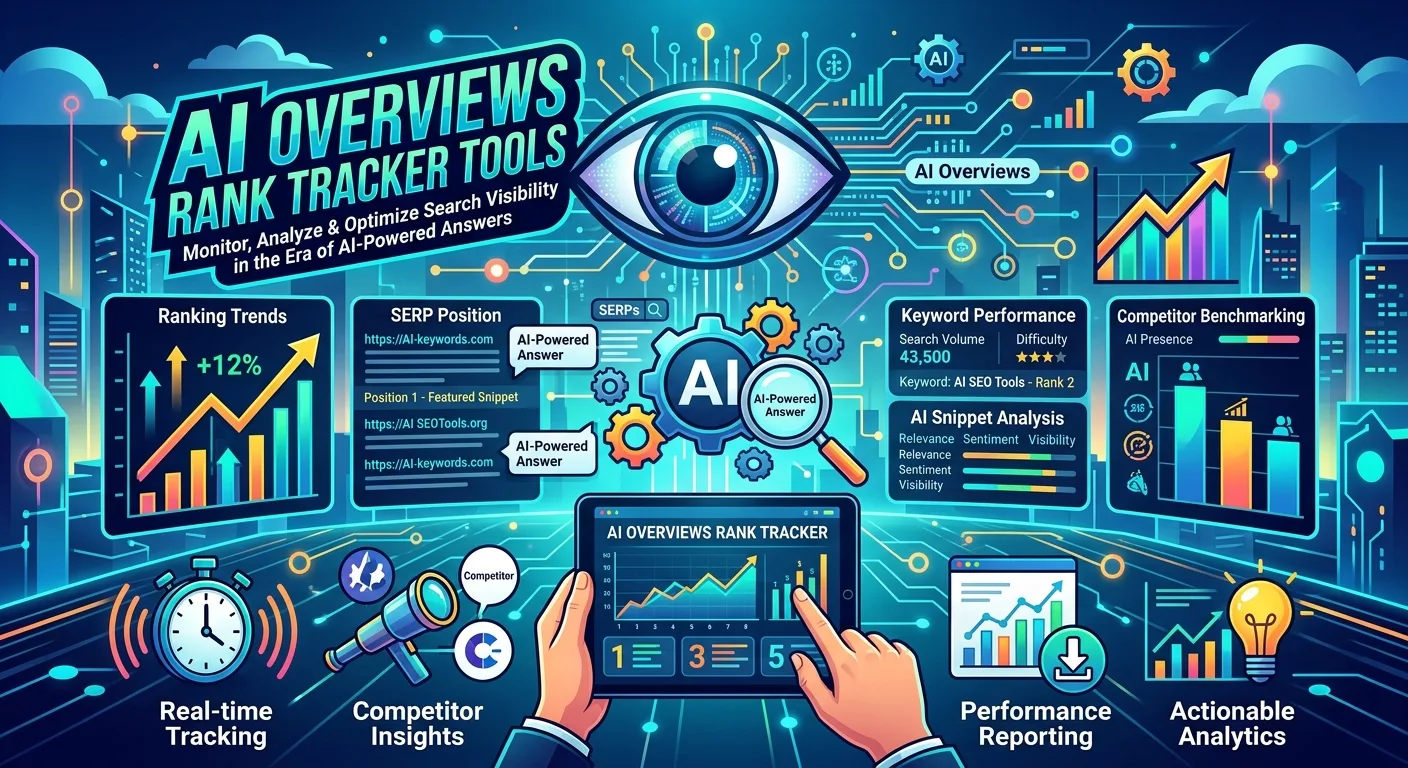
Google Search is changing quickly. Traditional rankings still matter, but search visibility now includes AI Overviews, AI Mode, featured snippets, citations, and other AI-powered search features. This shift has created a new need for reliable AI Overviews rank tracker tools that can show when your website appears in Google’s AI-generated answers and when competitors take that visibility.
AI Overview tracking tools help SEO professionals move beyond simple keyword positions. They can reveal which queries trigger AI Overviews, whether your domain is cited, which pages receive visibility, and how your presence changes over time. Some platforms also connect AI search data with traditional SEO metrics, making it easier to turn insights into practical actions.
For businesses, publishers, agencies, and freelancers, these tools can improve productivity, efficiency, automation, creativity, and decision-making. Instead of manually checking hundreds of searches, marketers can monitor important queries and identify opportunities at scale.
What Are AI Overviews Rank Tracker Tools?
AI Overviews rank tracker tools are SEO platforms or specialized monitoring systems that track a website’s visibility within Google’s AI-generated search summaries. They help determine whether an AI Overview appears for a target query and whether a website or page is included as a cited source.
Traditional rank trackers normally answer questions such as, “Is my page ranking in position three?” AI Overview tracking asks a different question: “Is my website being referenced inside the AI-generated answer?” This distinction matters because an AI Overview can appear above traditional organic listings and can change how users interact with search results.
Google’s current Search Console documentation confirms that AI Overviews contain links to supporting web resources. Google also explains that links inside an AI Overview are counted within Search Console’s performance system, while the AI Overview itself occupies a single search-result position.
Modern tools therefore combine conventional ranking information with AI visibility signals. Depending on the platform, you may see AI Overview triggers, cited domains, cited pages, competitor appearances, keyword groups, visibility trends, and other search features.
How Do AI Overview Rank Tracking Tools Work?
Most AI Overview rank trackers begin with a keyword or query set. You provide important keywords, topics, or questions related to your website. The platform then monitors those searches and determines whether Google displays an AI Overview.
When an AI Overview appears, the tool analyzes the result to determine which sources Google references. Some platforms identify your domain, specific URLs, competitors, and other cited websites. This creates a visibility layer that traditional position tracking alone cannot provide.
For example, imagine a website targeting the query “best AI SEO tools for small businesses.” Your page may rank on the first page organically but not appear inside the AI Overview. A tracker can identify this difference.
The next step is historical monitoring. AI-generated answers can change, so checking a query once does not provide a complete picture. Ahrefs states that its research found AI Overviews can change substantially between observations, which is one reason ongoing tracking is more useful than occasional manual checks.
The best workflow is therefore simple:
Track → compare → identify gaps → improve content → monitor again.
This creates a repeatable SEO process instead of relying on random searches.
Key Features to Look for in AI Overviews Rank Tracker Tools
A useful AI Overview tracker should offer more than a simple “mentioned/not mentioned” indicator. The strongest platforms provide multiple layers of visibility data.
AI Overview detection is one of the most important features. The tool should tell you which tracked queries generate AI Overviews and which do not.
Citation tracking is equally important. Knowing that an AI Overview exists is helpful, but knowing whether Google cites your page gives you a much clearer picture of visibility.
Competitor monitoring can reveal which competing websites appear in AI answers while your site does not. This creates useful content research opportunities.
Historical tracking allows you to identify trends. You can see whether your visibility is increasing, declining, or fluctuating.
Location and device tracking can also matter. Search results can differ by country, language, device, and search context.
Other useful features include:
- Keyword grouping
- Topic segmentation
- SERP feature monitoring
- URL-level reporting
- Competitor comparison
- Scheduled reports
- Data exports
- Search Console integration
- Google Analytics integration
- API access
- Custom prompts
- AI visibility dashboards
Semrush, for example, currently describes Position Tracking as capable of monitoring AI Overviews alongside traditional rankings, locations, devices, and competitors.
The right feature set depends on whether you are managing one website, several client websites, or a large SEO operation.
Why AI Overview Tracking Matters for SEO
AI search changes the meaning of search visibility. A website can rank well organically but still have limited exposure within an AI-generated answer.
Consider a searcher asking a detailed question. Google may provide an AI Overview containing a short explanation and links to several sources. A user may interact with those sources differently from a conventional list of blue links.
That makes AI citation visibility an increasingly important SEO metric.
Google’s 2026 Search Console documentation now describes a dedicated Generative AI performance report covering AI Overviews and AI Mode. The report can show generative-AI impressions over time, pages receiving those impressions, and dimensions such as device and country.
This is particularly useful because SEO teams can combine first-party Search Console information with third-party tracking tools.
The goal should not be to chase an AI feature simply because it exists. Instead, use AI Overview tracking to answer practical questions:
- Which topics generate AI answers?
- Where is my website already cited?
- Which important queries do competitors dominate?
- Which pages have strong organic rankings but weak AI visibility?
- Which topics deserve better coverage?
- Are visibility changes affecting organic performance?
These questions turn AI tracking into a business-focused SEO activity.
Important Metrics to Monitor in AI Overview Tracking
The first metric to monitor is AI Overview presence. This tells you how often your tracked keywords trigger Google’s AI-generated feature.
Next, monitor citation presence. A query can trigger an AI Overview without including your website. That difference is important when analyzing content opportunities.
Another useful metric is AI visibility or share of voice. Different tools calculate this differently, so you should always understand the methodology before comparing scores between platforms.
Ahrefs specifically warns that some AI visibility metrics are modeled signals rather than direct measurements of audience reach.
You should also monitor cited URLs. If one page repeatedly receives citations, investigate why it performs well. It may provide clear definitions, direct answers, original research, strong evidence, or comprehensive topical coverage.
Competitor citations can provide another useful signal. If competitors repeatedly appear for questions related to your target topic, examine the information they provide and identify genuine gaps in your own content.
Finally, connect AI visibility with traditional metrics such as:
Organic impressions + clicks + rankings + conversions + AI visibility = broader search performance context.
No single metric tells the entire story.
Best Use Cases for AI Overviews Rank Tracking Tools
These tools can support many SEO workflows. For content marketers, they can reveal which articles have opportunities to gain AI citations.
For SEO agencies, tracking can help create recurring client reports. Instead of saying that rankings improved, an agency can show changes across traditional rankings and AI search visibility.
For freelancers, AI Overview tracking can become part of a content optimization service. A freelancer might monitor a client’s most valuable 50 or 100 queries and provide monthly recommendations.
For ecommerce websites, tracking can identify product-category questions and buying-intent searches where competitors appear in AI-generated answers.
For publishers, the data can highlight informational topics where their articles are already being cited or where stronger topical coverage may be needed.
For example, a technology website might track:
- Best AI writing tools
- AI SEO software
- AI productivity tools
- AI tools for students
- AI tools for small businesses
- AI marketing software
Instead of checking these searches manually every day, a tracking platform can create a repeatable monitoring system.
This is where automation creates real productivity gains. The marketer spends less time collecting information and more time interpreting it.
How to Choose the Right AI Overviews Rank Tracker
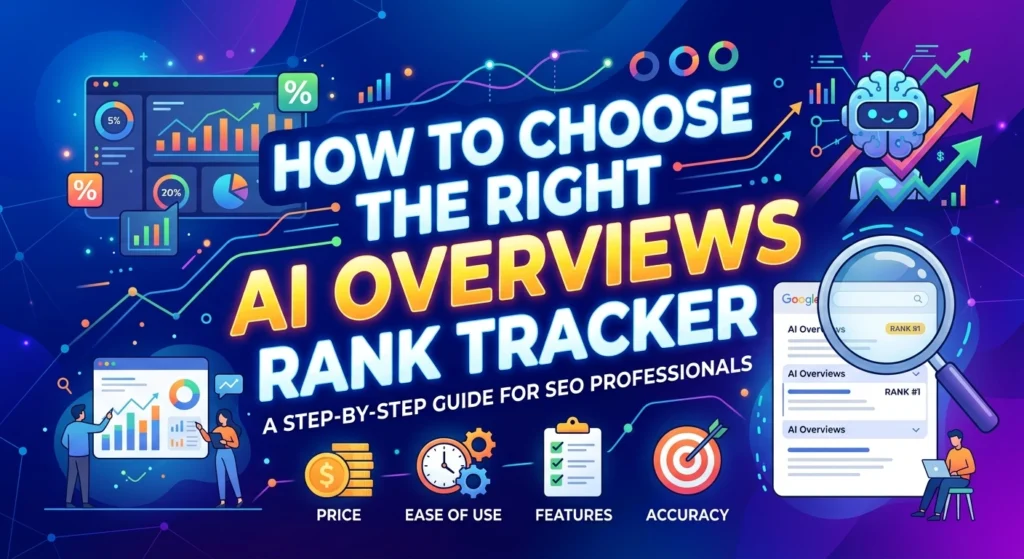
Start with your actual objective. If you only want to monitor a small collection of important Google queries, you may not need an enterprise platform.
If you manage hundreds or thousands of keywords, look for stronger automation, historical data, segmentation, reporting, and API capabilities.
Data freshness should be another major consideration. AI-generated results can change, so stale information can lead to poor decisions.
Check whether the tool tracks:
- AI Overview appearances
- Your domain citations
- Specific cited URLs
- Competitor citations
- Historical changes
- Geographic variations
- Mobile and desktop results
- Custom keywords
- Custom prompts
- Traditional rankings
Also investigate how the provider collects its data. Different tools may use different databases, sampling methods, search environments, or refresh schedules.
For example, Ahrefs describes both keyword-based and prompt-based indexes for AI Overview research, while Semrush describes daily tracking for selected keywords and prompts.
Do not choose a tool only because it displays a large AI visibility score. Understand what that score actually measures.
Free vs Paid AI Overview Tracking Tools
Free tools can be useful for beginners and small websites. They may provide limited AI Overview checks, visibility snapshots, or basic reporting.
Google Search Console has become more important because Google now provides a generative AI performance report for eligible websites. This gives site owners first-party information about impressions from AI Overviews and AI Mode.
However, first-party reporting and dedicated rank tracking solve different problems.
Search Console focuses on your website’s performance, while third-party tools can provide additional competitive and keyword-level context.
Paid platforms generally offer more advanced monitoring. Depending on the product and plan, you may get competitor tracking, daily updates, larger keyword limits, historical data, automated reporting, custom prompts, and integrations.
Ahrefs currently offers a free limited AI Overview visibility report and paid Brand Radar capabilities with broader tracking.
The best approach for a small website is often to start with free or low-cost data sources. Upgrade when the additional data saves enough time or improves decisions enough to justify the cost.
Pricing and Value Considerations
Pricing varies significantly because AI search monitoring can be part of a larger SEO platform rather than a standalone product.
Some tools bundle AI Overview tracking into traditional rank-tracking plans. Others offer AI visibility as a separate module or premium feature.
When comparing pricing, calculate cost per useful insight, not simply the monthly subscription price.
For example, suppose a tool costs more but saves several hours every week by automatically monitoring hundreds of keywords and generating reports. That may provide more practical value than a cheaper tool that requires manual checking.
Before paying, evaluate:
Keyword limits: How many queries can you track?
Refresh frequency: How often does the system update?
Competitor limits: How many competing domains can you monitor?
Historical data: How far back can you analyze trends?
Location coverage: Can you track the markets you target?
Reporting: Can you export or automate reports?
Integrations: Can the data connect with your existing SEO workflow?
Also check whether AI Overview tracking is included in the base subscription or requires an additional package.
Pricing pages and product limits can change, so always verify current plan details directly with the provider before purchasing.
Integrations With SEO and Analytics Platforms
Integrations make AI Overview tracking much more useful because visibility data becomes part of a larger SEO workflow.
Google Search Console is especially important. It provides first-party search performance information, while a third-party tracker can add competitive and feature-level context.
Google Analytics can help connect search visibility with user behavior and conversions. This helps answer an important question: does increased search visibility actually contribute to business results?
Other useful integrations can include SEO auditing platforms, content optimization systems, reporting dashboards, spreadsheets, APIs, and project-management tools.
Semrush, for example, describes reporting workflows that can combine Position Tracking with Google Analytics 4 and Google Search Console.
A simple workflow could look like this:
Keyword research → AI Overview tracking → content optimization → Search Console monitoring → Analytics measurement → monthly reporting.
This creates a more complete SEO system.
AI Overviews vs Traditional Rank Tracking
Traditional rank tracking focuses mainly on where a page appears in the organic search results.
AI Overview tracking focuses more on whether and how a website appears inside Google’s AI-generated answer.
These are related but different measurements.
A page can rank number one organically and still not be cited inside an AI Overview. Another page might rank lower traditionally but become a cited source because its content directly answers a particular question.
This is why SEO teams should avoid replacing traditional rank tracking with AI tracking.
Instead, combine both.
Traditional rankings still help measure organic visibility. AI Overview monitoring adds another layer that helps explain how search experiences are changing.
Google itself distinguishes AI Overviews from AI Mode. AI Overviews appear within standard Google Search results, while AI Mode provides a more interactive AI search experience. Search Console currently includes both in its generative AI performance reporting.
For 2026 and beyond, a broader search visibility strategy is likely to be more useful than focusing on one ranking number.
Best Practices for Improving AI Overview Visibility
Tracking alone does not improve visibility. You need to turn the data into content and SEO actions.
Start by identifying keywords where you already rank well but do not receive AI Overview citations. These are often useful opportunities because your page already demonstrates relevance in traditional search.
Next, make important answers easy to find. Put direct answers near the beginning of relevant sections. Use descriptive headings and organize supporting details logically.
Build topic clusters instead of creating isolated articles. A website that comprehensively covers a subject can provide more useful contextual information across related searches.
Support important claims with credible sources, original information, examples, data, and clear explanations. Strong content should help readers first rather than being written only to manipulate a search feature.
Keep important pages updated. AI search systems and search results change frequently, so outdated information can become less useful.
Also strengthen your overall website authority through legitimate digital PR, useful resources, relevant mentions, strong internal linking, and high-quality content.
Ahrefs’ research highlights factors such as direct answers, fresh content, long-tail topic coverage, and broader web mentions when studying AI Overview visibility. These should be treated as evidence-informed SEO considerations rather than guaranteed ranking formulas.
Common AI Overview Tracking Mistakes to Avoid
One common mistake is checking only traditional rankings. A first-page ranking does not automatically mean strong AI Overview visibility.
Another mistake is treating every AI visibility score as an exact measurement of traffic. Many tools calculate modeled visibility metrics, so you should understand their methodology before using them for business decisions.
Do not check one query once and assume the result is permanent. AI-generated answers can change, sometimes significantly.
Avoid tracking too many irrelevant keywords. A massive keyword list can create noise instead of useful insight. Start with queries connected to your products, services, audience, and business goals.
Another mistake is copying competitors without understanding search intent. If a competitor gets cited, study the useful information they provide rather than simply reproducing their structure.
Finally, do not optimize exclusively for AI summaries. Human readers remain the most important audience. Content should be accurate, useful, trustworthy, accessible, and genuinely valuable.
The best AI Overview strategy strengthens the underlying quality of your website instead of relying on shortcuts.
Latest AI Overview Tracking Trends for 2026 and Beyond

AI search measurement is moving from simple rank checking toward broader visibility intelligence.
One major trend is the combination of traditional SEO and AI visibility in one dashboard. Modern platforms increasingly monitor organic rankings, AI Overviews, AI Mode, and other AI platforms together.
Semrush currently describes tracking across Google Search, AI Overviews, AI Mode, ChatGPT, Gemini, and other AI environments, showing how SEO measurement is expanding beyond conventional search results.
Another trend is prompt-level tracking. Instead of monitoring only short keywords, platforms increasingly track complete questions and natural-language searches.
Competitor benchmarking is also becoming more sophisticated. SEO teams can investigate not only which competitor ranks higher but which competitor becomes a source inside an AI answer.
Google’s own reporting is also evolving. As of August 31, 2026, Google says its generative AI performance report has rolled out worldwide, giving website owners visibility into impressions from AI Overviews and AI Mode.
Google has also introduced a Search generative AI control that allows site owners to manage inclusion in certain generative AI features, including AI Overviews and AI Mode.
Looking ahead, successful SEO measurement will likely combine organic rankings, AI citations, search demand, brand visibility, user behavior, and conversions.
The important lesson is simple: AI search should be measured as part of the complete search journey, not as an isolated ranking number.
Frequently Asked Questions About AI Overviews Rank Tracker Tools
What are AI Overviews rank tracker tools?
AI Overviews rank tracker tools monitor how websites appear within Google’s AI-generated search summaries. They can identify AI Overview triggers, citations, URLs, competitors, and visibility changes.
Can Google Search Console track AI Overviews?
Yes. Google’s current Search Console documentation says its generative AI performance report includes AI Overviews and AI Mode data for websites with sufficient data.
Are AI Overview rankings the same as Google organic rankings?
No. Traditional rankings measure positions in Google’s conventional search results. AI Overview tracking measures visibility within the AI-generated answer and its cited sources.
Why should I track AI Overviews?
AI Overviews can change how users interact with search results. Tracking them helps you understand whether important queries generate AI answers and whether your website is included as a source.
Are free AI Overview tracking tools available?
Yes. Some providers offer limited free reports or free features. Google Search Console also provides first-party generative AI performance information. The exact features and limits depend on the provider.
How often should AI Overviews be monitored?
For important commercial or strategic keywords, regular monitoring is more useful than occasional manual checks. Daily tracking can help reveal changes faster, while weekly or monthly analysis can provide a clearer strategic view.
Can AI Overview trackers monitor competitors?
Many dedicated SEO platforms can compare your visibility with competitors. The available competitor features and limits depend on the specific tool.
Should I stop traditional rank tracking because of AI Overviews?
No. Traditional rankings remain useful. AI Overview tracking should complement conventional SEO measurement rather than completely replace it.
Can AI Overview tracking improve SEO directly?
Tracking itself does not improve rankings or citations. Its value comes from identifying opportunities. You can use the findings to improve content quality, answer search intent more clearly, strengthen topical coverage, and monitor results.
What is the difference between AI Overviews and AI Mode?
AI Overviews are AI-generated summaries shown within Google Search results. AI Mode is a more conversational search experience. Google currently includes both in its generative AI performance reporting.
Conclusion
AI Overviews rank tracker tools are becoming an important part of modern SEO measurement. Search visibility is no longer limited to a page’s position among traditional organic results. Websites also need to understand how they appear in AI-generated answers, which pages receive citations, and how competitors perform across changing search experiences.
The most effective approach is not to chase an AI feature blindly. Start with your most valuable keywords and topics. Track AI Overview appearances and citations. Compare your visibility with competitors. Connect the findings with Search Console, analytics, rankings, and conversions.
Use the data to improve content rather than simply producing more content. Give readers direct answers, demonstrate expertise, maintain accurate information, organize topics clearly, and build genuine authority.
As Google’s AI search ecosystem continues to evolve, AI visibility tracking will increasingly work alongside traditional SEO instead of replacing it. Businesses that measure both sides of search can make more informed decisions and build a stronger, more adaptable organic search strategy for 2026 and beyond.