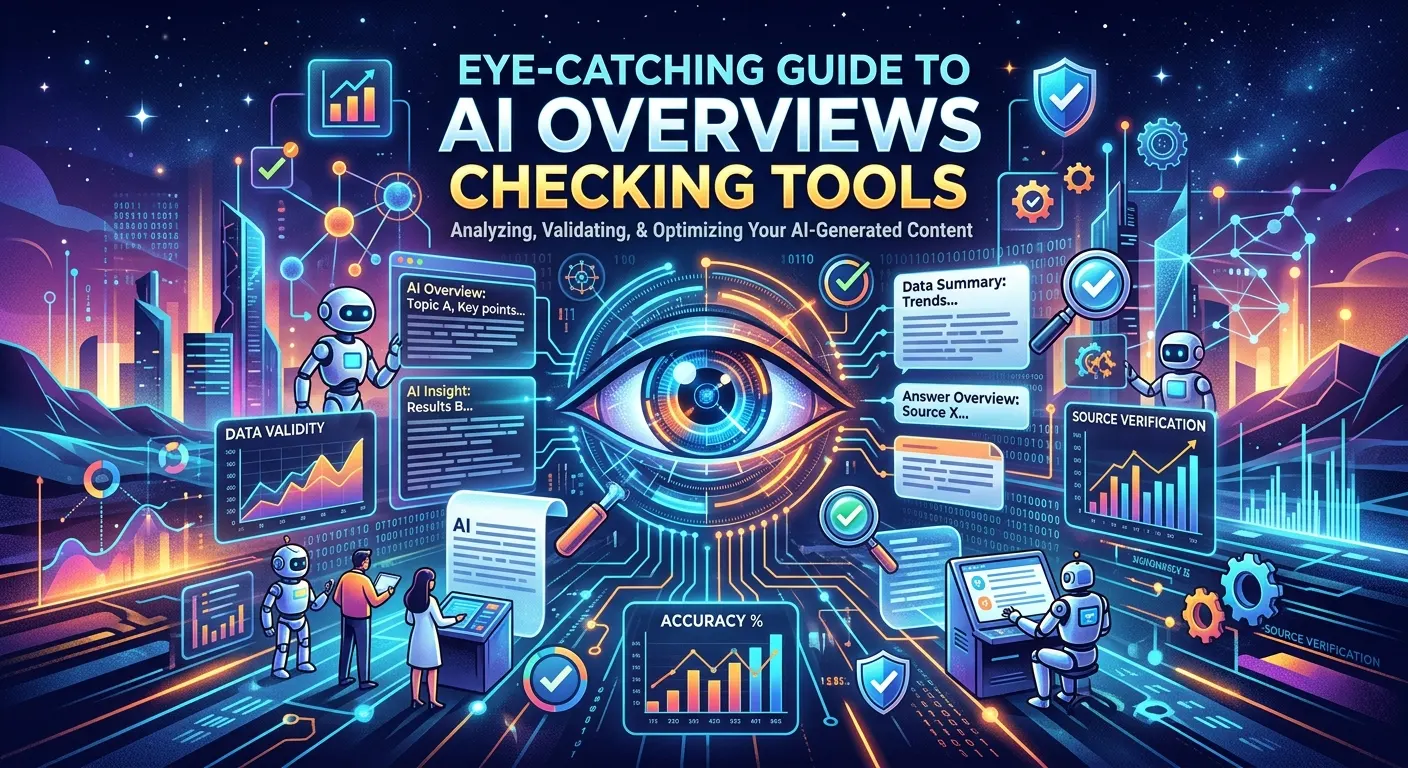
AI Overviews checking tools help marketers, SEO professionals, publishers, and businesses understand what appears in Google’s AI-generated search results. Instead of manually searching hundreds of queries, these tools can make it easier to monitor AI Overview presence, citations, sources, brand mentions, competitors, and visibility patterns.
This type of monitoring has become increasingly useful as search evolves beyond traditional blue-link rankings. A website may rank well organically but receive little visibility in an AI-generated answer, while another source may earn a citation despite having a different traditional ranking position.
The right checking workflow can improve productivity, efficiency, automation, creativity, and decision-making. Teams can identify important changes faster, discover content opportunities, and understand how search engines present information. For businesses investing in SEO during 2026 and beyond, AI Overview monitoring can provide valuable context for building content that is useful to both people and modern search systems.
What Are AI Overviews Checking Tools?
AI Overviews checking tools are software platforms or monitoring solutions that help users inspect and track Google AI Overview results for selected search queries. Their purpose is to make AI search visibility easier to observe at scale.
A basic checker may tell you whether an AI Overview appears for a query. More advanced platforms can analyze the sources shown in the generated answer, identify cited websites, track brand mentions, compare competitors, and store historical observations.
This is different from a conventional rank checker. Traditional SEO software usually focuses on where a webpage appears among organic results. AI Overview tools examine an additional search layer where information may be summarized before users interact with individual websites.
For example, a marketing team might monitor 200 commercial keywords. Instead of manually checking every search, an AI Overview tool can organize the results and highlight queries where the company’s website appears or where competitors receive citations.
How AI Overview Checking Tools Work
Most AI Overview checking tools begin with a collection of keywords or questions. The system checks those searches and determines whether an AI-generated overview appears.
When an AI Overview is present, the platform may collect information about its sources. Depending on the software, this can include cited domains, URLs, brand mentions, query categories, competitors, and historical changes.
A simplified workflow is:
Enter queries → check AI search results → identify sources → analyze visibility → compare historical data → optimize content.
Automation makes this process much faster than manual checking. A business can monitor important questions on a recurring schedule rather than asking an employee to search each phrase individually.
However, AI search results can change. Different searches may produce different answers, sources, or layouts. Therefore, repeated checks are generally more useful than relying on one search performed on one day.
Key Features of AI Overviews Checking Software
The most useful tools offer more than simple yes-or-no detection. Source and citation analysis can show which websites appear in an AI-generated response and which pages receive links.
Keyword organization is another important feature. Users should be able to group searches by product, service, topic, customer journey, or search intent. This makes large monitoring projects easier to manage.
Competitor tracking can provide additional context. If several competitors appear repeatedly for your target queries while your site rarely appears, that pattern may indicate an opportunity to investigate content quality, topical coverage, or authority.
Useful features may include:
- AI Overview detection
- Keyword monitoring
- Citation tracking
- Source URL identification
- Brand mention tracking
- Competitor monitoring
- Historical data
- Search intent organization
- Location-based tracking
- Automated reports
- Data exports
- API access
The right combination depends on your website size and monitoring goals.
Benefits of Using AI Overviews Checking Tools
The biggest benefit is faster visibility analysis. Manual searches can become difficult when a website targets hundreds or thousands of queries. Automated checking reduces repetitive work.
These tools can also reveal content opportunities. For example, suppose a competitor receives citations for several questions related to a product category. You can study those searches and determine whether your content fully addresses the underlying user needs.
Another benefit is better SEO reporting. AI visibility can be added as an additional data point alongside rankings, impressions, clicks, traffic, and conversions.
AI Overview checking can help with:
Content research: Discover topics and questions that appear in AI search.
Competitive analysis: Identify websites that frequently receive citations.
Brand monitoring: See when your business appears in AI-generated answers.
Content optimization: Find pages that may need clearer information or broader topical coverage.
SEO strategy: Understand how search behavior is changing.
The key is to use the data for decisions rather than simply collecting large numbers of observations.
AI Overviews Checking Tools for SEO and Content Teams
SEO teams can use AI Overview checkers to monitor priority queries across different topic groups. This can be particularly useful when a website publishes large amounts of informational or commercial content.
Content teams can use the results to identify questions that deserve better answers. If AI-generated results repeatedly reference particular concepts, organizations can ensure their own content covers those concepts accurately and comprehensively.
For example, a software company might track searches such as product comparisons, integration questions, pricing-related searches, and problem-solving queries. The team can then examine which pages appear in AI results and which competitors are cited.
Agencies can also use these tools for client reporting. Instead of saying only that organic rankings changed, an agency can explain how AI search visibility and citations changed for important topics.
This creates a more complete picture of modern search visibility.
AI Overviews Checking vs Traditional Google Search Monitoring
Traditional search monitoring focuses on conventional organic listings, advertisements, featured snippets, maps, and other established search elements. AI Overview checking focuses specifically on AI-generated summaries and their supporting sources.
These two approaches measure different things. A page can rank highly in conventional results but not receive a citation in an AI Overview. Another page may appear as a source in an AI-generated answer even if it does not hold the highest traditional ranking.
Traditional monitoring may focus on:
- Keyword positions
- Organic impressions
- Organic clicks
- Click-through rates
- Search traffic
- SERP features
AI Overview monitoring may focus on:
- AI Overview presence
- Citations
- Source URLs
- Brand mentions
- Competitor visibility
- Changes in AI-generated answers
For this reason, businesses should generally treat AI Overview checking as a complement to traditional SEO monitoring, not a complete replacement.
Free vs Paid AI Overviews Checking Tools
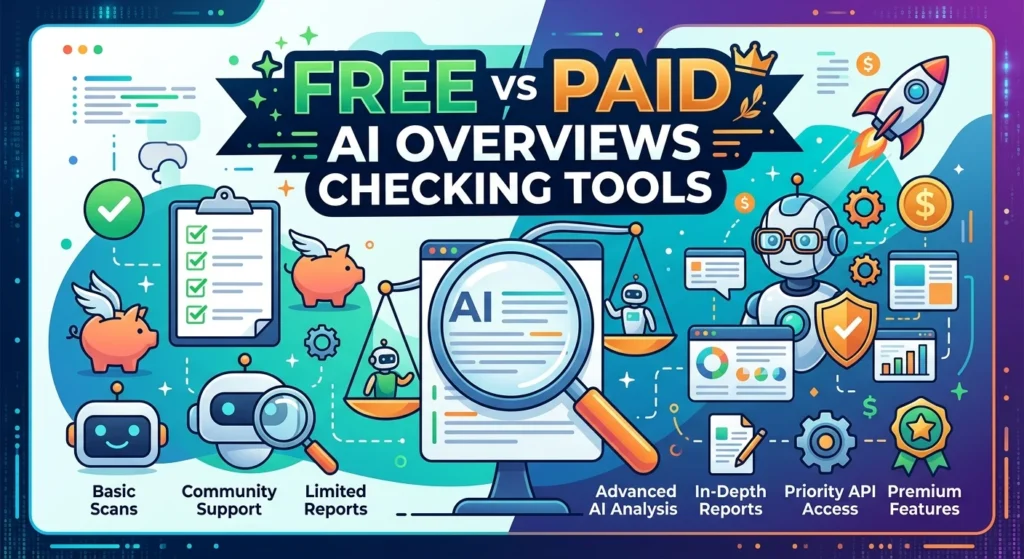
Free AI Overview checkers can be useful for beginners and small websites. They may allow users to test individual searches or monitor a limited number of keywords.
Paid platforms generally offer more automation and larger monitoring capacity. Common premium capabilities include historical tracking, competitor analysis, recurring checks, reporting, larger keyword limits, and integrations.
The right choice depends on your requirements. If you only need to inspect a few important queries, a simple checker may be enough. If you manage a large website or multiple clients, automation can save significant time.
Before paying, test a small set of meaningful searches. Make sure the tool provides information you can actually use.
Also check the provider’s current pricing, usage limits, data retention, and feature restrictions. Software packages can change over time.
Pricing Factors for AI Overview Checking Tools
Pricing varies depending on the type of platform. Some SEO tools include AI Overview checking within broader subscription plans, while specialized services may charge specifically for AI search monitoring.
Common pricing factors include number of keywords, checking frequency, projects, users, locations, historical data, competitor monitoring, reports, and API access.
A small business may only need a focused keyword set. An SEO agency could need monitoring across many websites and thousands of queries.
Do not compare tools based only on their monthly price. Consider the amount of useful monitoring you receive and how much manual work the platform eliminates.
A practical calculation is to consider the cost of monitoring your most important queries, rather than paying for a large package that contains data you will never use.
Integrations and Reporting for AI Overview Monitoring
Integrations help connect AI Overview data with other parts of an SEO workflow. Depending on the platform, you may be able to export results or connect them with analytics, reporting software, spreadsheets, APIs, or other SEO systems.
Reporting can be especially useful for agencies. A recurring report can show which queries gained or lost AI visibility and which competitors appeared during the same period.
For internal teams, integration can help combine AI visibility with business metrics. For example, a team could compare changes in AI citations with organic traffic and conversions.
Useful integration categories include:
Analytics systems: Connect search visibility with user behavior.
SEO platforms: Combine AI monitoring with keyword and technical data.
Reporting tools: Create recurring stakeholder or client reports.
APIs: Build customized monitoring dashboards.
The best integration is one that reduces repetitive work and makes the data easier to act on.
AI Overviews Checking Alternatives and Complementary Methods
Dedicated AI Overview software is not the only way to research AI search visibility. Manual Google searches can still provide valuable qualitative information, especially when investigating a small number of important queries.
Traditional rank trackers can also complement AI Overview tools by showing conventional organic performance. Analytics platforms can help determine whether visibility changes result in actual traffic or conversions.
Content optimization and technical SEO tools can help investigate why a page might not perform well. Together, these systems create a more complete workflow.
A practical SEO stack might include:
AI Overview monitoring + keyword tracking + analytics + technical SEO + content analysis + manual search review.
No single tool can explain every factor behind search visibility. Combining automated data with human analysis produces stronger insights.
How to Choose the Right AI Overviews Checking Tool
Start by identifying the questions you need the tool to answer. Do you want to know whether your brand appears in AI Overviews? Do you need competitor tracking? Are citations more important than simple presence?
Next, test the platform using your actual keywords. Do not rely entirely on screenshots or marketing claims. Real searches will show whether the tool fits your industry and search environment.
Pay close attention to data quality. Accurate, relevant information is more valuable than a complicated dashboard.
Important evaluation factors include:
- AI Overview detection
- Citation accuracy
- Keyword capacity
- Tracking frequency
- Geographic support
- Competitor monitoring
- Historical data
- Reporting
- Export options
- API access
- Integrations
- Ease of use
- Pricing
A short testing period can help you determine whether the tool provides enough practical value before you commit to a long-term subscription.
Common Mistakes When Checking AI Overviews
One common mistake is assuming that AI Overviews remain identical over time. AI-generated search experiences can change, so a single check should not be treated as permanent evidence.
Another mistake is tracking too many irrelevant searches. A huge keyword list can create unnecessary noise. Focus on queries that matter to your customers, products, services, and content strategy.
Some teams also confuse AI citations with traditional rankings. An AI Overview may reference several sources, so there may not be a straightforward ranking position comparable to a conventional organic result.
Another important mistake is focusing only on visibility. A citation can create exposure, but it does not automatically guarantee clicks, leads, or sales.
Finally, avoid copying competitors simply because their pages appear in AI-generated answers. Instead, analyze what information users need and create original, accurate, useful content that satisfies those needs.
Latest AI Overview Checking Trends for 2026

AI search is becoming increasingly conversational. Users can ask detailed questions and expect synthesized responses rather than simply receiving a list of webpages.
This makes search intent and topical relevance increasingly important. Content teams need to understand the questions behind keywords and provide useful answers in a clear structure.
Another important trend is broader visibility monitoring. SEO professionals increasingly need to understand citations, brand mentions, source selection, and visibility across multiple AI-powered search experiences.
There is also growing interest in measuring brand presence beyond traditional rankings. A company may want to know not only where its website ranks but also whether AI-generated answers recognize the company as a relevant source.
For SEO teams, this creates a broader measurement framework:
Traditional rankings + AI visibility + citations + brand mentions + traffic + conversions.
This combined approach provides more context than relying on one search metric.
Best Practices for Using AI Overviews Checking Tools
Start with your highest-value queries. Focus on searches that represent important customer problems, product questions, commercial intent, and major informational topics.
Organize your keywords into logical groups. Categories such as brand, product, comparison, informational, commercial, and problem-solving queries can make the data easier to analyze.
Review the actual content behind important citations. Look for useful patterns in structure, clarity, topical coverage, evidence, and user experience. Do not copy the source. Use the information to identify opportunities for your own original content.
Other best practices include:
- Track important queries consistently.
- Keep content accurate and updated.
- Answer questions directly.
- Use clear headings.
- Build strong internal links.
- Demonstrate relevant expertise.
- Add original information.
- Monitor competitors responsibly.
- Connect visibility with traffic and conversions.
- Review important AI results manually.
Most importantly, optimize for people first. Helpful content provides the foundation for sustainable visibility across both traditional and AI-powered search.
Future of AI Overviews Checking Tools
AI Overview checking tools will likely become more sophisticated as AI search develops. Future platforms may analyze not only whether a website appears but also why particular sources receive citations and how visibility changes across different search contexts.
Automation is also likely to improve. Instead of simply reporting a visibility change, advanced systems may identify related queries, affected URLs, competitors, and content opportunities.
Another likely development is greater integration between traditional SEO and AI search monitoring. Marketers may increasingly use unified platforms that combine rankings, traffic, citations, mentions, technical SEO, and content performance.
This could change how SEO teams define success. A single keyword position may become only one part of a larger visibility picture.
The long-term objective remains straightforward: create trustworthy content, understand user intent, monitor search visibility, and use reliable data to improve the experience for real users.
Frequently Asked Questions About AI Overviews Checking Tools
What are AI Overviews checking tools?
AI Overviews checking tools help users monitor Google AI-generated search results. Depending on the platform, they can identify AI Overview presence, citations, source URLs, brands, and competitors.
Why should I check AI Overviews?
Checking AI Overviews can show how your website or competitors appear in AI-generated search experiences. This information can complement traditional SEO data.
Are AI Overview checking tools free?
Some tools provide free or limited checking. More advanced features such as automated monitoring, historical data, and competitor analysis are often available through paid platforms.
Can AI Overview tools track competitors?
Many specialized platforms can monitor competitor visibility and identify domains that appear frequently in AI-generated results.
Do AI Overviews checking tools replace rank trackers?
No. Traditional rank trackers measure conventional organic positions, while AI Overview tools focus on AI-generated search visibility. Using both can provide broader insights.
How often should I check AI Overviews?
The ideal frequency depends on your keywords and business goals. Important commercial queries may benefit from regular monitoring, while less important searches can be checked less frequently.
Can checking AI Overviews improve my SEO?
The tool itself does not improve SEO. However, the information it provides can help identify content gaps, citation opportunities, competitor patterns, and changes in search visibility.
What should I track besides AI Overviews?
Track organic rankings, impressions, clicks, traffic, conversions, content performance, technical SEO, and relevant business metrics alongside AI visibility.
What makes content useful for AI search?
Useful content should be accurate, clear, original, well structured, relevant to user intent, and supported by meaningful information. Strong topical coverage and good internal linking can also improve discoverability.
Conclusion
AI Overviews checking tools give SEO professionals a practical way to understand an increasingly important part of search. They can help monitor AI-generated answers, citations, source websites, brand mentions, competitors, and visibility trends.
The strongest approach is not to depend on AI visibility alone. Combine it with traditional keyword rankings, analytics, technical SEO, content quality, and business performance.
As AI-powered search continues to evolve through 2026 and beyond, regular monitoring can help businesses understand where their content appears and where new opportunities may exist.
Ultimately, the goal is simple: create useful, accurate, trustworthy content that deserves to be discovered and referenced by both search systems and real people.