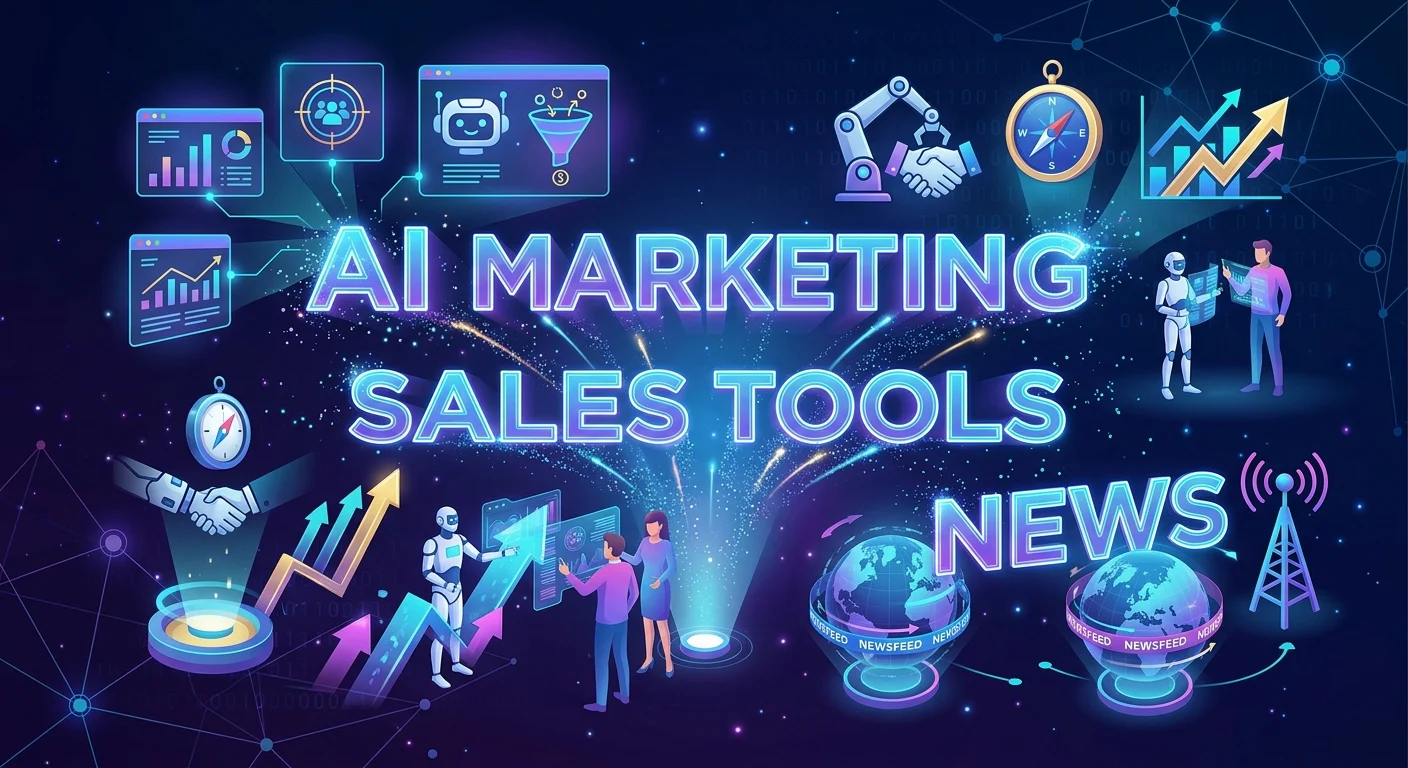
The AI marketing and sales tools landscape changed quickly around February 26–27, 2026, as companies moved beyond simple content generation toward connected AI agents, revenue intelligence, automation, and AI visibility. The biggest theme was not just creating more content or writing faster. It was using AI to understand customer data, connect previously isolated systems, prioritize opportunities, and help teams take action. Outreach expanded its agent and MCP capabilities, Gong introduced a broader AI-powered revenue platform direction, and marketers increasingly focused on measuring how brands appear inside AI-generated answers.
At the same time, major marketing organizations explored agentic workflows that combine creativity, personalization, analytics, and automation. This article examines the most important developments surrounding AI marketing sales tools news February 26–27 2026, explains what they mean for marketers and sales professionals, and highlights the trends likely to shape AI-powered revenue teams beyond 2026.
What happened in AI marketing and sales tools on February 26–27 2026
The February 26–27 window was part of a broader transition in AI software. Instead of treating AI as a separate assistant that users open when they need help, vendors increasingly embedded AI directly into marketing and sales workflows. This meant AI could analyze information, recommend an action, and in some cases execute that action inside connected systems.
One important development came from Outreach, which had announced its February product release just before the target dates. The release introduced or expanded AI capabilities including a Meeting Prep Agent, Deal Agent improvements, Outreach Omni Agent, enterprise knowledge features, and an MCP server. Outreach described the strategy as moving from disconnected insights toward AI that understands and acts across revenue workflows. (Customer Support Portal)
The same period also highlighted the growing importance of AI visibility for marketers. Brands were beginning to monitor how often they appeared in answers generated by ChatGPT and other AI systems. That creates a new marketing measurement category alongside traditional search rankings, website traffic, social engagement, and conversions.
The AI Sales Summit, held virtually from February 25–27, reinforced the same direction. Its agenda focused on AI copilots, predictive revenue intelligence, personalized outreach, automation, and practical implementation for revenue teams. (Sales 30 Conference)
Why AI marketing and sales tools became a major business priority
AI marketing and sales software has become important because companies face a simple problem: customers expect faster, more relevant experiences while teams have limited time and resources.
Traditional marketing requires research, content creation, audience segmentation, campaign planning, testing, reporting, and optimization. Sales teams face similar pressure through prospect research, qualification, meeting preparation, follow-ups, CRM updates, forecasting, and pipeline management.
AI can reduce the amount of manual work involved in these activities. However, the more important shift in 2026 is workflow intelligence. Instead of generating a single email, an AI system can examine an account, understand previous interactions, identify relevant signals, prepare a message, and recommend the next step.
This explains why vendors increasingly emphasize terms such as AI agents, revenue orchestration, MCP, connected intelligence, buyer signals, predictive analytics, and autonomous workflows.
The practical goal is not to replace every marketer or salesperson. It is to give professionals more time for activities that require judgment, creativity, relationships, negotiation, and strategic thinking.
How AI marketing and sales tools work in 2026
Modern AI marketing and sales platforms generally combine several technologies. The first is a large language model or another AI model that can understand natural language and generate useful outputs.
The second component is business data. A sales AI tool becomes much more useful when it can access information about accounts, contacts, opportunities, emails, meetings, product usage, website activity, and customer interactions.
The third component is automation. AI can turn an insight into a workflow. For example, if a high-value prospect shows strong buying intent, an automated workflow might prioritize the account, create research notes, recommend messaging, and notify the appropriate salesperson.
The fourth component is integration. This is increasingly important because companies rarely operate with one application. They may use a CRM, sales engagement platform, analytics system, advertising platform, content management system, customer support tool, and communication application simultaneously.
MCP, or Model Context Protocol, became particularly relevant during this period because it provides a standardized way for AI applications and agents to exchange context and interact with connected systems. Outreach described its MCP server as a way to let external AI agents access Outreach knowledge and actions, reducing the need for separate custom integrations. (Outreach)
The rise of agentic AI for sales teams
One of the strongest sales technology trends around February 2026 was the movement from AI assistants toward agentic AI.
A traditional assistant waits for a person to ask a question. An AI agent can operate around a defined objective. It may research information, evaluate conditions, recommend actions, or perform approved tasks.
Outreach’s February release demonstrated this direction through features such as Meeting Prep Agent and Deal Agent. The Meeting Prep Agent was designed to help representatives prepare for customer conversations, while Deal Agent improvements could provide AI-recommended updates to opportunity fields and deal summaries. (Customer Support Portal)
This matters because administrative work consumes a significant amount of selling time. If an agent can summarize an opportunity and identify missing information, the salesperson can spend more time talking with customers.
The important word is approved. Businesses still need permissions, governance, data-quality controls, and human review. An autonomous system that works with incorrect CRM data can simply automate mistakes faster.
MCP and connected AI became a key sales technology trend
The Model Context Protocol deserves special attention because it addresses one of the biggest weaknesses of modern AI stacks: disconnected applications.
Imagine a salesperson using one system for customer records, another for sales conversations, another for research, and another for content. An AI assistant that can only see one system has limited context.
MCP is designed to provide a common way for AI systems to interact with external tools and information. Outreach announced its MCP Server as part of its February release and explained that it could allow external AI agents such as Claude and other systems to work with Outreach context and actions. (Outreach)
This creates an important opportunity for AI interoperability.
For businesses, the benefit can include fewer custom connections, less context switching, and more useful AI responses. For developers and RevOps teams, it also raises new questions about permissions, security, authentication, monitoring, and data governance.
In other words, connectivity makes AI more powerful, but it also makes governance more important.
AI visibility became the new marketing measurement challenge
Another major development in this period was the growth of AI search visibility.
For years, marketers focused on ranking web pages in traditional search engines. In 2026, customers increasingly use AI systems to research companies, products, services, and solutions. That means a brand can potentially lose visibility even when its conventional SEO performance remains strong.
On February 26, 2026, Ahrefs published guidance on monitoring brand mentions in ChatGPT. The discussion emphasized manual auditing as well as automated monitoring through tools such as Brand Radar. (LinkedIn)
The marketing implication is significant. Companies now need to ask questions such as:
- Does an AI system mention our brand?
- Which competitors appear instead?
- What sources does the AI cite?
- Is our company described accurately?
- Which product strengths does the AI associate with our brand?
- Are there important customer questions where our company is missing?
This is sometimes called AI search optimization, answer engine optimization, generative engine optimization, or AI visibility optimization.
AI visibility tools and competitive intelligence
AI visibility is becoming more sophisticated than simply checking whether a company name appears in an answer.
Marketers can monitor a collection of high-intent prompts and compare their brand with competitors. For example, a software company could track prompts such as “best project management software for small teams” or “alternatives to [competitor].”
The goal is to identify visibility gaps.
Semrush also highlighted workflows for identifying prompts where competitors appear but a particular brand does not, finding citation-source gaps, and examining how AI systems describe competing brands. (LinkedIn)
This creates a new type of competitive intelligence. Instead of asking only, “What keywords rank better?” marketers can ask, “What does AI say about our category, and what information is influencing that answer?”
The best strategy is not to manipulate AI systems with keyword stuffing. Brands should create useful, accurate, authoritative information that AI systems can understand and cite naturally.
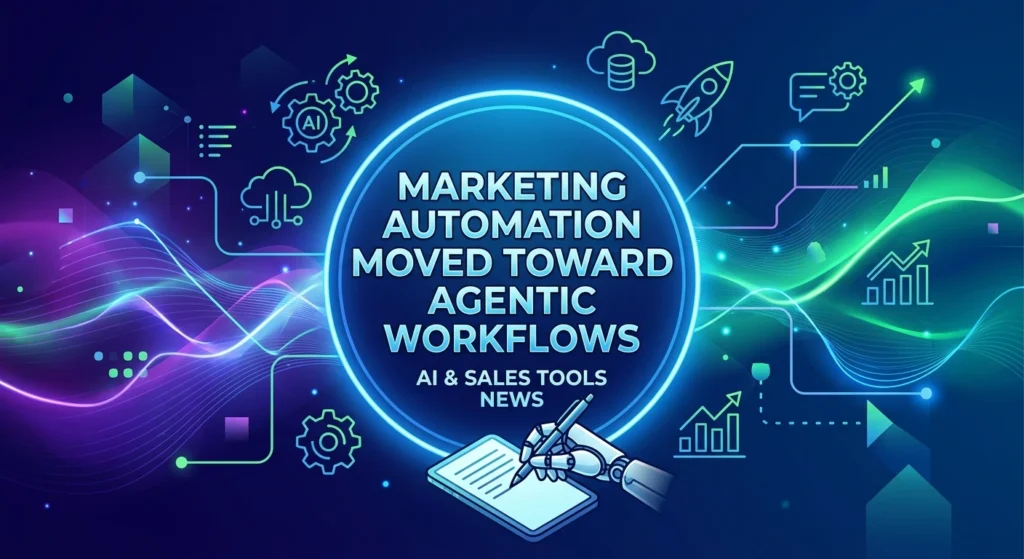
Marketing automation moved toward agentic workflows
Marketing teams also began moving beyond AI content generation.
An AI content generator can create a blog introduction, social post, advertisement, or email. An agentic marketing workflow can potentially go further by analyzing campaign performance, identifying a problem, recommending an adjustment, and initiating an approved workflow.
This direction was visible across the broader February marketing landscape. WPP reported that its expanded partnership with Adobe was embedding Adobe’s AI marketing capabilities into WPP Open to support personalization, media optimization, content creation, and agentic workflows. (WPP.com)
The strategic difference is important.
Generative AI creates. Agentic AI coordinates.
For marketers, this can mean moving from individual AI prompts toward complete workflows. For example, a campaign workflow could connect audience analysis, creative development, testing, reporting, and optimization.
Human approval remains valuable, especially for brand voice, legal compliance, advertising claims, customer communications, and sensitive business decisions.
The most useful AI sales and marketing features in 2026
The most valuable tools tend to share several capabilities.
AI prospect research helps salespeople understand an account before contacting it. Instead of manually searching multiple sources, AI can organize available information into a concise research brief.
Lead scoring and prioritization help teams decide which prospects deserve attention first. Good scoring systems combine multiple signals rather than relying on a single activity.
Conversation intelligence analyzes sales calls and customer conversations to identify topics, objections, risks, and opportunities.
AI-generated personalization can help create relevant outreach, although humans should review important messages before sending them.
Forecasting and pipeline intelligence use historical and current data to help sales leaders understand potential outcomes and risks.
AI visibility monitoring helps marketing teams understand how brands appear in AI-generated answers.
Marketing analytics assistants can explain campaign performance and surface recommendations. Bluecore, for example, described its Marketing Agent as an AI-powered analytics assistant that helps marketers understand campaign performance and receive actionable recommendations. (Bluecore Help)
Free versus paid AI marketing and sales tools
Free AI tools can be useful for individuals, students, freelancers, startups, and small teams. They are often suitable for basic content creation, brainstorming, summarization, research, and limited automation.
Paid platforms generally become more valuable when a business needs integrations, larger data volumes, team collaboration, analytics, security controls, automation, or enterprise administration.
The right choice depends on the workflow rather than the number of AI features.
A small marketing team might get more value from one strong AI automation platform connected to its existing tools than from ten separate applications. A large sales organization may need specialized systems for prospecting, conversation intelligence, forecasting, CRM automation, and governance.
Pricing also varies significantly. Some AI tools use subscriptions, while others charge according to users, usage, contacts, API calls, automation runs, or data volume.
Before paying, calculate the expected business value. Ask whether the tool can save time, improve conversion, increase qualified pipeline, reduce administrative work, or provide information that the team could not easily obtain otherwise.
Integrations are becoming more important than isolated features
In earlier generations of software, companies often selected applications based on individual features. In the AI era, integration quality can be just as important as the feature list.
An AI sales tool may have excellent writing capabilities, but if it cannot access accurate customer information, its personalization may remain generic.
Likewise, a marketing analytics tool can produce impressive reports, but its value drops if the team cannot connect the findings to campaign execution.
This is why technologies such as APIs, webhooks, native connectors, and MCP are increasingly important.
Outreach’s February release specifically emphasized external connectivity and data integration. Its MCP Server was designed to allow external AI agents to use Outreach knowledge and actions, while other features connected revenue intelligence with workflows and enterprise content. (Customer Support Portal)
When evaluating a tool, check CRM compatibility, data access, authentication, permissions, API availability, workflow triggers, and export options before focusing on flashy AI features.
Pros and cons of AI marketing and sales tools
AI tools offer several clear advantages.
They can reduce repetitive work, accelerate research, help teams personalize communication, summarize large amounts of information, identify patterns, and support faster decisions. They can also allow smaller teams to perform work that previously required more people or more hours.
AI can improve creativity as well. Marketers can use it to generate variations, explore campaign concepts, analyze customer language, and test different approaches.
However, there are limitations.
AI can produce inaccurate information. It may misunderstand customer intent, rely on incomplete data, or generate messaging that sounds generic. Automated systems can also create privacy, compliance, security, and brand-reputation risks if businesses do not establish appropriate controls.
Another problem is tool overload. Companies can purchase many AI applications without improving their underlying processes.
The best approach is to start with a measurable business problem and introduce AI where it creates a clear advantage.
How businesses should choose an AI marketing or sales tool
Start by defining the workflow you want to improve.
If your problem is lead research, look for prospecting and enrichment capabilities. If sales representatives spend too much time preparing for calls, investigate meeting intelligence and AI preparation tools. If marketers cannot understand campaign performance, consider AI analytics.
Next, examine the data requirements.
Ask what information the system needs, where that information comes from, and how frequently it updates. AI quality depends heavily on data quality.
Then evaluate integrations. Confirm whether the platform works with your CRM and other essential applications.
Finally, test the system with a small pilot. Define a few measurable outcomes before expanding.
Useful measurements include time saved per employee, qualified meetings, conversion rates, pipeline generated, response rates, campaign efficiency, and customer satisfaction.
Avoid choosing a platform simply because it has the largest number of AI features.
Common mistakes when adopting AI sales and marketing software
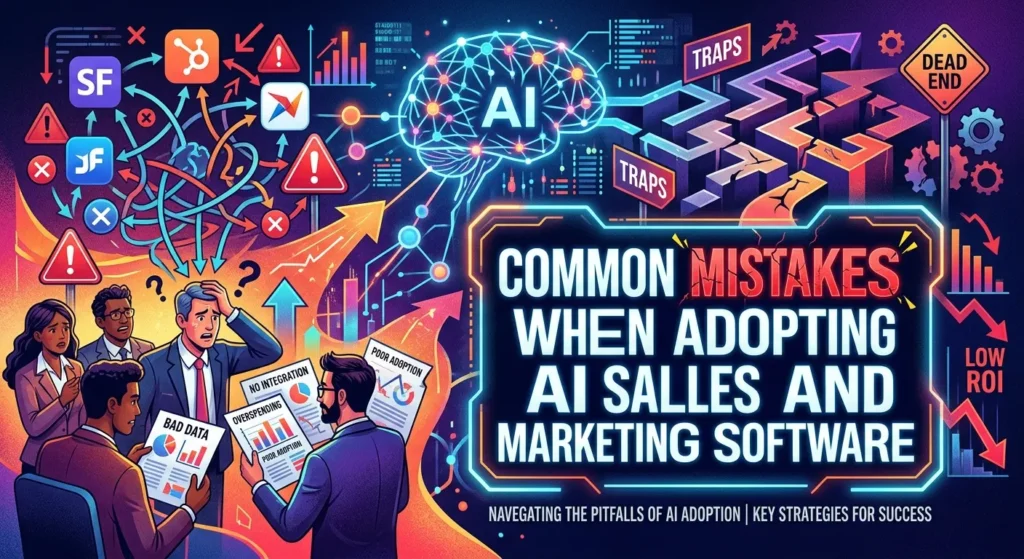
One common mistake is automating before fixing the process.
If a company has unclear lead qualification rules, inconsistent CRM data, and weak messaging, adding AI will not automatically solve those problems.
Another mistake is allowing AI to operate without appropriate human review. High-impact customer communications should generally have clear approval rules.
A third mistake is using poor data. Duplicate records, outdated contact information, incomplete customer histories, and inconsistent definitions can reduce AI accuracy.
Businesses should also avoid creating too many disconnected AI tools. Every additional application can increase subscription costs, maintenance requirements, security considerations, and employee training.
Finally, companies should not measure success by the number of AI-generated outputs. Revenue impact, customer value, productivity, and quality are better measures than raw AI activity.
February 26–27 2026 trends that point toward the future
The strongest trend was the shift from AI assistance to AI execution.
Outreach’s February release provides a useful example. Its agents were designed around sales preparation, deal intelligence, natural-language interaction, and connected workflows rather than simple text generation. (Customer Support Portal)
Another trend was the rise of AI interoperability. MCP demonstrated why AI systems increasingly need standardized ways to access context and tools.
A third trend was the emergence of AI visibility as a marketing discipline. Companies now have to think about how their products are represented inside AI-generated answers, not just how pages rank in conventional search.
A fourth trend was vertical AI. Instead of general-purpose assistants trying to serve every department, specialized platforms are increasingly designed for sales, retail marketing, customer intelligence, legal marketing, and other professional workflows.
Finally, the line between marketing technology and sales technology is becoming less clear. Modern revenue platforms increasingly combine customer signals, marketing interactions, sales conversations, analytics, and automation.
What AI marketing and sales tools mean for 2026 and beyond
The February 26–27 period showed that AI is becoming part of the operating layer of marketing and sales.
The next generation of tools will likely focus less on isolated content generation and more on context, action, interoperability, and measurable outcomes.
A marketer may start with a business goal rather than a prompt. A sales leader may ask an AI system to investigate pipeline risk rather than manually inspect dozens of records. A revenue team may use multiple agents that coordinate through shared context and approved permissions.
This does not eliminate the need for human expertise. In fact, it makes expertise more valuable.
People still need to define strategy, understand customers, evaluate trade-offs, maintain brand trust, review important communications, and make difficult decisions.
The most successful companies will therefore treat AI as a force multiplier, not a substitute for thinking.
Conclusion
The AI marketing sales tools news February 26–27 2026 reflects a much larger transformation in business software. AI is moving from standalone assistants toward connected systems that understand business context and help teams take action.
The key developments around this period included agentic sales workflows, MCP-based interoperability, AI visibility monitoring, marketing automation, conversation intelligence, predictive revenue tools, and AI-powered analytics. Outreach’s February release illustrated how sales platforms are building agents and external AI connectivity, while the growing AI visibility movement showed marketers that brand discovery is expanding beyond traditional search. (Customer Support Portal)
For businesses evaluating AI tools in 2026, the smartest strategy is simple: start with the problem, connect reliable data, measure outcomes, and keep humans involved where judgment matters.
The future of AI marketing and sales will not be defined by which company has the most AI features. It will be defined by which teams use connected intelligence to create better customer experiences, improve productivity, and generate measurable business value.
Frequently Asked Questions
What were the biggest AI sales tool trends around February 26–27, 2026?
The major trends included agentic AI, MCP connectivity, AI-powered sales preparation, deal intelligence, conversation intelligence, AI visibility, and workflow automation. The emphasis was shifting from AI that simply answers questions toward AI that can work with business context and support actions.
What is MCP in AI sales tools?
Model Context Protocol (MCP) is a standard designed to help AI applications connect with external tools and information. In sales technology, it can allow an AI system to access approved revenue data and capabilities from another platform, reducing the need for separate custom connections. Outreach introduced an MCP Server as part of its February 2026 product release. (Outreach)
How can AI improve sales productivity?
AI can help with prospect research, meeting preparation, CRM updates, call analysis, lead prioritization, follow-ups, forecasting, and administrative tasks. The greatest productivity gains usually come when AI is connected to the systems salespeople already use.
What is AI visibility in marketing?
AI visibility refers to how frequently and accurately a company, product, or brand appears in AI-generated answers. It extends traditional search visibility by examining how AI systems describe brands and which sources they use.
Are AI marketing and sales tools free?
Some AI tools offer free plans or limited free usage, while professional and enterprise platforms usually charge subscription or usage-based fees. Free tools can work well for basic tasks, but businesses often need paid plans for integrations, automation, larger limits, analytics, collaboration, and administrative controls.
What should businesses look for in an AI sales tool?
Look for reliable data access, CRM integrations, useful automation, strong security controls, clear permissions, analytics, ease of use, and measurable ROI. AI model quality matters, but it should not be the only selection criterion.
Can AI replace marketing and sales teams?
AI can automate many repetitive activities, but it does not remove the need for human strategy, creativity, customer relationships, judgment, negotiation, and accountability. The strongest approach is to use AI to augment people and remove low-value administrative work.
Why are AI agents important for sales?
AI agents can move beyond generating answers and help complete defined workflows. For example, an agent can assist with account research, meeting preparation, opportunity updates, or other approved tasks. This can help sales representatives spend more time on customer-facing work.
What is the difference between generative AI and agentic AI?
Generative AI primarily creates or transforms information, such as text, images, summaries, or ideas. Agentic AI adds the ability to work toward a defined objective by using tools, accessing information, making decisions within constraints, and taking approved actions.
What is the future of AI marketing tools?
The future is likely to emphasize connected AI agents, real-time customer signals, AI search visibility, personalized experiences, autonomous workflows, stronger integrations, and outcome-based measurement. Marketing and sales platforms will increasingly work together as parts of a unified revenue technology ecosystem.