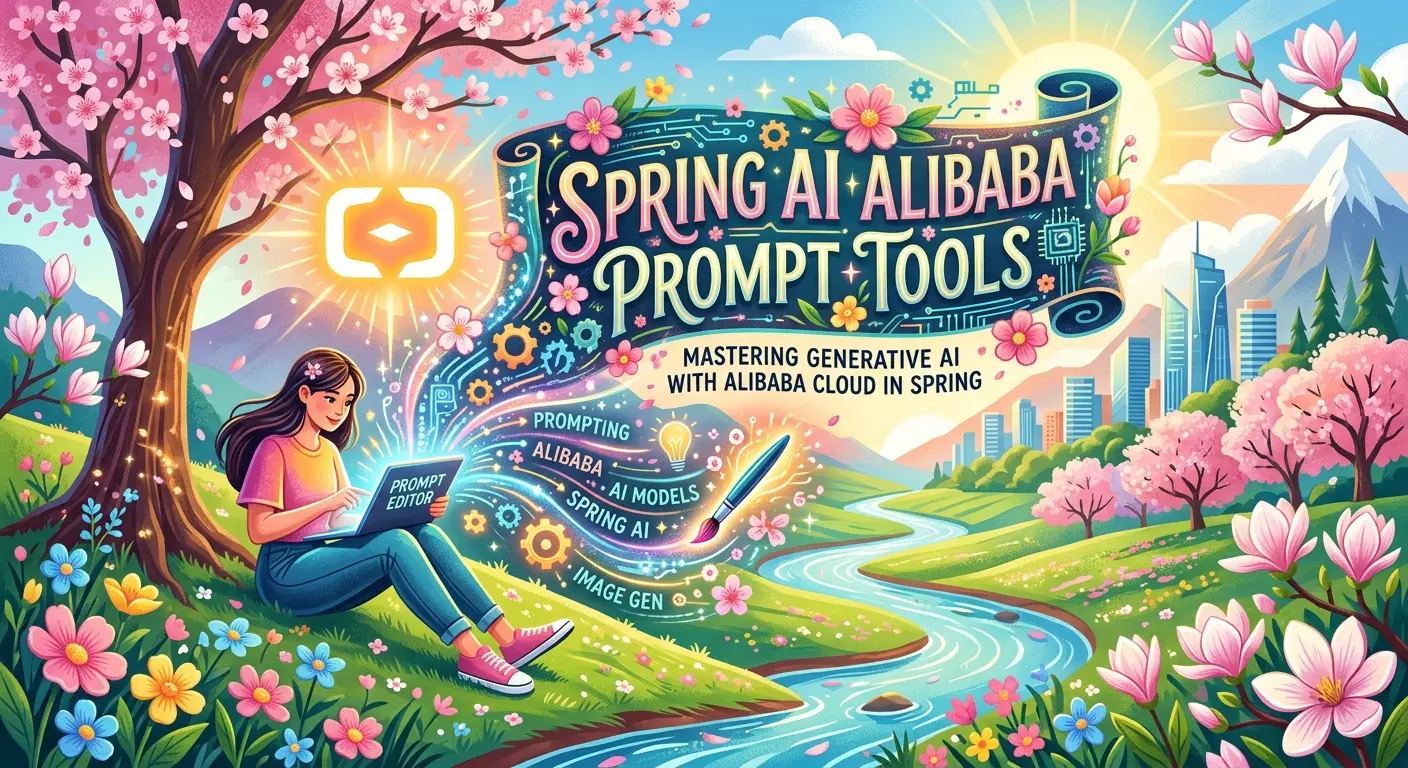
Spring AI Alibaba is a Java-focused framework and ecosystem for building AI applications, agents, workflows, and multi-agent systems with Spring-based development practices. Its prompt tooling is particularly useful for developers who need to create, manage, update, version, and reuse prompts instead of hard-coding every instruction inside application logic. The ecosystem includes prompt management capabilities, tool calling, model integrations, RAG, MCP, agent frameworks, and workflow orchestration.
For teams building production AI applications, prompt management can improve productivity, automation, consistency, maintainability, and development efficiency. Spring AI Alibaba also provides a Nacos-based prompt extension that supports dynamic prompt updates, version control, environment-specific prompts, and multi-tenancy.
This guide explains what Spring AI Alibaba prompt tools are, how they work, their main features, practical use cases, integrations, advantages and limitations, alternatives, common mistakes, and the latest direction of the ecosystem.
What Are Spring AI Alibaba Prompt Tools?
Spring AI Alibaba prompt tools refer to the prompt-management and AI development capabilities available within the Spring AI Alibaba ecosystem. They help Java developers create AI applications where prompts are treated as reusable application components instead of simple strings scattered throughout source code.
The broader Spring AI Alibaba project describes itself as a production-ready framework for building Agentic, Workflow, and Multi-agent applications. It provides an agent framework, graph runtime, model integrations, tool support, MCP support, and other components for AI application development.
Prompt management becomes important when an application has many AI interactions. A customer-support application, for example, might have separate prompts for classification, summarization, customer replies, document analysis, and escalation. Managing these prompts independently can make development and maintenance easier.
Spring AI Alibaba’s extensions specifically include Nacos Prompt, which can store and manage prompts through Nacos configuration infrastructure. The project documentation lists dynamic prompt updates without code changes, version control, environment-specific prompts, and multi-tenancy among its capabilities.
How Spring AI Alibaba Prompt Management Works
A traditional Java application might store an AI prompt directly inside a Java class. While this approach works for a small prototype, it can become difficult to maintain when prompts change frequently.
A prompt-management system separates the prompt from application logic. The application can retrieve a managed prompt and then provide variables or user-specific information before sending the completed request to an AI model.
Spring AI Alibaba’s Nacos prompt extension is designed around this approach. Developers can store prompts in Nacos and manage them separately from the main application code. This makes prompt changes more operationally flexible.
Imagine an online support assistant. Instead of embedding a long instruction inside a Java service, a team could maintain the instruction as a managed prompt. When the support team’s requirements change, the prompt can be updated through the prompt-management system rather than requiring developers to rewrite the entire application.
This architecture can create a cleaner separation between application code, prompt instructions, model configuration, and operational content.
Key Features of Spring AI Alibaba Prompt Tools
One of the most important features is dynamic prompt management. The Nacos Prompt extension is designed to let teams update prompts without changing application code. This can be useful when prompt wording needs frequent improvement.
Another important feature is version control. Prompt changes can affect an AI application’s output significantly. Keeping track of versions makes it easier for a team to understand which prompt produced a particular behavior and to manage controlled changes.
Spring AI Alibaba also supports broader AI application features around prompts. Its ecosystem includes RAG, tool callbacks, model integrations, chat memory, MCP, document parsing, and observability-related extensions.
The framework also supports agent development. Its current repository describes capabilities including context engineering, human-in-the-loop support, graph-based workflows, A2A communication, and multiple LLM providers.
Together, these capabilities allow prompts to become part of a larger AI application architecture rather than functioning as isolated text templates.
Benefits of Using Spring AI Alibaba for Prompt Engineering
The first major benefit is maintainability. When prompts are managed separately from business logic, developers can modify instructions without repeatedly editing Java source files.
The second benefit is consistency. A centralized prompt can be reused by multiple parts of an application. This reduces the chance that different services will accidentally use slightly different versions of the same instruction.
Prompt versioning can also support controlled experimentation. A team might maintain one prompt for production and test an improved version separately before deployment.
Another benefit is faster collaboration. Developers can focus on application architecture while AI specialists or product teams work on prompt wording and behavior. This separation can reduce friction in larger projects.
The ecosystem’s broader agent capabilities add further value. Spring AI Alibaba currently supports agentic workflows, multi-agent patterns, graph orchestration, tool calling, and human-in-the-loop functionality.
Spring AI Alibaba Prompt Tools and Nacos
Nacos is particularly relevant to Spring AI Alibaba prompt management because the project provides a Nacos Prompt extension for storing and managing prompts.
According to the Spring AI Alibaba extensions project, Nacos Prompt supports dynamic prompt updates, version control, environment-specific prompts, and multi-tenancy. The starter is provided as spring-ai-alibaba-starter-nacos-prompt.
Environment-specific prompts can be useful when an organization has separate development, testing, staging, and production environments. Each environment may need different configurations or controlled prompt versions.
Multi-tenancy is also valuable for SaaS applications. Different customers may require different AI instructions, rules, or business terminology while sharing the same underlying application architecture.
The main idea is to make prompts operationally manageable. Instead of treating prompts as permanent strings inside source code, a team can treat them as configurable assets that can evolve alongside the application.
Spring AI Alibaba Prompt Tools With LLM Models
Prompts are only one part of an AI application. An application also needs an LLM provider capable of receiving the prompt and generating a response.
Spring AI Alibaba supports multiple model integrations. The project’s current documentation and repository mention providers such as DashScope, OpenAI, and DeepSeek, among others.
This separation can be useful because the same application architecture may need to interact with different models. A development team might test one model during development and use another model for a particular production workload.
Spring AI Alibaba’s repository also provides a DashScope starter and example applications. Its quick-start documentation shows a chatbot example using a Spring AI Alibaba DashScope starter and an API key.
The important concept is that prompt management and model selection are separate concerns. A well-designed application can manage prompts independently while configuring the model layer according to the project’s needs.
Tool Calling, Agents, and Prompt Engineering
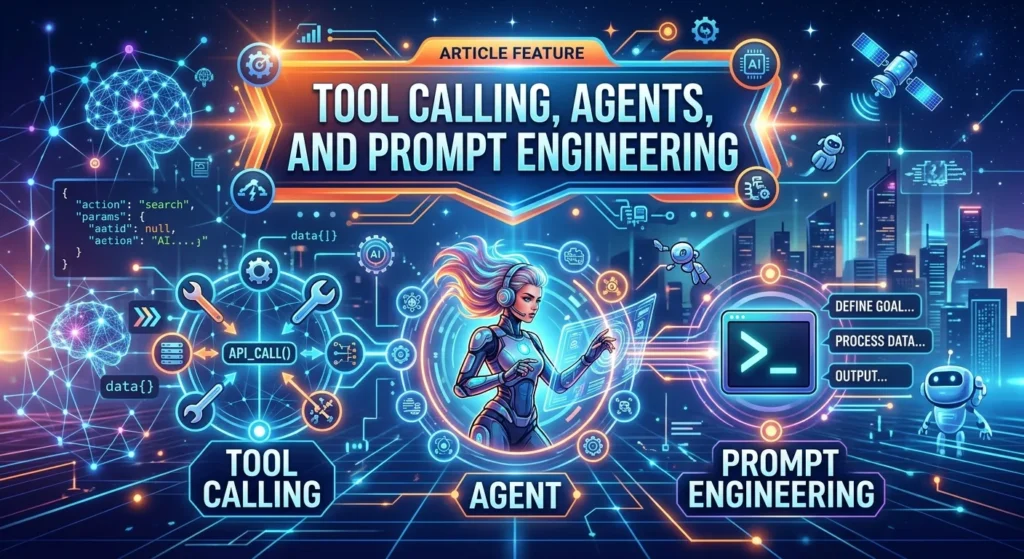
Prompt engineering becomes even more important when AI applications can call tools. A tool-enabled agent may need instructions explaining when it should search information, call a service, retrieve data, or ask for human approval.
Spring AI Alibaba provides tool and agent capabilities as part of its ecosystem. The official examples repository includes separate examples for prompt usage, RAG, structured output, and tool calling.
The agent framework also supports patterns such as sequential agents, parallel agents, routing agents, loop agents, and other multi-agent approaches.
This creates a more advanced prompt-engineering environment. Instead of writing one prompt for a chatbot, developers may need different prompts for specialized agents.
For example, a research workflow could contain one agent responsible for gathering information, another for analyzing it, and another for preparing the final response. Each agent can have a specialized role and instruction set.
This is where prompt management, tool calling, memory, workflow orchestration, and model integration begin working together.
Practical Spring AI Alibaba Prompt Tool Use Cases
Customer service is one practical use case. A company can maintain prompts for greeting users, classifying requests, summarizing conversations, and preparing escalation messages.
Another use case is enterprise knowledge search. A RAG application can use prompts to instruct a model how to answer questions based on retrieved documents. Spring AI Alibaba provides RAG-related extensions and examples as part of its ecosystem.
Content-processing applications can also benefit. A company might create prompts for extracting information from documents, summarizing reports, classifying text, or generating structured responses.
AI agents provide another major use case. Spring AI Alibaba’s agent framework is designed for applications where an AI system can execute workflows, interact with tools, maintain context, and coordinate multiple agents.
Other possible applications include:
- AI customer support
- Enterprise search
- Document analysis
- Content summarization
- Data extraction
- Developer assistants
- Workflow automation
- Multi-agent applications
- RAG applications
- Internal business copilots
The best architecture depends on the application’s data, security requirements, model choice, and workflow complexity.
Spring AI Alibaba Prompt Tools for RAG Applications
Retrieval-augmented generation, commonly called RAG, combines information retrieval with language-model generation. Instead of relying only on a model’s existing knowledge, the application retrieves relevant information and supplies that context to the model.
Prompts are important because they tell the model how to use retrieved information. A RAG prompt might instruct the model to answer using supplied documents, avoid unsupported claims, and clearly indicate when the available context does not contain an answer.
Spring AI Alibaba’s ecosystem includes RAG extensions and examples. Its extensions repository lists RAG, vector-store, document-parser, and document-reader capabilities.
Good prompt design can improve the reliability of RAG applications. However, prompts cannot solve every retrieval problem. If the search system retrieves irrelevant documents, the model may still produce an unreliable answer.
For that reason, developers should evaluate the entire pipeline: document processing → indexing → retrieval → prompt construction → model response → validation.
Spring AI Alibaba Prompt Tools Pricing and Availability
Spring AI Alibaba is an open-source project. Its main GitHub repository is publicly available, and the project is distributed under the Apache-2.0 license.
That does not mean every component of an AI application is automatically free. The framework itself can be open source while the infrastructure around it creates costs.
For example, an application may use paid model APIs, cloud infrastructure, databases, vector stores, observability services, or managed Nacos deployments. Those costs depend on the architecture and providers selected.
The model provider is particularly important. If your application sends requests to a paid LLM service, the provider may charge according to usage, model, tokens, or another pricing structure.
Therefore, there is an important distinction between framework cost and total AI application cost. Spring AI Alibaba can provide the development framework without eliminating the operational costs of running an AI system.
Teams should evaluate API usage, hosting, storage, monitoring, model inference, and development requirements before estimating a production budget.
Spring AI Alibaba vs Traditional Prompt Management
Traditional prompt management often means keeping prompts inside Java classes, configuration files, or application resources. This can be perfectly reasonable for a small project.
The problem appears when prompts become numerous or frequently updated. Developers may need to rebuild and redeploy an application simply to change an instruction.
A centralized prompt-management approach can reduce this dependency. Spring AI Alibaba’s Nacos Prompt extension specifically provides dynamic updates and version management.
There is also a governance advantage. Teams can establish a process around prompt versions, testing, and deployment instead of allowing prompt changes to happen informally.
However, centralized prompt management introduces additional infrastructure and operational considerations. A simple application may not need a dedicated prompt-management system.
The correct choice depends on application complexity, team size, update frequency, reliability requirements, and operational architecture.
Spring AI Alibaba Alternatives and Comparisons
Spring AI Alibaba is not the only framework available for Java-based AI development. Developers may also evaluate Spring AI, LangChain4j, vendor-specific SDKs, or other agent frameworks depending on their project requirements.
Spring AI Alibaba has a particularly strong relationship with the Spring ecosystem and Alibaba Cloud services. It also extends into agentic workflows, multi-agent orchestration, MCP, RAG, and other AI application capabilities.
LangChain4j is another Java ecosystem option for developers who want abstractions for language models, agents, tools, RAG, and related AI application patterns.
A vendor-specific SDK can sometimes be simpler when an application is tightly coupled to one model provider. The trade-off may be less abstraction across different providers.
When comparing frameworks, evaluate model compatibility, prompt management, tool calling, RAG support, agent orchestration, Java integration, observability, community activity, documentation, deployment requirements, and long-term maintenance.
The right framework depends on the application rather than a universal feature checklist.
Common Mistakes When Using Spring AI Alibaba Prompt Tools
One common mistake is writing prompts that are too vague. A production prompt should clearly describe the model’s role, expected task, relevant context, output requirements, and important constraints.
Another mistake is changing prompts without tracking versions. If the application’s behavior changes after a prompt update, developers need a way to identify what changed.
A third mistake is assuming that a better prompt can solve every AI problem. Model selection, retrieval quality, tool definitions, context size, application logic, and evaluation all affect output quality.
Security is another important consideration. Developers should avoid placing sensitive credentials directly inside prompts or exposing confidential information unnecessarily.
Teams should also test prompts with realistic edge cases. A prompt that works perfectly for five examples may behave differently with ambiguous questions, incomplete data, long documents, or unexpected user input.
Finally, avoid making the prompt unnecessarily complicated. Clear instructions, structured context, and explicit output requirements can often be more effective than extremely long instructions.
Latest Spring AI Alibaba Trends and Future Developments
Spring AI Alibaba continues to expand beyond basic model integration toward agentic application development. Its current project documentation emphasizes agents, workflows, multi-agent orchestration, graph-based execution, MCP, tool calling, and human-in-the-loop capabilities.
Recent releases have also added or expanded multi-agent patterns. The project’s release notes describe routing, supervisor, subagent, skills, handoffs, and workflow patterns, along with AgentScope integration.
Another important direction is context engineering. Modern AI applications increasingly need systems for managing conversation history, tools, runtime information, memory, and context size. Spring AI Alibaba’s agent framework explicitly includes context-engineering capabilities.
MCP is also becoming relevant to tool-enabled AI applications. Spring AI Alibaba’s ecosystem includes MCP support, allowing developers to build applications that connect models and agents with standardized tool and context interfaces.
The likely direction is toward more sophisticated AI systems in which prompts are only one layer of a larger architecture. Prompt management, agents, tools, memory, RAG, model routing, evaluation, and human oversight will increasingly work together.
Frequently Asked Questions
What are Spring AI Alibaba prompt tools? They are prompt-management and AI development capabilities within the Spring AI Alibaba ecosystem. They help Java developers manage prompts and build AI applications using models, agents, tools, RAG, workflows, and related components.
What is Nacos Prompt in Spring AI Alibaba? Nacos Prompt is an extension for managing prompts through Nacos. The project documents dynamic prompt updates, version control, environment-specific prompts, and multi-tenancy.
Can Spring AI Alibaba update prompts without changing application code? The Nacos Prompt extension is designed to support dynamic prompt updates without code changes. This can make prompt maintenance more flexible for applications where instructions change frequently.
Does Spring AI Alibaba support multiple AI models? Yes. The project supports multiple model integrations, including providers such as DashScope, OpenAI, and DeepSeek.
Does Spring AI Alibaba support tool calling? Yes. Tool calling is part of the Spring AI Alibaba ecosystem, and the official examples repository includes a dedicated tool-calling example.
Can Spring AI Alibaba be used for RAG? Yes. Spring AI Alibaba provides RAG-related extensions and examples, including vector-store and document-processing capabilities.
Is Spring AI Alibaba open source? Yes. The main Spring AI Alibaba repository is publicly available on GitHub and uses the Apache-2.0 license.
What programming language does Spring AI Alibaba focus on? Spring AI Alibaba is designed primarily for Java developers and integrates with the Spring ecosystem. Its repository describes it as an agentic framework for Java.
Can Spring AI Alibaba build AI agents? Yes. Its current agent framework supports agentic applications, workflows, multi-agent patterns, context engineering, human-in-the-loop capabilities, and graph-based orchestration.
Is Spring AI Alibaba suitable for enterprise AI applications? The project is specifically positioned as a production-ready framework for agentic, workflow, and multi-agent applications. Whether it fits a particular enterprise depends on requirements such as security, infrastructure, model support, governance, scalability, and team expertise.
What is the main advantage of centralized prompt management? It can make prompts easier to update, version, reuse, and manage across environments. Spring AI Alibaba’s Nacos Prompt extension specifically targets these capabilities.
Are prompt tools enough to build a complete AI application? No. A production AI application may also require model integration, retrieval, data processing, tools, memory, monitoring, security, evaluation, and application logic. Spring AI Alibaba provides many of these capabilities as part of its broader ecosystem.
Conclusion
Spring AI Alibaba prompt tools provide an important part of the modern Java AI development stack. Prompt management becomes increasingly valuable as AI applications grow from simple chatbots into production systems with agents, workflows, RAG, tools, memory, and multiple models.
The Nacos Prompt extension is particularly useful for teams that need dynamic prompt updates, version control, environment-specific configuration, and multi-tenancy.
At the same time, Spring AI Alibaba has expanded well beyond prompt management. Its current ecosystem includes agent frameworks, graph-based workflows, tool calling, MCP, RAG, model integrations, multi-agent patterns, and human-in-the-loop capabilities.
For developers building Java-based AI systems, the key is to treat prompts as one part of a larger engineering architecture. Good prompts matter, but reliable AI applications also require good models, retrieval, tools, context management, testing, security, and evaluation.
As AI development continues moving toward agentic and automated systems, structured prompt management can provide a strong foundation for building applications that are easier to maintain, update, test, and scale.