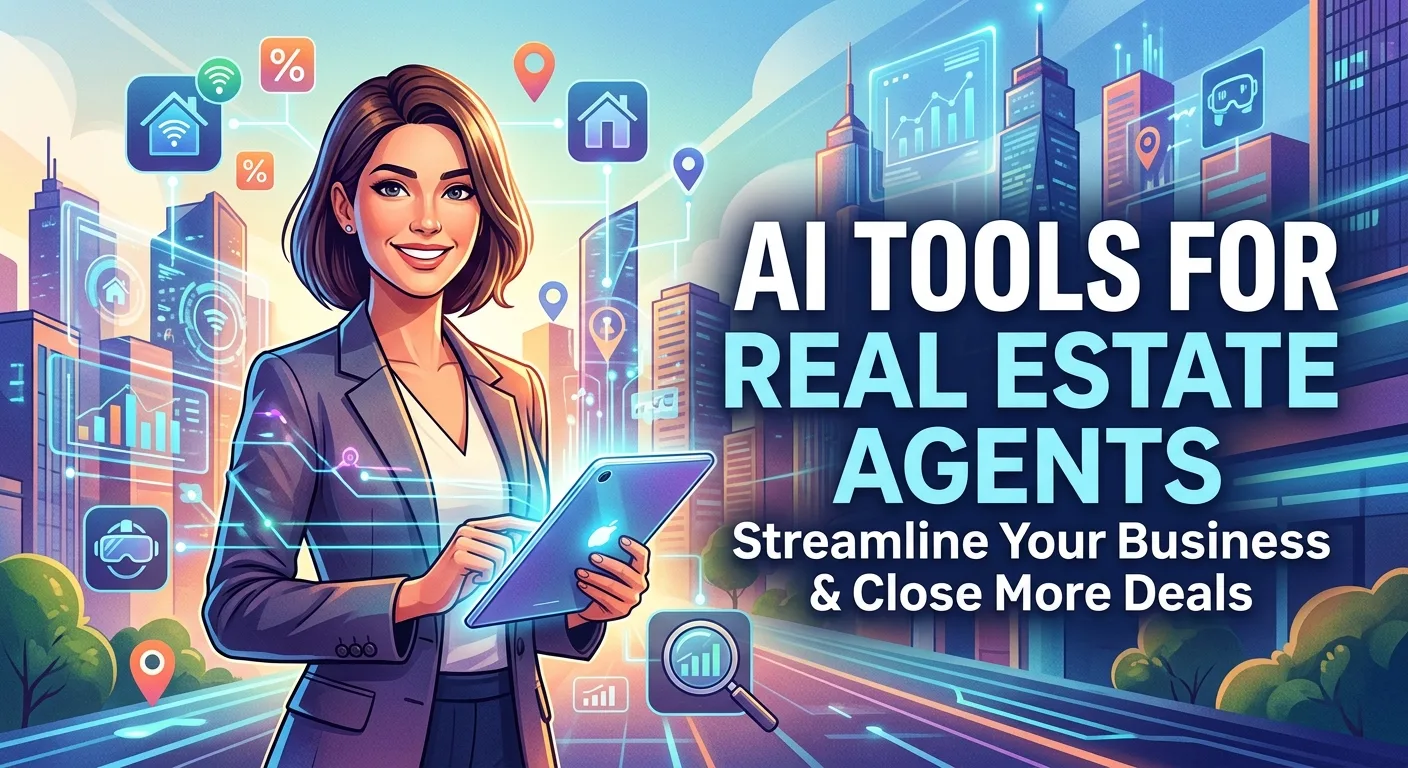
Artificial intelligence is changing how real estate professionals find leads, market properties, communicate with clients, and manage daily tasks. AI tools for real estate agents can reduce repetitive work while helping agents become more productive, organized, and responsive. From writing property descriptions to generating social media content, analyzing leads, preparing follow-up messages, and improving customer communication, AI can support almost every stage of the real estate process.
The biggest advantage is not simply automation. AI helps agents spend more time on activities that require human skills, such as building relationships, negotiating deals, understanding client needs, and closing transactions. Whether you are an independent agent, part of a brokerage, or a property marketing professional, the right AI workflow can improve efficiency and creativity. This guide explains how AI tools work in real estate, their benefits, use cases, costs, limitations, and the latest trends agents should understand.
What Are AI Tools for Real Estate Agents?
AI tools for real estate agents are software applications that use artificial intelligence, machine learning, natural language processing, computer vision, or automation to help real estate professionals complete tasks faster. These tools can assist with marketing, lead generation, customer relationship management, property research, content creation, communication, and business analysis.
Instead of replacing the agent, AI usually works as a digital assistant. For example, an agent can provide basic property information and ask an AI writing tool to create a listing description. Another tool may summarize client conversations, while a CRM platform can help identify leads that need follow-up.
AI can also help agents handle large amounts of information. Real estate professionals often work with property details, buyer preferences, emails, messages, appointments, market information, and marketing campaigns. AI can organize and analyze this information so agents can make better decisions.
The best approach is to view AI as a productivity system rather than a replacement for professional judgment. Agents still need to verify important information, understand local regulations, protect client data, and communicate honestly.
How AI Works in Real Estate
AI systems learn patterns from data and use those patterns to generate predictions, recommendations, summaries, classifications, or content. In real estate, the type of AI used depends on the task. A generative AI tool may create written content, while a predictive system may analyze historical information to identify patterns.
For example, an AI-powered CRM can examine lead activity such as emails, website visits, form submissions, and previous conversations. It may then help an agent prioritize which leads require attention. A content-generation platform works differently. It analyzes a prompt and creates text based on the information provided.
Computer vision is another useful AI technology. It can analyze images and help with tasks involving property photos. Some modern systems can recognize rooms, objects, visual characteristics, and other elements in an image.
Agents should remember that AI output depends heavily on the quality of the information provided. If a property description contains incorrect facts, AI may repeat or expand those errors. Always check generated content before publishing it.
Best AI Tools for Real Estate Marketing
Marketing is one of the easiest areas for real estate agents to improve with AI. Agents regularly need listing descriptions, social media posts, email campaigns, advertisements, video scripts, property headlines, and promotional ideas.
Generative AI writing tools can help create several versions of the same marketing message. For example, an agent could turn a property description into a Facebook post, Instagram caption, email announcement, and short video script. This saves time while maintaining a consistent message across channels.
AI image and design tools can also help agents create promotional graphics. An agent might provide a property photo and create a social media design around it. However, agents should avoid using AI to make a property appear materially different from reality. Marketing creativity should never become misleading representation.
AI can also help with audience targeting. An agent may create different messages for first-time buyers, investors, families, renters, or luxury-property prospects. The wording can change according to the audience while the underlying property facts remain accurate.
A useful workflow is to create a content calendar and let AI assist with drafts. The agent then reviews each piece, adds local expertise, checks facts, and publishes the final version.
AI Tools for Real Estate Lead Generation
Lead generation is another important application of AI. Real estate agents often receive leads from websites, property portals, social media, advertisements, referrals, and landing pages. Managing these leads manually can become difficult as the business grows.
AI-powered lead systems can help classify and prioritize prospects. For example, a system may distinguish between someone casually browsing properties and a prospect who has repeatedly requested information. This does not guarantee that one person will buy, but it can help the agent decide where to spend limited time.
AI chatbots can also answer basic questions when an agent is unavailable. A chatbot might collect a visitor’s preferred location, property type, budget range, and general requirements. The information can then move into a CRM for follow-up.
Another valuable use is lead nurturing. AI can help draft personalized follow-up messages based on previous interactions. Instead of sending the same generic message to everyone, an agent can create communication that reflects the prospect’s stated interests.
Agents should still maintain human oversight. Automated messages should not become excessive or misleading. A good AI lead-generation strategy combines automation with genuine personal communication.
AI for Property Listing Descriptions and Content
Writing property listings can consume a surprising amount of time. Every listing needs a clear headline, accurate description, key features, location information, and a compelling explanation of why the property may interest potential buyers or renters.
AI writing tools can turn basic notes into polished listing copy. An agent can provide information such as property type, number of rooms, approximate size, major features, nearby amenities, and selling points. AI can then organize the information into a readable description.
The important rule is never allow AI to invent property features. If the property does not have a swimming pool, AI should not add one simply because that sounds attractive. The agent should verify every factual statement.
AI can also help improve readability. A long technical description can be transformed into short paragraphs and bullet points. Search-friendly wording can make property content easier for users and search engines to understand.
For example, instead of repeatedly using generic phrases such as “beautiful home,” an agent can ask AI to focus on specific benefits supported by real property details. Specific information usually creates more useful marketing content than exaggerated adjectives.
AI Tools for Real Estate Social Media
Social media can help agents build personal brands and attract potential clients, but maintaining consistent content requires time. AI can make the process easier by helping agents generate ideas, captions, scripts, content calendars, and variations of promotional messages.
An agent can ask AI to develop a weekly content plan covering property listings, local market education, home-buying tips, seller advice, neighborhood information, and behind-the-scenes content. This creates a balanced strategy instead of publishing only property advertisements.
AI can also help turn one idea into multiple formats. A long educational article could become a short social media post, video script, carousel concept, or email newsletter. This process is sometimes called content repurposing.
However, social media should still feel human. Clients want to know the person behind the real estate business. Agents should add their own experiences, local knowledge, opinions, and professional perspective.
The strongest approach is to use AI for speed while keeping the agent’s personality at the center of the content.
AI for Customer Relationship Management and Follow-Ups

Customer relationship management is critical in real estate because a lead may take weeks or months to become a client. Agents need to remember conversations, preferences, appointments, property interests, and follow-up dates.
AI-powered CRM systems can help organize this information. Some platforms can summarize conversations, identify follow-up opportunities, draft messages, and automate reminders. This can reduce the chance of forgetting important interactions.
For example, imagine a buyer tells an agent that they want a three-bedroom home in a particular area and prefer properties close to schools. Instead of searching through old messages later, an organized CRM can keep the information accessible.
AI can also help create follow-up sequences. A new lead might receive an initial response, followed by educational content and a later personal check-in. The exact workflow depends on the agent’s business model.
Automation should support relationships, not replace them. A client who needs personal advice should be able to reach a real person. Agents should also review automated messages to ensure that they sound appropriate and contain accurate information.
AI for Real Estate Market Research and Data Analysis
Real estate agents often need to understand market conditions before advising clients. They may examine property prices, inventory, demand, neighborhood trends, comparable properties, and other information.
AI can help analyze large datasets and identify patterns that might be difficult to notice manually. Depending on the platform and available data, AI may help summarize market reports, organize comparable-property information, or identify changes over time.
For example, an agent could use AI to summarize a lengthy market report into key points for a client. The agent can then verify those points against the original source before presenting them.
AI can also help agents ask better analytical questions. Instead of simply looking at raw numbers, an agent might explore how inventory changes could affect buyer competition or how different property characteristics relate to pricing.
However, AI analysis is not automatically accurate simply because it looks professional. Market data can become outdated, incomplete, or incorrectly interpreted. Agents should verify important numbers through reliable sources and apply their own local expertise.
AI for Real Estate Virtual Assistants and Automation
A virtual AI assistant can handle many repetitive administrative tasks. Depending on the platform, these tasks may include scheduling, reminders, email drafting, document organization, meeting summaries, and basic client communication.
This can be especially useful for independent agents who manage most of their business alone. Instead of spending hours organizing routine tasks, an agent can automate parts of the workflow and focus on clients.
For example, an AI assistant could help prepare a daily task list based on appointments and follow-ups. Another system could summarize a meeting and create action items for the agent to review.
Automation becomes more valuable when several tools work together. A lead form can send information to a CRM. The CRM can trigger a notification. An AI assistant can help draft a response. The agent can then review and send it.
The goal should be fewer repetitive steps and more productive human time. Agents should avoid automating sensitive decisions that require professional judgment.
AI for Real Estate Images, Videos, and Virtual Staging
Visual marketing plays a major role in property sales. Buyers often form their first impression from photos, videos, floor plans, and virtual tours.
AI-powered visual tools can help agents improve marketing workflows. They may assist with image enhancement, background cleanup, resizing, design creation, video editing, and virtual staging.
Virtual staging can show how an empty room might look with furniture. This can help viewers understand the potential of a space. But agents should clearly communicate when an image is digitally staged or significantly altered.
AI video tools can also turn property information into short promotional videos. An agent can combine property photos, text, narration, transitions, and music into social-media-friendly content.
The key principle is visual accuracy. AI should improve presentation without hiding important property conditions or creating unrealistic expectations. Clear disclosure and honest marketing help protect both the agent and the client.
Free vs Paid AI Tools for Real Estate Agents
Many AI platforms offer free plans, trials, or limited features. These options can be useful for new agents who want to learn how AI fits into their workflow without making a large investment.
Free tools may provide basic writing, brainstorming, image editing, transcription, or automation features. They can be enough for simple tasks such as creating listing drafts, social posts, email ideas, or marketing concepts.
Paid tools often provide higher usage limits, advanced automation, team features, integrations, analytics, or specialized real estate functionality. The value depends on how frequently an agent uses the system.
Instead of asking whether an AI tool is cheap or expensive, agents should ask whether it saves meaningful time or generates measurable business value. If a tool saves several hours every week and improves lead response, its cost may be easier to justify.
Start small. Test free or low-cost options, measure the results, and upgrade only when advanced features provide a clear benefit.
AI Real Estate Tools: Integrations and Complete Workflows
The real power of AI often appears when tools connect with existing systems. Real estate agents may use a CRM, email platform, calendar, website, social media scheduler, advertising platform, document system, and communication tools.
Integrations can reduce manual data entry. For example, a website lead form can send information directly into a CRM. An automation system can notify the agent and create a follow-up task. An AI writing tool can then help prepare a personalized response.
Agents should build workflows around their most repetitive processes. Start by identifying tasks that happen every day or every week. Then determine whether software can automate part of the process.
A simple workflow might look like this:
Lead arrives → information enters CRM → lead is categorized → agent receives notification → AI assists with response → agent reviews message → follow-up is scheduled.
The human review step remains important. Integrations should make work easier without removing professional oversight.
Pros, Cons, and Limitations of AI Tools for Real Estate
AI offers several clear benefits for real estate professionals. It can save time, improve productivity, accelerate content creation, support lead management, organize information, and reduce repetitive administrative work.
AI can also help smaller agencies compete with businesses that have larger marketing teams. One agent can produce more content, respond faster, and organize more information with the right workflow.
However, AI also has limitations. It can generate incorrect information, misunderstand context, produce repetitive content, or make assumptions that do not match the real situation. Some systems may also create privacy and data-security concerns.
Another risk is over-automation. If every client receives generic AI-generated messages, the business can lose its personal character.
Agents should therefore use AI with human verification, privacy awareness, factual accuracy, and professional judgment. The best results come from combining technology with experience.
Common Mistakes When Using AI in Real Estate
One common mistake is publishing AI-generated content without reviewing it. Even a well-written property description can contain inaccurate details if the original prompt was incomplete.
Another mistake is using too much generic content. Search engines and users both benefit from useful information that demonstrates real expertise. Agents should add local insights, practical advice, and original observations.
Privacy is another important issue. Agents should be careful when entering confidential client information into third-party AI systems. Before using a platform, review its privacy and data-handling policies.
Agents should also avoid relying on AI for decisions that require professional expertise. AI can support research, but it should not replace legal, financial, valuation, or regulatory advice.
A useful checklist is simple:
- Verify every important fact.
- Protect confidential client information.
- Review AI-generated communication.
- Disclose significant digital alterations when appropriate.
- Add genuine local expertise.
- Keep human communication at the center of client relationships.
Latest AI Trends and Future of Real Estate Technology
The future of AI in real estate is moving toward more connected and specialized workflows. Instead of using separate tools for individual tasks, agents are increasingly interested in platforms that combine content creation, CRM automation, analytics, communication, and marketing.
AI search is also becoming increasingly important. Real estate businesses need useful, trustworthy content that can be understood by traditional search engines as well as AI-powered discovery systems. Clear answers, local expertise, structured information, and original insights can help businesses build stronger digital visibility.
Another major trend is multimodal AI. Modern systems can work with text, images, audio, and video. This creates new opportunities for property marketing, virtual assistance, listing creation, and client communication.
Predictive analytics may also become more useful. Future systems could help agents identify potential opportunities from larger datasets, although predictions will still depend on data quality and methodology.
The long-term winner will not necessarily be the agent who uses the most AI tools. It will likely be the agent who creates the most effective combination of AI efficiency and human expertise. Technology can accelerate work, but trust, negotiation, empathy, local knowledge, and relationships remain central to real estate.
How to Choose the Right AI Tools for Real Estate Agents

Choosing an AI tool should begin with a business problem rather than a technology trend. An agent who struggles with follow-ups needs a different solution from an agent who spends too much time writing listings.
Start by identifying your biggest time-consuming tasks. List activities such as lead management, content creation, email communication, scheduling, research, social media, image editing, or reporting.
Next, evaluate tools based on usability, cost, integrations, privacy, reliability, and support. A powerful tool that is difficult to use may provide less value than a simpler platform that fits naturally into your daily routine.
It is also helpful to test one tool at a time. Set a measurable goal. For example, you might aim to reduce listing-writing time from one hour to 20 minutes while maintaining quality.
Finally, review the results regularly. The best AI tool is the one that solves a real problem, fits your workflow, protects important information, and produces useful results.
Conclusion
AI tools for real estate agents are becoming valuable assistants for marketing, lead generation, customer communication, research, content creation, scheduling, and business automation. They can help agents work faster while giving them more time to focus on relationships and high-value activities.
The most effective strategy is not to automate everything. Instead, agents should identify repetitive tasks and use AI where it creates clear value. Listing descriptions, social media content, lead organization, follow-ups, market research, and administrative work are strong starting points.
At the same time, agents should verify information, protect client data, maintain honest marketing practices, and review AI-generated content before using it publicly. Human expertise remains the foundation of successful real estate work.
As AI continues to develop, the agents who learn how to combine automation with communication, creativity, local knowledge, and professional judgment can build more efficient and competitive businesses. Start with one useful tool, measure the results, and expand your AI workflow as your needs grow.
FAQs
What are the best AI tools for real estate agents?
The best tools depend on the task. Agents may use AI for content writing, CRM management, lead generation, social media marketing, image editing, scheduling, research, and customer communication. The right choice should match the agent’s specific workflow.
How can AI help real estate agents get more leads?
AI can support lead generation through chatbots, automated forms, audience analysis, personalized marketing, and lead-prioritization systems. AI can help organize and nurture leads, but agents still need strong offers, useful content, and personal follow-up.
Can AI write real estate listing descriptions?
Yes. Generative AI can create listing descriptions from accurate property information. Agents should always review the result and remove or correct anything that does not accurately describe the property.
Are free AI tools useful for real estate agents?
Yes. Free AI tools can be useful for beginners and small businesses. They can assist with writing, brainstorming, content planning, basic image editing, and other tasks. Paid platforms become more useful when an agent needs advanced automation, integrations, higher limits, or specialized features.
Can AI replace real estate agents?
AI can automate many repetitive tasks, but it does not replace the human relationship involved in real estate. Negotiation, trust, local knowledge, client understanding, and professional judgment remain important parts of the agent’s role.
How can real estate agents use AI for social media?
Agents can use AI to generate content ideas, captions, video scripts, educational posts, content calendars, and marketing variations. The agent should add personal experience and local knowledge so the content remains authentic.
Is AI safe for real estate client information?
Safety depends on the platform and how the agent uses it. Agents should review privacy policies, avoid sharing unnecessary confidential information, use appropriate security controls, and understand how a platform stores and processes data.
Can AI help with real estate market research?
Yes. AI can summarize reports, organize information, identify patterns, and assist with data analysis. Important market statistics should still be verified against reliable and current sources before being used in professional advice.
How much do AI tools for real estate agents cost?
Pricing varies widely. Some tools offer free plans, while others charge monthly or annual subscriptions. Specialized real estate platforms may cost more because they combine AI with CRM, marketing, analytics, or automation features.
What is the best way for a beginner to start using AI in real estate?
Start with one repetitive task. Listing writing, social media content, email drafting, or task organization are good starting points. Learn the tool, measure the time saved, and then gradually add AI to other parts of the workflow.