AI search is changing how people discover brands, products, and services. Instead of relying only on traditional search rankings, users increasingly ask AI systems for recommendations, comparisons, and answers. This creates a new SEO challenge: how can a brand know whether AI systems mention, recommend, or cite it?
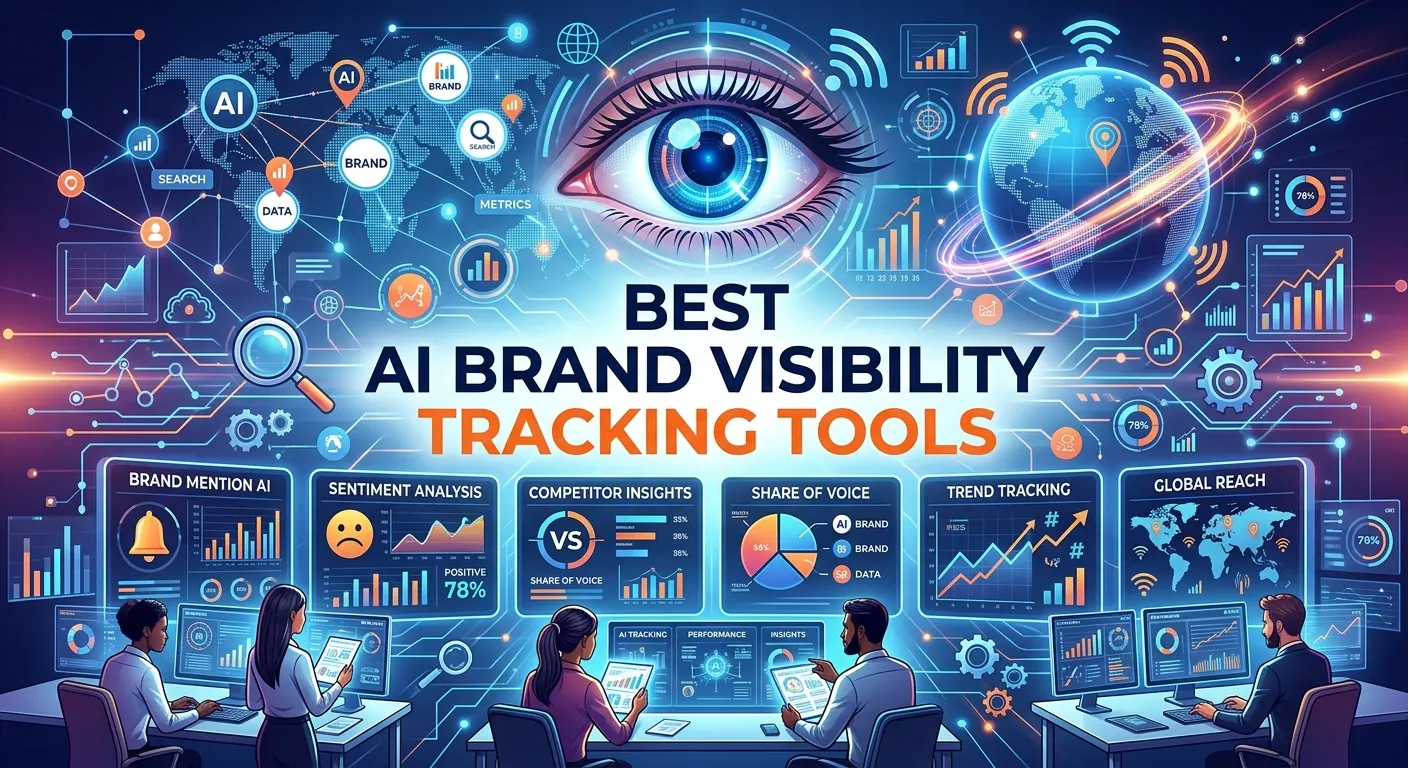
The best AI brand visibility tracking tools help answer that question. They monitor brand mentions, citations, competitors, prompts, sentiment, and share of voice across AI-powered search experiences. Unlike traditional rank trackers, these platforms focus on how brands appear inside generated answers.
For marketers, SEO professionals, agencies, and businesses, AI visibility tracking can improve productivity, efficiency, content strategy, automation, and decision-making. The right platform turns AI search data into practical opportunities for improving online visibility.
What Are the Best AI Brand Visibility Tracking Tools?
AI brand visibility tracking tools are software platforms that monitor how often and how prominently a brand appears in AI-generated answers. They can track systems such as ChatGPT, Perplexity, Gemini, Google AI Overviews, Google AI Mode, and other answer engines, depending on the platform.
Traditional SEO tools mainly measure rankings for keywords and URLs. AI visibility platforms measure different signals, including brand mentions, citations, recommendations, competitor appearances, sentiment, and share of voice. This makes them useful for understanding how AI systems represent a business.
The market has expanded quickly in 2026. Current tool comparisons include platforms such as Semrush, Ahrefs Brand Radar, Profound, Peec AI, Otterly.AI, Scrunch, AthenaHQ, and others. However, each platform has a different focus, so there is no single tool that is perfect for every business.
How AI Brand Visibility Tracking Works
Most AI visibility trackers start with a collection of prompts related to a brand, industry, product, or customer problem. The platform repeatedly checks how AI systems respond to those prompts and records whether the brand appears.
For example, a software company could track prompts such as “best project management software for small teams.” The system may record whether the company appears, where it appears in the answer, which competitors are mentioned, and which websites the AI cites.
The platform can then compare results over time. This makes it possible to identify visibility trends rather than isolated AI responses.
A useful tracking workflow usually looks like this:
- Define important customer questions.
- Create a structured prompt set.
- Track prompts across relevant AI platforms.
- Record brand mentions and citations.
- Monitor competitors.
- Compare visibility over time.
- Identify content and authority gaps.
- Take action and measure the results.
The goal is not simply to collect data. The goal is to understand why the brand appears or does not appear and use that information to improve its digital presence.
Key Metrics to Track for AI Brand Visibility
Choosing an AI visibility platform becomes easier when you understand its metrics. Different tools use different terminology, but several measurements appear frequently across the category.
Brand mention rate measures how often a brand appears in relevant AI responses. A higher rate can indicate stronger visibility for the tracked prompts.
Citation rate measures how frequently AI responses reference the brand’s website or other sources associated with the brand. Mentions and citations are not identical. A brand can be mentioned without receiving a direct citation.
Other useful metrics include:
- Share of voice
- Mention position
- Citation frequency
- Competitor visibility
- Sentiment
- Prompt coverage
- Source visibility
- Historical changes
- AI referral traffic
- Geographic visibility
The most useful metric depends on your goal. An SEO team may focus on citations and share of voice, while a PR team may care more about sentiment and brand mentions.
Features to Look for in AI Visibility Tracking Software
The best platform should provide more than a single visibility score. Detailed evidence is more useful than a mysterious number.
Look for prompt tracking, multiple AI engine coverage, competitor monitoring, citation analysis, historical reporting, and customizable dashboards. These features help teams understand exactly what changed.
Geographic and language controls can also matter for international brands. AI results can vary depending on the platform, prompt, location, and other contextual factors, so a serious measurement system should make its methodology clear.
Important features include:
- Multi-engine monitoring
- Custom prompt tracking
- Brand mention detection
- Citation analysis
- Competitor comparisons
- Share-of-voice measurement
- Sentiment analysis
- Historical trends
- Reporting and alerts
- API or integrations
- Team collaboration
- Actionable recommendations
Before buying, test whether the tool gives you enough detail to answer the most important question: what should I do with this data?
Best AI Brand Visibility Tracking Tools for Different Use Cases
Different tools serve different audiences. Some specialize in AI search analytics, while others combine AI visibility with traditional SEO and content workflows.
Current 2026 comparisons frequently highlight Semrush for combining AI visibility with broader SEO capabilities, Ahrefs Brand Radar for brands already using the Ahrefs ecosystem, Peec AI for deeper AI search analytics and agency workflows, and Otterly.AI as a more accessible dedicated visibility tracker.
Enterprise teams may prefer platforms such as Profound or Scrunch when they need deeper reporting, larger-scale monitoring, governance, or enterprise-oriented workflows.
A practical way to categorize tools is:
- SEO-focused teams: choose platforms that combine AI visibility with keyword and content data.
- Agencies: prioritize multi-client reporting and scalable prompt tracking.
- Small businesses: prioritize simple dashboards and affordable plans.
- Enterprise brands: look for governance, integrations, APIs, and advanced analytics.
- Content teams: prioritize citation analysis and content recommendations.
This approach is better than selecting a tool solely because it appears first in a “best tools” list.
AI Brand Mentions, Citations, and Share of Voice
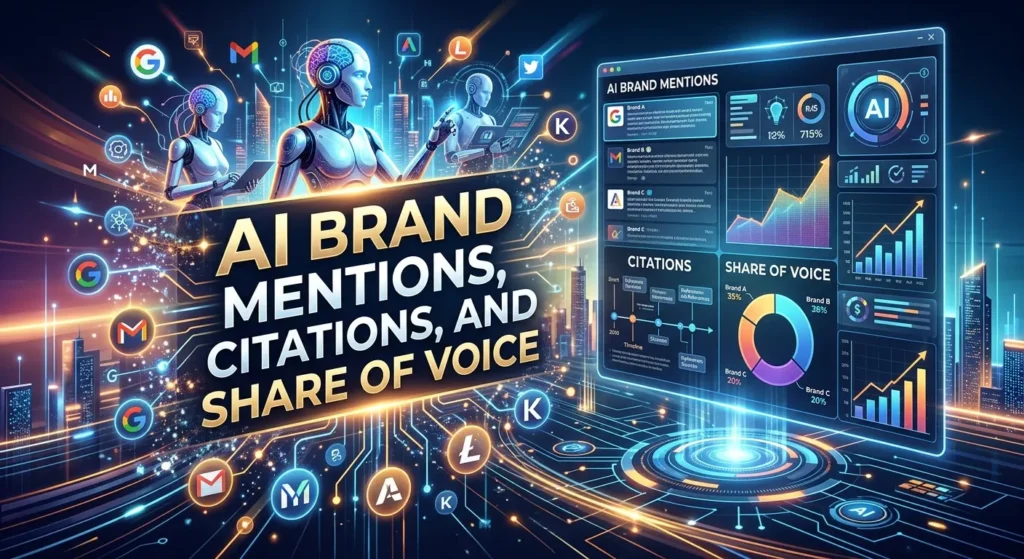
Three concepts are especially important in AI visibility measurement: mentions, citations, and share of voice.
A mention occurs when an AI-generated response names your brand. A citation refers to the source or page used to support the answer. Share of voice measures your visibility relative to competitors across a defined set of prompts.
These signals answer different questions. Mentions tell you whether the AI system recognizes your brand. Citations provide evidence about the sources supporting an answer. Share of voice shows how your presence compares with competing brands.
For example, imagine five competitors appear across 100 relevant prompts. Your brand appears in 35 responses while another competitor appears in 60. Even if your website ranks well in traditional Google results, the AI visibility data may reveal a different competitive picture.
That is why AI visibility tracking should complement—not simply replace—traditional SEO measurement.
Free vs Paid AI Brand Visibility Tracking Tools
Free tools and manual testing can help beginners understand the basics of AI search visibility. You can create a small prompt list and manually check how different AI systems respond.
However, manual tracking becomes difficult as the number of prompts and platforms increases. Results can change, and maintaining historical records requires significant time.
Paid platforms generally automate repetitive monitoring and add features such as historical tracking, competitor analysis, reporting, citation discovery, and larger prompt sets. Current 2026 market comparisons show entry-level AI visibility products at various price points, with enterprise platforms costing considerably more.
For a small website, start with a limited prompt set before purchasing an expensive platform. If manual tracking becomes too time-consuming, automation may provide a clear productivity benefit.
Pricing and ROI of AI Brand Visibility Tools
AI visibility software uses several pricing models. Some platforms offer monthly subscriptions based on prompts, projects, tracked brands, seats, or AI engines. Others target larger organizations with enterprise plans.
Published 2026 comparisons show a wide range of pricing. For example, some dedicated trackers begin around the lower end of the monthly subscription market, while enterprise platforms can cost several hundred dollars per month or more. Prices and included features change frequently, so businesses should verify current pricing before purchasing.
ROI should not be measured only by the number of AI mentions. Consider whether tracking helps you:
- Find content gaps.
- Improve important pages.
- Discover competitor advantages.
- Identify inaccurate brand information.
- Improve citations.
- Prioritize PR or content opportunities.
- Understand changing customer questions.
The best tool is therefore the one that turns visibility data into measurable business improvements.
AI Visibility Tools vs Traditional SEO Platforms
Traditional SEO platforms focus heavily on search rankings, keywords, backlinks, technical SEO, organic traffic, and website performance.
AI visibility platforms focus on a different environment. They examine generated answers, prompts, mentions, citations, competitors, and AI source selection.
The two approaches work well together. Traditional SEO can help build a strong website and content foundation, while AI visibility tracking can reveal how that information appears in AI-generated answers.
Some platforms now combine both approaches. Semrush, for example, positions its AI visibility capabilities alongside its broader SEO and content ecosystem. Ahrefs has also expanded its Brand Radar product to include AI search visibility.
For most brands, the strongest strategy is not SEO versus AI visibility. It is SEO plus AI visibility measurement.
Integrations and AI Search Optimization Workflows
Integrations can make AI visibility data more useful. Instead of keeping tracking information inside a separate dashboard, teams can connect it with existing SEO, analytics, content, reporting, or workflow systems.
For example, a marketing team could monitor prompts, identify a missing citation, assign a content task, update the relevant page, and then monitor future AI responses.
Advanced platforms may offer APIs or other data-access options for custom dashboards and internal systems. This is especially valuable for agencies and larger organizations managing many brands or markets. Current tool comparisons increasingly evaluate API access and workflow support as important differentiators.
A practical workflow is:
Track → Diagnose → Improve → Recheck → Report.
This creates a continuous optimization cycle rather than treating AI visibility as a one-time audit.
Use Cases for AI Brand Visibility Tracking
AI brand visibility tracking has applications across marketing, SEO, public relations, content strategy, product marketing, and competitive research.
An SEO team can identify questions where competitors receive AI recommendations but the company does not. A content team can discover which sources AI systems rely on and use those findings to improve its information architecture.
PR teams can monitor how external publications and other sources influence AI-generated brand narratives. This matters because third-party sources can strongly influence how AI systems describe companies. Recent industry research and reporting increasingly connects earned media and AI visibility.
Other use cases include:
- Competitor research
- Brand reputation monitoring
- Product discovery tracking
- Content gap analysis
- Citation research
- Customer question analysis
- International visibility monitoring
- AI search reporting
- Marketing strategy
- Generative Engine Optimization (GEO)
For e-commerce brands, tracking can also help reveal how AI systems recommend products and compare brands.
Pros and Cons of AI Brand Visibility Tracking Tools
AI visibility tracking provides a new measurement layer, but it is not perfect.
The biggest advantage is visibility into an environment traditional rank trackers cannot fully measure. Businesses can see which prompts matter, which competitors appear, and which sources AI systems use.
Another benefit is automation. Instead of repeatedly testing hundreds of questions manually, a tracking platform can organize and monitor them at scale.
However, there are limitations:
- AI responses can change between runs.
- Different platforms use different methodologies.
- Prompt wording can affect results.
- Geographic context can change results.
- Some tools measure different metrics.
- Visibility does not automatically equal revenue.
- No platform can guarantee AI recommendations.
Industry comparisons specifically note that AI-generated results can vary by model, prompt, location, and repeated runs.
Therefore, treat AI visibility metrics as directional business intelligence, not as an absolute ranking system.
Common Mistakes When Tracking AI Brand Visibility
One common mistake is tracking too many random prompts. A large number of irrelevant queries can create a lot of data without producing useful insights.
Instead, build prompts around real customer intent. Include informational, commercial, comparison, problem-solving, and product-specific questions.
Another mistake is focusing only on whether your brand appears. Context matters. A brand mention can be positive, neutral, or negative. A citation can come from a strong source or an outdated page. Competitor visibility can also reveal opportunities.
Avoid these common errors:
- Using irrelevant prompts
- Tracking only one AI platform
- Ignoring competitors
- Measuring mentions without citations
- Ignoring sentiment
- Treating AI results as permanent
- Publishing content solely to influence AI
- Failing to verify important information
- Ignoring traditional SEO
A better strategy is to create a small, high-quality prompt set and expand it as you learn which questions matter most.
How to Improve AI Brand Visibility After Tracking
Tracking is only useful if it leads to action. When your tool identifies a visibility gap, investigate the sources that AI systems already use for that topic.
Review your website content for clarity, factual accuracy, useful structure, strong evidence, and clear entities. Make important information easy for both users and search systems to understand.
Also examine third-party sources. If AI systems frequently cite industry publications, review sites, directories, research organizations, or other authoritative sources, earning accurate mentions in relevant publications may strengthen your overall digital presence.
Useful actions include:
- Improve important website pages.
- Answer specific customer questions.
- Add clear factual information.
- Strengthen internal linking.
- Update outdated content.
- Build credible third-party references.
- Improve brand consistency across the web.
- Monitor competitor citation sources.
- Recheck important prompts after changes.
The goal should be better information and stronger authority, not attempts to manipulate AI answers.
Latest AI Brand Visibility Trends and Future Developments
AI visibility tracking is becoming a more established part of digital marketing. In 2026, tools increasingly measure not only mentions but also citations, competitor share of voice, sentiment, prompt coverage, and source-level intelligence.
Another important development is the growing connection between AI visibility and GEO, AEO, SEO, PR, and content strategy. Brands are beginning to treat AI search as another discovery environment rather than a completely separate marketing channel.
The technology is also moving toward more actionable systems. Instead of simply showing a visibility score, newer platforms increasingly attempt to identify content gaps and recommend specific actions.
Future AI visibility platforms may focus more on:
- Real-time monitoring
- AI agent and shopping visibility
- More precise attribution
- Automated competitive intelligence
- Multilingual tracking
- Geographic analysis
- API-based workflows
- Better sentiment and factuality analysis
- Integration with content operations
AI search itself is also becoming more commercial. As AI-powered shopping and recommendation systems evolve, brands may need to measure not only whether they are mentioned, but whether AI systems make them discoverable, trustworthy, and actionable.
Conclusion
The best AI brand visibility tracking tools help businesses understand how they appear inside modern AI-powered search experiences. They provide insights that traditional keyword rankings alone cannot capture, including brand mentions, citations, competitors, share of voice, sentiment, and prompt-level visibility.
The right platform depends on your goals. A freelancer or small business may need a simple and affordable tracker. An agency may need multi-client reporting. An enterprise organization may require APIs, governance, advanced analytics, and broader AI engine coverage.
Most importantly, do not treat AI visibility as another vanity metric. Use it to discover real content gaps, competitive opportunities, citation sources, and customer questions. Combine AI visibility tracking with strong SEO, helpful content, credible sources, and genuine expertise.
As AI search continues to develop, brands that measure their presence early can make better decisions about content, SEO, PR, and digital strategy.
Frequently Asked Questions
What are AI brand visibility tracking tools?
AI brand visibility tracking tools monitor how brands appear in AI-generated answers. They can measure mentions, citations, competitors, share of voice, sentiment, and related metrics across AI search platforms.
Why is AI brand visibility important?
AI systems increasingly influence product research, recommendations, and comparisons. Tracking visibility helps businesses understand whether AI systems recognize and recommend their brand for relevant customer questions.
What is the difference between a brand mention and a citation?
A brand mention means an AI response names the brand. A citation generally refers to a source or page used to support the generated answer. A brand can receive a mention without receiving a direct citation.
Which AI platforms should businesses track?
The ideal coverage depends on the audience. Common platforms include ChatGPT, Perplexity, Gemini, Google AI Overviews, and Google AI Mode, with some tools also covering other AI answer engines.
Are AI visibility tracking tools worth paying for?
They can be worthwhile when the data leads to useful actions. Businesses should compare the tool’s cost with the value of identifying content gaps, competitor opportunities, citation sources, and changes in AI visibility.
Can AI visibility tools replace traditional SEO tools?
No. AI visibility and traditional SEO measure different environments. The strongest strategy generally combines organic search data with AI search visibility data.
How often should I track AI brand visibility?
For important commercial prompts, regular monitoring is useful because AI results can change. A weekly or monthly schedule may work for many teams, while high-priority brands may benefit from more frequent monitoring.
What is share of voice in AI search?
AI search share of voice measures how frequently a brand appears compared with competitors across a defined set of prompts. It helps show whether your brand is gaining or losing visibility relative to other companies.
What is GEO in AI search?
GEO commonly refers to Generative Engine Optimization. It describes strategies designed to improve a brand’s visibility and representation in AI-generated answers and other generative search experiences.
What should I do if competitors appear more often than my brand?
Start by analyzing the prompts where competitors appear. Review their cited sources, content coverage, brand information, and authority signals. Then improve your own content and relevant third-party presence based on genuine information gaps.