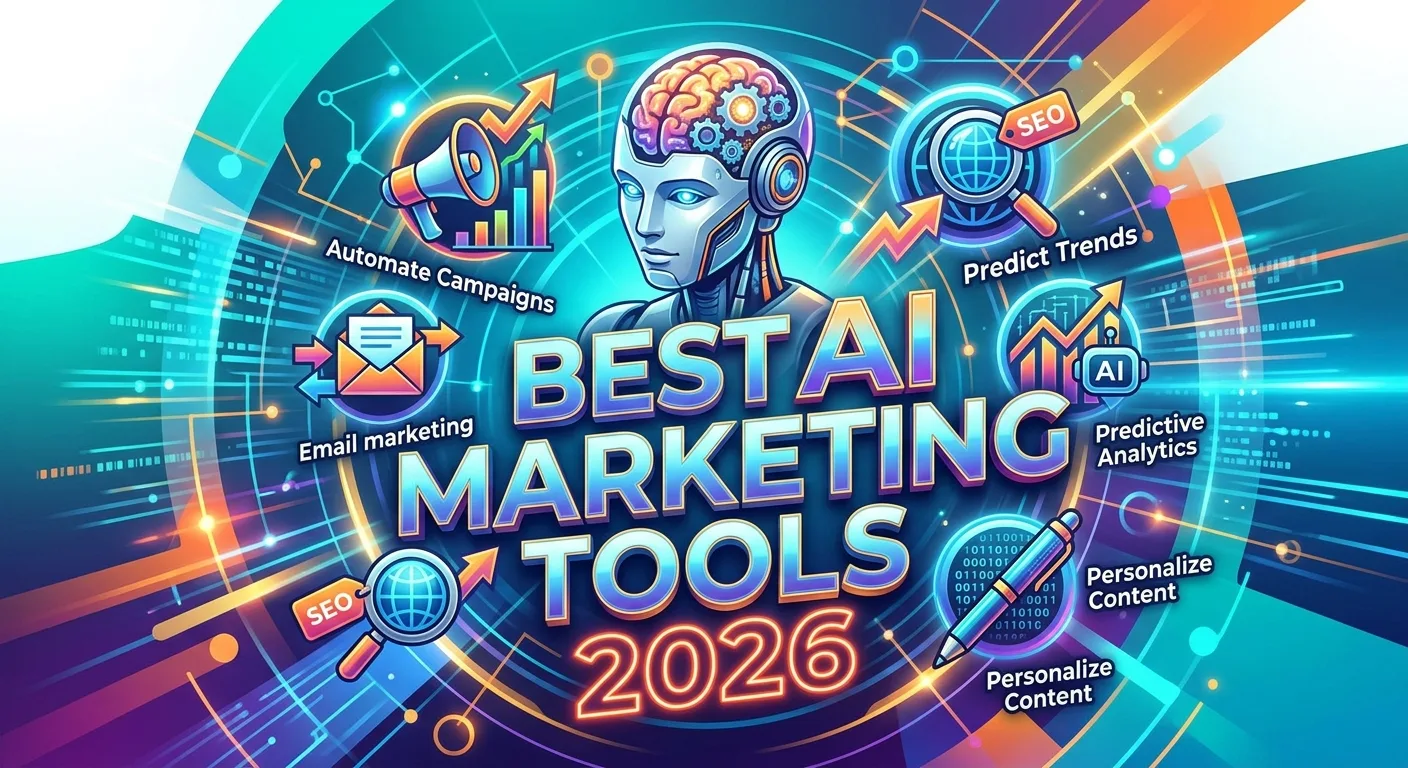
AI has changed how businesses plan, create, analyze, and improve their marketing campaigns. In 2026, the best AI marketing tools help marketers save time, understand customers, automate repetitive work, and create better content. These tools can support everything from SEO and social media to email marketing, advertising, customer research, analytics, and lead generation.
The biggest advantage is not simply automation. Modern AI marketing software can turn large amounts of data into useful insights and help teams make faster decisions. A small business can use AI to compete with larger brands, while agencies can manage more campaigns with fewer manual tasks. However, choosing the right platform matters because every tool has different strengths, pricing models, integrations, and limitations.
This guide explains the best AI marketing tools in 2026, how they work, where they fit into a marketing workflow, and how to choose the right solutions for your goals.
What Are the Best AI Marketing Tools in 2026?
The best AI marketing tools in 2026 are software platforms that use artificial intelligence to improve marketing tasks such as content creation, SEO, customer research, advertising, email campaigns, social media, analytics, and automation.
AI marketing software can analyze information much faster than a person working manually. For example, an AI platform may examine search data, customer behavior, campaign results, or competitor content and then identify useful patterns.
Different businesses need different tools. A freelancer may need an AI writing and social media platform. An ecommerce store may benefit more from AI product recommendations, advertising optimization, and customer support. An SEO agency may prioritize keyword research, content optimization, and AI search visibility.
A useful AI marketing stack usually combines several specialized capabilities rather than depending on one platform for everything. The best tool is the one that solves your specific marketing problem efficiently and reliably.
How AI Marketing Tools Work
AI marketing tools typically combine machine learning, natural language processing, predictive analytics, automation, and generative AI. These technologies allow software to understand data, recognize patterns, generate content, and recommend actions.
For example, an AI content platform can analyze a topic and generate an outline. An SEO tool can evaluate search intent and competing pages. An advertising platform can use campaign data to identify audiences and optimize performance.
The quality of the result depends heavily on the information provided to the system. Clear goals, accurate data, and detailed instructions usually produce better outcomes.
Marketers should also review AI-generated work before publishing it. AI should support human decision-making rather than replace strategy, fact-checking, brand judgment, and creativity.
Key Features to Look for in AI Marketing Software
When comparing AI marketing software, start with the features that directly support your marketing goals. Look for capabilities such as content generation, SEO analysis, audience insights, campaign automation, analytics, personalization, workflow automation, and integrations.
Ease of use also matters. A powerful platform can become expensive and inefficient if your team struggles to learn it. Look for intuitive dashboards, useful reporting, clear controls, and good documentation.
Data privacy should receive equal attention. Marketing platforms may process customer information, campaign data, or business documents. Review the provider’s privacy practices and understand how your information is handled.
Integration is another important factor. An AI marketing tool becomes more useful when it works with your CRM, analytics platform, email system, ecommerce platform, advertising accounts, or content management system.
Best AI Tools for Content Marketing and Copywriting
AI has become an important part of content marketing. Modern writing tools can help marketers brainstorm topics, create outlines, draft copy, rewrite text, summarize research, and generate variations for different channels.
For example, a content team can use AI to develop blog post ideas from customer questions. A marketer can then turn one article into social media posts, email content, short video scripts, and ad concepts.
However, publishing raw AI-generated content without review can create problems. Content may contain inaccurate claims, generic language, or ideas that do not reflect the company’s expertise.
The strongest workflow combines AI speed with human expertise. Use AI for research organization and first drafts, then add original insights, examples, experience, verification, and brand personality.
For SEO content, focus on satisfying the reader rather than repeating keywords. Search engines and AI-powered search systems increasingly reward useful, trustworthy, well-structured information.
Best AI SEO and Search Marketing Tools
AI SEO tools help marketers improve organic search performance by analyzing keywords, search intent, content quality, competitors, technical issues, and search visibility.
Many platforms can identify related keywords and topics that help build topical coverage. Others analyze competing pages and provide suggestions for improving headings, content depth, internal links, or semantic relevance.
AI search has also expanded beyond traditional blue-link rankings. Marketers increasingly need to understand how their brands appear in AI-generated answers, summaries, and conversational search experiences.
A strong AI SEO workflow should therefore monitor traditional rankings, organic traffic, content performance, brand mentions, citations, and AI search visibility.
Do not blindly follow every recommendation from an automated SEO platform. Review suggestions against your audience, industry, search intent, and business objectives.
Best AI Marketing Tools for Social Media
Social media marketing involves continuous content planning, writing, publishing, monitoring, and analysis. AI can reduce the manual workload involved in these activities.
AI social media tools can help generate post ideas, create captions, adapt content for different platforms, identify engagement patterns, and organize publishing schedules. Some platforms also provide analytics that help marketers understand which content performs best.
For example, a small business could turn one long-form article into several short social posts. The marketer can then adjust each version to match the tone and format of the specific platform.
AI can also help identify patterns in comments and customer conversations. However, automated replies should be used carefully. Human review is especially important when responding to complaints, sensitive issues, or complex customer questions.
The goal is not to make social media feel robotic. Use AI to increase consistency and speed while keeping the brand’s human voice.
Best AI Email Marketing and Personalization Tools
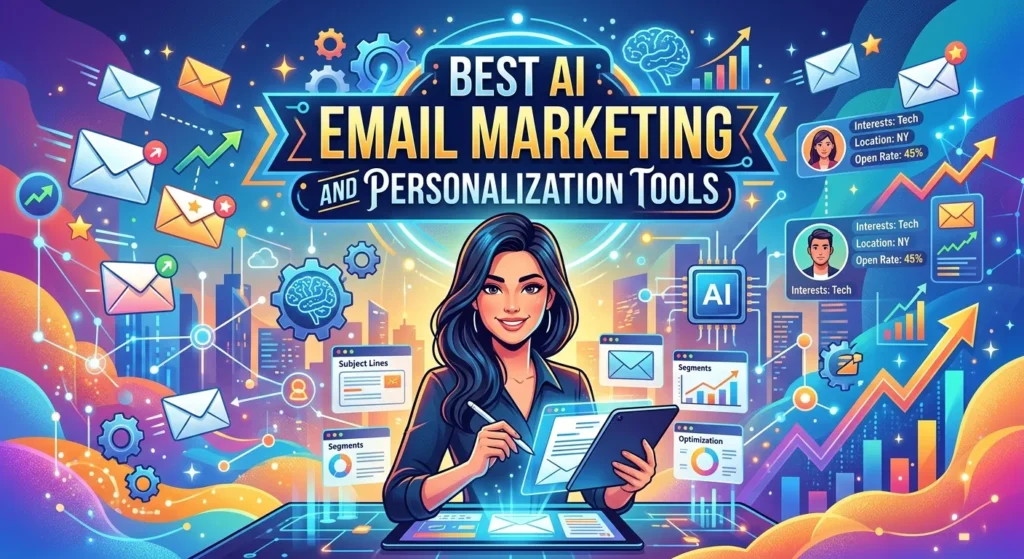
Email marketing is another area where AI can improve efficiency. AI-powered email platforms can help marketers create subject lines, draft messages, segment audiences, personalize campaigns, and analyze engagement.
Personalization can go beyond simply adding a customer’s name. AI can help marketers organize audiences based on behavior, interests, purchase history, engagement, or other appropriate business signals.
For example, an ecommerce company may create different email campaigns for first-time visitors, returning customers, and existing buyers.
AI can also help identify patterns in campaign performance. If one type of message consistently produces stronger engagement, marketers can use those insights when planning future campaigns.
Still, personalization should respect privacy and user expectations. Use customer data responsibly and avoid personalization that feels intrusive or misleading.
Best AI Marketing Tools for Advertising and Paid Campaigns
Paid advertising can generate large amounts of data. AI can help marketers analyze campaign performance and identify opportunities to improve targeting, creative testing, budgets, and messaging.
AI advertising systems can evaluate different signals and optimize campaigns according to defined objectives. Marketers can also use generative AI to create multiple ad copy variations and creative concepts for testing.
For example, a business might create several headline variations for the same offer. AI can help produce the initial versions, while the marketing team chooses the most relevant messages.
The important point is that AI optimization works best when the campaign has a clear objective. Define whether you want leads, sales, website visits, app installations, or another measurable outcome.
Monitor results carefully. Never assume an AI-generated campaign will automatically be profitable. Track actual business outcomes rather than focusing only on clicks or impressions.
Best AI Tools for Customer Research and Marketing Analytics
Understanding customers is one of the most valuable uses of AI in marketing. Analytics tools can process large datasets and identify trends that may be difficult to notice manually.
AI can help marketers analyze customer feedback, website behavior, campaign performance, survey responses, and other business data. This can reveal common questions, product interests, customer concerns, and content opportunities.
For example, a company could analyze thousands of customer support messages to identify recurring problems. The marketing team could then create content addressing those issues.
AI analytics can also support forecasting and campaign planning. However, predictions are not guarantees. Market conditions, customer behavior, competitors, and external events can change quickly.
Use AI insights as decision support. Combine automated analysis with human interpretation and reliable source data.
Free vs Paid AI Marketing Tools
Free AI marketing tools can be useful for beginners, freelancers, students, and small businesses. They allow users to test features without committing to a subscription.
However, free plans often come with limitations. These may include usage caps, fewer integrations, limited analytics, restricted automation, slower processing, or fewer advanced features.
Paid tools usually offer more capacity and functionality. Depending on the platform, a subscription may provide advanced analytics, team collaboration, automation, customer support, API access, or higher usage limits.
Before paying, identify the specific problem you want to solve. Do not buy an AI marketing platform simply because it has a long list of features.
A practical approach is to start with a free or trial version when available. Test it using real marketing tasks and measure whether it actually saves time or improves results.
AI Marketing Tool Pricing, ROI, and Value
AI marketing pricing can range from free plans to expensive enterprise subscriptions. Some tools charge monthly fees, while others use usage-based pricing, credits, seats, or custom enterprise packages.
The cheapest tool is not necessarily the best value. A platform that costs more but saves several hours every week may produce better ROI than a cheap tool that requires extensive manual work.
To calculate value, consider both direct and indirect benefits. Direct benefits may include increased leads, sales, conversions, or traffic. Indirect benefits can include saved working hours, faster campaign production, and improved decision-making.
For example, if an AI tool saves a marketing team ten hours each week, those saved hours can be used for strategy, customer research, creative development, or sales activities.
Track measurable outcomes before and after implementation. Good AI marketing software should create measurable business value, not just impressive demonstrations.
AI Marketing Integrations and Automation Workflows
Integrations allow AI marketing tools to work as part of a larger technology stack. Common integrations include CRM systems, email platforms, analytics tools, ecommerce systems, advertising platforms, content management systems, and project management software.
Automation can connect multiple steps in a workflow. For example, a new lead might enter a CRM, receive an appropriate email, trigger a task for a sales representative, and appear in an analytics dashboard.
This reduces repetitive manual work and helps teams maintain consistency.
However, automation needs safeguards. Build approval steps for important activities such as customer communication, advertising changes, publishing, or data processing.
Start with simple workflows before creating complex automation. Automate repetitive tasks first, then gradually automate more advanced processes after testing the results.
AI Marketing Tools for Small Businesses, Freelancers, and Agencies
Small businesses can use AI marketing tools to perform tasks that previously required larger teams. Content planning, social media scheduling, email campaigns, customer research, and analytics can become more manageable.
Freelancers can also use AI to improve productivity. For example, a freelance marketer can use AI for campaign research, content ideation, reporting, and workflow organization while keeping strategy and client communication personal.
Agencies may need more advanced systems. They often require team permissions, multiple client workspaces, reporting, integrations, automation, and scalable pricing.
The right setup depends on workload and business size. Small teams should prioritize simplicity and ROI, while agencies should also consider scalability and collaboration.
Avoid building an unnecessarily complicated marketing stack. A small company may need only a few well-connected tools rather than dozens of separate subscriptions.
Pros, Cons, and Limitations of AI Marketing Tools
AI marketing tools provide major advantages. They can increase productivity, speed up content production, analyze large datasets, support personalization, automate repetitive tasks, and help marketers discover new ideas.
They can also help smaller teams compete more effectively. Instead of spending hours on repetitive research or drafting, marketers can focus more time on strategy and creative thinking.
There are also limitations. AI can generate incorrect information, misunderstand context, produce repetitive content, or make recommendations based on incomplete data.
Privacy, security, cost, and over-automation are additional concerns. Excessive automation can make customer interactions feel impersonal.
The best approach is balanced. Use AI where it creates clear value, but keep humans responsible for strategy, accuracy, ethics, quality control, and important decisions.
Common AI Marketing Mistakes and How to Avoid Them
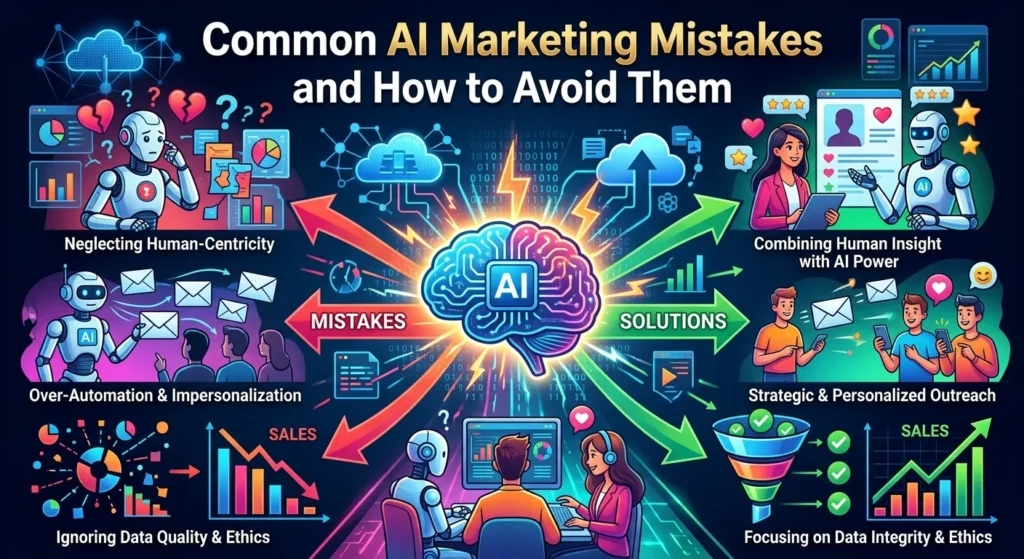
One common mistake is choosing tools based on hype rather than business needs. A popular AI platform may not be the right solution for your workflow.
Another mistake is trusting AI output without checking it. Generated content can contain factual errors, unsupported claims, or wording that does not match your brand.
Keyword stuffing is another problem. AI can generate large amounts of SEO content quickly, but publishing excessive low-value material can hurt the user experience.
Businesses should also avoid automating everything immediately. Start with low-risk repetitive tasks and measure the results.
A better strategy is to create an AI marketing workflow with human review. Define objectives, establish quality standards, test outputs, monitor performance, and improve the system over time.
Latest AI Marketing Trends and Future Developments
AI marketing is moving toward more connected and autonomous workflows. Instead of using separate tools for individual tasks, marketers increasingly expect platforms to connect research, content, analytics, automation, and optimization.
Generative AI will continue to support text, image, audio, and video creation. At the same time, marketers will need stronger systems for brand consistency, content quality, factual verification, and responsible AI use.
AI search visibility is another major development. Businesses now need to understand not only where they rank in traditional search but also how their brand appears in AI-generated answers.
Personalization and predictive analytics are also likely to become more sophisticated. AI systems can help marketers identify patterns and adapt campaigns more quickly.
The future will not simply belong to businesses using the most AI. It will favor businesses that combine AI efficiency with strong data, original expertise, creative thinking, customer understanding, and trustworthy brand communication.
Frequently Asked Questions
What are the best AI marketing tools in 2026?
The best AI marketing tools depend on your needs. Common categories include AI SEO platforms, content tools, social media software, email marketing systems, advertising platforms, analytics solutions, and marketing automation tools.
Are AI marketing tools free?
Some AI marketing tools offer free plans or limited free features. Paid plans usually provide higher usage limits, advanced features, integrations, automation, and analytics.
Can AI replace marketing professionals?
AI can automate many repetitive marketing tasks, but it does not fully replace human strategy, creativity, judgment, relationship building, and business understanding. The strongest approach combines AI with human expertise.
Are AI marketing tools good for small businesses?
Yes. AI can help small businesses create content, analyze data, manage social media, support SEO, and automate repetitive tasks without requiring a large marketing department.
How can I choose the right AI marketing tool?
Start by identifying one specific marketing problem. Compare features, pricing, integrations, ease of use, data policies, support, and expected ROI. Test the tool before making a long-term commitment when possible.
Are AI marketing tools useful for SEO?
Yes. AI SEO tools can support keyword research, content optimization, competitor analysis, technical SEO, search intent analysis, and AI search visibility monitoring. Human review remains important.
Can AI marketing tools improve productivity?
Yes. They can reduce repetitive work, accelerate research and content creation, organize information, automate workflows, and help marketers make faster data-informed decisions.
What is the biggest risk of using AI in marketing?
One major risk is relying on AI output without human review. Incorrect information, poor personalization, privacy problems, generic content, and excessive automation can reduce trust and marketing performance.
Should businesses use multiple AI marketing tools?
They can, but more tools do not always mean better results. Choose a small set of complementary platforms that integrate well and solve important business problems.
What is the future of AI marketing?
AI marketing is moving toward deeper automation, multimodal content creation, predictive analytics, personalization, AI search optimization, and connected marketing workflows. Human expertise will remain important for strategy and trust.
Conclusion
The best AI marketing tools 2026 can help businesses work faster, create better campaigns, analyze information, automate repetitive tasks, and improve customer experiences. From SEO and content creation to email, social media, advertising, analytics, and automation, AI now supports almost every part of modern marketing.
But successful AI marketing is not about using as many tools as possible. It is about choosing technology that solves real problems and produces measurable value.
Start with one important workflow. Test an appropriate AI tool. Measure the results. Keep human oversight where quality and trust matter. Then expand your AI marketing system gradually.
As AI search, automation, personalization, and generative technology continue to develop, businesses that combine smart technology with original expertise and customer-focused strategy will be better prepared for the future.