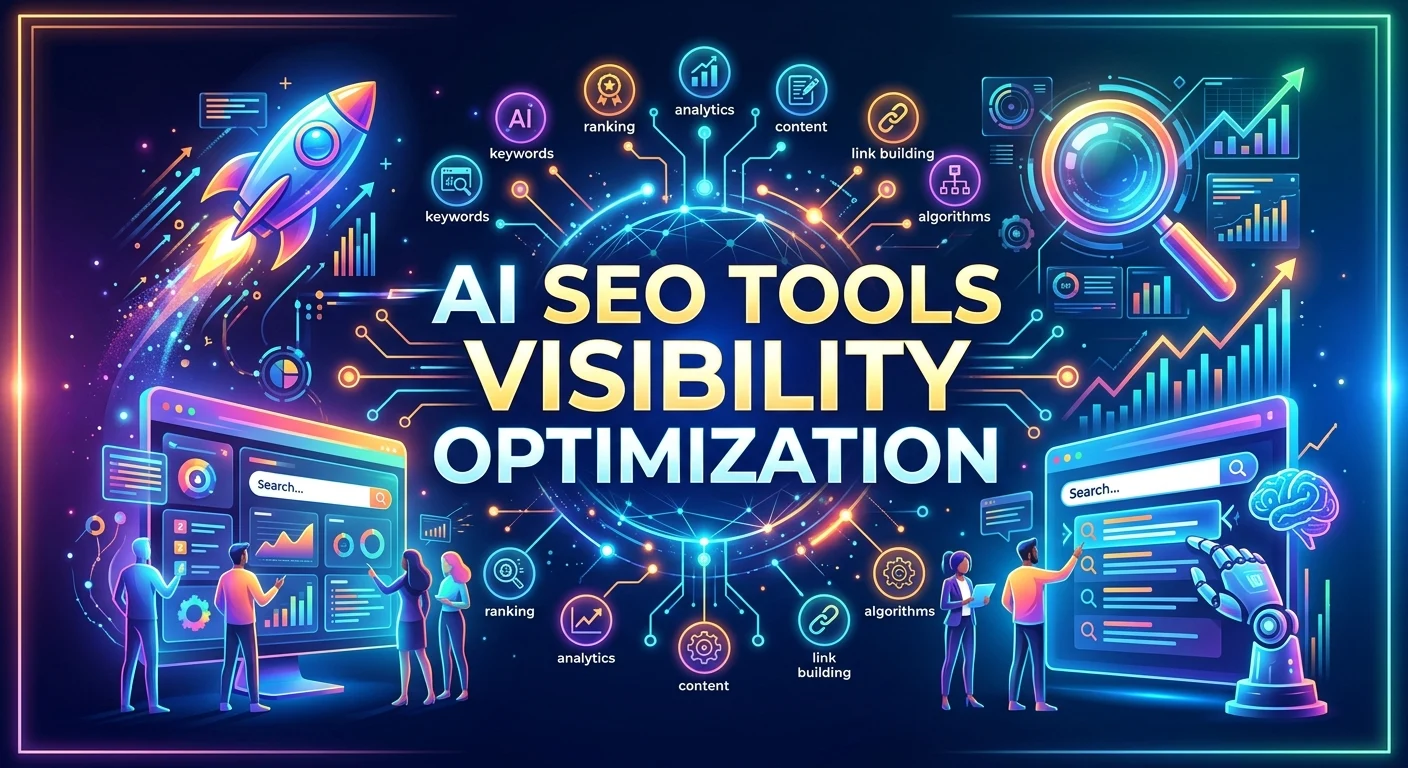
Search is changing rapidly as AI becomes a bigger part of how people discover information, products, services, and brands. AI SEO tools visibility optimization combines traditional search engine optimization with AI-powered analysis to help websites become easier to discover, understand, and recommend across modern search experiences. These tools can analyze keywords, content quality, technical SEO, competitors, search intent, entities, citations, and AI-generated search results.
They can also automate repetitive tasks, helping marketers improve productivity, efficiency, creativity, innovation, and real-world performance. Instead of guessing what search engines or AI systems need, businesses can use data to identify opportunities and improve their digital presence. This guide explains how AI SEO tools work, their most important features, benefits, use cases, pricing considerations, optimization strategies, common mistakes, and future developments.
What Is AI SEO Tools Visibility Optimization?
AI SEO tools visibility optimization is the process of using artificial intelligence-powered SEO software to improve how easily a website, brand, product, or piece of content can be discovered through search engines and AI-powered search experiences.
Traditional SEO focuses heavily on keywords, rankings, backlinks, technical performance, and organic traffic. AI-powered SEO adds more advanced analysis, including search intent, content relationships, semantic relevance, entities, competitor patterns, and AI-generated search visibility.
The goal is not simply to rank for one keyword. Modern optimization aims to build topical authority and useful content that clearly answers users’ questions.
For example, instead of creating one article around “best project management software,” a company might build a complete content cluster covering project management features, pricing, comparisons, use cases, integrations, implementation, and common problems. AI SEO tools can help identify these related opportunities.
How AI SEO Tools Improve Search Visibility
AI SEO tools process large amounts of search and content data much faster than manual research. Depending on the platform, they can analyze keywords, competitors, pages, content structure, technical problems, backlinks, and search trends.
A typical workflow starts with keyword and intent research. The tool identifies relevant search terms and groups them according to informational, commercial, navigational, or transactional intent.
The next step involves content analysis. AI can compare existing pages with competing results and identify missing topics, weak sections, unclear answers, or opportunities for stronger semantic coverage.
Some tools also monitor changes in rankings and AI-generated results. This allows marketers to see whether optimization efforts are producing measurable improvements.
The important principle is that AI should support decision-making rather than replace it. Human review remains essential for accuracy, originality, expertise, and brand quality.
Key Features of AI SEO Visibility Optimization Tools
Modern AI SEO platforms can offer many features, but several are especially useful for visibility optimization. AI keyword research can identify related queries, long-tail keywords, questions, and search intent.
Content optimization is another major feature. AI can analyze a page and recommend improvements to headings, topic coverage, readability, internal linking, and semantic relevance.
Competitor analysis can reveal which topics competing websites cover successfully. This information can help identify content gaps without simply copying competitors.
Other features may include rank tracking, technical SEO audits, backlink analysis, content briefs, entity optimization, schema recommendations, AI visibility monitoring, automated reports, and integrations.
When choosing a platform, focus on the features that solve actual problems. A large feature list does not necessarily mean better SEO results.
Benefits of AI SEO Tools for Website Visibility
One major advantage of AI SEO tools is speed. Tasks that previously required hours of manual research can often be completed much faster.
AI can also improve consistency. A content team can use standardized workflows for keyword research, content briefs, optimization checks, and performance monitoring.
Another benefit is better data analysis. AI can detect relationships between topics and search queries that may be difficult to identify manually.
These tools can also support creativity. Instead of spending most of their time collecting data, marketers can spend more time developing useful content, original ideas, expert insights, and better user experiences.
However, AI does not guarantee rankings. Search visibility depends on many factors, including content quality, relevance, competition, technical performance, authority, user satisfaction, and search engine behavior.
AI SEO Tools for Keyword and Search Intent Optimization
Keywords remain useful, but modern SEO requires more than repeating exact phrases. Search engines increasingly understand meaning, context, entities, relationships, and user intent.
AI SEO tools can help identify clusters of related queries. For example, a primary keyword about “email marketing software” could connect to questions about automation, templates, analytics, segmentation, pricing, integrations, and deliverability.
Search intent should guide content decisions. An informational query usually needs educational content, while a commercial query may require comparisons, features, pricing information, reviews, and practical recommendations.
AI tools can classify and organize these patterns quickly. However, marketers should manually review the suggestions because automated keyword grouping can sometimes misunderstand context.
A strong strategy is to select keywords based on relevance, intent, business value, competition, and content usefulness, rather than search volume alone.
AI Content Optimization for Better Search Visibility
AI content optimization involves using artificial intelligence to identify ways to make existing or planned content more useful and relevant.
A good optimization process begins with the searcher’s question. The content should provide a clear answer early, then expand with supporting information, examples, explanations, and actionable advice.
AI can help identify missing subtopics and related concepts. It can also suggest better heading structures and internal linking opportunities.
However, publishing generic AI-generated text at scale can create weak content. Original experience, expert knowledge, examples, evidence, and useful analysis make content more valuable.
For example, an AI tool might recommend adding a section about pricing. A skilled writer can improve that recommendation by explaining what customers should evaluate when comparing pricing models and what hidden costs they should consider.
The best approach is therefore AI-assisted optimization rather than AI-only content production.
AI Search Visibility Beyond Traditional Google Rankings
Search visibility is becoming broader than conventional organic rankings. AI-powered search experiences can generate direct answers and may reference multiple sources.
This creates an additional optimization question: Does AI recognize and use my content when answering relevant questions?
AI visibility monitoring tools can track brand mentions, citations, source appearances, competitors, and other signals. The exact metrics differ between platforms.
A website may rank well for a traditional keyword but receive limited representation in AI-generated answers. Conversely, a highly useful resource may become a cited source even when its traditional ranking is not number one.
This does not mean traditional SEO is no longer important. Technical SEO, useful content, internal links, authority, and discoverability can still contribute to a strong search presence.
Modern optimization should therefore consider both conventional search visibility and AI-generated discovery.
AI SEO Tools for Competitor and Content Gap Analysis
Competitor analysis is one of the most practical applications of AI SEO software. Instead of manually opening hundreds of competitor pages, marketers can use AI to identify patterns across large datasets.
A tool may reveal which topics competitors cover, which keywords they target, which pages attract links, or where their content appears stronger.
Content gap analysis then turns those observations into opportunities. If several competitors provide detailed resources about a topic that your website barely covers, that may indicate an opportunity to create a better resource.
The goal should not be to copy competitors. Differentiation matters.
A stronger strategy is to identify the common information users need and then add something competitors lack. That might include original research, clearer explanations, expert examples, updated information, practical templates, or a more useful structure.
Technical SEO and AI-Powered Visibility Optimization
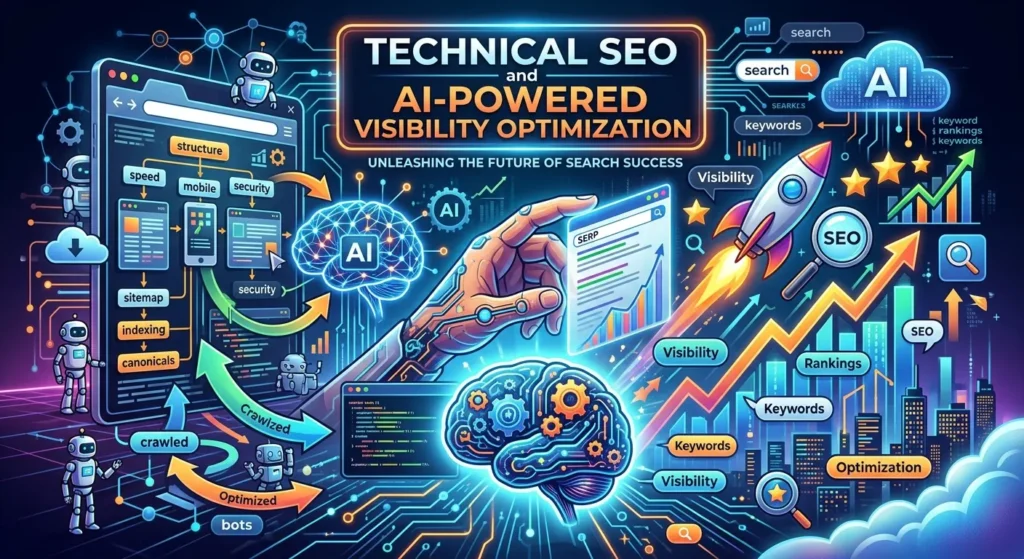
Content quality cannot compensate for every technical problem. Search engines need to crawl, understand, and access a website efficiently.
AI SEO tools can help identify issues involving broken links, indexing, redirects, metadata, duplicate content, page performance, structured data, internal links, and site architecture.
Technical optimization should support users first. Fast-loading pages, logical navigation, mobile usability, accessible content, and clear page structures create a better experience.
AI can prioritize technical problems based on potential impact, which can be useful for large websites with thousands of URLs.
Still, recommendations should be reviewed before implementation. A technically correct suggestion in one situation may be inappropriate for a particular website architecture.
The best workflow combines automated technical auditing with human validation.
AI SEO Tools, Entities, and Semantic Search Optimization
Search engines increasingly need to understand what a website is about, which organizations it discusses, and how different concepts relate to one another.
This is where entities and semantic SEO become important. An entity can represent a person, organization, place, product, concept, or other identifiable subject.
AI SEO tools can help identify related entities and concepts that belong naturally within a topic. This can make content more comprehensive and easier for search systems to interpret.
For example, an article about cloud computing may naturally discuss infrastructure, servers, virtualization, storage, security, scalability, software platforms, and deployment models.
The goal is not to insert unrelated terms. Semantic optimization should create a clear information network around the main subject.
A useful rule is: write for complete understanding, not for keyword density.
Free vs Paid AI SEO Tools for Visibility
Free AI SEO tools can be useful for beginners, freelancers, students, and small websites. They may provide basic keyword suggestions, content analysis, technical checks, or limited visibility monitoring.
Their main advantage is accessibility. Users can learn SEO workflows without immediately committing to a subscription.
However, free tools often limit the number of queries, projects, reports, tracked keywords, or advanced features.
Paid platforms generally provide greater scale. Depending on the provider, they may offer historical data, competitor monitoring, automated reports, API access, advanced content analysis, team collaboration, and larger keyword databases.
The right choice depends on your needs. A small blog may need only basic research, while an agency managing multiple websites may benefit from advanced automation.
Before paying, evaluate data quality, usability, accuracy, integrations, support, limits, and business value, not just the number of features.
Pricing, ROI, and Choosing the Right AI SEO Tool
AI SEO software can follow different pricing structures. Some platforms charge based on users, tracked keywords, projects, content volume, credits, or feature tiers.
The cheapest tool is not always the best option. A platform that saves significant research and reporting time may provide more value than a cheaper platform that requires extensive manual work.
Consider the workflow you want to improve. If keyword research consumes most of your team’s time, prioritize strong research features. If content optimization is the bottleneck, focus on content analysis. If AI search is your main concern, prioritize AI visibility monitoring.
ROI should be connected to meaningful outcomes such as organic traffic, qualified leads, conversions, revenue, content production efficiency, and time saved.
Avoid measuring success only by the number of keywords or AI recommendations generated. More data does not automatically mean better business results.
Integrating AI SEO Tools Into a Complete SEO Workflow
AI SEO tools work best when they become part of a repeatable workflow rather than isolated software.
A practical workflow begins with research. Identify target audiences, business goals, customer questions, search intent, keywords, and competitors.
Next, create a content strategy. Organize topics into clusters and determine which pages should target broad topics and which should answer specific questions.
Then create or update content. Use AI for research assistance, outlines, content analysis, optimization suggestions, and repetitive tasks while maintaining human editorial control.
After publishing, monitor results. Track rankings, traffic, conversions, backlinks, indexing, and AI search visibility where appropriate.
Finally, improve continuously. Search behavior changes, competitors publish new content, and AI systems evolve. SEO should be treated as an ongoing optimization cycle, not a one-time project.
Common AI SEO Visibility Optimization Mistakes
One of the biggest mistakes is relying completely on AI-generated content. Automated writing can produce repetitive or inaccurate material that provides little original value.
Another mistake is keyword stuffing. Adding a keyword repeatedly can make content unnatural and does not create genuine topical authority.
Some marketers also optimize only for tools. They follow every automated recommendation without asking whether the change improves the actual user experience.
Ignoring original expertise is another problem. AI can summarize existing information, but strong content often requires human experience, testing, examples, opinions supported by evidence, and firsthand knowledge.
Finally, businesses should avoid chasing every new AI SEO trend. Sustainable optimization depends on useful content, technical quality, trustworthy information, and a clear understanding of the audience.
Latest AI SEO Visibility Trends and Future Developments
AI SEO is moving toward a broader concept of search visibility optimization. The focus is gradually expanding from individual rankings toward how brands and information are discovered across multiple search interfaces.
AI-generated answers, conversational search, multimodal search, and AI assistants may influence how users discover information. This means websites need content that is easy for both people and machines to understand.
Another trend is greater emphasis on brand authority. When AI systems answer complex questions, trustworthy sources and recognizable entities can become important parts of the information ecosystem.
Automation will also continue to improve. Future AI SEO platforms may connect keyword research, content analysis, technical auditing, competitor monitoring, and AI visibility measurement into unified workflows.
However, the fundamentals will remain important. Useful information, accurate claims, strong expertise, good website architecture, and genuine user value are likely to remain central to sustainable search visibility.
Businesses should prepare by building adaptable content systems instead of relying on one search feature or one AI platform.
Conclusion
AI SEO tools visibility optimization represents an important evolution in digital marketing. AI-powered tools can help businesses research topics, understand search intent, analyze competitors, improve content, identify technical issues, monitor rankings, and measure emerging AI search visibility.
The biggest opportunity is not simply automation. It is using automation to make better decisions. When repetitive analysis becomes faster, marketers can spend more time creating original resources, improving customer experiences, and developing stronger strategies.
A successful approach combines AI technology with human expertise. Use AI to identify patterns and opportunities, but review recommendations carefully. Verify important information, add original insights, avoid low-quality mass production, and keep the audience at the center of every optimization decision.
As search continues to evolve through AI-generated answers and conversational discovery, visibility will become increasingly multidimensional. Businesses that build useful content, maintain strong technical foundations, monitor performance, and adapt to new search behaviors will be better prepared for the future.
FAQs About
What is AI SEO tools visibility optimization?
AI SEO tools visibility optimization is the use of AI-powered SEO software to improve a website’s discoverability across traditional search engines and emerging AI-powered search experiences.
How do AI SEO tools improve website visibility?
They can help with keyword research, search intent analysis, content optimization, competitor research, technical SEO, internal linking, rank tracking, and AI search visibility monitoring.
Are AI SEO tools better than traditional SEO tools?
Not necessarily. AI SEO tools often add automation and advanced analysis, while traditional SEO platforms remain valuable for rankings, backlinks, traffic, and technical data. Using both can create a stronger workflow.
Can AI SEO tools guarantee higher rankings?
No. No legitimate SEO tool can guarantee search rankings. Search visibility depends on many factors, including relevance, content quality, competition, technical performance, authority, and search engine algorithms.
Are free AI SEO tools worth using?
Yes, especially for beginners and small projects. Free tools can help with basic research and learning, although paid platforms often provide greater data coverage and automation.
How can AI improve content SEO?
AI can identify related topics, search intent, content gaps, readability issues, semantic concepts, and optimization opportunities. Human review should remain part of the publishing process.
What is AI search visibility?
AI search visibility describes how frequently and prominently a brand, website, product, or source appears in AI-generated answers and AI-powered search experiences.
Should I optimize content specifically for AI search?
You should create content that is clear, accurate, useful, well-structured, and comprehensive. These qualities can help both human readers and automated systems understand the information.
What is semantic SEO?
Semantic SEO focuses on meaning, context, related concepts, entities, and relationships rather than relying only on exact keyword matches.
How often should I use AI SEO tools?
Use them as part of a continuous workflow. Regular research, monitoring, technical auditing, and content updates can help you respond to changes in search behavior and competition.
What is the future of AI SEO?
AI SEO is likely to expand beyond traditional ranking reports toward broader visibility measurement across AI-generated answers, conversational search, multimodal discovery, brand mentions, citations, and automated optimization workflows.
This version maintains exactly 15 H2 headings, keeps the FAQs as H3s, and uses the exact primary keyword as the only H1.