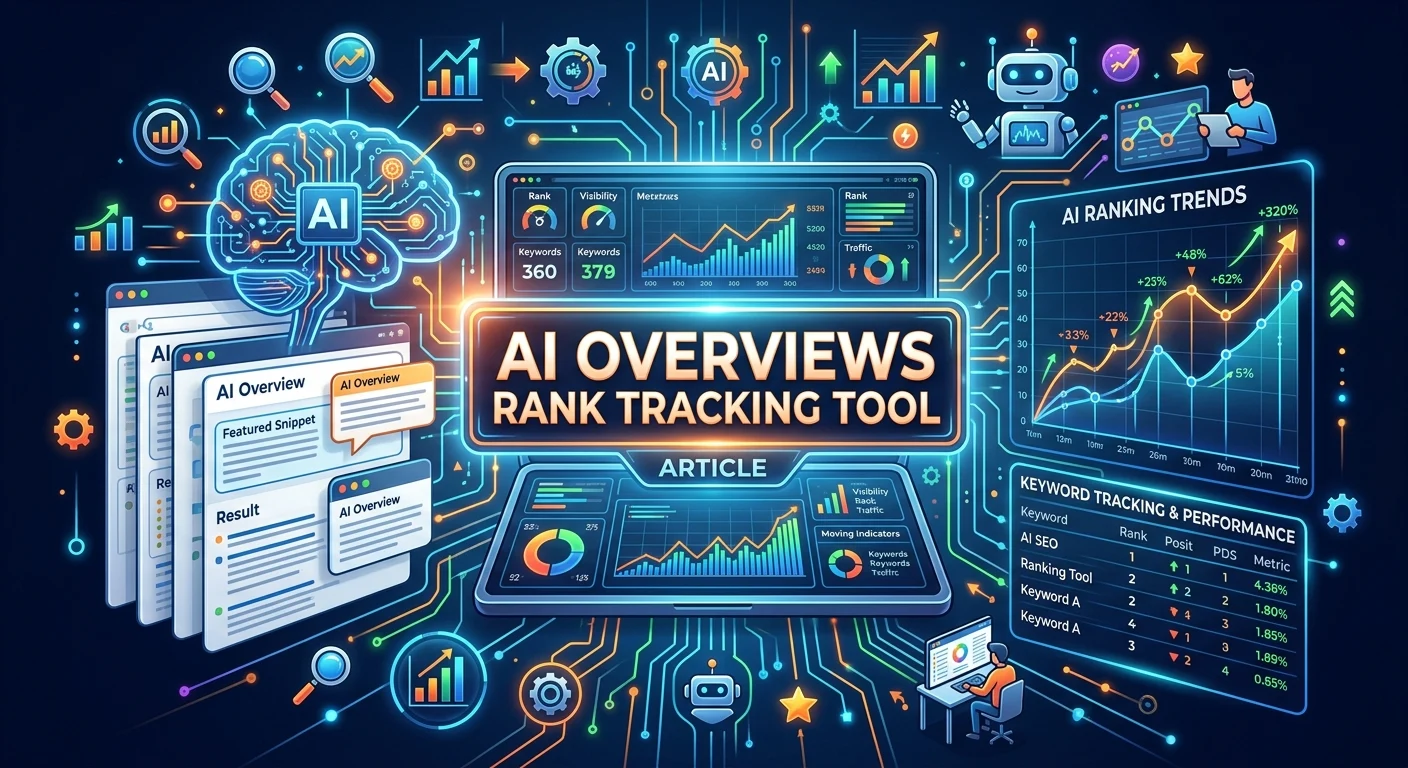
Google Search is changing quickly, and AI-generated answers are becoming an important part of how people discover information, products, and businesses. An AI Overviews rank tracking tool helps marketers understand how their content appears within Google’s AI-generated search experiences and whether their brand earns visibility for important queries. Instead of looking only at traditional blue-link rankings, these tools focus on AI mentions, citations, source visibility, query coverage, and competitive presence. This gives SEO teams a broader view of search performance. For businesses, the goal is not simply to rank higher but to become a trusted source that AI systems can recognize and reference. With automation, reporting, and competitive analysis, AI Overview tracking can improve productivity and help teams make smarter content decisions.
What Is an AI Overviews Rank Tracking Tool?
An AI Overviews rank tracking tool is software designed to monitor how a website, brand, product, or piece of content appears in Google’s AI-generated search results. Traditional rank trackers primarily monitor positions such as #1, #5, or #10. AI Overview tracking adds another layer by examining whether an AI-generated answer appears and which sources it references.
The concept is important because AI search does not always behave like conventional search. A website can rank well organically but receive little visibility inside an AI-generated answer. Another site may receive strong visibility because its content provides useful, well-structured information that search systems can understand and trust.
A useful AI Overview tracker may monitor brand mentions, cited URLs, query-level visibility, competitor appearances, and changes over time. These measurements help SEO professionals understand whether their content is becoming more influential in AI-powered search.
For example, a software company could track queries related to its product category. Instead of asking only, “What is our Google position?” the company can also ask, “Does our brand appear in AI-generated answers, and is our website used as a source?”
How AI Overview Rank Tracking Works
AI Overview tracking generally begins with a predefined collection of search queries. These queries can include informational searches, commercial keywords, branded searches, comparison queries, and long-tail questions. The tracking system repeatedly evaluates these queries and records relevant search visibility signals.
Depending on the platform, the tool may identify whether an AI Overview appears, which brands or websites are mentioned, and which pages are cited as sources. It can then organize this information into dashboards or reports.
Query consistency matters. Search results can vary based on location, language, device, search history, and other contextual factors. A professional tracking workflow should therefore use consistent settings whenever possible.
Many tools also automate monitoring. Instead of manually searching hundreds of queries, marketers can create a keyword set and receive periodic updates. This automation saves time and makes it easier to identify significant changes.
Why AI Overviews Rank Tracking Matters for SEO
Traditional SEO metrics remain important, but AI-generated search experiences introduce additional visibility opportunities. Users may receive a detailed answer before they ever interact with traditional organic listings.
This means search visibility is becoming broader than rankings alone. A company may want to know whether its content contributes to an AI answer, whether its brand is mentioned, and whether users can discover its website through cited sources.
AI Overview tracking also supports competitive research. If competitors consistently appear in AI-generated answers while your brand does not, that difference can reveal areas where your content strategy needs improvement.
For example, imagine two websites targeting the same topic. Both rank on the first page, but only one frequently appears as a cited source. Traditional rank tracking might suggest that both websites perform similarly. AI visibility data can reveal an additional competitive advantage.
Key Features of an AI Overviews Rank Tracking Tool
The most useful tools combine several visibility measurements rather than relying on one metric. AI Overview detection is a basic feature because marketers need to know whether their tracked searches trigger AI-generated results.
Another important capability is citation monitoring. This shows which pages or domains appear as sources for AI-generated answers. Citation data can help identify content that search systems consider useful for answering particular questions.
Brand and competitor tracking are also valuable. A tool may record how frequently your brand appears compared with competing businesses. Some platforms calculate visibility or share-of-voice measurements to simplify competitive analysis.
Good tools should also offer historical tracking. A single snapshot can be misleading. Historical data helps identify trends, sudden changes, and the impact of content updates.
Additional features can include keyword grouping, geographic tracking, scheduled reports, exports, alerts, API access, and integrations with other SEO platforms.
Benefits of Using AI Overview Rank Tracking
The biggest benefit is better visibility into modern search behavior. Instead of focusing exclusively on traditional rankings, marketers can see how their content performs in AI-generated experiences.
Automation creates another major advantage. SEO teams can monitor large keyword sets without manually checking every search. This improves productivity and allows specialists to spend more time analyzing data and creating useful content.
AI Overview tracking can also improve content planning. Suppose a competitor repeatedly appears for questions where your website has relevant content. That signal can encourage you to review the competing page, identify missing information, improve clarity, and strengthen supporting evidence.
Another benefit is reporting. Marketing teams can communicate AI search performance using measurable signals such as query coverage, brand mentions, citations, and competitive visibility.
AI Mentions, Citations, and Search Visibility Metrics
AI mentions and citations are related but should not be treated as identical. A mention generally means that a brand, organization, product, or website appears within an AI-generated response. A citation indicates that a source is referenced or linked as supporting information.
These metrics provide different insights. A brand mention can show awareness, while a citation can demonstrate that the underlying content is being used as a source.
Marketers should also look at visibility across a group of queries rather than obsessing over one keyword. Search systems can generate different results for similar questions, so broader query coverage often provides a more useful picture.
For example, a company could track 100 commercial and informational queries. If its brand appears in AI-generated results for 35 of those searches, that percentage can become a useful internal benchmark. The number itself is less important than tracking how it changes consistently over time.
AI Overview Rank Tracking Use Cases
SEO agencies can use AI Overview tracking to create new reporting services for clients. Instead of providing only traditional ranking reports, agencies can show how clients appear across AI-generated search experiences.
Ecommerce businesses can track product-related queries, comparison searches, category questions, and buying-intent searches. This helps them understand whether their products or website are visible when customers research purchasing decisions.
SaaS companies can monitor queries involving software comparisons, alternatives, features, pricing, and use cases. These searches often represent users who are actively evaluating solutions.
Publishers and content websites can track informational queries related to their subject areas. The data can reveal which topics generate AI visibility and which pages have citation potential.
Local businesses can also monitor relevant geographic queries. However, local search behavior can vary considerably by location, so businesses should interpret geographic tracking carefully.
Free vs Paid AI Overview Rank Tracking Tools
Free tools can be useful for learning the basics of AI search visibility. They may provide limited query monitoring, manual checking, or small-scale reporting. For an individual website owner, that can be enough to understand the concept.
However, paid platforms usually provide more automation and historical data. Larger keyword sets, competitor monitoring, scheduled reports, alerts, integrations, and team features can become important as a website grows.
The right choice depends on the scale of the SEO operation. A small business might begin with a modest solution, while an agency managing multiple clients may need advanced monitoring.
Before paying for a platform, check its query limits, update frequency, geographic coverage, historical data retention, reporting options, and cancellation terms. Avoid choosing a tool simply because it displays many metrics.
Pricing and ROI of AI Overview Tracking Tools
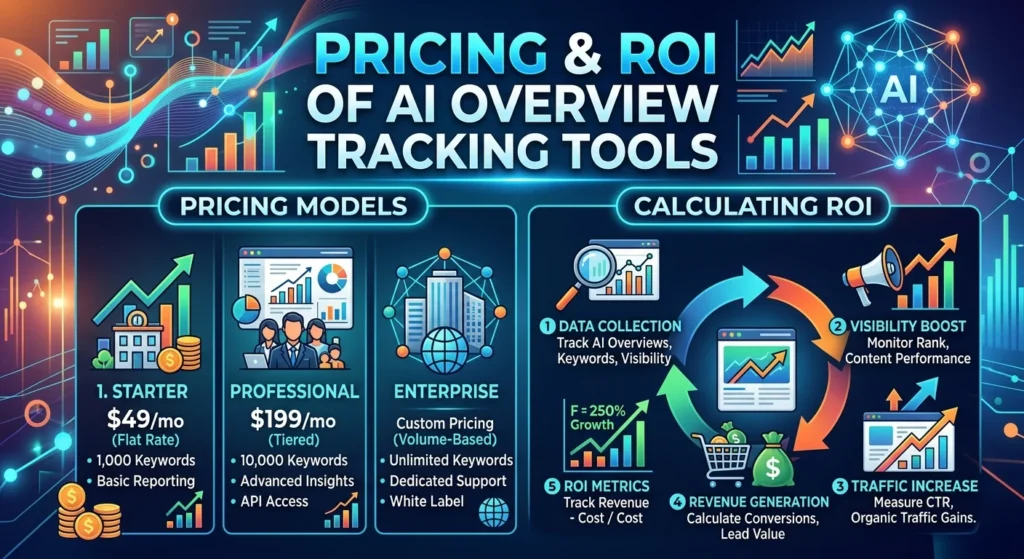
Pricing varies significantly across SEO and AI visibility platforms. Some services use monthly subscriptions, while others base pricing on the number of tracked queries, projects, users, or monitored domains.
The best way to evaluate cost is through business value rather than feature count. A tool is valuable when its data helps your team make better decisions.
For example, suppose a content team discovers that several competitors consistently receive AI citations for a group of important topics. The team can use that information to improve content coverage and source quality. If those improvements contribute to more qualified organic traffic or conversions, the tracking investment can have measurable value.
Businesses should define their objectives before purchasing. Useful objectives might include improving brand visibility, monitoring competitors, measuring content performance, identifying citation opportunities, or creating client reports.
AI Overview Tools vs Traditional SEO Rank Trackers
Traditional rank trackers answer questions such as “Where does this page rank?” AI visibility tools answer broader questions such as “How does this brand appear in AI-generated search experiences?”
Neither approach completely replaces the other. Traditional rankings still provide important information about organic search performance. AI Overview tracking adds another layer that can reveal visibility inside AI-generated answers.
A strong SEO workflow can therefore combine both. Traditional rank data can measure organic positions, while AI visibility data can measure mentions, citations, and presence within AI-generated results.
This combined approach creates a more complete search strategy. Marketers can identify whether improvements in technical SEO, content quality, authority, and topical coverage are associated with broader search visibility.
Integrations and AI Search Optimization Workflows
Integrations can make AI Overview tracking more useful. SEO teams may want to connect tracking data with analytics platforms, reporting systems, keyword databases, content workflows, or project-management tools.
A practical workflow starts with query research. Create groups based on user intent, such as informational, commercial, navigational, transactional, branded, and comparison searches.
Next, monitor those queries consistently. Review which searches trigger AI Overviews and which sources appear. Then compare your website with competitors.
Finally, turn observations into content actions. Improve pages that lack important information, strengthen internal linking, clarify factual claims, update outdated material, and make the content easier for both users and search systems to understand.
The goal should not be to manipulate an AI system. The goal is to publish genuinely useful, trustworthy, comprehensive information that deserves to be discovered and referenced.
Pros, Cons, and Limitations of AI Overview Rank Tracking
AI Overview tracking offers several advantages. It provides visibility beyond traditional rankings, supports competitor research, automates monitoring, and creates new ways to measure brand presence in AI search.
However, there are limitations. AI-generated results can change frequently, and different users may see different search experiences. Tracking platforms may also use different methodologies, meaning that two tools can report different numbers.
Another limitation is that AI visibility does not automatically equal business success. A citation or mention may increase awareness, but it does not guarantee clicks, leads, sales, or conversions.
Marketers should therefore treat AI visibility as one part of a broader measurement framework. Combine it with organic traffic, engagement, conversions, rankings, backlinks, brand searches, and other meaningful business metrics.
Common AI Overview Tracking Mistakes to Avoid
One common mistake is tracking too few queries. A handful of keywords cannot represent an entire search strategy. Build a balanced keyword set covering different intents and customer questions.
Another mistake is treating every visibility metric as equally important. A mention for an irrelevant query may have little commercial value. Focus on high-value topics and searches connected to your audience.
Inconsistent tracking settings can also create misleading comparisons. If location, language, device, or query sets change frequently, historical comparisons become harder to interpret.
Finally, do not chase AI visibility by creating low-quality content. Keyword stuffing, repetitive pages, unsupported claims, and excessive automation can reduce content quality. Sustainable visibility comes from helpful information, clear expertise, trustworthy sources, and strong user experience.
Latest AI Overview Trends and Future Developments
AI-powered search is likely to become an increasingly important part of the search ecosystem. As search interfaces become more conversational, users may ask longer and more complex questions rather than entering short keywords.
This shift increases the importance of entity understanding, topical authority, structured information, original research, trustworthy sources, and clear content organization. SEO teams will need to understand not only where pages rank but also how their information is interpreted across different search experiences.
AI visibility measurement will likely become more sophisticated as well. Future tools may combine traditional rankings, AI citations, brand sentiment, entity associations, competitive visibility, and conversion data into unified dashboards.
However, the fundamentals will remain important. Websites that consistently publish accurate, useful, original, and audience-focused content will have a stronger foundation for long-term search visibility.
Conclusion
An ai overviews rank tracking tool gives marketers a broader way to understand search visibility in an AI-driven environment. Traditional rankings still matter, but they no longer tell the entire story. AI-generated answers can introduce new opportunities for brands to be mentioned, cited, and discovered.
The most effective strategy is to use AI Overview tracking alongside traditional SEO analytics. Monitor meaningful queries, analyze competitor visibility, study citations, improve content quality, and measure changes over time.
Rather than trying to create content specifically to satisfy an algorithm, focus on building useful, accurate, trustworthy, and well-organized resources. That approach supports users first while creating a stronger foundation for visibility across both traditional and AI-powered search.
FAQs
What is an AI Overviews rank tracking tool?
An AI Overviews rank tracking tool monitors how websites, brands, and content appear in Google’s AI-generated search experiences. Depending on the platform, it can track mentions, citations, queries, competitors, and historical visibility.
Why should I track Google AI Overviews?
Tracking AI Overviews helps you understand search visibility beyond traditional organic rankings. It can reveal whether your brand or website appears in AI-generated answers and which competitors receive visibility.
Are AI Overview rank tracking tools accurate?
They can provide useful directional data, but results may vary because AI-generated search experiences can change by query, location, language, device, and other factors. Consistent methodology is important.
Can AI Overview tracking replace traditional rank tracking?
No. AI visibility tracking and traditional SEO tracking measure different things. Using both can provide a more complete picture of search performance.
What metrics should I monitor?
Important metrics can include AI Overview presence, brand mentions, citations, query coverage, competitor visibility, source URLs, and historical changes. Connect these metrics with traffic and conversion data whenever possible.
Are free AI Overview tracking tools useful?
Free tools can be useful for testing the concept and monitoring a small number of searches. Paid platforms generally provide greater automation, scale, historical tracking, and reporting capabilities.
How can I improve my AI Overview visibility?
Focus on helpful, accurate, original content. Answer relevant questions clearly, demonstrate expertise, support factual claims with trustworthy sources, maintain strong technical SEO, and build comprehensive topical coverage.
Does appearing in an AI Overview guarantee more traffic?
No. An AI mention or citation does not guarantee clicks or conversions. AI visibility should be measured alongside organic traffic, engagement, leads, sales, and other business outcomes.
What should I look for when choosing an AI Overview tracking tool?
Look for reliable query monitoring, historical data, competitor tracking, citation analysis, geographic coverage, reporting, integrations, and transparent methodology. Choose features based on your actual SEO objectives rather than selecting the tool with the longest feature list.