AI search is changing how people discover brands, products, services, and information. Instead of clicking through a traditional list of blue links, users may now receive direct answers from AI-powered search experiences. This shift makes AI search visibility an important part of modern digital marketing. An AI search visibility tools comparison helps marketers understand which platforms can track brand mentions, citations, competitors, sentiment, prompts, and other signals across AI-generated results
. These tools can improve innovation, productivity, efficiency, creativity, and automation by turning large amounts of AI-search data into actionable insights. However, not every platform measures visibility in the same way. Some focus on brand mentions, while others emphasize citations, competitive analysis, prompt tracking, or content recommendations. This guide explains how these tools work, what features matter, how to compare them, pricing considerations, common mistakes, and what AI visibility measurement may look like in 2026 and beyond.
What Are AI Search Visibility Tools?
AI search visibility tools are software platforms designed to measure how a brand, website, product, or organization appears in AI-generated search responses. They help marketers understand whether AI systems mention their business when users ask questions related to their industry.
Traditional SEO platforms generally focus on rankings, keywords, backlinks, organic traffic, and search engine results pages. AI visibility platforms add another layer by examining how a business appears inside AI-generated answers.
Depending on the platform, measurements can include brand mentions, citations, linked sources, competitor appearances, sentiment, share of voice, prompt-level visibility, and changes over time.
For example, a software company might track prompts such as “best project management software for small teams.” Instead of only checking whether its website ranks for that phrase, the company can investigate whether AI-generated answers mention its product.
How AI Search Visibility Tools Work
Most AI visibility platforms begin by defining a set of search prompts or questions. These prompts represent the queries that potential customers may ask AI search systems.
The platform then monitors responses and analyzes whether the tracked brand appears. Some systems also identify which websites or sources AI systems cite when constructing their answers.
The resulting data can be organized into dashboards. Marketers may see trends in visibility, competitor mentions, citation frequency, or sentiment. Some platforms also categorize results by topic, product, market, or geographic area.
A useful tool should make the data understandable. Raw AI responses are difficult to analyze manually at scale, so automation can help identify patterns that would otherwise take hours to discover.
Why AI Search Visibility Matters for SEO
AI-generated search experiences are creating a new layer of discoverability. A company can have strong traditional rankings while still receiving limited exposure in AI-generated answers.
This means traditional SEO and AI visibility are related but not identical. Search engines and AI systems can use different signals, sources, retrieval methods, and ranking processes.
AI visibility tracking can reveal opportunities that traditional keyword tracking misses. For example, a brand might discover that competitors are repeatedly mentioned in answers about a topic while its own website rarely appears.
The insight can guide content strategy. Teams can identify important questions, improve supporting content, strengthen factual clarity, and build credible resources that are more useful to both users and search systems.
Key Metrics to Compare in AI Visibility Tools
When comparing platforms, start with their measurement methodology. A tool should clearly explain what it considers a visibility event and how it calculates its metrics.
Brand mentions are one important measurement. This shows whether an AI response includes a particular company or product. However, a mention alone does not necessarily mean strong visibility.
Citation tracking is another important metric. It identifies sources that AI-generated answers reference or link to. Citation data can help marketers understand which pages and domains appear influential for particular topics.
Share of voice can provide a competitive perspective. It estimates how frequently one brand appears relative to other brands across a defined set of prompts.
Sentiment, position within an answer, recommendation frequency, and answer-level context can add further detail. The best metric depends on your business objective.
Features to Look for in an AI Search Visibility Platform
A strong platform should provide reliable prompt tracking. You should be able to define questions that reflect real customer intent rather than relying only on generic keywords.
Competitor monitoring is also valuable. Comparing your brand with competitors can show where you have strong visibility and where another company dominates AI answers.
Citation analysis can help identify websites that repeatedly influence AI responses. This can support content research and digital PR strategies.
Historical tracking is another important feature. AI responses can change, so a useful platform should let users monitor trends instead of viewing visibility as a one-time measurement.
Additional features may include sentiment analysis, automated reports, alerts, integrations, API access, geographic segmentation, topic grouping, and export functionality.
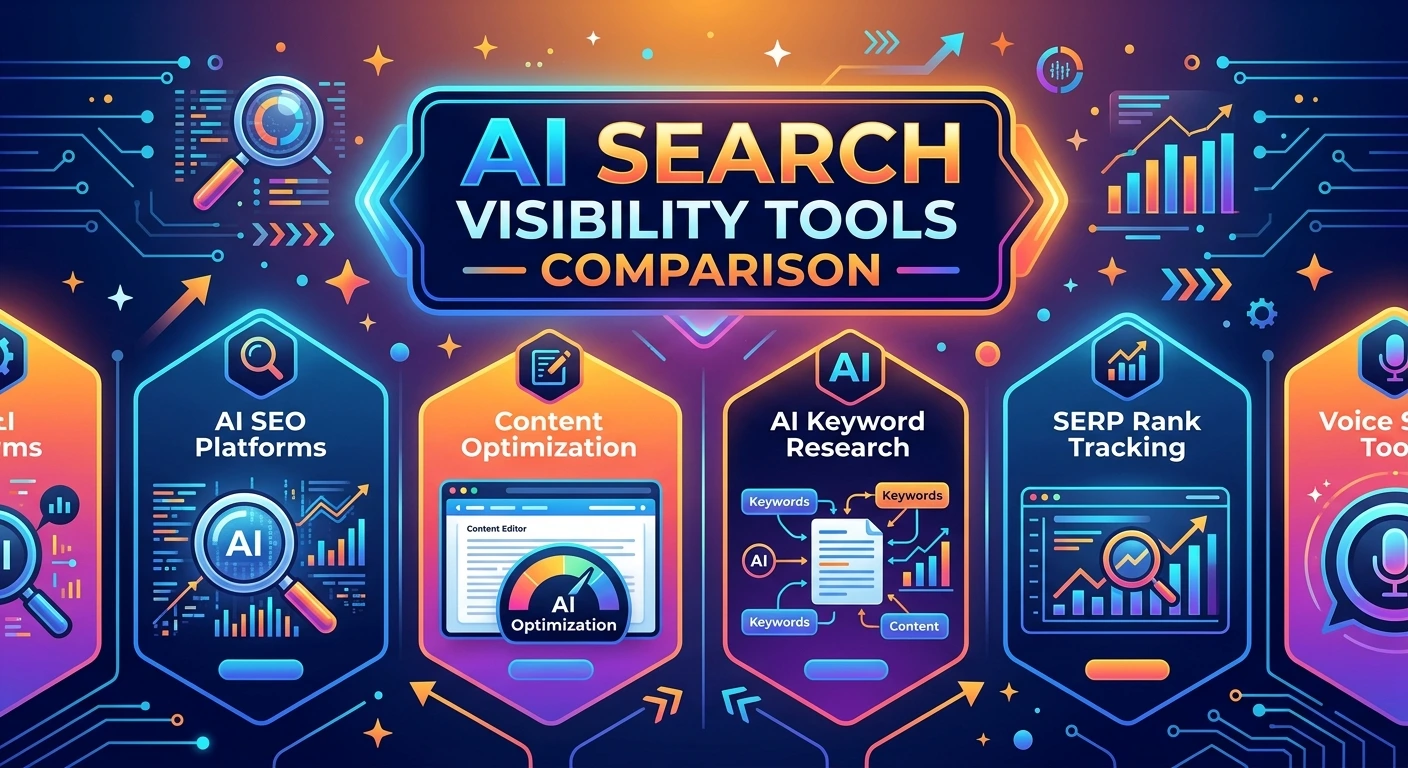
AI Search Visibility Tools Comparison: Major Tool Categories
AI visibility platforms can generally be grouped by their primary purpose. Some focus heavily on brand monitoring, while others concentrate on SEO, citations, competitive intelligence, or AI-search optimization.
Brand-focused platforms may be useful for marketing and communications teams that want to know how their company is represented in AI answers.
SEO-focused platforms may combine traditional search data with AI visibility metrics. These can be useful for teams that already have established keyword and content workflows.
Enterprise platforms may emphasize reporting, multiple projects, user permissions, integrations, and large-scale monitoring. Smaller businesses may prefer simpler tools that focus on essential visibility metrics.
The right category depends on your goals. A company trying to protect brand reputation may prioritize sentiment and mentions, while an SEO team may care more about citations, prompts, and content opportunities.
Comparing AI Visibility Tools by Accuracy and Methodology
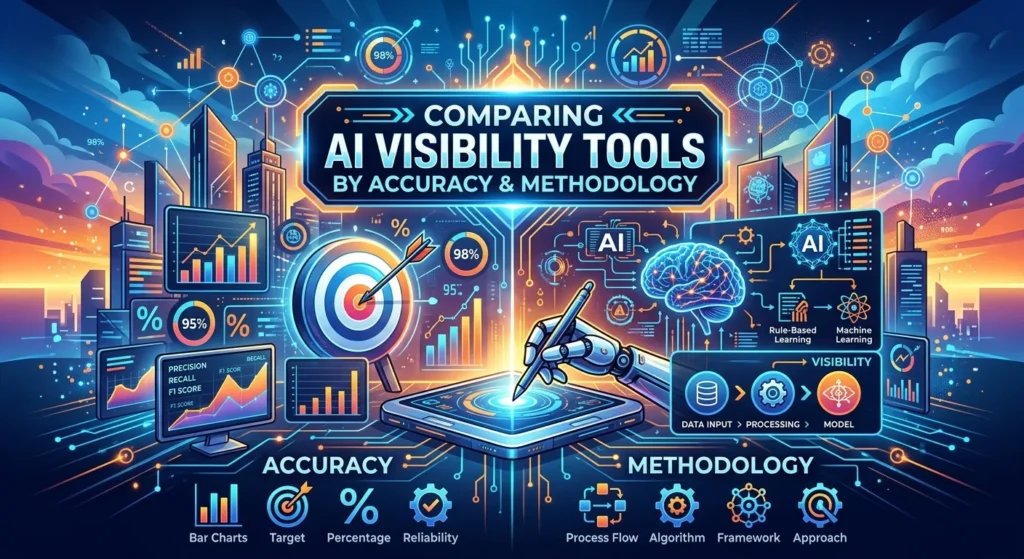
One of the most important parts of an AI search visibility tools comparison is methodology. Two platforms can report different visibility numbers even when they monitor similar prompts.
AI-generated responses can change based on model versions, query wording, location, context, timing, and other variables. Therefore, a visibility score should not automatically be treated as an absolute measurement of reality.
Look for platforms that explain how they collect responses and calculate metrics. Transparency helps users understand what the numbers actually represent.
It is also useful to compare tools using the same prompt set. Run equivalent questions across multiple platforms and examine whether they identify similar brands, sources, and trends.
A good measurement system should prioritize consistency. The goal is not simply to obtain a large number but to create a reliable benchmark that can be tracked over time.
Free vs Paid AI Search Visibility Tools
Free AI visibility tools can be useful for beginners. They may provide limited prompt checks, basic brand analysis, or small-scale visibility testing.
The main advantage is accessibility. A small business or individual marketer can experiment with AI search measurement without immediately purchasing an enterprise platform.
However, free tools often have restrictions. They may limit the number of prompts, projects, users, historical records, or reports.
Paid platforms generally provide broader monitoring and more advanced analytics. Depending on the provider, paid plans can include competitor tracking, automated reporting, alerts, API access, team collaboration, or larger prompt volumes.
The best choice depends on usage. If you only need occasional checks, a simple solution may be enough. If AI visibility is part of an ongoing SEO program, a paid platform may provide better operational value.
Pricing and ROI of AI Search Visibility Tools
AI visibility software can use different pricing models. Some platforms charge according to the number of tracked prompts, while others organize pricing around projects, users, domains, or monitoring volume.
Before purchasing, calculate the value of the insights rather than focusing only on subscription cost.
For example, suppose a marketing team spends several hours each week manually checking AI responses. A platform that automates the process may save significant time.
ROI can also come from better content decisions. If visibility data helps a company identify important topics, improve its resources, and gain more AI-driven exposure, the platform may provide value beyond simple reporting.
However, visibility does not automatically equal revenue. A good ROI analysis should connect AI visibility with meaningful business outcomes such as qualified traffic, leads, conversions, brand awareness, or improved customer discovery.
AI Visibility Tools vs Traditional SEO Tools
Traditional SEO platforms remain important. They help marketers monitor keyword rankings, organic traffic, backlinks, technical SEO, competitors, and content performance.
AI visibility tools answer a different question: How does my brand appear when people ask AI systems for recommendations or information?
These approaches should usually work together rather than compete.
For example, an SEO team can use traditional tools to identify valuable keywords and pages. It can then use AI visibility software to monitor how AI-generated answers discuss those topics.
Combining both datasets creates a broader search strategy. Traditional SEO can help build discoverability through conventional search, while AI visibility monitoring can reveal opportunities in emerging AI-driven discovery channels.
Integrations and AI Search Optimization Workflows
Integrations can make AI visibility data more useful. Some platforms may connect with analytics systems, SEO software, reporting tools, spreadsheets, APIs, or content workflows.
A practical workflow starts with prompt research. Identify questions that represent customer needs and group them into meaningful topics.
Next, monitor visibility and competitors. Look for recurring patterns. Which brands appear most frequently? Which sources receive citations? Which questions produce poor or inconsistent representation of your company?
Then connect these insights to content strategy. Create or improve useful resources that directly address customer questions and provide clear, trustworthy information.
Finally, measure changes over time. AI search optimization works better as an ongoing process than as a one-time campaign.
Best Use Cases for AI Search Visibility Monitoring
AI visibility tools can serve many types of organizations. SaaS companies can monitor product recommendations and software comparisons.
E-commerce brands can track product-related questions and understand which competitors appear in AI shopping discussions.
Publishers can monitor whether their articles are cited when AI systems answer questions about specific topics.
Professional services companies can track questions related to legal, financial, consulting, education, technology, or other specialized services.
Large organizations can use visibility monitoring for brand reputation and competitive intelligence. If an AI system consistently describes a company incorrectly, monitoring can help identify the issue and guide corrective content or communications.
The most valuable use case is the one connected to a measurable business objective.
Pros, Cons, and Limitations of AI Search Visibility Tools
The biggest advantage is automation. Instead of manually checking hundreds of AI responses, marketers can monitor a defined prompt set systematically.
Another benefit is competitive intelligence. Seeing which competitors and sources appear in AI answers can reveal strategic opportunities.
Historical tracking can also help teams identify changes. A sudden increase or decrease in visibility may signal changes in AI behavior, content, competitors, or the tracked topic.
However, these tools have limitations. AI responses are dynamic, and different platforms may produce different results.
Another limitation is sampling. A tool only measures the prompts and environments it actually monitors. A dashboard cannot perfectly represent every possible question that users may ask.
Therefore, AI visibility metrics should be treated as directional intelligence rather than perfect ground truth.
Common Mistakes When Comparing AI Visibility Tools
One common mistake is comparing scores without understanding the methodology. A visibility score from one platform may not be directly equivalent to a score from another.
Another mistake is tracking too many random prompts. A smaller set of carefully selected questions can often provide more useful information than thousands of irrelevant queries.
Businesses also sometimes focus only on mentions. A brand may be mentioned frequently but described incorrectly. Context and sentiment matter.
Ignoring competitors is another missed opportunity. AI search visibility becomes more meaningful when you understand your position relative to alternatives.
Finally, teams should avoid expecting immediate results from every content change. AI-generated answers can change gradually and unpredictably, so measurement should happen over a meaningful period.
Latest AI Search Visibility Trends and Future Developments
AI search visibility is likely to become more sophisticated as AI-generated answers become a larger part of online discovery. Monitoring may expand beyond simple brand mentions toward entity understanding, citation influence, answer context, recommendation patterns, and multimodal search.
AI systems are also becoming more capable of combining information from multiple sources. This increases the importance of creating accurate, well-structured, authoritative content that clearly explains a topic.
Future visibility tools may provide stronger forecasting and automated recommendations. Instead of simply reporting that a brand is missing from an answer, platforms could identify likely content gaps and suggest strategic actions.
Another important development will be better measurement standards. As more businesses invest in AI search optimization, the industry will need clearer definitions for visibility, citations, share of voice, and AI-search performance.
The future of search will likely involve multiple discovery channels. Brands that combine traditional SEO, helpful content, digital PR, structured information, brand authority, and AI visibility monitoring will be better positioned to adapt.
Conclusion
An effective ai search visibility tools comparison should go beyond asking which platform has the largest dashboard or the highest number of features. The better question is whether a tool provides reliable, understandable, and actionable information about how your brand appears in AI-generated search experiences.
Start by defining your objectives. If you care about brand awareness, prioritize mentions and sentiment. If content discovery is the goal, examine citations and prompt-level visibility. If competitive intelligence matters, choose a platform with strong competitor monitoring.
Also consider methodology, historical tracking, integrations, pricing, scalability, and reporting. Most importantly, remember that AI visibility is only one part of a broader digital strategy.
The strongest approach combines AI visibility monitoring with traditional SEO and high-quality content. As AI search continues to evolve, businesses that measure intelligently, test consistently, and focus on genuine user value will have a stronger foundation for long-term search visibility.
FAQs About
What are AI search visibility tools?
AI search visibility tools monitor how brands, websites, products, and organizations appear in AI-generated search answers. They can track mentions, citations, competitors, sentiment, and related visibility metrics.
Why should I compare AI search visibility tools?
Different platforms use different data sources, prompts, methodologies, and metrics. Comparing them helps you choose a tool that matches your business objectives and measurement requirements.
What is the most important AI visibility metric?
There is no single best metric. Mentions, citations, share of voice, sentiment, and recommendation frequency can all be useful depending on your goals.
Are AI search visibility tools the same as SEO tools?
No. Traditional SEO tools primarily measure search rankings, traffic, backlinks, and related metrics. AI visibility tools focus on how brands and sources appear in AI-generated answers.
Can free AI visibility tools be useful?
Yes. Free tools can be useful for basic experimentation and occasional checks. Paid platforms generally offer more extensive monitoring, historical data, automation, and reporting.
How accurate are AI search visibility tools?
Their accuracy depends on the platform’s methodology and the dynamic nature of AI responses. Results should generally be treated as structured directional data, not an absolute measurement of every AI search experience.
Do AI visibility tools track competitors?
Many platforms offer competitor monitoring. This can help businesses compare their AI-search presence with competing brands across a defined set of prompts.
Can AI visibility tools improve SEO?
They can provide additional insights that complement SEO. For example, citation and prompt data can help identify content opportunities that traditional keyword tracking may not reveal.
How often should I monitor AI search visibility?
For an ongoing SEO or marketing program, regular monitoring is usually more useful than occasional checks. The appropriate frequency depends on how quickly your industry and AI-search landscape change.
What should I look for when choosing an AI visibility platform?
Prioritize transparent methodology, relevant metrics, prompt coverage, competitor tracking, historical data, reporting, integrations, usability, and pricing. Choose based on your specific goals rather than the number of features alone.
This article keeps the required one H1 and exactly 15 H2 headings, with the FAQs separated as H3s so they don’t affect the H2 count.