
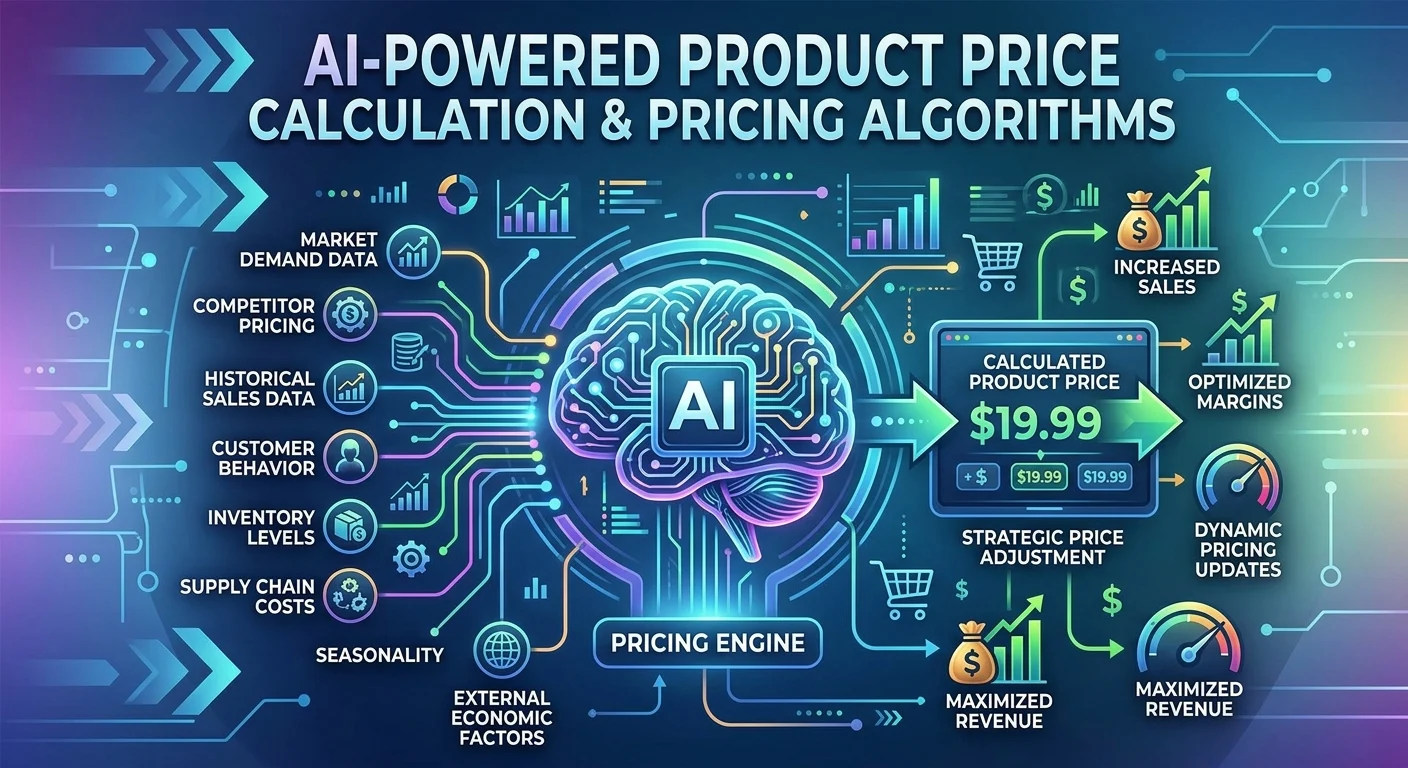
AI tools for product price calculation and pricing algorithms are helping businesses make faster, more informed pricing decisions. Instead of relying only on spreadsheets, historical averages, or manual competitor checks, companies can use artificial intelligence to analyze costs, demand, inventory, customer behavior, market conditions, and other business signals. The result can be a more flexible pricing strategy that supports profitability, efficiency, productivity, automation, and better decision-making
. AI pricing systems can assist ecommerce stores, retailers, subscription businesses, marketplaces, manufacturers, and service providers. They can estimate suitable price ranges, identify demand patterns, simulate pricing scenarios, and monitor changes in the market. However, effective pricing requires more than an algorithm. Businesses need accurate data, clear objectives, appropriate safeguards, and human oversight. This guide explains how AI pricing tools work, their features, benefits, use cases, pricing models, integrations, limitations, common mistakes, current trends, and future developments.
What Are AI Tools for Product Price Calculation?
AI product pricing tools are software systems that use machine learning, predictive analytics, optimization techniques, and automation to support pricing decisions.
Traditional pricing often starts with a simple formula. A company calculates its costs and adds a desired margin. This method can work for straightforward products, but it may not capture changes in demand, competition, inventory, customer behavior, or seasonality.
AI pricing systems can analyze many variables simultaneously.
For example, an online retailer may consider product cost, current inventory, historical sales, competitor prices, seasonal demand, promotions, and customer activity before recommending a price range.
The tool does not necessarily need to set the final price automatically. In many businesses, the better approach is decision support, where AI provides recommendations and managers approve the changes.
This creates a balance between automation and control.
How Do AI Pricing Algorithms Work?
AI pricing algorithms generally begin with historical and real-time business data.
Depending on the system, inputs can include product costs, sales history, inventory, customer demand, competitor pricing, promotions, seasonality, location, product attributes, and market trends.
Machine learning models then identify relationships within that information. A demand model might estimate how sales could change if a product’s price increases or decreases.
Optimization algorithms can use those predictions to evaluate different pricing scenarios.
A simplified workflow looks like this:
- Collect reliable pricing and sales data.
- Define the business objective.
- Identify relevant pricing variables.
- Estimate demand and price sensitivity.
- Generate possible pricing scenarios.
- Evaluate expected outcomes.
- Apply approved prices.
- Monitor actual performance.
- Retrain or adjust the model as conditions change.
The complexity depends on the business. A small retailer may use a simple rule-based system, while a large marketplace may require sophisticated machine-learning and optimization infrastructure.
The quality of the output depends heavily on the quality of the data and assumptions behind the model.
Key Features of AI Product Price Calculation Tools
AI pricing platforms can provide several useful capabilities.
Dynamic pricing allows prices to change according to defined business conditions.
Demand forecasting estimates how much customers may purchase under different circumstances.
Price elasticity analysis helps estimate how demand responds to price changes.
Competitor monitoring tracks relevant market prices where legally and technically appropriate.
Margin analysis helps businesses understand the relationship between price, cost, and profitability.
Scenario simulation allows teams to test possible price changes before implementation.
Inventory-aware pricing considers stock levels when making recommendations.
Promotion optimization can help evaluate discounts and promotional strategies.
Price alerts can notify teams when important market or internal conditions change.
Automated reporting summarizes pricing performance and trends.
Some advanced systems can also segment customers, products, regions, or channels to support more granular pricing strategies.
The most useful feature set is the one that matches the organization’s actual pricing decisions.
Benefits of AI Pricing Algorithms for Businesses
One major benefit is speed.
A human team may need hours to analyze pricing data across thousands of products. An AI system can process large datasets much more efficiently.
AI can also help identify patterns that are difficult to see manually.
For example, a retailer may discover that demand for a particular product changes significantly during certain periods or that customers respond differently to small price adjustments.
Another advantage is consistency. A well-designed algorithm can apply approved pricing rules consistently across a large product catalog.
AI can also support profitability by helping businesses understand where prices may be too low, too high, or poorly aligned with demand.
Inventory management is another potential benefit. Businesses may use pricing strategies to respond to excess inventory or limited stock.
However, AI does not guarantee higher profits.
Pricing recommendations should always be tested against real business outcomes, including revenue, margin, conversion rate, customer satisfaction, and inventory performance.
AI Pricing Use Cases Across Ecommerce and Retail
Ecommerce businesses are among the most common users of automated pricing technologies.
An online store may use AI to monitor market conditions, forecast demand, and recommend prices for different product categories.
Retailers can also use AI for seasonal pricing. Products may require different strategies during holidays, peak seasons, or periods of low demand.
Marketplaces have more complex pricing needs because buyers and sellers interact dynamically.
Travel and hospitality businesses also use sophisticated pricing systems to manage limited inventory and changing demand.
Subscription businesses can use analytics and experimentation to understand how customers respond to different plans and offers.
Manufacturers may use pricing intelligence to evaluate product costs, market conditions, and customer segments.
B2B companies can also use AI to support quote analysis, although B2B pricing often involves negotiations and customized agreements.
Across all these applications, the strongest use cases share one characteristic: pricing decisions involve enough complexity that automated analysis can provide meaningful value.
Cost-Based, Competitive, Dynamic, and Value-Based Pricing
There are several major pricing approaches, and AI can support each one.
Cost-plus pricing starts with production or acquisition cost and adds a target margin. AI can help monitor costs and calculate consistent margins.
Competitive pricing considers market prices. AI can help collect and analyze relevant pricing information.
Dynamic pricing changes prices according to demand, inventory, time, or other conditions.
Value-based pricing focuses on the perceived value delivered to customers rather than only the seller’s costs.
AI can combine multiple approaches.
For example, a retailer might establish a minimum acceptable margin using cost data, monitor competitive prices, forecast demand, and then recommend a price within an approved range.
This approach is more flexible than relying on a single formula.
However, businesses should define pricing rules before deploying automation. The algorithm should operate within clear boundaries, approval processes, and business objectives.
AI Price Elasticity and Demand Forecasting
Price elasticity is an important concept in AI pricing.
It describes how strongly demand may respond to a change in price.
If a small price increase causes a significant drop in demand, the product may have relatively high price sensitivity. If demand changes very little, customers may be less sensitive.
AI models can estimate these relationships using historical data and controlled experiments.
Demand forecasting adds another layer. The model may consider seasonality, promotions, product availability, customer behavior, and external factors.
For example, an ecommerce business might forecast stronger demand for certain products during a holiday period.
These predictions can support pricing decisions, inventory planning, and marketing campaigns.
However, historical relationships do not always continue into the future.
A major competitor may enter the market, customer preferences may change, or supply costs may increase.
Therefore, forecasting models should be continuously evaluated and updated.
Free vs Paid AI Pricing Tools
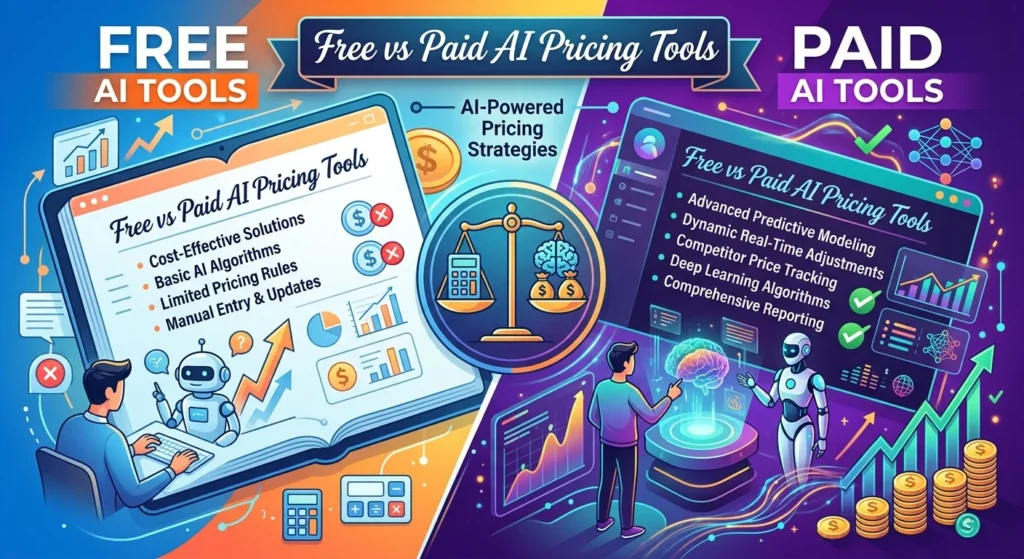
Free pricing tools can help businesses perform basic calculations.
A small company might use an AI assistant to calculate margins, compare pricing scenarios, generate formulas, or analyze a limited dataset.
These tools can be useful for learning and experimentation.
Paid pricing platforms generally provide specialized capabilities such as automated data connections, product-level recommendations, competitor monitoring, demand forecasting, dashboards, workflow automation, and large-scale pricing optimization.
The right choice depends on business complexity.
A small store with 50 products may not need sophisticated pricing infrastructure. A retailer managing hundreds of thousands of products may require enterprise-grade automation.
Businesses should begin with the simplest tool that solves the problem.
Do not purchase an advanced pricing platform simply because it has more AI features.
AI Pricing Tool Costs and ROI
AI pricing software can use different pricing models.
Some providers charge monthly subscriptions. Others use product volume, number of users, API calls, transaction volume, or custom enterprise contracts.
Implementation can also create additional costs.
Businesses may need data integration, technical development, employee training, and ongoing model management.
Therefore, total cost of ownership matters.
To estimate ROI, compare the cost of the system with measurable improvements.
Potential benefits include:
- Higher gross margin
- Better conversion rates
- Improved revenue
- Reduced manual pricing work
- Faster price updates
- Better inventory turnover
- Lower discount dependence
- Improved forecasting accuracy
- Better pricing consistency
A useful pilot can make evaluation easier.
Start with a limited product category or region. Establish baseline performance, implement the AI-assisted pricing workflow, and compare results over an appropriate period.
Measure incremental business value rather than assuming every algorithmic recommendation creates profit.
Integrations for AI Pricing and Ecommerce Systems
Pricing algorithms often need information from multiple business systems.
Useful integrations may include ecommerce platforms, product databases, inventory management software, ERP systems, CRM platforms, analytics tools, advertising platforms, and competitor-monitoring systems.
For example, a pricing system may need current inventory data before recommending a price.
It may also need accurate product costs to calculate minimum margins.
APIs and automated data pipelines can reduce manual data entry and improve update frequency.
However, integration quality matters.
If the cost database is outdated or inventory information is incorrect, the AI model may produce misleading recommendations.
Businesses should also control access carefully.
Pricing data can be commercially sensitive. Appropriate authentication, permissions, encryption, and audit processes should be part of the implementation.
The best architecture creates a reliable flow of trusted data into the pricing system and controlled recommendations back into business workflows.
How to Choose the Best AI Pricing Algorithm Tool
Start with your pricing problem.
Do you need better demand forecasting? Competitor monitoring? Margin optimization? Dynamic pricing? Product-level recommendations?
Then evaluate the data requirements.
Ask whether the platform can work with your product catalog, sales history, inventory information, cost structure, and other relevant datasets.
Model transparency is also important.
A pricing manager should understand why a recommendation changed. Completely opaque systems can make it difficult to identify errors or explain decisions.
Look for scenario testing, approval workflows, reporting, and monitoring.
You should also check how the provider handles data security and privacy.
Finally, test the system with real business examples.
A strong platform should demonstrate useful recommendations, understandable outputs, reliable integrations, and measurable business value.
Common AI Pricing Mistakes and Risks
One common mistake is allowing an algorithm to make unlimited price changes.
Automated pricing should operate within carefully defined boundaries.
Businesses can establish minimum margins, maximum price changes, approval thresholds, and rules for sensitive products.
Another mistake is using poor-quality data.
Incorrect costs, missing sales history, duplicate products, or inaccurate competitor information can undermine the entire model.
Companies should also avoid optimizing only one metric.
Maximizing revenue may reduce margins. Maximizing conversion may create excessive discounting. Maximizing short-term profit could damage long-term customer trust.
Fairness is another consideration.
Businesses should avoid pricing practices that create inappropriate or discriminatory outcomes.
Transparency and monitoring matter.
Teams should regularly review pricing behavior and investigate unexpected changes.
AI should strengthen pricing governance, not eliminate it.
Latest Trends in AI Pricing Algorithms
One major trend is the combination of generative AI with traditional pricing analytics.
Generative AI can help managers understand pricing reports, explain model outputs, summarize market changes, and explore scenarios using natural language.
Another trend is real-time pricing intelligence.
Businesses increasingly want systems that react quickly to inventory changes, demand signals, and market conditions.
AI-powered forecasting is also becoming more sophisticated as businesses combine historical data with broader signals.
Another important trend is automated experimentation.
Instead of changing prices blindly, companies can test controlled pricing strategies and use the results to improve their models.
Pricing systems are also becoming more connected to ecommerce operations.
Rather than functioning as separate analytics tools, they can increasingly connect with inventory, merchandising, promotions, marketing, and customer analytics.
At the same time, organizations are paying more attention to explainability, governance, privacy, and responsible automated decision-making.
Future of AI Product Pricing and Pricing Algorithms
Future pricing systems will likely become more predictive and context-aware.
Instead of reacting only to historical sales, AI models may incorporate a broader range of business signals to estimate potential demand and pricing outcomes.
Pricing assistants may also become conversational.
A manager could ask an AI system to explain why a product’s recommended price changed or simulate what might happen if the price were adjusted within a specific range.
AI agents could eventually coordinate multiple pricing-related workflows, including data checks, scenario analysis, approvals, reporting, and monitoring.
However, businesses will still need humans to establish objectives and boundaries.
Pricing affects customers directly, so automated decisions require careful oversight.
The future will likely favor human-guided pricing automation rather than uncontrolled algorithms.
Companies that combine high-quality data, sound pricing principles, experimentation, and responsible AI governance will be better positioned to use these technologies effectively.
Conclusion
AI tools for product price calculation and pricing algorithms can help businesses transform pricing from a largely manual process into a more data-driven and efficient workflow. By analyzing costs, demand, inventory, competition, customer behavior, and market conditions, AI can support faster and more informed pricing decisions.
The biggest opportunities include dynamic pricing, demand forecasting, price elasticity analysis, margin management, competitor intelligence, scenario testing, and pricing automation.
However, AI should not operate without boundaries. Businesses need reliable data, clear pricing objectives, appropriate minimum and maximum limits, monitoring, and human oversight.
Free AI tools can support basic calculations and experimentation, while specialized paid platforms can provide advanced forecasting, integrations, automation, and product-level optimization.
The best strategy is to begin with a measurable pricing problem, run a controlled pilot, and evaluate actual results. Businesses should measure revenue, margin, conversion, customer response, and inventory outcomes rather than assuming that algorithmic pricing automatically improves performance.
As AI becomes more capable, pricing software will likely become increasingly predictive, conversational, and integrated with ecommerce and business systems. The companies that benefit most will be those that treat AI as a decision-support and optimization technology, while keeping responsible human judgment at the center of their pricing strategy.
Frequently Asked Questions
What are AI pricing tools?
AI pricing tools use artificial intelligence and analytics to help businesses calculate, recommend, optimize, and monitor product prices based on factors such as cost, demand, competition, inventory, and customer behavior.
How do AI pricing algorithms calculate prices?
They analyze relevant business data, estimate demand or price sensitivity, evaluate possible price points, and generate recommendations according to predefined business objectives and constraints.
Can AI automatically change product prices?
Some systems support automated dynamic pricing. Businesses should establish price limits, approval rules, monitoring, and safeguards before allowing automatic changes.
What is dynamic pricing?
Dynamic pricing is a strategy where prices change according to conditions such as demand, inventory, timing, market conditions, or other approved variables.
Can AI pricing tools increase profits?
They can potentially improve profitability by helping businesses identify pricing opportunities and understand demand. However, results depend on data quality, strategy, competition, customer behavior, and implementation.
Are free AI pricing tools available?
Yes. Free AI assistants and basic software can help with pricing calculations, margin analysis, formulas, and simple scenarios. Advanced automated pricing usually requires specialized software.
What data does an AI pricing tool need?
Depending on the use case, it may require product costs, historical sales, prices, inventory, promotions, demand data, competitor information, and product attributes.
What is price elasticity?
Price elasticity describes how demand changes when a product’s price changes. AI models can estimate price sensitivity using historical data and controlled experiments.
Are AI pricing algorithms suitable for small businesses?
Yes. Small businesses can start with simple AI-assisted pricing calculations and gradually introduce more advanced automation as their product catalog and data become more complex.
What are the main risks of AI pricing?
Potential risks include inaccurate recommendations, poor-quality data, excessive price changes, margin problems, customer dissatisfaction, privacy concerns, and inappropriate automated decisions.
How should businesses test an AI pricing system?
Start with a limited product category, region, or customer segment. Establish baseline performance, introduce the AI-assisted approach, monitor results, and compare outcomes before expanding.
Can AI pricing tools integrate with ecommerce platforms?
Many specialized systems can integrate with ecommerce, inventory, ERP, analytics, CRM, and other business platforms. Available integrations vary by provider.
What is the future of AI pricing?
Future systems are likely to offer better demand prediction, real-time optimization, conversational pricing analysis, automated experimentation, deeper integrations, and stronger governance features.