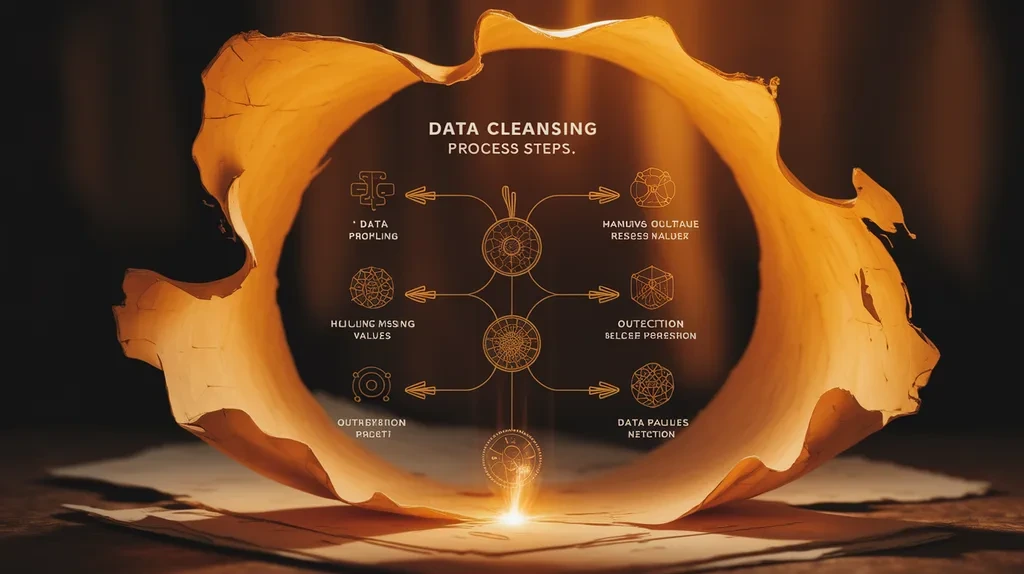
Data has become one of the most valuable resources for modern organizations, but raw data is rarely ready for analysis. Duplicate records, missing values, inconsistent formats, spelling errors, outdated information, and incorrect entries can reduce data quality and lead to unreliable decisions. This is why understanding the data cleansing process steps where AI tools can be used is increasingly important.
AI-powered data cleansing tools can help teams identify errors, standardize information, detect duplicates, fill certain gaps, and automate repetitive quality checks. Instead of manually reviewing thousands of records, businesses can use artificial intelligence to improve productivity, efficiency, automation, and accuracy.
The most effective approach combines AI with human oversight. AI can quickly detect patterns and suggest corrections, while people validate important changes. When used correctly, AI-assisted data cleansing creates cleaner datasets that support better analytics, reporting, machine learning, customer experiences, and business decisions.
What Is the Data Cleansing Process?
Data cleansing, also called data cleaning or data scrubbing, is the process of identifying and correcting inaccurate, incomplete, duplicated, inconsistent, or irrelevant information in a dataset. The goal is to improve data quality, consistency, accuracy, completeness, and usability.
A dataset might contain several versions of the same customer, for example. One record could list “John Smith,” another “J. Smith,” and another “John A. Smith.” If these records represent the same person, keeping them separate can distort customer counts and analytics.
Data cleansing can involve correcting values, removing duplicates, standardizing formats, handling missing information, validating records, and removing unnecessary data. AI tools can assist with many of these activities by recognizing patterns that would take humans much longer to identify.
A successful cleansing process does not simply delete questionable information. It uses rules, context, validation, and business requirements to determine what should be changed, retained, merged, or reviewed.
Why Data Cleaning Matters for Businesses and AI Systems
Poor-quality data can affect almost every part of an organization. Marketing teams may target the wrong customers, finance teams may generate inaccurate reports, and analysts may reach incorrect conclusions because the underlying dataset contains errors.
Data quality becomes even more important when organizations use machine learning or generative AI. AI systems learn patterns from data, so inconsistent or incorrect information can reduce the reliability of models and analytical results.
Clean data can provide several advantages:
- More reliable reporting
- Better business intelligence
- Improved customer records
- More accurate analytics
- Better machine learning outcomes
- Reduced manual work
- Fewer operational errors
- Improved data governance
For example, an ecommerce company could use AI to detect duplicate customer accounts before calculating customer lifetime value. Cleaning the records first can prevent one customer from being counted multiple times.
In simple terms, better input data creates a stronger foundation for analysis and automation.
Data Profiling: The First Step Where AI Can Help
Data profiling is usually one of the first steps in a data cleansing workflow. It involves examining a dataset to understand its structure, quality, patterns, and potential problems.
Traditional profiling can require analysts to manually inspect columns and calculate statistics. AI-assisted tools can accelerate this process by identifying unusual patterns, detecting potential anomalies, and highlighting columns that may require attention.
For example, an AI tool might analyze a customer database and notice that a “phone number” field contains several different formats. It could also identify that a percentage of email addresses appear invalid or that a particular column contains an unusually high number of missing values.
AI can help generate a data quality profile covering areas such as:
- Missing values
- Duplicate records
- Data types
- Unusual values
- Invalid formats
- Outliers
- Inconsistent categories
- Potential relationships between fields
The key advantage is speed. AI can scan large datasets and prioritize potential problems so data professionals can focus their attention where it matters most.
Identifying Missing and Incomplete Data with AI
Missing values are common in real-world datasets. A customer record might have no phone number, a sales record might lack a product category, or a survey response might leave several questions unanswered.
AI tools can help identify patterns in missing data. More advanced systems may suggest whether a missing value should remain empty, be replaced using a reliable rule, or require additional investigation.
However, automatically filling every blank field is not always appropriate. A missing value can contain meaningful information. For example, if a customer does not provide a phone number, replacing the blank with an invented value would create false information.
AI-assisted cleansing should therefore distinguish between missing data and data that can reasonably be inferred.
For numerical datasets, statistical or machine learning methods may sometimes estimate missing values. For categorical information, an AI system might identify likely values based on related records. These approaches should be validated before important data becomes part of operational systems.
Detecting and Removing Duplicate Records
Duplicate data is one of the most common data quality problems. Duplicates can appear when information comes from multiple databases, forms, applications, spreadsheets, or customer systems.
Simple duplicate detection looks for exact matches. However, real-world duplicates are often more complicated. Two records may have different spelling, formatting, capitalization, or abbreviations while still referring to the same entity.
AI and machine learning can support entity resolution and record matching by comparing multiple attributes. For example, the system could compare names, addresses, phone numbers, email addresses, and other available fields to estimate whether two records represent the same customer.
Consider these examples:
- “ABC Technologies Ltd.”
- “ABC Technology Limited”
- “ABC Technologies”
A basic exact-match system might treat these as three organizations. A more advanced matching system can identify them as potentially related records.
AI should generally recommend duplicate matches rather than blindly merge everything. High-confidence matches may be automated, while uncertain matches can be sent to a human reviewer.
Standardizing Data Formats with AI Tools
Standardization makes information consistent across a dataset. Without standardization, the same value may appear in many different forms.
Dates are a common example. One record may use “09/04/2026,” another “2026-09-04,” and another “September 4, 2026.” Depending on the intended convention, these values may need to follow a single format.
AI tools can help recognize inconsistent patterns and recommend standardized values. They can also assist with text normalization, category mapping, address formatting, and other repetitive transformations.
Common standardization tasks include:
- Date formats
- Phone numbers
- Currency formats
- Country names
- State or province names
- Product categories
- Address fields
- Capitalization
- Measurement units
- Text abbreviations
AI can be particularly useful when standardization requires understanding context rather than applying a simple character replacement.
Still, businesses should define clear data standards before automating transformations. AI should follow established rules rather than inventing its own definitions.
Correcting Inaccurate and Inconsistent Data

After identifying problems, the next step is correction. Some errors are simple, such as extra spaces or inconsistent capitalization. Others require more contextual reasoning.
AI can identify likely spelling mistakes, inconsistent labels, suspicious values, and unusual combinations of fields. Natural language processing can be especially useful when cleaning text-based information.
For example, an AI system might identify that “Californa” is likely a misspelling of “California.” It could flag the record for correction according to the organization’s data standards.
However, AI-generated corrections require appropriate validation. A system should not automatically change important information simply because one value appears unusual.
A strong workflow separates high-confidence corrections from uncertain suggestions. High-confidence formatting fixes may be automated, while ambiguous business information should receive human review.
Using AI for Outlier and Anomaly Detection
Not every unusual value is an error. Some unusual records are legitimate and important. This makes anomaly detection a useful but sensitive part of data cleansing.
AI and machine learning algorithms can identify observations that differ significantly from normal patterns. For example, a sales dataset might contain one transaction that is much larger than typical transactions.
The system can flag the record for investigation. It should not automatically delete it.
An anomaly could represent:
- A data-entry mistake
- Fraud
- A legitimate large transaction
- A new customer pattern
- A system integration problem
- A rare but valid event
The best approach is to treat AI anomaly detection as a review mechanism, not a deletion mechanism. Analysts can investigate flagged records and determine the correct action.
This reduces the risk of accidentally removing valuable information simply because it differs from the majority.
Validating Cleaned Data After AI Processing
Validation is essential after cleansing. A dataset should not be considered clean simply because an AI tool reports that it completed a process.
Validation checks whether the cleaned dataset meets predefined quality requirements. These requirements may cover accuracy, completeness, uniqueness, consistency, validity, and integrity.
Useful validation checks include:
- Are required fields complete?
- Are data types correct?
- Are duplicate rates acceptable?
- Are values within expected ranges?
- Do relationships between tables remain intact?
- Did automated corrections introduce errors?
- Are important records still present?
- Do totals match trusted source systems?
Organizations should maintain before-and-after quality measurements. This makes it easier to determine whether the cleansing process actually improved the dataset.
For important business data, human review should remain part of validation. AI can accelerate the process, but accountability should remain with qualified people.
AI Data Cleansing for Different Business Use Cases
AI-assisted cleansing can support many industries and departments. The specific workflow depends on the type of information being processed.
In marketing, AI can help standardize customer records, identify duplicate contacts, and improve segmentation data.
In finance, cleansing can help identify inconsistent transaction categories, formatting errors, and anomalies that require investigation.
In healthcare and research, data quality is especially important because inconsistent records can affect analysis. Strict validation and governance are essential when dealing with sensitive information.
In ecommerce, AI can help standardize product names, categories, attributes, measurements, and customer information.
In human resources, organizations can use data cleansing techniques to standardize employee records and identify incomplete information.
In machine learning, clean training data can improve the consistency of model inputs and reduce noise.
Across these use cases, the central principle remains the same: AI should support data quality processes while business rules and responsible human oversight guide important decisions.
AI Data Cleansing Tools, Features, and Integrations
Modern data quality platforms can include AI-powered capabilities alongside traditional data preparation functions. The exact features vary by provider, so businesses should evaluate tools according to their workflows.
Useful capabilities can include automated profiling, duplicate detection, pattern recognition, anomaly detection, data matching, transformation suggestions, validation rules, and quality monitoring.
Integration is equally important. Data rarely exists in one location. Organizations may work with databases, spreadsheets, cloud storage, CRM systems, ERP platforms, data warehouses, APIs, and business intelligence tools.
A practical AI data cleansing solution should fit into the existing data pipeline instead of creating another isolated workflow.
Before selecting a tool, check whether it supports the data sources and destinations you already use. Also consider scalability, security, governance, audit trails, collaboration, and API availability.
Free vs Paid AI Data Cleansing Solutions
Free data cleaning tools can be useful for students, beginners, small datasets, and simple experiments. Spreadsheet functions, open-source libraries, and limited free versions of commercial platforms can handle many basic cleaning tasks.
Paid solutions become more attractive when data volumes increase or workflows become more complex. Commercial platforms may provide automation, enterprise integrations, monitoring, governance, collaboration, and technical support.
Pricing can vary significantly depending on factors such as:
- Number of records
- Data volume
- Number of users
- Processing frequency
- Cloud or self-hosted deployment
- Integration requirements
- AI capabilities
- Enterprise governance features
There is no single best pricing model for every organization. A small business may only need occasional cleaning, while an enterprise may require continuous data quality monitoring.
Before paying for a platform, test it with a representative sample of real data and evaluate the quality of its recommendations.
Pros and Cons of Using AI for Data Cleansing
AI can make data cleansing faster and more scalable, but it is not a replacement for data governance or professional judgment.
One major advantage is automation. AI can process large volumes of information much faster than manual review. It can also detect patterns that may be difficult to identify with simple rules.
Another advantage is consistency. Once appropriate rules and workflows are established, AI can apply them repeatedly across large datasets.
However, there are risks. AI may make incorrect assumptions, misunderstand unusual values, or recommend a correction that looks reasonable but changes the meaning of the data.
Potential advantages include:
- Faster data preparation
- Reduced repetitive work
- Better pattern detection
- Scalable quality checks
- Automated suggestions
- Improved productivity
Potential disadvantages include:
- Incorrect AI recommendations
- Over-automation
- Hidden data-quality issues
- Integration complexity
- Governance challenges
- Costs at large scale
- Need for human validation
The best model is usually human-in-the-loop data cleansing, where AI handles repetitive analysis and people review important or uncertain decisions.
Common Data Cleansing Mistakes to Avoid
One of the biggest mistakes is cleaning data without first defining what “clean” means. Different organizations may have different standards for completeness, accuracy, formatting, and acceptable values.
Another mistake is modifying the original dataset without creating a backup. Always preserve the source data so changes can be audited or reversed when necessary.
Organizations should also avoid deleting records simply because they look unusual. An unusual value may represent a legitimate event.
Other common mistakes include:
Ignoring business context: A technically unusual value may still be correct.
Using overly aggressive duplicate matching: Similar records are not always duplicates.
Filling every missing value: Some information should remain unknown.
Skipping validation: Cleaning requires quality checks after transformation.
Ignoring data lineage: Teams should know where data came from and how it changed.
Automating everything: High-risk decisions should receive appropriate human review.
Failing to monitor data continuously: A clean dataset can become dirty again as new information enters the system.
A strong process treats cleansing as an ongoing data quality practice, not a one-time cleanup project.
Latest Trends and Future of AI-Assisted Data Cleansing
AI-assisted data cleansing is moving toward more automated and intelligent workflows. Instead of simply applying fixed rules, modern systems can increasingly recognize patterns, suggest transformations, identify anomalies, and help analysts prioritize quality problems.
Another important trend is the integration of data quality with broader data governance and observability. Organizations increasingly want to know not only whether data contains errors but also where those errors originated and how they affect downstream systems.
Generative AI may also make data preparation more accessible. Natural-language interfaces can allow users to describe a task in plain language, such as asking a system to identify inconsistent product categories or explain unusual values.
However, responsible implementation remains important. Future systems should emphasize transparency, auditability, security, explainability, and human control.
The long-term goal is not to remove humans from the data cleansing process. It is to give professionals better tools for handling large, complex datasets while reducing repetitive manual work.
Conclusion
Understanding the data cleansing process steps where AI tools can be used is increasingly important for organizations that depend on reliable information. From data profiling and duplicate detection to standardization, anomaly detection, correction, and validation, AI can support many stages of the data quality lifecycle.
The biggest advantage of AI is its ability to process large amounts of information quickly and identify patterns that would be difficult to find manually. This can improve productivity, efficiency, automation, and analytical accuracy.
However, clean data requires more than automation. Businesses need clear rules, appropriate validation, data governance, and human oversight. AI should recommend and automate suitable tasks while people remain responsible for important decisions.
As AI-powered data management continues to develop, organizations that combine intelligent automation with strong data quality practices will be better prepared for analytics, machine learning, business intelligence, and AI-driven applications. The most successful approach is therefore not simply “clean data with AI,” but build a reliable, repeatable, and responsible data cleansing workflow supported by AI.
FAQs About
What is data cleansing?
Data cleansing is the process of finding and correcting inaccurate, incomplete, duplicate, inconsistent, or irrelevant information in a dataset.
What are the main steps in data cleansing?
Common steps include data profiling, identifying errors, handling missing values, detecting duplicates, standardizing formats, correcting data, validating results, and monitoring quality.
Where can AI tools be used in data cleansing?
AI can assist with profiling, duplicate detection, anomaly detection, pattern recognition, text normalization, standardization, data matching, correction suggestions, and quality monitoring.
Can AI completely automate data cleansing?
AI can automate many repetitive tasks, but complete automation is not appropriate for every situation. Human review is important when corrections could affect business meaning or important records.
How does AI detect duplicate records?
AI can compare multiple attributes such as names, addresses, phone numbers, emails, and other fields to estimate whether different records refer to the same entity.
Can AI fill missing data?
AI can sometimes suggest or estimate missing values based on patterns in the dataset. However, organizations should not invent information and should validate any automated inference.
Why is data validation important after cleansing?
Validation confirms that the cleaning process improved data quality without introducing new problems, deleting valuable records, or breaking relationships between datasets.
What is the difference between data cleaning and data transformation?
Data cleaning focuses primarily on improving data quality by addressing errors, duplicates, missing information, and inconsistencies. Data transformation changes data into a format or structure suitable for analysis or another system.
Are free AI data cleansing tools useful?
Free tools can be useful for small datasets, learning, and basic cleaning. Larger organizations may need paid solutions for automation, integrations, governance, scalability, and advanced monitoring.
What is the future of AI in data cleansing?
The future will likely include more intelligent profiling, automated recommendations, anomaly detection, natural-language data preparation, continuous quality monitoring, and stronger integration with data governance and observability.
If you want, I can also generate a 130-character SEO meta description and an optimized URL slug for this keyword.