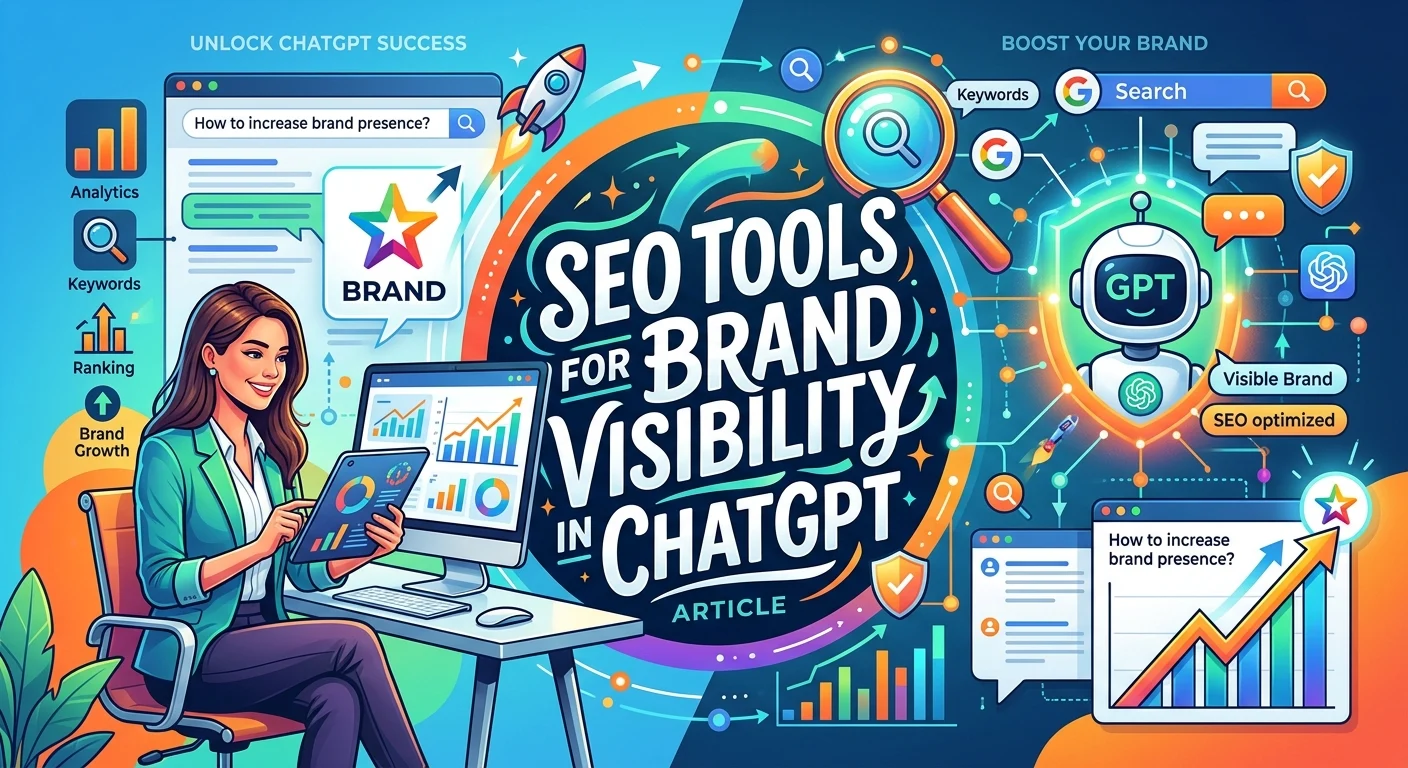
AI search is changing how people discover brands, products, services, and information. Instead of typing a keyword into a traditional search engine and choosing from a list of links, users can now ask conversational questions and receive direct answers from AI systems such as ChatGPT. This creates a new challenge for businesses: how can a brand become visible when customers ask AI about its industry?
That is where AI SEO tools for brand visibility in ChatGPT can help. These tools monitor brand mentions, analyze AI-generated answers, track competitors, identify citation opportunities, and reveal content gaps. They can automate repetitive research and give marketing teams useful data for improving their digital presence.
The goal is not to manipulate ChatGPT. It is to create accurate, useful, authoritative, and discoverable information that AI systems can understand and potentially reference when answering relevant questions.
What Are AI SEO Tools for Brand Visibility in ChatGPT?
AI SEO tools for brand visibility in ChatGPT are software solutions that help businesses monitor and improve how their brands appear in AI-generated search and conversational answers. They extend traditional SEO beyond keyword rankings and website traffic.
Traditional SEO platforms often measure rankings, backlinks, organic clicks, technical problems, and keyword performance. AI-focused tools add another layer by examining questions people might ask an AI system and checking whether a particular company, product, website, or brand appears in the resulting answers.
For example, imagine a company sells project-management software. Traditional SEO might track the keyword “best project management software.” An AI visibility tool could monitor questions such as “What project management software is good for remote teams?” or “Which project management tools are suitable for small businesses?”
The tool may then record whether the brand appears, which competitors are mentioned, and what websites or sources are associated with the answer. This information can help the marketing team understand its AI search presence.
The important distinction is that AI visibility is not simply another version of Google ranking. AI-generated answers can vary based on the question, context, available information, system behavior, and other factors.
How ChatGPT Brand Visibility and AI SEO Work
AI SEO for ChatGPT starts with understanding the questions that matter to a target audience. Instead of focusing only on short keywords, marketers should build a collection of natural-language prompts.
These prompts can represent different stages of the customer journey. Informational prompts might ask what a product category means. Commercial prompts might compare products. Transactional prompts might ask which service is suitable for a particular need.
A basic monitoring workflow looks like this:
Customer questions → AI responses → brand detection → competitor analysis → source analysis → content improvements → ongoing monitoring
AI SEO tools can automate parts of this workflow. A marketer might enter a brand name, competitors, industry, and target topics. The platform can then organize relevant prompts and monitor how frequently the brand appears.
For example, a digital marketing agency could monitor questions about SEO services for small businesses, local SEO agencies, and AI search optimization. If the agency rarely appears while several competitors appear repeatedly, the team can investigate the information available about each company.
The objective should be to improve the brand’s overall digital footprint rather than create content simply to trigger mentions. Useful information, expertise, accuracy, and trust remain central to sustainable visibility.
Key Features of AI SEO Tools for ChatGPT Visibility
AI SEO platforms can provide different features, so businesses should evaluate tools according to their actual needs. A useful platform should help turn AI search observations into practical marketing decisions.
One important feature is prompt tracking. Instead of checking one question manually, marketers can create groups of questions around products, services, competitors, and industry topics. The tool can monitor those prompts over time.
Another valuable feature is brand mention monitoring. It can show whether the company appears in AI-generated responses and how often it appears across a selected group of prompts.
Competitor tracking is also important. A company can monitor competitors alongside its own brand to identify areas where competitors receive greater AI visibility.
Citation and source analysis can provide additional context. When AI-generated answers identify websites or sources, marketers can study the pages associated with those answers.
Useful features may include:
- AI prompt monitoring
- Brand mention tracking
- Competitor monitoring
- Citation analysis
- Source discovery
- Share-of-visibility measurement
- Prompt categorization
- Historical reporting
- Sentiment monitoring
- Content gap analysis
- Domain tracking
- Automated alerts
- API access
- Team reporting
The most useful platforms make these features easy to understand. More data does not automatically mean better SEO. The value comes from turning data into specific actions.
Benefits of Using AI SEO Tools for Brand Visibility
The biggest benefit is improved understanding of how a brand appears in AI-driven discovery. Traditional analytics can tell you that people visited a website, but they may not explain how an AI system describes or recommends the brand.
AI SEO tools can also save time. Marketing teams can spend hours manually asking AI systems dozens or hundreds of questions. Automated monitoring can organize this work and make repeated analysis easier.
Another benefit is competitor research. If competing companies appear frequently for important customer questions, marketers can examine the content, authority signals, public information, and sources associated with those competitors.
These insights can influence content strategy. For example, a company may discover that AI answers frequently rely on detailed guides, independent reviews, expert articles, and comparison pages. That observation could encourage the company to develop more useful resources.
AI visibility monitoring can support several goals:
- Brand awareness
- Content strategy
- Competitive research
- Digital PR
- SEO planning
- Product positioning
- Reputation monitoring
- Customer research
- Content gap analysis
- Marketing reporting
However, marketers should avoid treating AI visibility metrics as guaranteed business outcomes. A brand mention does not automatically produce a customer, and lack of a mention does not necessarily mean poor marketing performance.
AI Search Use Cases for Brands, Agencies, and Content Teams
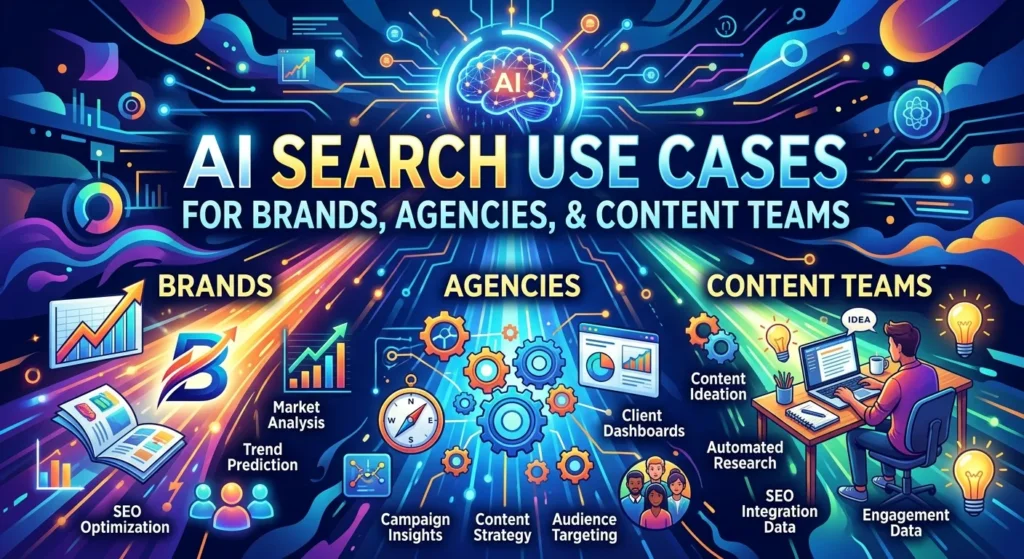
Brands can use AI SEO monitoring across many industries. The exact prompts should reflect real customer questions rather than generic keywords.
An e-commerce company might monitor questions about product recommendations, comparisons, features, and buying considerations. A software company could track prompts about alternatives, use cases, integrations, pricing, and competitors.
A local service business can monitor questions about providers in its category. A B2B company might track industry research questions and software comparisons.
Agencies can use AI visibility monitoring for client reporting. Instead of reporting only traditional rankings, an agency can show how a client’s brand appears across a defined collection of AI-related prompts.
Content teams can use the data to identify unanswered questions. If AI answers consistently discuss a topic but rarely reference the company’s resources, the team can investigate whether it needs stronger or more comprehensive content.
Practical use cases include:
Content planning: Discover questions that deserve detailed articles.
Competitor research: Monitor which brands appear for important topics.
Brand monitoring: Track how AI systems describe the business.
Product marketing: Study how products appear in comparison and recommendation prompts.
Digital PR: Identify information gaps that external publications could help address.
SEO strategy: Combine AI visibility insights with traditional search data.
The strongest use case is one where the monitoring directly supports a measurable marketing objective.
AI Brand Visibility Metrics You Should Monitor
AI visibility requires clear measurement. Without consistent metrics, marketers can collect large amounts of data without knowing what it means.
One useful metric is brand mention frequency. This shows how often a brand appears across a selected prompt set. It can help establish a baseline and identify changes.
Another metric is citation frequency. If AI responses provide sources, marketers can examine how often their website or specific URLs appear as supporting sources.
Competitive visibility can show how frequently a brand appears compared with selected competitors. The calculation can vary between platforms, so marketers should understand the methodology before comparing reports.
Prompt coverage is another useful measurement. Instead of asking whether a brand appears for one question, it examines visibility across multiple topics.
Other useful measurements include:
- Brand mentions
- Citation frequency
- Cited URLs
- Competitor mentions
- Topic coverage
- Prompt coverage
- Visibility changes over time
- Sentiment patterns
- Source domains
- Product mentions
Keep the measurement environment consistent. If you change the prompt set every week, it becomes difficult to determine whether visibility actually changed.
Use metrics as directional evidence rather than absolute rankings. AI responses can change, and different AI systems may produce different results.
Free vs Paid AI SEO Tools for ChatGPT Visibility
Businesses can begin AI visibility research without immediately purchasing expensive software. Manual testing can provide useful early insights, especially for small websites with a limited number of important topics.
A simple process involves creating a list of customer questions and checking relevant AI responses periodically. Record whether your brand appears, which competitors appear, and what sources are mentioned.
Free or limited tools may provide basic monitoring or a small number of searches. They can be suitable for learning the fundamentals and establishing whether AI visibility monitoring fits your workflow.
Paid platforms generally provide more automation and scale. Depending on the product, they may offer larger prompt libraries, historical tracking, competitor monitoring, automated reports, integrations, and team collaboration.
Before choosing a paid tool, consider:
- Number of prompts you need
- Number of brands or domains
- Competitor tracking requirements
- Historical data needs
- Reporting frequency
- Team size
- Integration requirements
- Export capabilities
- API availability
Start with the smallest solution that answers your real business questions. Upgrade when manual monitoring becomes inefficient or when additional data provides clear value.
Pricing Factors and Choosing the Right AI SEO Platform
AI SEO software can use different pricing models. Some platforms charge according to the number of prompts. Others may consider projects, domains, users, locations, AI models, reports, or monitoring frequency.
A small business may only need to monitor a few dozen high-value customer questions. A large company operating across several markets could require thousands of prompts and multiple competitor groups.
Pricing should therefore be evaluated according to usage rather than the headline plan price.
Before subscribing, ask whether the platform provides:
Relevant AI coverage: Does it monitor the environments that matter to your audience?
Prompt capacity: Can you track enough questions?
Historical analysis: Can you identify changes over time?
Competitor monitoring: Can you compare relevant brands?
Source data: Can you see citations or referenced domains where available?
Reporting: Can you create useful reports for stakeholders?
Data exports: Can your team analyze the data elsewhere?
A more expensive platform is not automatically more useful. The best option depends on your objectives, data requirements, budget, and marketing workflow.
Integrations With SEO and Marketing Workflows
AI visibility data becomes more useful when combined with existing marketing information. Instead of keeping AI search insights in a separate dashboard, teams can connect them with their broader SEO and content workflow.
For example, a marketing team could compare AI visibility observations with organic search performance. A page might have strong traditional rankings but receive little visibility in monitored AI answers. That difference could lead to a deeper content review.
Agencies can also use reporting integrations to combine client SEO data with AI visibility measurements.
Potential integration categories include:
- SEO platforms
- Web analytics
- Search performance systems
- Content management systems
- CRM software
- Business intelligence platforms
- Reporting dashboards
- Project management tools
- Marketing automation software
API access can be particularly useful for larger organizations. It can allow teams to move data into internal dashboards or automated reporting systems.
The key is to avoid collecting disconnected metrics. AI visibility should become part of an integrated search strategy rather than another isolated marketing dashboard.
AI SEO vs Traditional SEO for ChatGPT Brand Visibility
Traditional SEO and AI SEO overlap, but they measure different aspects of search visibility.
Traditional SEO often focuses on keywords, rankings, backlinks, technical performance, crawlability, organic traffic, and search intent. AI SEO focuses more heavily on how brands and sources appear within conversational and AI-generated responses.
Consider a hypothetical software company. It might rank highly for a keyword such as “CRM software for startups.” However, when someone asks an AI system for CRM recommendations for a startup, the company’s brand might not appear.
This difference does not prove that traditional SEO failed. It simply demonstrates that different search environments can produce different visibility patterns.
A modern strategy can combine:
Technical SEO + traditional keyword optimization + high-quality content + authority building + brand visibility monitoring + AI search research
This broader approach helps businesses understand multiple paths through which potential customers discover information.
Alternatives to Dedicated ChatGPT Visibility Tools
Dedicated AI SEO platforms are useful, but they are not the only option. Businesses can conduct manual AI search research when their requirements are small.
A spreadsheet can provide a surprisingly useful starting point. Create categories such as informational questions, commercial questions, comparison questions, product questions, and brand questions. Then record AI responses periodically.
Traditional SEO tools can provide complementary data about keywords, backlinks, content gaps, and organic search performance. Analytics platforms can show how users reach the website.
Other alternatives include:
- Manual prompt research
- Traditional rank trackers
- SEO content platforms
- Web analytics
- Search performance tools
- Competitive research tools
- Custom monitoring scripts
- Internal reporting systems
The main limitation is scalability. Manual research becomes increasingly difficult when the number of prompts, competitors, markets, and monitoring intervals grows.
A dedicated platform becomes more valuable when automation, historical data, competitive tracking, and reporting become important parts of the workflow.
Best Practices for Improving Brand Visibility in ChatGPT
The foundation of AI visibility is useful information. Start by understanding what your audience actually wants to know.
Create content that answers specific questions clearly. Use descriptive headings, concise explanations, relevant examples, original research, accurate facts, and trustworthy references.
Build topical authority instead of producing large quantities of shallow content. A strong website might include educational guides, comparisons, definitions, case studies, FAQs, product documentation, and detailed resources.
Make important information easy to understand. Clear writing helps human readers and makes the subject matter easier to interpret.
Strong practices include:
- Answer important questions directly.
- Demonstrate genuine expertise.
- Add original examples and insights.
- Keep important information current.
- Build logical internal links.
- Improve technical website accessibility.
- Use descriptive titles and headings.
- Support important claims with reliable evidence.
- Create comprehensive topic coverage.
- Maintain consistent business information.
- Monitor AI visibility regularly.
- Review automated insights before acting on them.
Avoid writing content solely because you believe it will make ChatGPT mention your company. The better objective is to become a genuinely useful source of information.
Common AI SEO Mistakes That Reduce Brand Visibility
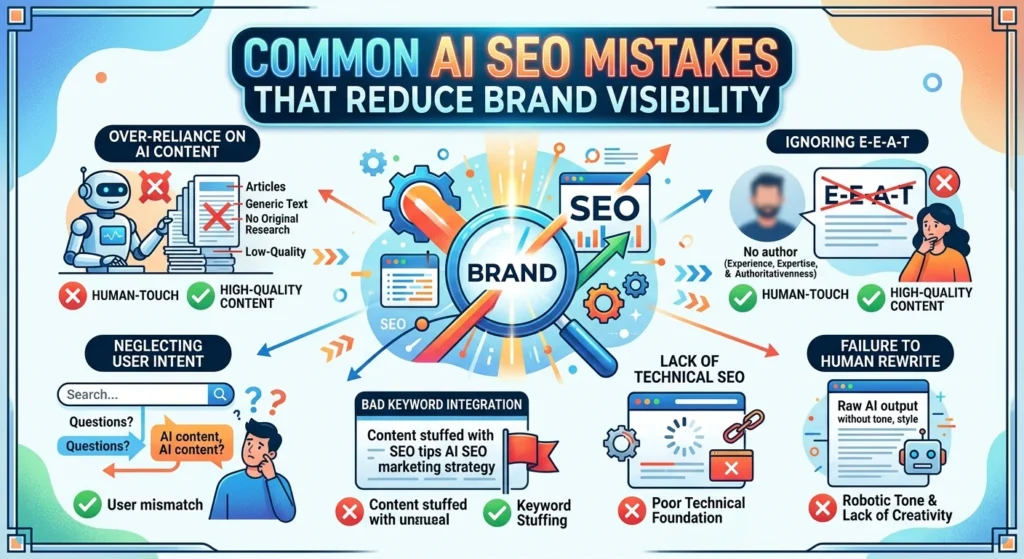
One common mistake is assuming that a single AI response represents overall visibility. AI-generated answers can vary significantly depending on the prompt and context.
Another mistake is monitoring only branded questions. If you only ask questions containing your company name, you may learn very little about broader discovery.
Instead, include unbranded customer questions. For example, a company selling accounting software should monitor questions about accounting software for freelancers, small-business bookkeeping, invoicing tools, and related problems.
Another problem is copying competitors. Seeing another company appear in AI answers does not mean copying its content will produce the same outcome.
Other common mistakes include:
- Tracking too few prompts
- Ignoring traditional SEO
- Publishing low-quality AI-generated content
- Chasing individual AI mentions
- Using inconsistent measurements
- Ignoring technical SEO
- Failing to update outdated content
- Treating AI output as perfectly factual
- Assuming visibility guarantees traffic
- Measuring without a clear objective
The solution is a balanced strategy. Use AI SEO tools to discover patterns, then use human judgment to decide what those patterns mean.
Latest Trends in AI Brand Visibility and Future Developments
AI search continues to move toward conversational discovery. Users can ask detailed questions instead of entering short keywords, creating a larger opportunity for brands that provide comprehensive information.
One important trend is multi-platform visibility. Businesses may need to monitor several AI-powered discovery environments rather than concentrating on one system.
Another trend is the growing importance of entities and context. AI systems need to understand what a company, product, person, service, or organization represents. Clear and consistent information across reputable sources can help create a stronger digital identity.
Citation analysis is also becoming more important. Marketers increasingly want to know not only whether a brand appears but also which sources support AI-generated answers.
Future AI SEO platforms may provide more advanced capabilities such as:
- Automated prompt discovery
- Cross-platform AI monitoring
- Advanced citation analysis
- Entity visibility tracking
- Content recommendations
- Competitive intelligence
- Automated alerts
- Multi-language monitoring
- Market-level analysis
- AI search reporting
However, businesses should avoid relying on permanent formulas. AI search technology changes quickly. Flexible experimentation, consistent measurement, and strong content quality are likely to remain more valuable than short-term tricks.
AI SEO Tools for Brand Visibility in ChatGPT FAQs
What are AI SEO tools for brand visibility in ChatGPT?
They are tools that monitor how brands appear in AI-generated answers and conversational search experiences. They can track mentions, competitors, prompts, citations, and related visibility signals.
Why does ChatGPT brand visibility matter?
People increasingly use conversational AI to research products, services, companies, and topics. Brand visibility in these experiences can therefore become another part of a broader digital discovery strategy.
Can AI SEO tools guarantee that ChatGPT will mention my brand?
No. AI systems generate responses using complex processes and changing information sources. SEO tools can monitor visibility and identify opportunities, but they cannot guarantee a mention or recommendation.
How can I improve my brand visibility in ChatGPT?
Focus on accurate, useful, original, and authoritative information. Build strong topical coverage, maintain technically accessible content, demonstrate expertise, and monitor relevant AI search questions.
Are free AI SEO tools available?
Some free or limited options exist. Businesses can also perform manual prompt research. Paid platforms generally provide more automation, prompt capacity, historical tracking, competitor monitoring, and reporting.
What metrics should I track for ChatGPT visibility?
Useful measurements include brand mentions, citation frequency, cited URLs, prompt coverage, competitor visibility, topic coverage, and changes over time.
Does AI SEO replace traditional SEO?
No. AI SEO complements traditional SEO. Keyword rankings, technical SEO, backlinks, organic traffic, content quality, and AI visibility can all provide different information about a brand’s digital presence.
How often should I monitor ChatGPT brand visibility?
The right frequency depends on your industry and goals. Fast-changing industries may benefit from frequent monitoring, while smaller businesses can use a less frequent schedule.
Can small businesses use AI SEO tools?
Yes. Small businesses can start with manual monitoring or affordable tools. The most important step is choosing a focused set of customer questions rather than trying to monitor everything.
Is AI-generated content good for ChatGPT visibility?
AI-generated content can assist with research and drafting, but simply producing large quantities of AI text does not guarantee visibility. Originality, accuracy, usefulness, expertise, and content quality remain important.
What is the difference between AI SEO and ChatGPT optimization?
AI SEO is a broader approach to improving visibility across AI-powered search and discovery systems. ChatGPT optimization focuses specifically on understanding and improving a brand’s presence within ChatGPT-related discovery experiences.
Conclusion
AI SEO tools for brand visibility in ChatGPT are becoming an important part of modern digital marketing. They give businesses a way to study how brands appear in conversational search and identify opportunities that traditional keyword tracking may not reveal.
The most effective strategy does not depend on trying to manipulate AI responses. Instead, businesses should create valuable information, demonstrate expertise, maintain accurate digital profiles, build comprehensive topic coverage, and monitor relevant customer questions.
AI SEO tools can make this process faster by automating prompt tracking, competitor research, citation analysis, and visibility reporting. But the data still needs human interpretation.
For businesses preparing for the future of search, the practical approach is simple: understand your audience, create genuinely useful content, measure AI visibility consistently, and improve based on evidence.
As AI-powered discovery continues to evolve, brands that combine traditional SEO with high-quality content and thoughtful AI visibility monitoring can build a stronger foundation for being discovered across the changing search landscape.