Search is changing from a list of blue links into a more conversational experience. Users now ask detailed questions and expect AI-powered systems to summarize information, compare products, recommend brands, and provide useful sources. This shift has created a growing need for an ai search visibility tracking tool that can show businesses how they appear in these new search environments.
An AI search visibility tracking tool helps marketers monitor brand mentions, citations, AI-generated answers, competitors, prompts, and visibility trends. Instead of checking hundreds of questions manually, teams can automate much of the monitoring process and turn scattered search observations into useful data.
For SEO professionals, content creators, agencies, and online businesses, this technology can improve productivity, efficiency, research, creativity, and decision-making. More importantly, it can reveal how a brand is represented when potential customers use AI-powered search.
What Is an AI Search Visibility Tracking Tool?
An ai search visibility tracking tool is software that monitors how a website, company, product, or brand appears in AI-powered search results and generated answers. It focuses on visibility signals that traditional keyword rank trackers may not fully capture.
Traditional SEO tracking usually answers questions such as, “Where does my page rank for this keyword?” AI visibility tracking asks a broader question: “When people ask AI systems questions related to my industry, does my brand appear in the answer?”
For example, a company selling accounting software might track questions such as “What is the best accounting software for freelancers?” or “Which accounting tools are easy for small businesses?” The tool can monitor whether the company appears, which competitors appear, and which sources the AI system uses.
This information gives marketers another perspective on search performance. It does not replace traditional SEO analytics. Instead, it adds a layer of AI search monitoring and brand intelligence.
How AI Search Visibility Tracking Works
Most AI visibility tracking systems begin with a collection of search prompts. These prompts represent questions that real users might ask about a business, product, service, or topic.
The platform then monitors responses from supported AI search environments. Depending on the software, it may identify brand mentions, linked sources, citations, competitors, topics, and other measurable signals.
A basic workflow looks like this:
Create prompts → monitor AI responses → detect mentions → analyze citations → compare competitors → identify opportunities → optimize content → track changes
Automation makes this process much easier at scale. A marketer might need to monitor 100 or 1,000 questions over several weeks. Manually checking every question would consume significant time.
A tracking tool can organize the results and show patterns. For example, a brand may appear frequently for beginner questions but rarely appear for comparison questions. That difference can help the content team identify an area worth investigating.
The important point is that AI visibility is dynamic. Responses can change because of different queries, sources, models, updates, and search contexts. Therefore, consistent monitoring is more useful than checking one AI response once.
Key Features of an AI Search Visibility Tracking Tool
The most useful tools combine monitoring, analysis, reporting, and competitive research. Features differ between platforms, so businesses should focus on capabilities that match their actual goals.
Prompt tracking is one of the core features. It allows marketers to create groups of questions around products, services, competitors, industries, and customer problems.
Brand mention monitoring identifies when a company appears in AI-generated responses. Some platforms can also distinguish between direct mentions and references to specific products or services.
Citation tracking is another important capability. It helps users discover which websites and URLs AI systems use as supporting sources. This can provide valuable information for content research.
Other features may include:
- Competitor visibility tracking
- Share-of-visibility measurements
- Prompt categorization
- Historical monitoring
- AI response snapshots
- Source and citation analysis
- Sentiment monitoring
- Topic clustering
- URL tracking
- Automated alerts
- Custom reports
- API access
- Team collaboration
- Data exports
When evaluating software, look beyond the feature list. A tool is useful only when its data helps you make better decisions.
Benefits of Using an AI Search Visibility Tracking Tool
One of the biggest advantages is visibility into AI-driven discovery. Traditional SEO reports can tell you how pages perform in conventional search results, but they may not show how AI systems represent your brand.
An AI visibility tracker can reveal whether your business appears when users ask conversational questions. This is particularly useful for industries where customers research products before making a decision.
Another benefit is automation. Marketing teams can monitor large numbers of prompts without manually repeating the same searches every day.
Competitive intelligence is also valuable. If another company appears repeatedly for important questions, marketers can investigate what information supports those appearances. They can then identify potential gaps in their own content.
AI visibility tracking can also improve content planning. Suppose a company discovers that AI systems frequently cite detailed educational guides. The content team might decide to strengthen its own educational resources with clearer explanations, original examples, and reliable supporting evidence.
Overall, the technology can help teams make more informed SEO and content decisions, rather than relying entirely on assumptions.
AI Search Visibility Tracking Use Cases
AI visibility tracking can support many different marketing workflows. SEO teams can use it to monitor important questions and investigate how brands appear across AI search environments.
Content teams can use prompt data to discover topics that deserve new articles, guides, FAQs, comparisons, or tutorials. This can make editorial planning more closely connected to real user questions.
Digital PR teams can monitor brand representation and identify external sources that frequently appear in AI-generated answers. E-commerce companies can track product discovery questions and category-level recommendations.
Agencies can use AI visibility data in client reporting. Instead of reporting only traditional rankings, an agency can show how a client’s brand appears across a defined set of conversational search questions.
Common use cases include:
- SEO monitoring
- Content strategy
- Competitor research
- Brand monitoring
- Digital PR
- E-commerce research
- Product positioning
- Customer research
- Agency reporting
- Market intelligence
- Topic discovery
- Content gap analysis
The best use case depends on the business. A small blog may need basic monitoring, while an international company may need large-scale prompt tracking across multiple markets.
Important AI Visibility Metrics to Track
A tracking platform may provide dozens of metrics, but marketers should focus on measurements that answer practical questions.
Brand mention rate measures how frequently a brand appears within a defined group of prompts. It can provide a useful directional view of visibility.
Citation frequency measures how often a website or URL is referenced as a source. This can help content teams understand which pages receive visibility.
Competitor visibility shows how frequently other brands appear within the same prompt set. This can help identify areas where competitors receive more exposure.
Prompt coverage measures visibility across different question categories. A brand may have strong visibility for informational questions but weaker visibility for commercial or comparison questions.
Other useful metrics include:
- Brand mentions
- Citation URLs
- Cited domains
- Competitor mentions
- Topic visibility
- Prompt-level visibility
- Visibility changes
- Source frequency
- Sentiment signals
- Market-level visibility
Metrics should always be interpreted within context. A percentage or visibility score is not meaningful without knowing how the platform calculates it, which prompts it uses, and which AI environments it monitors.
AI Search Tracking for SEO and Content Optimization
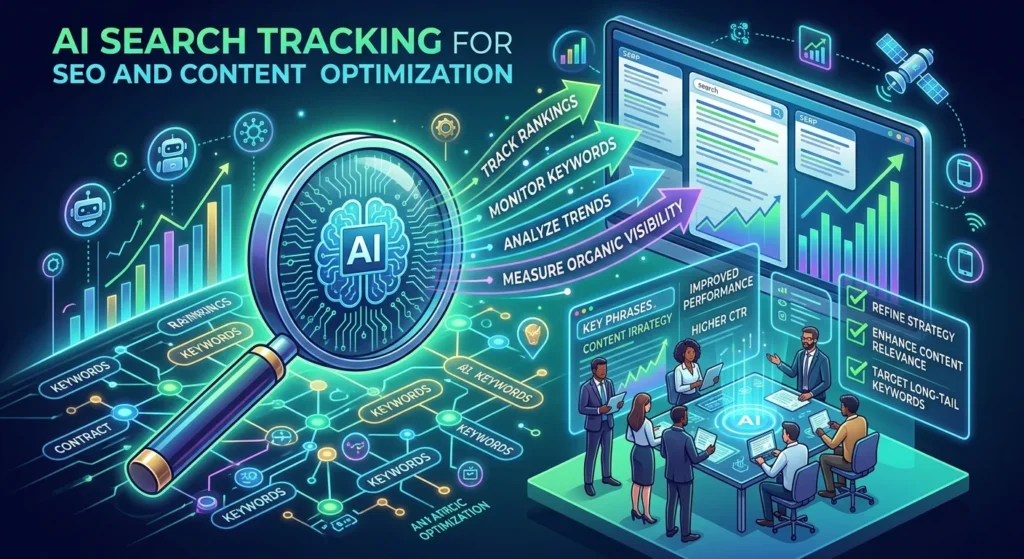
AI search tracking can complement traditional SEO. Instead of abandoning keyword research, marketers can connect keyword data with conversational search questions.
For example, a keyword such as “project management software” can generate many natural-language questions:
“Which project management software is best for remote teams?”
“What project management tools are affordable for startups?”
“How do I choose project management software?”
These questions can become part of an AI visibility tracking campaign.
When a brand fails to appear, marketers should not immediately assume that the content is inadequate. They should investigate the sources appearing in the AI response and compare the information those sources provide.
Look for patterns in:
- Content depth
- Topic coverage
- Original research
- Clear definitions
- Expert information
- Relevant examples
- Internal linking
- External references
- Technical accessibility
The goal is not to manipulate an AI answer. The goal is to make your content genuinely useful, accurate, authoritative, and easy to understand.
Free vs Paid AI Search Visibility Tracking Tools
Free tools can be a good starting point for freelancers, students, small businesses, and beginners who want to understand AI search visibility.
A basic free workflow can involve creating a list of important questions, manually checking AI search responses, and recording brand mentions and citations. This approach costs little but requires more time.
Paid platforms generally provide more automation. Depending on the product, they may support larger prompt sets, historical tracking, competitor monitoring, scheduled checks, reports, alerts, and integrations.
Before choosing a paid solution, estimate your actual requirements.
Ask:
How many prompts do I need to track?
How often should they be checked?
How many competitors matter?
Do I need historical data?
Do I need reports for clients or managers?
Do I need API access or integrations?
A small website may be perfectly comfortable with manual monitoring or a basic plan. A large SEO agency may require automation and extensive reporting.
The best choice depends on scale and workflow, not simply price or the number of advertised features.
AI Search Visibility Tracking Tool Pricing
Pricing varies significantly between platforms. Some tools charge based on tracked prompts, while others use projects, users, domains, locations, monitoring frequency, or data volume.
Entry-level plans are generally designed for individuals and smaller teams. Enterprise-oriented platforms may provide higher limits, multiple projects, additional users, advanced reports, API capabilities, and larger monitoring volumes.
Before subscribing, calculate the approximate number of searches you need to monitor. Tracking thousands of prompts can produce more data, but it can also create unnecessary complexity if your team does not have a process for analyzing it.
A practical approach is to begin with a focused prompt set. Choose the questions that directly relate to:
- Your products
- Your services
- Your main customer problems
- Important competitors
- High-value topics
- Commercial search intent
- Educational search intent
Then expand your monitoring program after you understand which measurements are genuinely useful.
Integrations With SEO and Marketing Platforms
Integrations can make AI visibility tracking more powerful because they connect AI search data with existing marketing workflows.
For example, an SEO team could compare AI visibility with organic search performance. A page may rank strongly for conventional keywords but receive little AI citation exposure. That difference can encourage further research.
Analytics integrations can help teams understand whether changes in AI visibility correspond with changes in website visits or other measurable business outcomes.
Reporting integrations are particularly useful for agencies. Instead of manually copying results into client reports, marketers may be able to automate parts of the reporting workflow.
Useful integration categories include:
- SEO platforms
- Web analytics
- Search performance systems
- Content management systems
- CRM software
- Business intelligence platforms
- Reporting tools
- Marketing automation
- Project management systems
API access can also help technical teams build custom dashboards or connect AI visibility data with internal systems.
The strongest integrations reduce repetitive work and turn visibility monitoring into part of an existing marketing process.
AI Visibility Tracking vs Traditional Rank Tracking
Traditional rank tracking and AI visibility tracking measure different aspects of search.
A rank tracker might tell you that a webpage appears in position five for a particular keyword. An AI visibility tracker may instead tell you whether the brand appears when users ask a conversational question related to that topic.
For example, a company could rank highly for “best website builder,” while an AI system might recommend several competing platforms without mentioning that company.
The reverse can also happen. A brand may have modest traditional keyword rankings but appear in AI-generated answers because its information is cited by sources that the AI system uses.
Neither measurement should automatically replace the other.
A modern search strategy can combine:
Keyword rankings + organic traffic + technical SEO + backlinks + content quality + brand visibility + AI citations
This broader measurement framework helps businesses understand several different ways customers may discover information.
Best Practices for Using an AI Search Visibility Tracking Tool
Start with a carefully selected prompt set. Do not track random questions simply because they contain your main keyword.
Think about what your customers actually ask. Include informational, commercial, comparison, problem-solving, and product-specific questions.
Group prompts by topic and intent. For example, an online accounting company could create groups for accounting basics, software comparisons, pricing, tax questions, and small-business accounting.
Keep the prompt set consistent when measuring changes. If you replace most of your questions every month, it becomes difficult to determine whether visibility actually changed.
Review the source information behind AI responses. If competitors appear frequently, investigate the sources supporting their visibility.
Additional best practices include:
- Track important questions consistently.
- Keep historical records.
- Monitor competitors.
- Review citations.
- Verify important data manually.
- Connect AI visibility with broader SEO data.
- Update outdated content.
- Improve factual accuracy.
- Build topical authority.
- Use original examples and research.
- Avoid keyword stuffing.
- Prioritize user intent.
Most importantly, treat AI visibility as an ongoing research process rather than a one-time SEO task.
Common Mistakes in AI Search Visibility Tracking
One major mistake is assuming that one AI response represents overall visibility. AI-generated answers can change, so a single test does not provide a complete picture.
Another mistake is tracking too many irrelevant prompts. A huge dataset can look impressive but provide little strategic value. A smaller set of high-quality questions may produce more actionable insights.
Some teams also focus too heavily on competitors. Competitor data is useful, but copying competitor content can weaken originality and create a poor user experience.
Another common mistake is treating AI-generated answers as perfectly reliable. AI systems can make errors, misunderstand information, or change their responses. Always verify important findings before using them for major business decisions.
Avoid these problems:
- Tracking random prompts
- Ignoring traditional SEO
- Chasing individual mentions
- Assuming visibility equals traffic
- Copying competitors
- Publishing low-quality AI content
- Ignoring technical SEO
- Using inconsistent measurement
- Treating scores as universal rankings
- Expecting immediate results
A disciplined monitoring process produces more useful information than simply collecting large amounts of data.
Latest Trends and Future of AI Search Visibility Tracking
AI search is becoming increasingly conversational. Users can ask longer questions, provide context, and request comparisons or recommendations instead of entering short keywords.
This trend makes prompt-level visibility tracking increasingly relevant. Businesses need to understand not only which keywords matter, but also which questions and topics influence customer discovery.
Another important trend is multi-platform monitoring. Search behavior may occur across traditional search engines, AI assistants, answer engines, shopping experiences, and other AI-powered interfaces.
AI visibility tools may also become more sophisticated. Future platforms could provide deeper entity analysis, automated prompt generation, source-quality analysis, content recommendations, and more advanced competitive intelligence.
Automation will likely play an important role. Instead of simply reporting that a brand appeared or disappeared, future systems may connect visibility changes with specific topics, sources, pages, and content updates.
However, businesses should avoid relying on fixed formulas. AI search technology continues to evolve, so measurement systems need to remain flexible.
The long-term opportunity is broader than ranking. Businesses can build strong digital visibility by creating trustworthy information that users find useful across multiple discovery environments.
AI Search Visibility Tracking Tool FAQs
What is an AI search visibility tracking tool?
An AI search visibility tracking tool monitors how brands, websites, products, and content appear in AI-powered search responses. It can track mentions, citations, competitors, prompts, and visibility trends.
Why should businesses track AI search visibility?
People increasingly use conversational and AI-powered search experiences to research products, services, and information. Tracking visibility helps businesses understand whether their brand appears in these experiences.
Does AI visibility tracking replace SEO?
No. AI visibility tracking complements traditional SEO. Keyword rankings, organic traffic, technical SEO, backlinks, content quality, and AI visibility can all provide different insights.
What should I track with an AI visibility tool?
Start with important customer questions. Track brand mentions, citations, competitors, topics, prompt coverage, and changes over time.
Are free AI search visibility tracking tools available?
Some free and limited solutions are available, and businesses can also perform manual monitoring. Paid tools generally offer more automation, larger prompt limits, historical data, and reporting features.
How often should I track AI search visibility?
There is no universal schedule. Fast-changing industries may benefit from frequent monitoring, while smaller websites can use a less frequent schedule. Consistency matters when comparing results.
Can an AI visibility tool guarantee that my brand will appear?
No. Search and AI systems use complex processes that change over time. Tracking tools provide measurements and insights, but they cannot guarantee mentions, citations, rankings, or traffic.
How can I improve AI search visibility?
Create useful, accurate, original, and well-structured content. Answer real customer questions, demonstrate expertise, maintain technical SEO, strengthen topical coverage, and monitor relevant AI search prompts.
What is the difference between AI visibility and AI search ranking?
AI visibility is a broader concept that can include brand mentions, citations, source appearances, and topic presence. AI-generated responses do not always operate like a traditional ranked list, so a single “position” may not accurately describe visibility.
Can small businesses use AI search visibility tracking?
Yes. Small businesses can begin with a focused list of important questions and manually monitor results or use an affordable tracking solution. The key is to track questions that directly relate to their customers and services.
Is AI-generated content enough for better AI visibility?
No. Simply creating large amounts of AI-generated text does not guarantee visibility. Accuracy, usefulness, originality, expertise, relevance, and technical accessibility remain important considerations.
Conclusion
An ai search visibility tracking tool gives marketers a way to monitor an increasingly important part of modern search. Instead of focusing only on traditional keyword positions, businesses can investigate how their brands and content appear when users ask AI-powered systems conversational questions.
The most effective approach combines AI visibility tracking with traditional SEO, content strategy, analytics, technical optimization, and human expertise. Tracking data can reveal opportunities, but marketers still need to evaluate the information and make thoughtful decisions.
Start with a small collection of high-value prompts. Monitor brand mentions, citations, competitors, and topic coverage. Look for patterns instead of reacting to individual answers. Then use those insights to improve content that genuinely helps users.
As AI search continues to develop, visibility will become increasingly multi-dimensional. Businesses that build useful, accurate, authoritative, and discoverable information will be better prepared for the changing search landscape.
The purpose of AI visibility tracking is not simply to make an AI system mention a brand. Its real value is helping businesses understand how modern search experiences discover, interpret, and present information—and then use that knowledge to create better digital experiences.