AI marketing software platforms have changed how businesses plan campaigns, create content, analyze customers, and automate repetitive work. In 2025 and 2026, marketers can choose from AI-powered platforms for content generation, SEO, email marketing, customer relationship management, advertising, social media, analytics, and marketing automation. The biggest challenge is no longer finding an AI tool. It is finding a platform whose features, pricing, integrations, usage limits, and automation capabilities match your actual needs.
This comparison explains how AI marketing software pricing plans work and what businesses should evaluate before subscribing. It covers free plans, paid subscriptions, usage-based pricing, enterprise options, important features, integrations, use cases, advantages, limitations, and emerging trends. Whether you run a small website, online store, agency, startup, or established company, the goal is to help you understand real-world value rather than simply choosing the platform with the longest feature list.
What Are AI Marketing Software Platforms?
AI marketing software platforms are digital tools that use artificial intelligence to help marketers perform tasks such as content creation, customer analysis, campaign planning, personalization, SEO research, advertising optimization, and reporting. Some platforms specialize in one area, while others combine several marketing functions inside one system.
Modern platforms may use machine learning, natural language processing, generative AI, predictive analytics, recommendation systems, or automated workflows. For example, an AI marketing platform might analyze customer behavior, suggest an email campaign, generate draft copy, segment an audience, and report campaign performance.
The main advantage is productivity. Instead of completing every repetitive task manually, marketers can automate parts of the workflow. However, human review remains important because AI-generated content and recommendations can contain errors, lack context, or fail to match a company’s brand voice.
How AI Marketing Platforms Work in 2025 and 2026
Most AI marketing platforms connect several data sources and marketing functions. Depending on the product, these sources can include website analytics, customer relationship management systems, advertising accounts, email platforms, social networks, ecommerce stores, and content databases.
The AI layer processes available information and produces recommendations or automated outputs. For example, a platform may identify customers who frequently purchase a product and create an audience segment for a personalized campaign.
In 2026, automation and AI-assisted decision-making are increasingly important parts of marketing software. Still, businesses should understand what data a platform uses, how frequently it updates information, and which actions require human approval.
A practical workflow might look like this:
Collect data → analyze behavior → identify opportunities → generate content → launch campaign → measure results → improve the next campaign.
Key Features to Compare Before Choosing an AI Marketing Platform
Feature comparison should start with your marketing goals rather than the number of AI features advertised on a pricing page. A small business may need content generation and email automation, while an enterprise organization may require advanced customer data, permissions, analytics, and workflow automation.
Important features include AI content generation, SEO tools, customer segmentation, predictive analytics, campaign automation, personalization, A/B testing, reporting, lead management, social media management, advertising optimization, and integration support.
Also examine practical limits. A platform may advertise AI writing but restrict the number of generations available each month. Another may provide unlimited users but limit automation runs or data storage.
Before purchasing, check whether the plan includes the features you actually need. A lower monthly price does not automatically mean lower total cost, and a more expensive plan does not automatically provide better value.
AI Marketing Software Pricing Models Explained
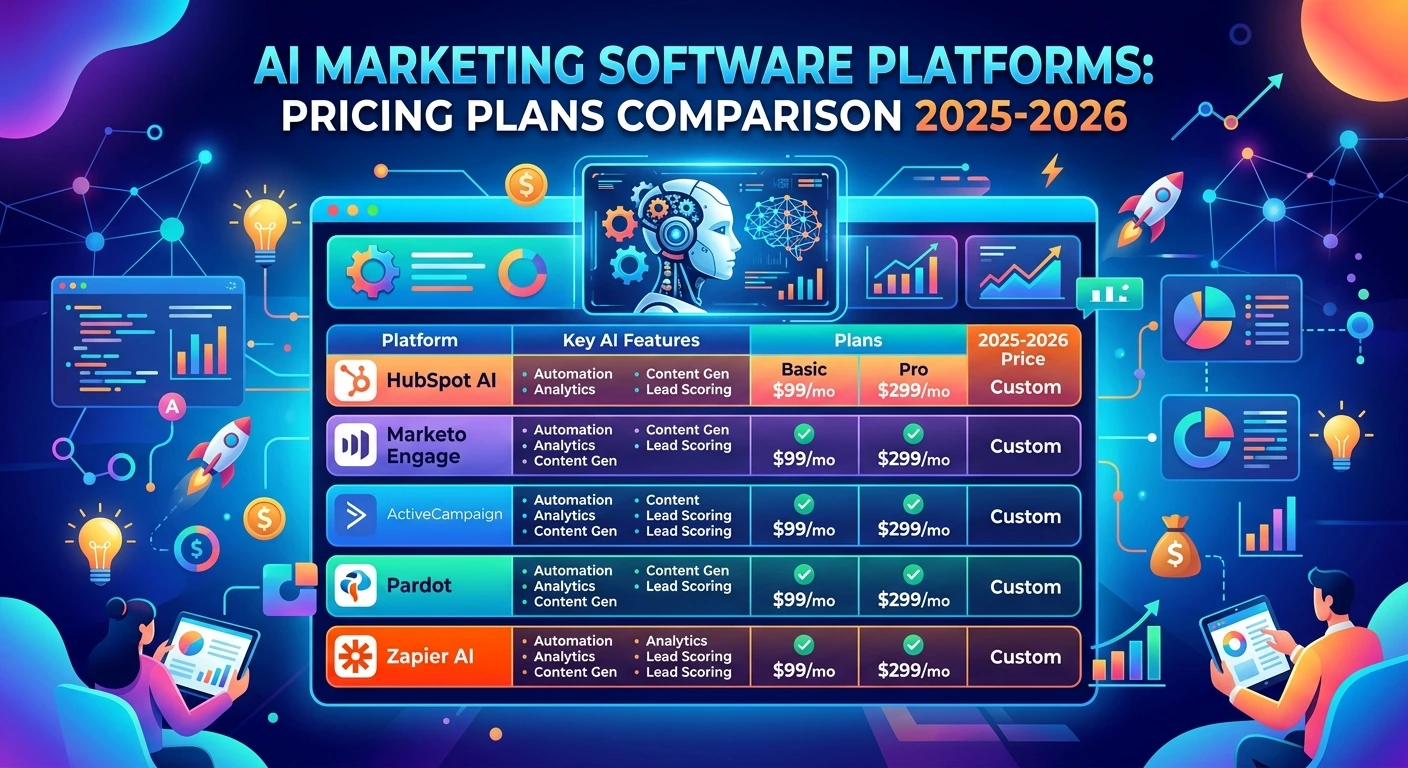
AI marketing software usually follows several pricing models. The most common is subscription pricing, where customers pay monthly or annually for access to a particular plan. Many providers offer several tiers designed for individuals, small businesses, growing teams, and enterprises.
Another model is usage-based pricing. Under this structure, customers pay according to credits, API calls, generated content, contacts, emails, automation executions, or other measurable usage.
Some platforms combine subscription and usage-based pricing. A plan may include a monthly allowance and charge additional fees after that limit. This structure can make budgeting more difficult when usage changes significantly from month to month.
Enterprise software may use custom pricing. The final cost can depend on the number of users, contacts, data volume, integrations, security requirements, support level, and contract terms.
Free AI Marketing Tools vs Paid Marketing Platforms
Free AI marketing tools can be useful for beginners, freelancers, students, and small businesses that want to test a workflow before spending money. Free plans often provide limited AI generations, fewer integrations, basic analytics, or restricted automation.
Paid plans generally provide higher limits and additional capabilities. Depending on the platform, these may include advanced reporting, larger contact databases, team collaboration, premium integrations, custom branding, priority support, or more sophisticated automation.
A sensible approach is to start with a free trial or free tier when available. Use it for a real marketing task instead of simply exploring the interface. For example, create an email campaign, analyze a website, produce several social posts, or build an automation workflow.
Then calculate whether the time saved and additional marketing output justify the subscription.
Comparing AI Marketing Platforms for Small Businesses
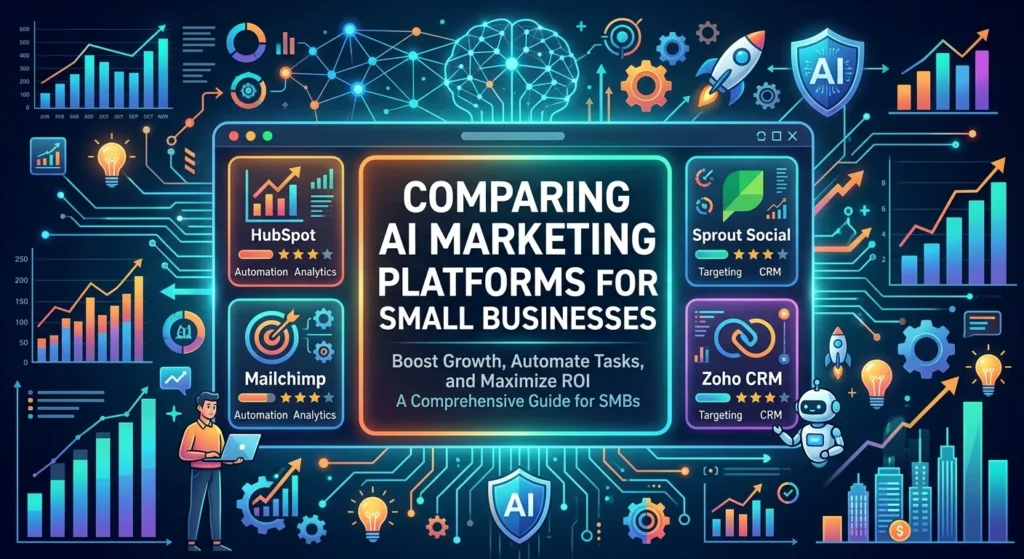
Small businesses often need a balance between affordability and useful automation. They may not have a large marketing department, so software that combines several tasks can be especially helpful.
Useful capabilities can include AI-assisted copywriting, email automation, social media scheduling, SEO assistance, customer segmentation, lead management, and simple performance reporting.
However, small businesses should avoid paying for enterprise-level features they will never use. Choose based on current workflow requirements and realistic growth, not on a feature list designed for much larger organizations.
For example, a local service business may gain more value from lead capture, automated follow-up emails, and customer relationship management than from an advanced enterprise analytics system.
AI Marketing Platforms for Ecommerce and Online Stores
Ecommerce businesses have different requirements because marketing connects closely with products, customers, transactions, inventory, and repeat purchases. AI software can help create product descriptions, personalize recommendations, segment customers, predict purchasing behavior, and automate promotional campaigns.
A strong ecommerce workflow can connect an online store with email marketing, customer data, analytics, advertising, and content systems. This allows marketers to build campaigns around customer behavior instead of sending identical messages to everyone.
For example, an ecommerce company could create an automated workflow for customers who viewed a product but did not purchase it. The system might send a reminder email and later measure whether the customer returned and completed the purchase.
When comparing plans, check contact limits, ecommerce integrations, automation rules, product-data synchronization, personalization features, and reporting capabilities.
AI Marketing Software for Content, SEO, and Social Media
AI marketing platforms can significantly speed up content workflows. They can help marketers brainstorm topics, create outlines, draft social posts, summarize research, develop email copy, and identify content opportunities.
SEO-focused platforms may provide keyword research, content optimization, competitor analysis, search performance tracking, and AI visibility insights. Social media platforms may focus on content calendars, scheduling, audience analysis, and engagement monitoring.
AI should support the content process rather than replace editorial judgment. Strong marketing content still needs accurate information, original insights, useful examples, appropriate search intent, and a clear brand voice.
For SEO, businesses should also avoid producing large quantities of generic AI content simply because generation is inexpensive. Quality, usefulness, originality, and relevance remain central to sustainable search performance.
Integrations, Automation, and Marketing Workflows
Integrations can make a major difference in the real cost of marketing software. A platform may have excellent AI features, but its value decreases if it cannot connect to the systems your business already uses.
Common integrations include CRM platforms, ecommerce systems, analytics tools, email services, advertising networks, social platforms, calendars, spreadsheets, and customer-support applications.
Automation can connect these systems. For example:
New lead arrives → CRM creates contact → AI categorizes lead → email workflow starts → sales team receives notification → campaign performance is tracked.
Before buying a platform, confirm whether required integrations are included in your selected plan. Some providers place advanced integrations behind higher pricing tiers.
Pros and Cons of AI Marketing Software Platforms
AI marketing platforms offer several important advantages. They can reduce repetitive work, increase content production speed, support personalization, identify patterns in customer data, and help small teams handle larger marketing workloads.
They can also improve consistency. Automated workflows can perform routine tasks according to predefined rules without requiring a marketer to repeat every step manually.
However, AI software has limitations. AI-generated output can be inaccurate, repetitive, overly generic, or inappropriate for a specific audience. Automation can also create problems when incorrect data enters a workflow.
Another concern is cost. A business may subscribe to several specialized tools and eventually spend more than expected. That is why companies should periodically review their software stack and remove tools that duplicate existing functionality.
How to Compare AI Marketing Pricing Plans Correctly
Do not compare monthly prices alone. First identify what each plan actually includes. Look at users, contacts, AI credits, automation runs, storage, integrations, analytics, customer support, and feature restrictions.
Then estimate your expected usage. If you have 10,000 contacts but a plan supports only 1,000, the advertised base price may not represent your real cost.
Also compare annual and monthly billing carefully. Annual plans may reduce the effective monthly price but require a larger upfront commitment. Free trials can help you test whether a platform works before making that commitment.
A useful evaluation formula is:
Total software cost = subscription fee + usage charges + add-ons + required integrations + additional seats.
Then compare that cost against practical benefits such as hours saved, campaigns produced, leads managed, or manual tasks eliminated.
Common Mistakes When Buying AI Marketing Software
One common mistake is choosing software because it has the largest number of AI features. More features can create unnecessary complexity and increase the subscription cost.
Another mistake is ignoring usage limits. A plan may appear affordable until the business exceeds its monthly AI credits, contact allowance, automation limit, or data capacity.
Businesses should also avoid purchasing multiple tools that perform essentially the same function. For example, maintaining several AI writing platforms may create unnecessary expenses when one reliable solution is sufficient.
Finally, do not automate a broken process. First create a clear marketing workflow, then use AI to improve and automate it. Automation makes a good process faster, but it can also make a bad process happen faster.
AI Marketing Platform Alternatives and Specialized Tools
An all-in-one platform is not always the right choice. Some businesses prefer a specialized software stack where each tool handles one important function.
For example, one product may focus on SEO, another on customer relationship management, another on email automation, and another on social media. This approach can provide deeper capabilities but may require more integrations and administration.
An all-in-one platform can simplify management because several functions exist in one ecosystem. However, specialized products may provide more advanced capabilities for particular marketing tasks.
The right approach depends on business size, workflow complexity, budget, technical skills, and marketing objectives. Evaluate the complete workflow rather than comparing isolated features.
Latest AI Marketing Trends in 2025 and 2026

One major trend is the movement from simple AI content generation toward AI-assisted marketing workflows. Instead of asking AI to produce one piece of content, marketers increasingly use AI across research, planning, production, personalization, optimization, and reporting.
Another trend is greater use of predictive analytics. Platforms can analyze customer behavior and help marketers identify patterns that may support campaign decisions.
AI search is also changing content strategy. Businesses increasingly need to consider how their brands and content appear across traditional search engines and AI-powered search experiences.
Marketing platforms are also becoming more connected. CRM data, website behavior, advertising information, email activity, and customer interactions can increasingly work together inside automated workflows.
Future of AI Marketing Software Platforms Beyond 2026
The next stage of AI marketing software is likely to focus more heavily on autonomous and semi-autonomous workflows. Instead of simply generating text, AI systems may coordinate multiple steps across different marketing applications.
For example, a marketer could define a campaign objective, audience, budget, and brand guidelines. The software could then assist with research, creative development, audience segmentation, campaign setup, testing, and reporting while keeping important decisions under human control.
Data quality will become increasingly important. AI systems can only produce reliable recommendations when they have accurate and relevant information.
Privacy, security, transparency, and human oversight will also remain important. Businesses should evaluate how platforms store customer information, manage permissions, protect sensitive data, and explain automated recommendations.
Practical Tips for Choosing the Right AI Marketing Platform
Start by writing down your top three marketing problems. For example, you may want to reduce content production time, automate lead follow-ups, or improve campaign reporting.
Next, identify the features required to solve those problems. Avoid paying for features that have no connection to your workflow.
Test before committing whenever possible. Use a free trial or demo to complete a realistic task. Test the platform with your own content, audience structure, integrations, and reporting requirements.
Finally, review the software regularly. Marketing needs change as a business grows, and a platform that works well today may not be the best fit later.
The best AI marketing software is not necessarily the cheapest or the most expensive. It is the platform that delivers the capabilities you need at a cost your business can justify.
Conclusion: Making a Smarter AI Marketing Software Decision
AI marketing software platforms can improve productivity, creativity, automation, customer engagement, and marketing efficiency. But pricing should never be evaluated separately from actual usage and business requirements.
When comparing plans for 2025 and 2026, examine features, AI limits, contacts, users, integrations, automation, analytics, support, billing structure, and total cost. Free plans and trials can help you test software before making a financial commitment.
The strongest approach is practical. Identify your marketing problems first, select the capabilities that solve them, calculate realistic usage, and measure the results after implementation. AI can become a powerful marketing assistant, but human strategy, brand knowledge, quality control, and responsible decision-making remain essential.
FAQs About AI Marketing Software Platforms Pricing Plans
What are AI marketing software platforms?
AI marketing software platforms use artificial intelligence to assist with marketing activities such as content creation, customer analysis, campaign automation, SEO, personalization, advertising, and reporting.
How much does AI marketing software cost?
Pricing varies widely. Some platforms offer free plans, while paid products may use monthly subscriptions, annual contracts, usage-based pricing, or custom enterprise pricing.
Are free AI marketing platforms useful?
Yes. Free plans can be useful for testing workflows, learning a platform, and completing smaller marketing tasks. However, free plans usually have limits on features, usage, users, contacts, or integrations.
What should I compare when evaluating AI marketing pricing plans?
Compare total cost, AI usage limits, users, contacts, automation, integrations, analytics, support, storage, and additional charges rather than looking only at the advertised monthly price.
Are AI marketing platforms worth paying for?
They can be valuable when they save significant time, automate repetitive work, improve campaign management, or provide capabilities that would otherwise require additional staff or software.
Should a small business use an all-in-one AI marketing platform?
An all-in-one platform can simplify marketing operations, but it is not automatically the right choice. A small business should compare its actual requirements with the platform’s features, cost, complexity, and integrations.
Can AI marketing software replace marketers?
AI can automate and assist with many marketing tasks, but it does not eliminate the need for human strategy, creativity, judgment, fact-checking, brand management, and customer understanding.
What is usage-based AI marketing pricing?
Usage-based pricing charges according to measurable activity, such as AI credits, generated content, contacts, emails, automation executions, API calls, or data volume.
Should I choose monthly or annual billing?
Monthly billing usually provides greater flexibility, while annual billing can sometimes reduce the effective monthly cost. Check cancellation terms and discounts before committing.
What is the biggest mistake when comparing AI marketing software?
One of the biggest mistakes is comparing only the headline subscription price. Usage limits, add-ons, integrations, extra users, and required features can significantly change the real cost.
How can I choose the right AI marketing software?
Define your marketing goals, identify required features, calculate expected usage, test shortlisted platforms, review integrations, and compare the total cost against measurable business benefits.