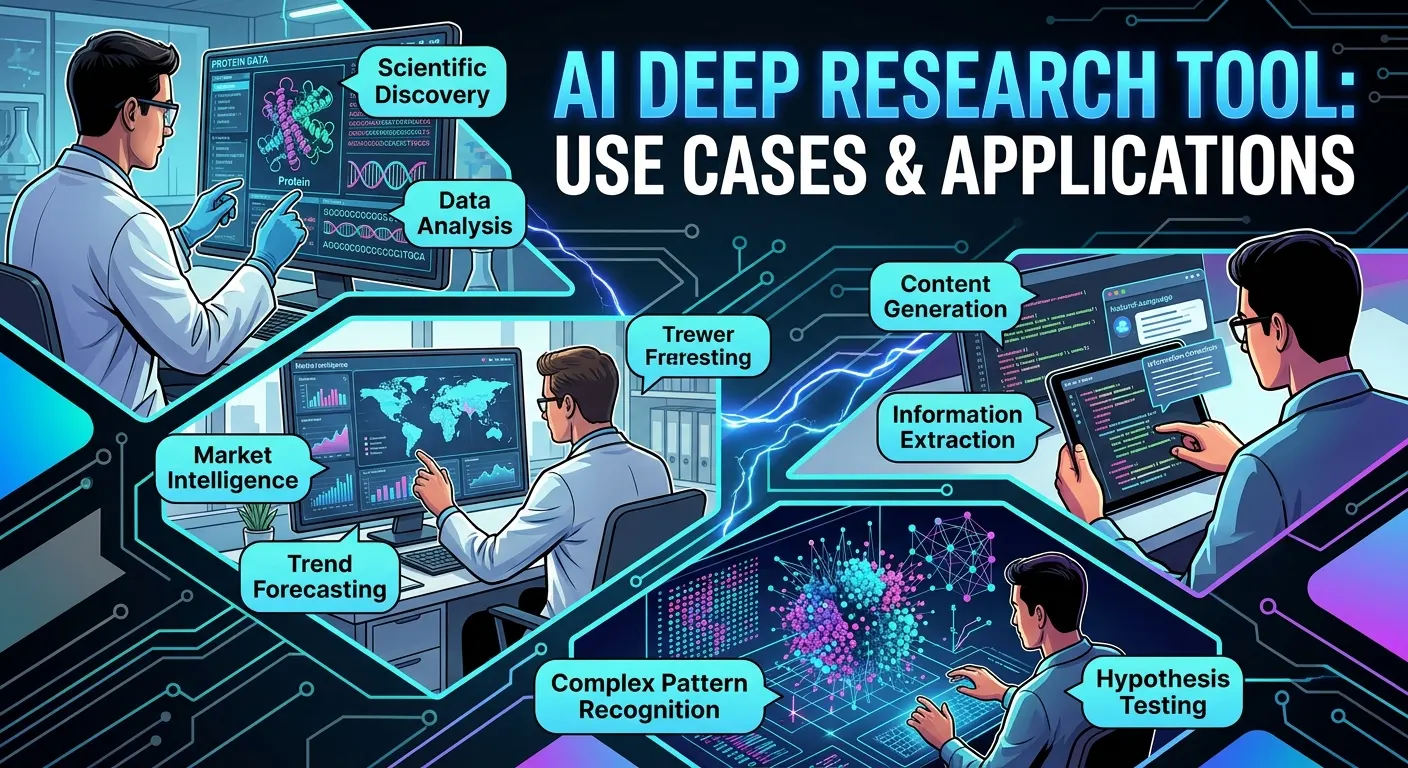
AI deep research tools are changing how people find, analyze, organize, and use information. Instead of spending hours opening dozens of pages, reading long documents, and manually comparing sources, these tools can help automate much of the research process. The most valuable AI deep research tool use cases and applications range from business intelligence and academic research to market analysis, content creation, product development, competitor research, and everyday decision-making.
They combine artificial intelligence, web research, information retrieval, summarization, reasoning, and structured analysis to turn large amounts of information into useful insights. For businesses and individuals, this can improve productivity, efficiency, creativity, automation, and real-world decision-making. However, the quality of the final result still depends on the tool, the sources it accesses, and how carefully users verify important information.
What Is an AI Deep Research Tool?
An AI deep research tool is an artificial intelligence system designed to investigate a topic across multiple information sources and produce a structured research result. Unlike a basic chatbot that may answer from its existing knowledge, a deep research system can often search for information, examine multiple sources, compare findings, identify patterns, and create a detailed response.
The main purpose is to reduce the manual work involved in research. A user can provide a complex question instead of searching for every small detail separately. The AI may break the question into smaller research tasks, search relevant sources, collect information, and organize the findings into a readable report.
For example, imagine a small business owner wants to understand the electric vehicle market. Instead of manually searching market reports, competitor websites, news articles, customer discussions, and product pages, an AI research tool can help organize these research areas into one workflow.
Deep research does not simply mean “more text.” Its value comes from combining multiple research steps into a more organized process.
How AI Deep Research Tools Work
Most AI deep research systems follow a multi-step workflow. First, the tool interprets the user’s question and determines what information is needed. A complicated request may be divided into smaller subtopics so that each part can be researched separately.
The system may then search available sources, retrieve relevant information, compare different documents, and identify useful evidence. Advanced systems can sometimes revisit searches when the first results are insufficient. This iterative process helps create a more complete research picture.
After collecting information, the AI organizes the findings into categories or themes. It can summarize sources, compare viewpoints, identify trends, and generate a final report. Some tools also provide source citations or links, which can help users verify important claims.
A useful workflow looks like this:
Question → Research plan → Source discovery → Information extraction → Analysis → Synthesis → Report
The process can save significant time, but users should still review important claims, especially when research involves finance, law, medicine, academic work, or business decisions.
Key Features of AI Deep Research Tools
One important feature is multi-source research. Instead of relying on a single webpage, a deep research tool can investigate information from multiple sources. This is useful when a topic has many different perspectives or rapidly changing information.
Another useful capability is automated summarization. Long reports, articles, research papers, and documents can contain hundreds of pages. AI can help identify the major findings and organize them into shorter explanations.
Many systems also provide:
- Web search and source discovery
- Research planning
- Document analysis
- Citation generation
- Fact comparison
- Trend identification
- Competitor research
- Data extraction
- Report generation
- Follow-up research
- Question answering
- Information classification
Advanced tools may also combine reasoning, browsing, document processing, and structured writing in one workflow.
The most useful feature depends on the user’s objective. A student may prioritize document analysis, while a marketer may need competitor research and market intelligence.
Business Intelligence and Market Research Applications
One of the strongest AI deep research tool applications is business intelligence. Companies constantly need information about markets, customers, competitors, industries, regulations, and emerging opportunities.
An AI research workflow can help investigate questions such as:
- What are the current trends in a specific industry?
- Who are the major competitors?
- What products are competitors launching?
- What customer problems remain unsolved?
- What changes are happening in consumer behavior?
- Which technologies are gaining attention?
For example, a startup planning a fitness application could research competitors, pricing models, app features, customer complaints, market trends, and emerging technologies. The research could then help the team identify gaps worth investigating.
AI does not replace business judgment. Instead, it can reduce the time required to gather information and give decision-makers a broader evidence base.
Academic Research and Education Use Cases
AI deep research tools can also support academic research and learning. Students and researchers often need to examine large amounts of information before writing an assignment, literature review, research proposal, or report.
A research tool can help locate relevant papers, summarize complex concepts, identify recurring themes, and organize sources. For example, a student researching renewable energy could ask the tool to investigate recent developments, major technologies, challenges, and areas of ongoing research.
Researchers can also use AI to create initial research maps. Instead of starting with a blank document, they can identify major themes and questions that deserve deeper investigation.
However, academic users should be particularly careful with citations and source accuracy. AI-generated summaries should not automatically be treated as authoritative. Important claims should be checked against the original papers or trusted academic sources.
The best approach is to use AI as a research assistant, not as a replacement for scholarly judgment.
Content Creation, SEO, and Topic Research
Content creators and SEO professionals can use AI deep research applications to investigate topics before producing articles, guides, reports, and other content.
For example, an SEO writer working on an article about AI search optimization may research related questions, competing pages, terminology, industry trends, user concerns, and frequently discussed subtopics. This can help create content that addresses search intent more completely.
AI research can also help identify:
Primary topics: The main subject the audience wants to understand.
Supporting topics: Related concepts that add depth.
Questions: Specific problems users commonly ask.
Entities: Companies, technologies, concepts, products, and organizations connected to the topic.
Content gaps: Areas where existing information may be incomplete or unclear.
This research can support semantic SEO and AI search optimization because well-researched content tends to cover a topic from multiple relevant angles.
Still, creators should add original analysis, practical experience, examples, and accurate sources. Simply publishing an AI-generated research summary does not automatically create useful content.
Competitor Research and Competitive Intelligence

Another major use case is competitor analysis. Businesses can investigate competitors without manually checking every website, product page, announcement, article, and public resource.
An AI research tool can help organize information about competitor products, pricing, positioning, marketing messages, features, customer feedback, and content strategies.
For example, an online software company might ask:
“Research the major project management platforms and identify their core features, target customers, pricing approaches, integrations, and common customer complaints.”
The resulting research can provide a starting point for competitive analysis.
However, businesses should distinguish documented facts from AI-generated interpretations. A competitor’s publicly listed feature is a fact. An assumption about why the competitor introduced that feature is an interpretation and should be treated differently.
Product Research and Innovation Applications
Product teams can use deep research tools during product discovery and innovation. Before building something new, teams need to understand customer problems, competing solutions, technical developments, and market demand.
AI research can investigate product categories, customer reviews, industry discussions, product announcements, technical documentation, and public feedback.
For example, a company considering a new note-taking application could research:
- Existing note-taking products
- Common user complaints
- Popular features
- Pricing models
- AI capabilities
- Integration requirements
- Privacy concerns
- Collaboration features
- Mobile and desktop workflows
This information can help product teams create better questions before making development decisions.
AI can also support brainstorming by connecting information from different areas. This creates opportunities for innovation and creative problem-solving.
Customer Research and Consumer Insights
Understanding customers is another practical AI deep research application. Companies can research public reviews, discussions, surveys, product feedback, and other available information to identify recurring customer concerns.
For example, an ecommerce company selling backpacks could investigate what buyers frequently complain about. Research might reveal concerns about durability, storage space, comfort, materials, or product sizing.
The AI can organize recurring themes and help teams understand which topics deserve further investigation.
This approach can support:
- Customer experience improvement
- Product development
- Marketing messaging
- FAQ creation
- Customer support
- Product positioning
- Content strategy
Businesses should avoid treating online discussions as a perfect representation of all customers. Public feedback can contain selection bias. It is best combined with direct customer research and internal data.
Free vs Paid AI Deep Research Tools
The difference between free and paid AI research tools usually involves access, usage limits, research depth, speed, model capabilities, integrations, and advanced features.
Free versions can be useful for simple research questions and experimentation. They allow users to understand how AI research workflows operate without immediately paying for a subscription.
Paid plans may provide higher usage limits, stronger models, longer research tasks, additional document processing, more advanced research features, or better access to integrations.
The right choice depends on the user’s needs. A student performing occasional research may not require an expensive subscription. A professional researcher or business team conducting research every day may benefit from more advanced capabilities.
Before paying, check the current plan details, usage limits, source access, privacy terms, and export options. Pricing and features can change frequently, so users should verify them directly with the provider.
Integrations With Documents, Search, and Productivity Tools
Integrations can make AI deep research more useful because research rarely exists separately from the rest of a workflow.
A research system may work alongside documents, spreadsheets, cloud storage, browsers, note-taking platforms, project management software, or other productivity applications. These connections can reduce the need to manually copy information between tools.
For example, a marketing team might research a new industry and then move the findings into a project document. A product team might analyze customer feedback and organize important findings inside its product planning workflow.
Integrations can improve automation and efficiency, but users should understand what information an integration can access. Sensitive business documents should only be connected when the organization’s privacy and security requirements are satisfied.
A good integration should save meaningful time rather than simply add another feature to the workflow.
AI Deep Research Tools vs Traditional Research
Traditional research and AI-assisted research solve the same broad problem—finding and understanding information—but they approach the process differently.
Traditional research usually requires the user to manually search, open sources, take notes, compare information, and create a final summary. This method gives the researcher direct control but can require considerable time.
AI deep research can automate many repetitive steps. It can search multiple sources, summarize information, group findings, and produce a structured report much faster.
However, AI introduces its own risks. It can misunderstand a source, overlook important information, rely on weak sources, or produce an incorrect interpretation. Traditional research also has risks, such as researcher bias and incomplete searching.
For important projects, the strongest workflow is often AI-assisted research plus human verification. Let AI handle repetitive information processing while the human researcher evaluates evidence and makes the final judgment.
Pros, Cons, and Common Limitations

AI deep research tools offer several advantages. They can save time, reduce repetitive searching, organize large information sets, generate research outlines, and help users explore unfamiliar subjects.
They can also improve creativity by exposing users to different perspectives and connections. A writer may discover new angles, while a product team may identify an overlooked customer problem.
However, limitations remain. AI research can contain inaccurate information, incomplete sources, outdated material, misunderstood context, or incorrect conclusions. Search quality also depends on the sources available to the system.
Common limitations include:
- Source quality differences
- Incomplete coverage
- Potential factual errors
- Citation problems
- Outdated information
- Context misunderstandings
- Overreliance on summaries
- Limited access to paywalled information
- Privacy concerns
- Human bias in interpreting results
The solution is not to avoid AI research. Instead, users should build verification into the workflow.
Common Mistakes and Best Practices for AI Research
One common mistake is asking an overly broad question without defining the goal. A vague prompt can produce a large amount of information without a clear outcome.
A better approach is to explain the research objective, audience, time period, geography, source preferences, and expected output.
For example, instead of asking:
“Research AI tools.”
A stronger research request could specify:
“Research AI SEO tools used by small businesses in 2026. Compare their main capabilities, typical use cases, limitations, and publicly available pricing information. Identify recurring themes across reliable sources.”
Another mistake is accepting every AI-generated statement without checking it. Important facts should be verified against primary or authoritative sources whenever possible.
Users should also keep research organized. Save useful sources, record important findings, distinguish evidence from assumptions, and update research when the topic changes quickly.
Latest Trends and Future of AI Deep Research Applications
AI deep research is moving toward more agentic and autonomous research workflows. Instead of responding to one prompt, future systems may perform longer sequences of research tasks, evaluate intermediate results, and adjust their strategy based on what they discover.
Another important trend is multimodal research. Future tools will increasingly work with text, images, charts, spreadsheets, audio, video, and structured data in the same workflow.
Personalized research is also likely to become more important. A system could understand a user’s preferred sources, research format, industry, previous work, and recurring information needs.
Other developments may include:
- Better source verification
- More transparent citations
- Improved reasoning
- Real-time information retrieval
- Stronger document analysis
- More advanced research agents
- Better enterprise security
- Deeper productivity integrations
- Automated monitoring of changing topics
The future is not simply about AI generating longer reports. The real opportunity is better research workflows that turn reliable information into useful decisions faster.
Frequently Asked Questions About AI Deep Research Tool Use Cases
What is an AI deep research tool used for?
An AI deep research tool is used to investigate complex topics, collect information from multiple sources, analyze findings, summarize evidence, and create structured research outputs.
What are the most common AI deep research applications?
Common applications include market research, competitor analysis, academic research, product research, content planning, SEO research, customer insights, business intelligence, and trend analysis.
Can AI deep research tools replace human researchers?
They can automate many repetitive research tasks, but they do not completely replace human researchers. People still need to evaluate sources, verify important claims, understand context, and make decisions.
Are free AI deep research tools useful?
Yes. Free tools can be useful for learning, simple research, brainstorming, and occasional projects. Professional users may need paid features for higher usage limits and advanced capabilities.
Can AI deep research tools help with SEO?
Yes. They can help identify search topics, related questions, competitors, content gaps, entities, trends, and supporting information. Human expertise is still important for creating accurate and genuinely useful content.
How accurate are AI deep research reports?
Accuracy varies by tool, sources, research topic, and task complexity. Users should verify important claims against original or authoritative sources rather than assuming every generated statement is correct.
What is the best way to use an AI deep research tool?
Start with a clear research question, define the scope, request reliable sources, review the evidence, verify important claims, and turn the findings into original analysis or decisions.
Can AI deep research tools analyze documents?
Many modern AI systems can analyze documents such as reports, articles, PDFs, and other files. Capabilities vary by platform, so users should check the specific tool’s current limits.
Are AI deep research tools useful for small businesses?
Yes. Small businesses can use them for competitor research, customer research, industry analysis, content planning, product research, and identifying emerging opportunities.
What is the future of AI deep research?
The field is moving toward more autonomous research agents, stronger source verification, multimodal analysis, real-time research, personalized workflows, and deeper integration with productivity and business systems.
AI deep research tools are becoming valuable because they can transform a complicated information-gathering process into a more organized and efficient workflow. Their applications extend from academic research and SEO to market intelligence, product development, customer analysis, competitive research, and business strategy. The biggest benefit is not simply faster searching. It is the ability to connect information, identify patterns, and present useful findings in a structured way.
At the same time, responsible use matters. AI-generated research should be treated as a starting point for investigation rather than unquestionable truth. Users should verify important information, evaluate source quality, protect sensitive data, and apply human judgment.
As AI research systems become more capable, the most productive approach will combine automation with human expertise. AI can handle much of the repetitive research work, while people provide context, critical thinking, creativity, and final decision-making. That combination can make deep research faster, more efficient, and more valuable across a wide range of real-world applications.
This article is structured for semantic SEO, long-tail search intent, featured snippets, and AI-search visibility, while keeping the language natural and beginner-friendly.