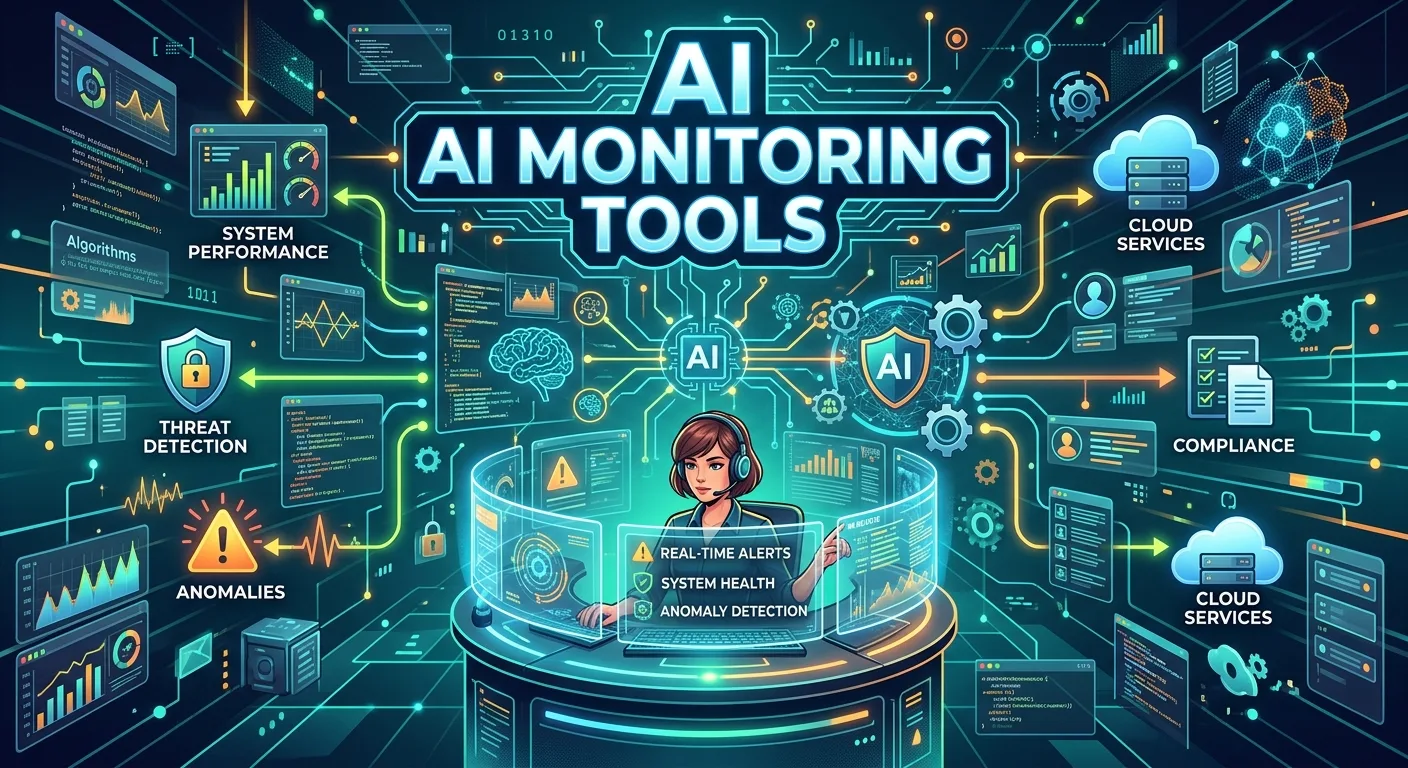
AI has become part of everyday business operations, content creation, customer service, cybersecurity, marketing, analytics, and workflow automation. As these systems become more important, organizations need reliable ways to understand how they perform. AI monitoring tools help teams track AI systems, applications, models, workflows, and outputs so they can identify problems and improve performance.
Modern AI monitoring goes beyond checking whether a system is online. It can examine accuracy, latency, costs, errors, model behavior, data quality, security, user feedback, and operational performance. This information helps businesses improve productivity while reducing unnecessary manual work.
Whether you manage an AI chatbot, machine-learning model, generative AI application, or automated workflow, monitoring provides valuable visibility. The right solution can help teams make faster decisions, protect users, control spending, and build more reliable AI experiences.
What Are AI Monitoring Tools?
AI monitoring tools are software solutions that help organizations observe, measure, and manage the performance of artificial intelligence systems. They collect information about AI applications and turn that information into useful metrics, alerts, reports, and diagnostics.
Traditional application monitoring usually focuses on infrastructure, uptime, server performance, and technical errors. AI monitoring adds another layer. It can examine model outputs, prompts, responses, prediction quality, token usage, drift, hallucination-related signals, and other AI-specific behavior.
For example, a company might operate an AI customer-support assistant. A standard monitoring system could tell the team whether the application is running. An AI monitoring platform could provide additional information about response latency, failed requests, model usage, costs, user feedback, and potentially problematic responses.
This distinction is important because an AI application can be technically operational while still producing poor results. Monitoring helps teams identify both technical and AI-specific problems.
How AI Monitoring Works
An AI monitoring system typically collects telemetry from an AI application, model, API, database, or workflow. The platform processes that information and displays it through dashboards, reports, alerts, or other interfaces.
Depending on the product, monitoring may include application logs, model metrics, traces, user feedback, evaluation results, and operational data. Some platforms also support automated evaluations that assess responses against predefined criteria.
A typical workflow looks like this:
Collect data → Analyze performance → Detect problems → Alert the team → Investigate → Improve the system.
For example, imagine an AI writing assistant that normally responds within two seconds. If response times suddenly increase to six seconds, an AI monitoring platform can help the team identify the change.
The same system could monitor an increase in failed requests or unusual output patterns. This allows developers to investigate problems before they become major user-facing issues.
Key Features of AI Monitoring Tools
The most useful AI monitoring platforms combine traditional application observability with AI-specific measurements. The exact feature set varies between providers, so businesses should evaluate tools according to their specific requirements.
Real-time dashboards provide an overview of application health. Teams can monitor requests, errors, response times, model usage, and other important signals from a central location.
Alerts and notifications help teams react quickly. A monitoring platform might alert a developer when error rates exceed a threshold or when AI spending increases unexpectedly.
Other important capabilities can include:
- Model performance monitoring
- Latency tracking
- Error and exception monitoring
- Token and API usage tracking
- Cost monitoring
- Data-quality checks
- Model drift detection
- Prompt and response tracing
- User feedback analysis
- Security monitoring
- Automated evaluations
- Custom dashboards
The best feature set depends on whether you are monitoring a machine-learning model, generative AI application, chatbot, recommendation system, or enterprise AI workflow.
Benefits of Using AI Monitoring Software
The biggest benefit of AI monitoring is visibility. Without monitoring, teams may know that an AI application has problems but struggle to understand when, where, or why those problems occur.
Monitoring also supports productivity. Developers can spend less time manually investigating every incident because alerts and dashboards highlight important changes.
Cost control is another major benefit. Generative AI applications can generate significant API and infrastructure expenses. Tracking usage allows teams to identify unusually expensive workflows and optimize model selection, prompts, caching, or request frequency.
AI monitoring can also improve reliability. If a team identifies recurring errors, slow responses, poor evaluations, or unexpected model behavior, it can make targeted improvements.
Key benefits include:
Faster troubleshooting: Identify problems more quickly.
Better reliability: Detect issues before they affect many users.
Cost optimization: Understand where AI spending comes from.
Improved quality: Measure outputs against defined expectations.
Greater transparency: Understand what happens inside AI workflows.
Better user experience: Track feedback and performance signals.
AI Monitoring Use Cases Across Industries
AI monitoring tools can support almost any organization that operates AI-powered systems. The specific monitoring requirements depend on the application and industry.
In customer service, companies can monitor chatbot latency, failed conversations, user feedback, escalation rates, and response quality.
In healthcare, AI systems may require additional monitoring around reliability, data handling, and human oversight. Organizations should follow applicable laws, internal policies, and professional requirements.
In finance, monitoring can help track model performance, unusual behavior, operational failures, and system availability.
Marketing teams can monitor AI-powered content workflows, recommendation systems, analytics models, and automation pipelines.
Ecommerce businesses can monitor product recommendations, search systems, personalization engines, and AI customer-support tools.
Other common use cases include:
- Fraud detection
- Cybersecurity
- Predictive analytics
- Recommendation systems
- AI assistants
- Document processing
- Machine translation
- Computer vision
- Generative AI applications
- Enterprise automation
- Software development assistants
The important principle is simple: monitor the signals that matter to the actual business outcome rather than collecting every possible metric.
AI Model Monitoring vs AI Application Monitoring
AI model monitoring and AI application monitoring are related but different. Model monitoring focuses primarily on the behavior and performance of a machine-learning or AI model.
For example, a model monitoring system might track prediction accuracy, data drift, feature changes, or changes in model performance.
Application monitoring looks at the complete AI-powered application. It may include the model, API requests, databases, user interface, external services, infrastructure, and application logic.
Generative AI applications often require both approaches.
Consider an AI document assistant. The model may perform well in isolation, but the overall application could still experience slow API calls, database failures, excessive token consumption, or poor retrieval results.
Therefore, end-to-end AI observability can provide a more complete view than model metrics alone.
Generative AI Monitoring and LLM Observability
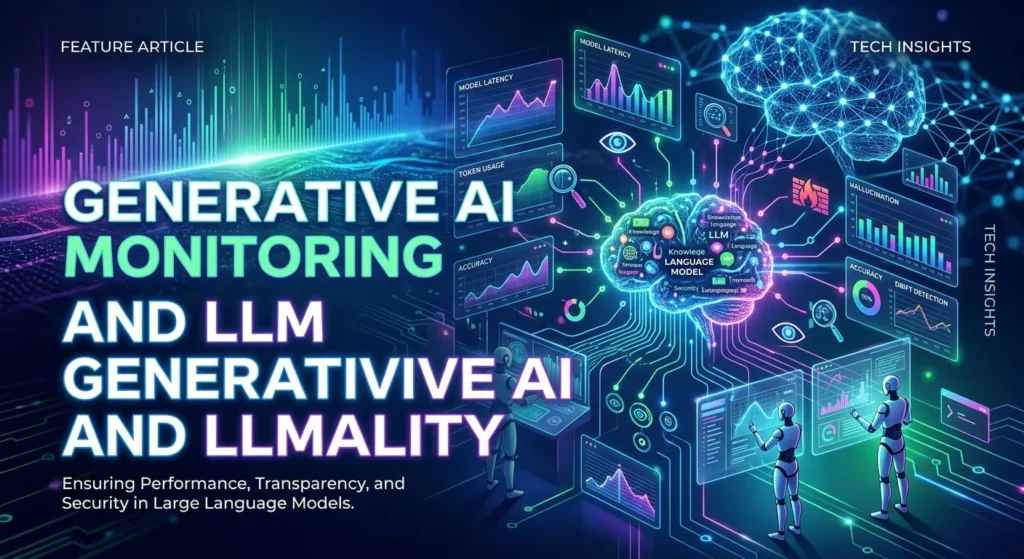
Large language model applications introduce monitoring challenges that traditional software systems do not always have. An LLM application can produce different answers for similar inputs, depending on context, prompts, model configuration, retrieved information, and other factors.
LLM observability helps teams understand these interactions. Depending on the platform, it can track prompts, responses, traces, model calls, token usage, latency, costs, and evaluation results.
For retrieval-augmented generation applications, monitoring can also help teams investigate the retrieval process. A response may be poor because the model misunderstood the prompt, because the retrieval system supplied weak context, or because the underlying documents lacked useful information.
This makes tracing valuable. Instead of simply seeing a bad answer, developers can investigate the steps that contributed to it.
For generative AI teams, useful monitoring areas include:
- Prompt performance
- Response quality
- Token consumption
- Model latency
- Retrieval quality
- Tool calls
- Failed generations
- User feedback
- Evaluation scores
- AI application costs
AI Monitoring for Performance, Accuracy, and Cost
AI performance involves more than speed. A fast AI system that produces unreliable results may create more problems than it solves.
Teams should define measurable quality criteria before launching a monitoring program. For example, a customer-support assistant could track response time, successful resolution rate, escalation rate, and user satisfaction.
Accuracy may also be measured differently depending on the application. A classification system might have clear labels for evaluation. A generative AI application may require human review, automated evaluation, reference answers, or multiple quality criteria.
Cost monitoring is increasingly important as well. Teams should understand how many requests they send, which models they use, how much data each request consumes, and where unexpected usage occurs.
A useful monitoring strategy connects these metrics. If a more expensive model improves response quality significantly, the additional cost may have a business justification. If costs rise without measurable improvement, optimization may be necessary.
Free vs Paid AI Monitoring Tools
Free AI monitoring options can be useful for developers, students, small projects, and early experiments. They may provide basic dashboards, limited usage, simple logging, or community-supported functionality.
Paid platforms usually offer greater scale and more advanced features. These can include higher data volumes, longer retention, team collaboration, enterprise security, advanced analytics, integrations, and dedicated support.
Before selecting a paid platform, calculate what you actually need. A small application with a few hundred daily requests may not require an enterprise monitoring package.
A growing AI application may have different requirements. If request volume, model complexity, or team size increases, more sophisticated monitoring may become useful.
When comparing free and paid solutions, consider:
Data limits: How much telemetry can you collect?
Retention: How long can you access historical data?
Integrations: Does the platform work with your existing stack?
Alerts: Can you create custom thresholds?
Security: Does it meet your organization’s requirements?
Scalability: Can the platform support future growth?
Free software can be an excellent starting point, but the right choice depends on workload and business requirements.
AI Monitoring Integrations and Developer Workflows
Integrations make monitoring more practical because AI systems rarely operate alone. A modern application may use cloud infrastructure, databases, APIs, model providers, vector databases, analytics platforms, and development tools.
An AI monitoring platform can connect these systems so teams can investigate problems from one place. For example, a developer might see that an AI request failed and trace the event through an API call, retrieval process, model request, and application response.
Popular integration categories can include:
- Cloud platforms
- AI model APIs
- Application frameworks
- Databases
- Data warehouses
- Logging systems
- Collaboration tools
- Incident-management platforms
- Analytics systems
- CI/CD pipelines
APIs are especially useful for larger organizations. They allow monitoring information to move into custom dashboards, internal systems, or automated workflows.
The best integration strategy is focused. Connect systems that help you diagnose problems or make decisions, rather than creating unnecessary technical complexity.
Pros and Cons of AI Monitoring Tools
AI monitoring offers significant advantages, but it also introduces challenges.
The main advantage is better visibility. Teams can understand system behavior, identify errors, track costs, and investigate performance changes using actual data.
Monitoring also supports proactive maintenance. Instead of waiting for users to report every issue, teams can configure alerts for important changes.
However, monitoring can create additional costs and complexity. Collecting large amounts of telemetry may increase storage and processing requirements. Poorly configured dashboards can also overwhelm teams with unnecessary information.
Privacy is another important consideration. AI systems may process sensitive prompts, documents, or user information. Organizations should carefully review what their monitoring platform collects, where it stores information, how long it retains data, and who can access it.
The goal should be useful observability without excessive data collection.
How to Choose the Best AI Monitoring Tool
There is no single AI monitoring platform that fits every project. The right choice depends on your application, technical architecture, budget, team size, and monitoring objectives.
Start by defining the most important problems you need to solve. If your biggest challenge is LLM cost, prioritize token and spending analytics. If reliability is the issue, focus on errors, latency, traces, and alerts.
If output quality matters most, look for evaluation capabilities and feedback analysis.
Consider these factors:
Compatibility: Does the tool support your AI stack?
Observability: Can you trace AI requests from beginning to end?
Evaluation: Can you measure output quality?
Scalability: Can it handle your expected workload?
Security: Does it provide appropriate access controls and data protection?
Usability: Can developers and business teams understand the dashboards?
Pricing: Does the cost match your usage?
Start with a small proof of concept. Send realistic application traffic through the monitoring system and evaluate whether the information actually helps your team.
Common AI Monitoring Mistakes to Avoid
One common mistake is monitoring everything without defining priorities. Large volumes of data do not automatically produce better insights.
Start with a small set of meaningful metrics. For example, an LLM application might begin with latency, errors, token usage, cost, and response quality.
Another mistake is creating alerts that trigger too frequently. Too many notifications can cause alert fatigue. Teams may eventually ignore important warnings because they receive too many low-value alerts.
Privacy is another major consideration. Avoid sending sensitive information to monitoring systems unless you understand the platform’s data-handling policies and have appropriate authorization.
Teams should also avoid relying on one metric. A model can have strong technical performance while producing poor user outcomes.
Finally, do not treat monitoring as a one-time setup. AI applications change as models, prompts, data, tools, and users change. Continuous monitoring and periodic review are essential.
Latest Trends and Future of AI Monitoring
AI monitoring is becoming more sophisticated as organizations deploy increasingly complex AI applications. Monitoring is moving beyond basic infrastructure metrics toward AI observability, evaluation, governance, security, and quality management.
Generative AI is also driving demand for better tracing. Modern applications may combine multiple models, tools, retrieval systems, and external APIs. Teams need visibility across the complete workflow rather than a single model call.
Automated evaluations are another important trend. Instead of manually checking every response, organizations can use evaluation systems to assess selected quality characteristics at scale.
Cost intelligence is likely to become more important as organizations compare models and architectures. Monitoring tools can help teams understand whether a workflow delivers enough value relative to its infrastructure and model expenses.
In the future, AI monitoring may become increasingly proactive. Instead of simply telling teams that something went wrong, monitoring systems may identify unusual patterns, explain likely causes, and suggest areas for investigation.
However, human oversight will remain important. Automated monitoring should support human decision-making, not replace responsible evaluation.
Conclusion
AI monitoring tools provide the visibility organizations need to operate artificial intelligence systems more reliably and efficiently. They can track performance, errors, latency, costs, model behavior, user feedback, and other important signals.
The right monitoring strategy depends on the AI system being used. A simple application may only need basic logging and alerts, while a large generative AI platform may require detailed tracing, evaluation, security monitoring, cost analysis, and governance.
The most effective approach is to start with clear objectives. Identify the metrics that directly affect users and business outcomes. Then build monitoring around those signals.
As AI becomes more deeply integrated into software and business operations, AI observability will become an important part of responsible and scalable AI development. Teams that combine automation with thoughtful human oversight can build systems that are easier to understand, improve, and maintain.
Frequently Asked Questions About AI Monitoring Tools
What are AI monitoring tools?
AI monitoring tools are software solutions that track the performance, behavior, reliability, costs, and quality of AI-powered systems. They help teams detect problems and improve applications.
Why do businesses need AI monitoring?
Businesses use AI monitoring to identify technical problems, track model performance, control costs, improve reliability, and understand how AI applications perform in real-world situations.
What is LLM monitoring?
LLM monitoring focuses on applications that use large language models. It can track prompts, responses, latency, tokens, costs, model calls, traces, evaluations, and user feedback.
Can AI monitoring tools track AI costs?
Many AI monitoring platforms can track usage-related costs. Depending on the provider, they may monitor token consumption, model usage, API requests, and estimated spending.
Are there free AI monitoring tools?
Yes. Some monitoring platforms provide free plans, open-source options, trials, or limited usage tiers. The available features and limits vary between providers.
What metrics should I monitor for an AI application?
Important metrics can include latency, errors, request volume, cost, token usage, model performance, response quality, user feedback, and system availability. The right metrics depend on your application.
What is AI observability?
AI observability is the practice of collecting and analyzing information about AI systems so teams can understand their behavior, performance, failures, and outcomes.
How is AI monitoring different from traditional software monitoring?
Traditional software monitoring often focuses on infrastructure, uptime, logs, errors, and application performance. AI monitoring adds AI-specific signals such as model behavior, output quality, prompts, evaluations, token usage, and model-related costs.
Can AI monitoring detect hallucinations?
Some platforms provide evaluations or quality checks that can help identify potentially incorrect or unsupported AI responses. However, no monitoring system should be assumed to detect every hallucination perfectly.
How should I choose an AI monitoring platform?
Evaluate compatibility, observability, evaluation features, integrations, security, scalability, usability, and pricing. Test the platform with realistic workloads before making a long-term commitment.