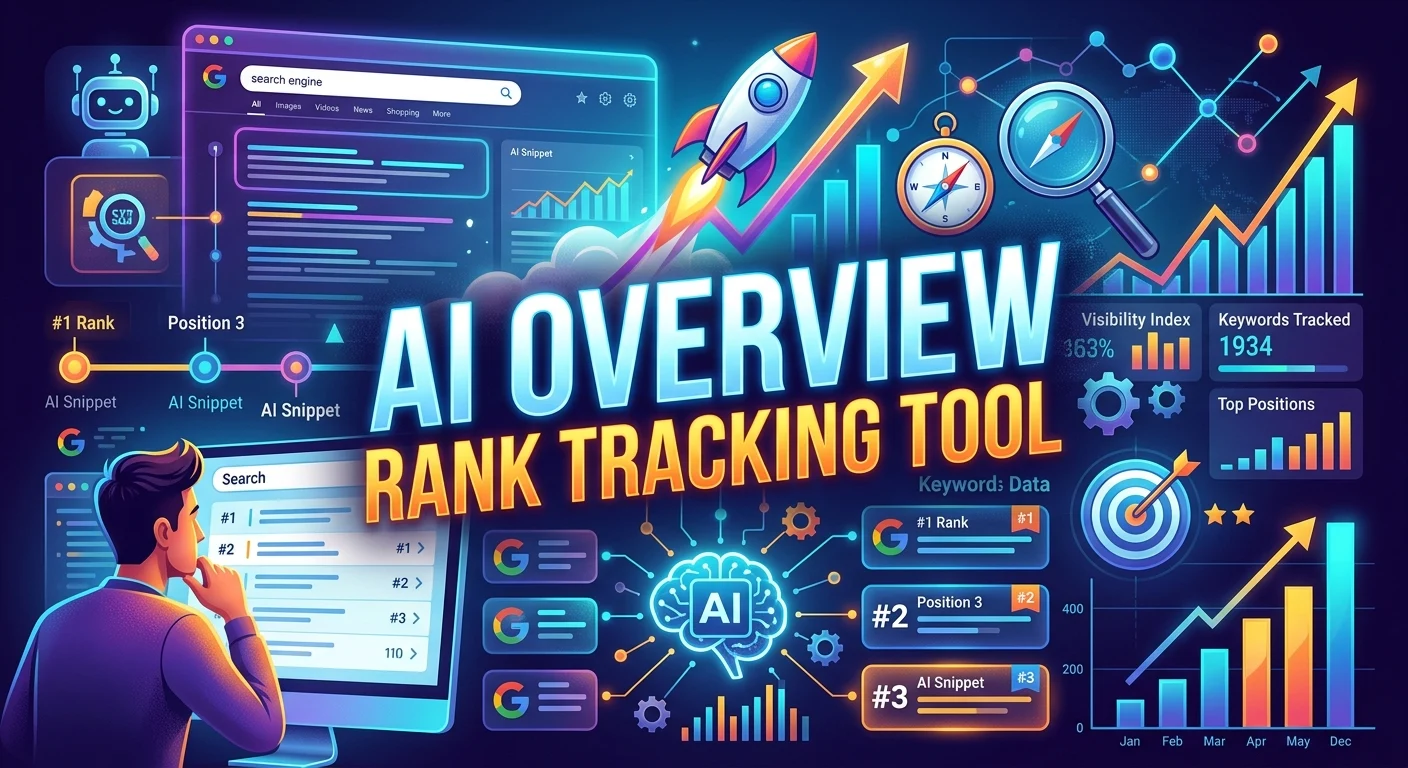
Search is changing as AI-generated answers become part of the search experience. For SEO professionals, this creates a new challenge: traditional keyword rankings no longer tell the complete story. An ai overview rank tracking tool helps marketers monitor how their pages and brands appear in AI-generated search results and understand which queries, sources, and competitors receive visibility.
These tools can improve productivity, efficiency, automation, and decision-making by reducing the need for repeated manual searches. Instead of checking important queries one by one, marketers can track them systematically and study visibility patterns over time.
For businesses, publishers, agencies, and content creators, AI Overview tracking can reveal opportunities that traditional rank tracking may miss. It can show whether a website is being cited, which competitors appear in AI answers, and where content improvements may increase visibility.
What Is an AI Overview Rank Tracking Tool?
An AI Overview rank tracking tool is an SEO platform or feature that monitors website visibility within AI-generated search summaries and related search experiences. It extends traditional rank tracking by examining whether a website, page, brand, or source appears in an AI-generated response.
Traditional rank tracking usually reports a position such as first, fifth, or tenth. AI-generated search results work differently. An answer may contain several sources, links, references, or brand mentions rather than one simple ranking position.
AI Overview tracking therefore focuses on additional signals. These can include AI Overview presence, source citations, linked pages, brand mentions, competitors, query coverage, and historical visibility.
For example, suppose a website targets the query “best AI SEO tools.” A traditional SEO tracker might report its organic position. An AI Overview tracker can additionally help determine whether the website is referenced inside an AI-generated answer for that query.
How AI Overview Rank Tracking Works
AI Overview tracking generally begins with a set of keywords or search queries. These queries can include informational keywords, commercial terms, branded searches, product comparisons, and long-tail questions.
The tracking platform periodically checks supported search environments and records the available AI-generated results. Depending on the provider, it may identify whether an AI Overview appeared, which sources were referenced, and whether the tracked website or competitor was included.
Historical tracking makes the data more useful. A single AI Overview can change, so marketers need repeated observations to understand broader patterns.
For example, a company might track 100 important keywords every week. Over time, it could discover that its content appears frequently for informational questions but rarely for commercial comparisons.
That information can guide content strategy.
A simplified workflow is:
Track queries → Detect AI Overviews → Identify sources → Compare visibility → Analyze changes → Improve content → Track again.
Key Features of AI Overview SEO Tracking Tools
Different platforms offer different capabilities, but several features are particularly useful for AI Overview monitoring.
Keyword tracking allows marketers to define the queries that matter most. Good platforms make it easy to organize keywords by topic, intent, location, product, or campaign.
AI Overview detection helps determine whether an AI-generated result appears for a tracked search. This is important because not every query necessarily produces the same search experience.
Citation monitoring identifies websites or pages referenced by AI-generated answers. This can help marketers understand which sources appear frequently within their topic area.
Other useful features can include:
- AI Overview visibility tracking
- Citation and source tracking
- Brand mention monitoring
- Competitor comparisons
- Historical visibility data
- Keyword grouping
- Search intent analysis
- SERP feature tracking
- Automated reports
- Alerts
- Location-based tracking
- Export options
- API access
The best feature set depends on your SEO objectives. A small website may need simple monitoring, while an agency may require large-scale reporting and competitor analysis.
Benefits of Using an AI Overview Rank Tracking Tool
One of the biggest advantages is time savings. Manually checking hundreds of searches every week is inefficient. Automated tracking gives marketers a structured way to monitor important queries.
These tools also provide a broader view of search visibility. A webpage might rank well organically but never appear as an AI Overview source. Another page could have a moderate traditional ranking but still receive a citation.
This creates new opportunities for SEO analysis.
AI Overview tracking can help businesses:
- Identify citation opportunities
- Monitor competitors
- Find content gaps
- Track brand visibility
- Measure changes over time
- Prioritize content updates
- Understand search behavior
- Improve reporting
The most important benefit is not the dashboard itself. It is the ability to turn AI search data into practical SEO decisions.
AI Overviews vs Traditional Google Rank Tracking
Traditional Google rank tracking measures organic search positions. If a page ranks at position three for a keyword, the tracker can record that position and compare it with previous results.
AI Overviews introduce another layer. Instead of simply asking where the page ranks, marketers may need to ask whether the page is used as a source in an AI-generated answer.
These measurements should not be treated as identical.
A traditional ranking can indicate organic search performance. AI Overview visibility can indicate whether a source is being surfaced within an AI-generated response.
For example, a website could rank number two organically but not appear among the sources shown in an AI Overview. Another site might rank lower organically while still being referenced.
This is why AI search visibility and traditional SEO rankings should be monitored together.
AI Overview Citations and Source Visibility
Citations are one of the most valuable signals to monitor. When an AI-generated answer references a webpage, that citation can provide evidence that the page is being considered relevant to the query.
However, citation frequency should not become the only SEO goal.
Marketers should examine the context in which their content appears. Is the cited page genuinely useful? Does it answer the user’s question? Does it provide original information? Does it demonstrate experience and expertise?
For example, an article may receive citations because it contains clear definitions and useful examples. Another page may receive citations because it provides original research or unique statistics.
This highlights an important principle: create content worth citing rather than simply trying to force citations.
Strong content usually combines accuracy, clarity, depth, first-hand knowledge, relevant evidence, and good organization.
Use Cases for SEO Agencies and Businesses
SEO agencies can use AI Overview rank tracking to monitor visibility across multiple clients. Instead of manually checking every keyword, agencies can organize queries into projects and generate recurring reports.
Businesses can use the same approach to monitor important product, service, and informational searches.
For example, an ecommerce company might track:
“best running shoes for beginners”
“comfortable running shoes”
“best shoes for daily running”
“running shoe brands”
The company can compare AI Overview visibility with organic rankings and other search signals.
Publishers can also use tracking to understand whether their informational content is being referenced. If competing publications repeatedly appear as AI sources, that may encourage the publisher to investigate differences in depth, evidence, structure, or topical coverage.
Other use cases include:
- Enterprise SEO
- Local SEO
- Ecommerce SEO
- Content marketing
- Brand monitoring
- Competitor research
- Digital PR
- SEO reporting
- Content optimization
Free vs Paid AI Overview Rank Tracking Tools
Free AI Overview tracking options can be useful for testing the concept. They may allow a limited number of searches, keywords, or reports.
Paid platforms generally provide greater scale and automation. Features can include more tracked queries, historical data, competitor monitoring, scheduled reports, multiple projects, and additional search environments.
The right choice depends on your workload.
A small website with 20 important queries may not need an expensive enterprise solution. An SEO agency managing hundreds of client keywords may require significantly more capacity.
Before paying for a tool, check:
Keyword limits: How many queries can you track?
Update frequency: How often does the platform collect data?
Historical data: Can you compare visibility over time?
Competitor tracking: Can you monitor other domains?
Reporting: Can you create useful client reports?
Locations: Can you track relevant countries or regions?
Integrations: Can you export or connect the data to other systems?
Start with your real requirements rather than choosing a platform based only on its feature count.
Pricing Factors to Consider
AI Overview rank tracking pricing can vary depending on the provider and the scale of monitoring. Some tools use subscription tiers, while others may base pricing on keywords, projects, search volume, locations, or data usage.
A low-cost plan may work well for a small website. Larger teams may need higher limits, more frequent updates, additional users, or advanced reporting.
Do not evaluate pricing only by the monthly subscription.
Consider the value of the information you receive. If a platform identifies content opportunities that save hours of manual research, its practical value may exceed the subscription price.
Also check for additional charges. Some platforms may charge separately for API usage, extra keywords, additional locations, or expanded historical data.
A trial period can help you determine whether the platform’s data is useful before committing to a long-term plan.
Integrations and SEO Reporting Workflows
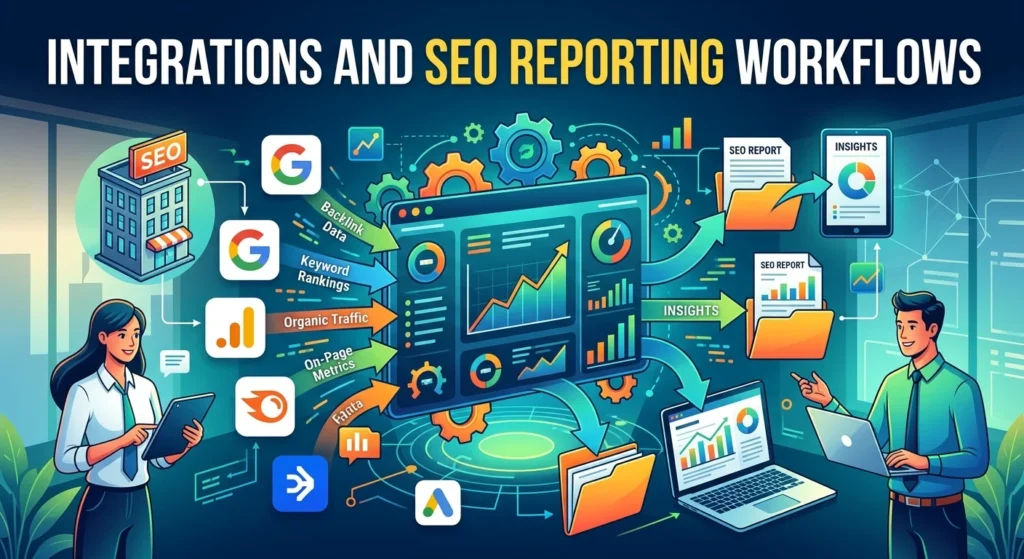
Integrations make AI Overview tracking more useful for professional SEO teams. Agencies often need to combine ranking data with analytics, content management, reporting, and project-management workflows.
Depending on the platform, integrations may include APIs, spreadsheets, dashboards, SEO platforms, analytics tools, and reporting systems.
For example, an SEO manager could export AI Overview visibility data into a reporting dashboard. The team could then compare AI citations with organic rankings, traffic, conversions, and content updates.
Automation can also create recurring reports. Instead of manually collecting data every month, the system can organize and deliver reports on a schedule.
However, integrations should remain practical. More integrations do not automatically mean better SEO. Choose connections that help your team understand performance and take action.
Pros and Cons of AI Overview Rank Tracking
AI Overview tracking provides several benefits, but it also has limitations.
The biggest advantage is visibility into a search feature that traditional ranking reports may not fully describe. It can help marketers identify cited sources, competitors, and changes in AI-generated search results.
Automation is another advantage. Large keyword sets become much easier to monitor when the platform collects data automatically.
However, AI-generated search results can change frequently. Results may vary based on search context, location, language, personalization, system updates, and other factors.
Another limitation is measurement complexity. A traditional rank can be represented by a simple number. AI visibility may involve multiple sources and different positions within an answer.
Therefore, AI Overview tracking should be treated as a directional and comparative SEO signal, not as a perfect replacement for traditional rankings.
How to Choose the Right AI Overview Tracking Tool
Begin by defining what you want to measure.
If your primary goal is citation tracking, choose a platform with detailed source analysis. If competitor research is more important, prioritize domain comparisons and historical visibility.
If you work with clients, reporting and project management may matter more.
Look for:
Accurate tracking: Does the tool reliably identify AI Overview results?
Useful historical data: Can you see trends rather than isolated observations?
Competitor analysis: Can you compare relevant domains?
Keyword management: Can you organize large query sets?
Reporting: Are the reports clear enough for clients and decision-makers?
Automation: Can the tool reduce manual work?
Scalability: Can it handle your future requirements?
Testing a tool with your own keywords is often more useful than reading a long list of features.
Best Practices for Improving AI Overview Visibility
Tracking alone will not improve rankings or AI visibility. The data needs to influence your content strategy.
Start by identifying queries where competitors appear frequently but your website does not. Then examine the content that receives visibility.
Look for useful patterns. Do competing pages provide clearer definitions? Do they answer multiple related questions? Do they include original research, practical examples, expert commentary, or strong supporting evidence?
Improve your content based on genuine user needs.
Use descriptive headings and answer important questions directly. Keep key information easy to find. Support factual claims with trustworthy evidence when appropriate.
Build topical authority rather than producing shallow pages for every possible keyword.
A practical optimization cycle is:
Monitor → Compare → Analyze → Improve → Recheck.
This process is more sustainable than making random changes based on individual search results.
Common AI Overview Tracking Mistakes
One common mistake is focusing entirely on visibility percentages. A single number rarely explains why a website gained or lost AI visibility.
Another mistake is tracking irrelevant keywords. A massive keyword list can create noise and make reporting difficult.
Focus on searches connected to your audience, products, services, and business goals.
Marketers should also avoid assuming that appearing in an AI Overview automatically generates traffic. A user may read an AI-generated answer without visiting any cited website.
Another mistake is copying competitor content simply because it appears in an AI Overview. Instead, identify the useful qualities of that content and create something original and genuinely helpful.
Finally, avoid reacting to one unusual result. Look for repeated patterns over time before making major SEO decisions.
Latest Trends in AI Overview SEO Tracking
AI search is becoming increasingly conversational. Users can ask detailed questions rather than entering short keyword phrases.
This means SEO monitoring is moving toward queries, topics, entities, citations, context, and brand presence rather than keywords alone.
Another trend is the growing importance of AI-generated answers across different search experiences. Marketers may need to monitor multiple forms of AI visibility instead of focusing on one search feature.
Automation is also improving. Future tracking platforms may do more than report visibility. They may categorize changes, identify content gaps, compare sources, and highlight pages that deserve attention.
AI Overview tracking is also likely to become more integrated with broader AI search visibility monitoring. Instead of measuring one feature separately, platforms may provide a combined view of brand presence across multiple AI-powered search environments.
The measurement model will continue evolving, so marketers should focus on durable principles: useful content, trustworthy information, strong topical coverage, and measurable business outcomes.
Conclusion: Building a Smarter AI Overview SEO Strategy
An ai overview rank tracking tool can help SEO professionals understand a new layer of search visibility. Traditional rankings remain important, but marketers increasingly need to know whether their pages and brands appear inside AI-generated search experiences.
The most effective strategy combines AI Overview tracking with traditional SEO data. Monitor important queries, analyze citations, study competitors, improve content, and measure changes over time.
Do not chase every new AI metric. Focus on information that helps you make better decisions.
As AI-powered search continues to evolve, SEO success will increasingly depend on understanding how users discover information across multiple search experiences. A thoughtful tracking strategy can help businesses adapt while keeping the focus on valuable content and real user needs.
Frequently Asked Questions About AI Overview Rank Tracking Tools
What is an AI Overview rank tracking tool?
An AI Overview rank tracking tool monitors how websites, brands, and pages appear in AI-generated search results. It can track AI Overview presence, citations, sources, competitors, and historical visibility.
Why should I track AI Overviews?
AI Overviews can change how users discover information. Tracking them helps SEO teams understand whether their content is being referenced and how competitors perform in AI-generated answers.
Is AI Overview tracking the same as keyword rank tracking?
No. Traditional rank tracking measures organic search positions, while AI Overview tracking examines visibility within AI-generated search experiences. Using both can provide a broader SEO picture.
Can AI Overview tracking tools monitor competitors?
Many platforms provide competitor monitoring. Depending on the tool, you may be able to compare domains, citations, mentions, and query-level visibility.
Does appearing in an AI Overview guarantee traffic?
No. An AI Overview can answer a user’s question without generating a website visit. AI visibility should therefore be evaluated alongside traffic, conversions, engagement, and other business metrics.
How can I increase my chances of appearing in AI Overviews?
Create accurate, useful, well-structured content that directly answers user questions. Demonstrate expertise, provide original value, maintain topical depth, and support important claims with reliable information.
Are free AI Overview rank tracking tools available?
Some providers offer free plans, trials, or limited tracking options. Paid tools generally provide greater keyword limits, historical data, automation, and reporting capabilities.
How often should I track AI Overview rankings?
The ideal frequency depends on your website and industry. Regular monitoring helps identify trends, while checking only once in a long period can make important changes harder to detect.
What metrics should I track?
Useful metrics can include AI Overview presence, citation frequency, cited URLs, brand mentions, competitor visibility, query coverage, and changes over time.
Will AI Overview tracking replace traditional SEO tools?
It is unlikely to replace all traditional SEO measurement. Organic rankings, technical SEO, traffic, conversions, and other metrics remain valuable. AI Overview tracking adds another layer of search visibility analysis.