AI search is changing how people discover brands, products, services, and information. Instead of relying only on traditional blue-link rankings, users increasingly interact with AI-generated answers, AI Overviews, conversational search, and answer engines. This creates a new challenge: businesses need to understand whether AI systems mention their brand and how they represent it.
Leading AI visibility optimization tools help marketers monitor brand mentions, analyze AI-generated responses, identify competitors, track citations, and discover opportunities to improve visibility across AI search experiences. These platforms can support SEO teams, content marketers, agencies, SaaS companies, ecommerce businesses, and publishers.
The right tool can improve productivity, efficiency, research, automation, and strategic decision-making. However, AI visibility optimization is not simply about getting mentioned more often. It also involves improving the accuracy, relevance, authority, and consistency of information that AI systems can discover and use.
What Are Leading AI Visibility Optimization Tools?
Leading AI visibility optimization tools are software platforms designed to measure and improve how brands, websites, products, and organizations appear within AI-powered search experiences. These experiences can include AI Overviews, conversational search engines, answer engines, and generative AI assistants.
Traditional SEO tools mainly focus on keyword rankings, backlinks, organic traffic, technical issues, and search engine results pages. AI visibility platforms add another layer by examining how AI systems respond when users ask questions related to a business or topic.
For example, a company selling project management software might want to know whether AI systems mention its product when users ask, “What are the best project management tools for small teams?” An AI visibility platform can help monitor those responses and identify competing brands that appear more frequently.
The exact capabilities differ by provider. Some tools emphasize prompt tracking, while others focus on citations, brand mentions, competitive analysis, sentiment, content recommendations, or automated reporting.
How AI Visibility Optimization Tools Work
Most AI visibility platforms begin by creating a collection of prompts or questions relevant to a brand. These prompts represent the types of questions potential customers might ask AI search systems.
The platform then monitors responses from supported AI environments and records information such as brand mentions, competitors, citations, linked sources, and response context. Some systems can repeat these checks over time to identify changes.
The data can then be organized into dashboards. Marketers may see how frequently a brand appears, which competitors receive visibility, which sources AI systems cite, and what topics generate the most opportunities.
A useful workflow is:
Create relevant prompts → collect AI responses → measure visibility → analyze competitors and citations → improve content and authority → monitor changes.
This process turns AI search from something difficult to observe into a measurable marketing activity.
Key Features of AI Search Visibility Platforms
A strong AI visibility platform usually combines several monitoring and analysis capabilities. Prompt tracking is one of the most important because it allows teams to monitor real customer-style questions.
Another useful feature is citation tracking. AI-generated answers may reference websites, articles, documentation, research, or other sources. Understanding which sources receive citations can help marketers identify the information that AI systems consider useful or relevant.
Competitive monitoring is also valuable. A company may discover that its competitors consistently appear in AI responses while its own brand rarely appears.
Other capabilities can include sentiment analysis, share-of-voice measurements, source analysis, historical tracking, custom prompt sets, scheduled reporting, alerts, and team collaboration.
The strongest platforms make the data understandable. A dashboard should help users answer practical questions such as “Where are we visible?”, “Where are competitors visible?”, and “What can we improve?”
Benefits of Leading AI Visibility Optimization Tools
The primary benefit is visibility measurement. Without dedicated monitoring, a marketing team may have little insight into how AI systems describe its brand.
These tools can also save time. Instead of manually asking dozens of questions across different AI platforms, marketers can organize prompts and monitor results through a centralized workflow.
Another benefit is competitive intelligence. AI visibility data can reveal which companies appear in conversations around a specific topic. This can help marketers identify gaps in positioning and content.
AI visibility tools can also support content strategy. If AI systems repeatedly cite certain types of authoritative sources, marketers can investigate those sources and improve their own content accordingly.
For agencies, automated reports can make it easier to communicate AI search performance to clients. For internal marketing teams, historical data can help identify whether visibility changes after content updates or digital PR campaigns.
AI Visibility Use Cases for SEO and Marketing Teams
SEO teams can use AI visibility tools to expand traditional search tracking. Instead of measuring only Google rankings, they can monitor how brands appear in AI-generated answers.
Content teams can use these platforms to identify content gaps. Suppose AI responses repeatedly mention statistics, definitions, comparisons, and expert sources when answering a topic. A content team can use that information to create more useful resources.
Digital PR teams can also benefit from source analysis. If AI systems frequently cite respected publications or industry websites, marketers can study those sources to understand how authority is being established.
SaaS companies and ecommerce brands can monitor product-related prompts. For example, a software company might track questions involving alternatives, pricing, features, and comparisons.
Agencies can create separate prompt sets for different clients and industries. This makes AI visibility monitoring easier to scale.
Free vs Paid AI Visibility Optimization Tools
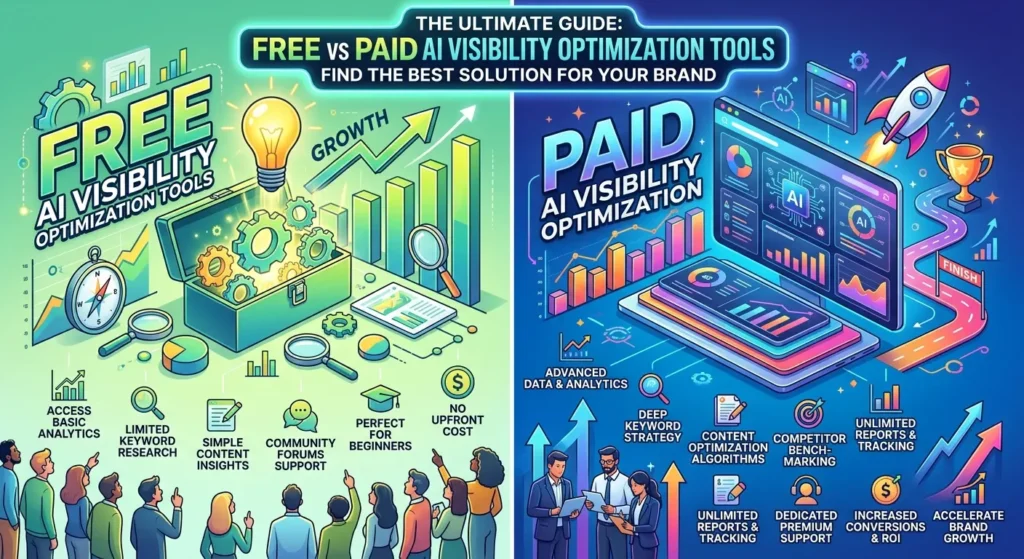
Free AI visibility tools can be useful for beginners who want to understand the basics of AI search monitoring. They may provide limited prompt tracking, manual analysis, or basic visibility checks.
Paid platforms generally provide more advanced capabilities such as larger prompt volumes, historical data, automated monitoring, competitive analysis, reporting, integrations, and team features.
However, the most expensive tool is not automatically the right choice. The best fit depends on the number of brands, prompts, markets, users, and AI platforms that need monitoring.
Before purchasing a platform, calculate the actual workload. A small business monitoring a few dozen prompts may need a much simpler solution than an international company tracking hundreds or thousands of queries.
Always verify current pricing directly with the vendor because AI software pricing, usage limits, and feature packages can change frequently.
Pricing and Cost Factors for AI Visibility Tools
AI visibility platforms can use different pricing structures. Some charge according to tracked prompts, while others may use plans based on projects, keywords, users, domains, AI platforms, or reporting features.
A basic plan may be suitable for a small website or individual marketer. Larger organizations may require enterprise functionality, multiple users, advanced reporting, API access, or higher monitoring limits.
When comparing pricing, look beyond the monthly subscription. Consider the number of prompts included, refresh frequency, supported AI systems, historical data, competitor tracking, exports, integrations, and customer support.
For example, a low-cost plan may appear attractive but become expensive if you need significantly more tracked prompts. Another platform might cost more but include the workflow automation your team needs.
The practical goal is to determine cost per useful insight, not simply cost per month.
Integrations and AI Search Marketing Workflows
Integrations can make AI visibility monitoring more useful because marketing teams rarely work inside one platform. They may already use SEO software, analytics platforms, content management systems, reporting tools, project-management software, or customer relationship management systems.
Depending on the provider, an AI visibility platform may offer integrations, exports, APIs, or connections to other marketing systems. These capabilities allow teams to move insights into existing workflows.
For example, a marketing team could monitor AI prompts, identify a visibility gap, create a content task, publish an improved resource, and then continue monitoring the same prompts.
Automation can reduce repetitive work. Scheduled reports and alerts can help teams identify major changes without manually checking dashboards every day.
Before selecting a platform, confirm that its integrations actually match your existing technology stack.
AI Visibility Tools vs Traditional SEO Tools
Traditional SEO platforms and AI visibility platforms solve related but different problems. SEO tools typically focus on search rankings, keywords, backlinks, organic traffic, technical SEO, and SERP analysis.
AI visibility platforms focus more heavily on how brands appear in generated answers and conversational search environments. They may track mentions, citations, sources, competitors, and answer-level visibility.
The two approaches should not be treated as competitors. They can work together.
A strong search strategy can monitor traditional rankings while also examining AI-generated discovery. This gives marketers a broader view of how people may find information online.
For example, a page might rank well for a traditional keyword but receive little visibility in AI-generated answers. Conversely, a smaller website might be cited by an AI system even when it does not dominate traditional rankings.
Alternatives to Dedicated AI Visibility Platforms
Businesses do not always need a specialized platform immediately. Smaller teams can start with manual prompt testing, spreadsheets, analytics, content audits, and traditional SEO tools.
Manual research can be useful for learning how AI search works. A marketer can create a list of important questions, test them across supported AI systems, record mentions and citations, and repeat the process periodically.
However, manual monitoring becomes difficult as the number of prompts increases. It can also introduce inconsistency because responses from generative AI systems can vary.
Dedicated platforms become more valuable when monitoring needs to scale. They can automate data collection, organize historical information, and provide repeatable reporting.
The right choice depends on scale, budget, monitoring frequency, and reporting requirements.
How to Choose the Right AI Visibility Optimization Tool
Start by defining what you need to measure. Do you want to monitor brand mentions, citations, competitors, sentiment, product recommendations, or all of these?
Next, identify the AI environments that matter to your audience. A tool that supports one set of AI search experiences may not cover every environment your customers use.
Check whether the platform provides historical tracking. Historical data is important because a single AI response does not represent long-term visibility.
Also evaluate data accuracy and transparency. Understand how the platform collects results, how often it refreshes data, and how it defines metrics such as visibility or share of voice.
Finally, test the interface before committing to a long-term subscription. A sophisticated dashboard has little value if your team cannot easily turn its data into useful actions.
Common Mistakes in AI Visibility Optimization
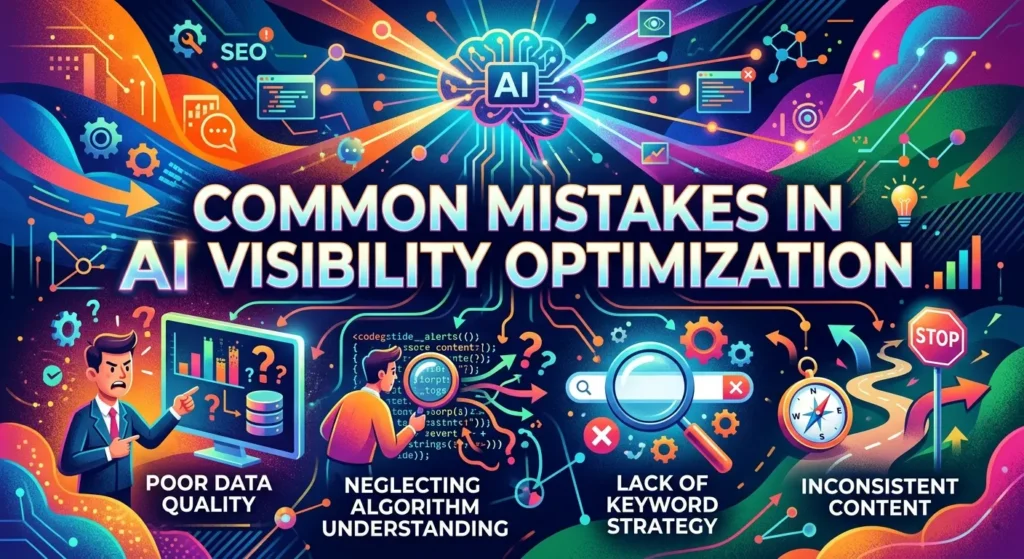
One major mistake is treating AI visibility like a simple ranking position. AI-generated answers can vary based on the prompt, context, model, location, freshness, and other factors.
Another mistake is focusing only on brand mentions. A mention without accurate context may not provide meaningful business value. Accuracy, relevance, authority, and positive representation matter too.
Some marketers also track too many prompts. A huge list can produce noise instead of useful insights. Start with the questions that closely match your audience’s search behavior.
Finally, avoid changing content based on one AI response. Generative systems can produce different answers at different times. Look for patterns across repeated observations before making major strategic decisions.
Latest Trends in AI Search Visibility Optimization
AI search is becoming more conversational and increasingly focused on direct answers. Users may ask complex questions instead of entering short keyword phrases.
This creates demand for answer engine optimization, generative engine optimization, AI search optimization, brand monitoring, and citation analysis.
Another important trend is the growth of multimodal search. Future AI systems may combine text, images, video, audio, maps, products, and other information types when generating answers.
AI agents are also becoming more important. Instead of simply answering a question, an agent may research products, compare options, organize information, and complete multiple steps.
As these systems develop, visibility measurement will likely become more complex. Marketers will need to understand not only whether a brand appears but why it appears, which sources influence the answer, and how the answer affects user decisions.
Future of AI Visibility Optimization Tools
The future of AI visibility optimization is likely to involve deeper automation and more sophisticated analysis. Platforms may move beyond simple mention tracking toward understanding the full context of AI-generated recommendations.
Future systems could provide more detailed information about brand representation, citation influence, entity relationships, competitive positioning, content freshness, and topic authority.
AI visibility platforms may also connect directly with content workflows. A system could identify a visibility gap, recommend a content improvement, monitor the resulting change, and report whether AI-generated answers changed afterward.
However, human oversight will remain important. AI-generated data can contain errors, and automated recommendations should not replace expert review.
The most useful future platforms will likely combine accurate monitoring, transparent data, practical recommendations, workflow automation, and strong reporting.
Best Practices for Improving AI Search Visibility
Start by creating genuinely useful content that answers important questions clearly. Use concise definitions, relevant examples, original research, expert insights, and trustworthy sources.
Make important information easy for search systems to understand. Clear headings, descriptive page titles, structured content, consistent terminology, and well-organized information can improve machine readability.
Build authority beyond your own website. Relevant mentions, reputable references, expert contributions, industry publications, and credible digital PR can strengthen the information ecosystem around a brand.
Most importantly, monitor results continuously. AI visibility is not a one-time SEO project. AI systems, search interfaces, competitors, content, and user behavior continue to change.
Use visibility tools to identify patterns, then combine those insights with traditional SEO data, analytics, customer research, and human judgment.
Leading AI Visibility Optimization Tools FAQs
What are AI visibility optimization tools?
AI visibility optimization tools monitor how brands, products, and websites appear in AI-generated search answers. They can track mentions, citations, competitors, prompts, and other visibility signals.
How is AI visibility different from traditional SEO?
Traditional SEO focuses heavily on search rankings, organic traffic, keywords, backlinks, and technical optimization. AI visibility focuses on how brands and sources appear inside AI-generated answers and conversational search experiences.
Why should businesses track AI visibility?
AI systems increasingly influence how users discover information. Monitoring visibility can help businesses understand whether AI systems mention their brand and which competitors or sources appear alongside relevant questions.
Are AI visibility optimization tools free?
Some platforms offer free trials or limited free features, while many advanced platforms use paid plans. Pricing and included features vary by provider.
What should an AI visibility tool track?
Useful measurements can include brand mentions, citations, competitors, prompts, sources, visibility trends, sentiment, and historical changes.
Can AI visibility tools replace SEO software?
Generally, they serve different purposes. AI visibility platforms can complement traditional SEO tools rather than completely replacing them.
What is Generative Engine Optimization?
Generative Engine Optimization, often called GEO, refers broadly to strategies designed to improve how content and brands are represented in AI-generated answers and generative search experiences.
How often should AI visibility be monitored?
The appropriate frequency depends on the business. High-change industries may benefit from frequent monitoring, while smaller websites may review important prompts weekly or monthly.
Do AI visibility tools guarantee AI mentions?
No. Monitoring software can measure and analyze visibility, but it cannot guarantee that an AI system will mention a particular brand.
What makes content more useful for AI search?
Clear answers, trustworthy information, original insights, relevant evidence, strong topical coverage, understandable structure, and accurate factual information can all contribute to content quality.
Are AI visibility tools useful for small businesses?
They can be, especially when AI-generated recommendations influence customers in their market. Small businesses can begin with a focused set of important prompts instead of monitoring hundreds of queries.
Conclusion
Leading AI visibility optimization tools give marketers a new way to understand search performance in an environment where AI-generated answers increasingly complement traditional search results. They can monitor prompts, brand mentions, citations, competitors, sources, and visibility trends.
The most effective approach is not to chase every AI mention. Instead, businesses should create useful, accurate, authoritative, and clearly structured content, then use visibility data to understand how AI systems represent that information.
Traditional SEO still matters. AI visibility should become another layer in a broader digital strategy that includes technical SEO, content quality, digital PR, analytics, customer research, and brand authority.
As AI search continues to evolve through conversational interfaces, multimodal systems, agents, and answer engines, visibility measurement will become increasingly important. Businesses that consistently monitor changes, test their strategies, and focus on real user value will be better equipped to adapt to the changing search landscape.