AI search is changing how people discover brands, products, services, and information. Instead of relying only on traditional blue-link rankings, users increasingly ask AI-powered search systems for direct answers and recommendations. This makes AI visibility optimization tools valuable for businesses that want to understand how their brand appears across AI-driven search experiences. These tools can help track mentions, citations, competitors, prompts, topics, and visibility patterns. The best option depends on your goals, budget, website size, and the AI platforms you want to monitor. Some platforms focus on brand monitoring, while others combine AI visibility tracking with traditional SEO, content optimization, and analytics. This guide explains which AI visibility optimization tools are best, how they work, what features matter, pricing considerations, free versus paid options, common mistakes, and practical strategies for improving visibility in AI search.
What Are AI Visibility Optimization Tools?
AI visibility optimization tools help businesses measure and improve how their brands, websites, products, or content appear in AI-generated search results. Traditional SEO tools mainly focus on rankings, backlinks, keywords, and organic traffic. AI visibility platforms add another layer by examining how AI systems represent a business when users ask relevant questions.
For example, imagine a company sells project management software. A user might ask an AI search engine, “What are the best project management tools for small teams?” An AI visibility platform can help the company understand whether its brand appears in the answer, how often it appears, which competitors are mentioned, and whether the AI system cites its website.
These tools can monitor brand mentions, citations, recommendation frequency, sentiment, share of voice, competitors, and query performance. Some also provide suggestions for improving website content and entity signals.
The best tools do not simply produce a visibility score. They help you understand why your brand appears or does not appear and what actions could improve your presence.
How AI Visibility Optimization Tools Work
Most AI visibility platforms begin by creating a set of relevant search prompts. These prompts represent questions that potential customers might ask AI systems. The platform then runs or analyzes those queries across supported AI search environments.
The system records information such as whether your brand appeared, where it appeared, which competitors appeared, and which sources the AI cited. Some platforms also monitor how frequently a brand receives mentions across different topics and questions.
For example, a marketing agency could track prompts such as:
- Best digital marketing agencies for startups
- How can a small business improve SEO?
- What are affordable SEO services?
- Which agencies specialize in local SEO?
The platform can compare results over time. If your agency appears in only a few relevant answers, you can investigate the content and authority signals behind stronger competitors.
A useful AI visibility workflow is:
Discover → Monitor → Compare → Analyze → Optimize → Measure again.
This continuous process is more useful than checking AI search visibility once and forgetting about it.
Key Features to Look for in the Best AI Visibility Tools
When deciding which AI visibility optimization tools are best, focus on capabilities rather than impressive marketing claims. A good platform should provide useful data that supports real SEO and content decisions.
Prompt tracking is one of the most important features. You should be able to create or monitor questions related to your products, services, industry, and customers.
Brand mention tracking is another core feature. The tool should show when your company appears in AI-generated answers and ideally explain the context of the mention.
Look for citation monitoring as well. A brand may be mentioned without receiving a website citation. Understanding which pages AI systems use as sources can reveal opportunities for better content.
Other useful features include:
- Competitor comparison
- Share-of-voice tracking
- Topic monitoring
- Sentiment analysis
- Source and citation analysis
- Historical reporting
- Automated alerts
- Multiple AI platform support
- Team collaboration
- Exportable reports
- API or analytics integrations
The best platform for your business is the one that connects these measurements to clear optimization actions.
Why AI Search Visibility Matters for Modern SEO
Search behavior is becoming more conversational. People can ask complex questions instead of entering short keywords. AI systems can then summarize information from multiple sources.
This creates a new opportunity for brands. A business may rank well for traditional keywords but still have weak visibility when customers ask AI systems for recommendations.
Consider a travel company ranking on the first page for “best family vacations.” If an AI-generated answer recommends several competitors but ignores that company, traditional rankings alone do not tell the complete story.
AI visibility optimization helps identify this gap.
It also encourages businesses to create content that provides clear, trustworthy, comprehensive answers. Strong content remains important because AI systems need reliable information to understand topics, entities, products, and organizations.
AI visibility therefore should not replace SEO. Instead, businesses should treat it as an additional layer of their broader search optimization strategy.
Comparing AI Visibility Optimization Tools by Use Case
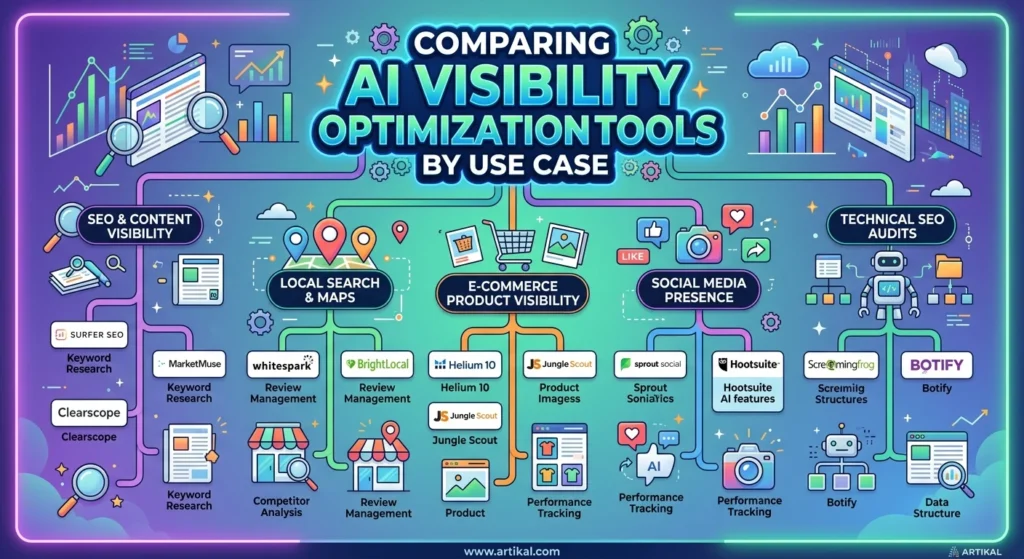
There is no universal winner because different businesses have different requirements. A large enterprise may need sophisticated reporting, while a small website may only need basic prompt and mention tracking.
For small businesses, simplicity and affordability usually matter most. A lightweight platform that tracks important customer questions can be more useful than an expensive enterprise system.
For SEO agencies, competitor comparisons, client reporting, multiple projects, and historical data are especially important. Agencies need to demonstrate measurable changes to clients.
For enterprise brands, scalability becomes critical. Large companies may need hundreds or thousands of prompts, multiple markets, multiple languages, detailed permissions, integrations, and automated reporting.
For content teams, citation and source analysis can be particularly valuable. These teams can investigate which content earns visibility and use those insights to improve existing pages.
Before choosing a tool, define your primary goal:
Do you need monitoring, competitor research, content optimization, reporting, or all of these?
That answer should guide your decision.
AI Brand Mentions, Citations, and Share of Voice
Brand mentions tell you whether an AI-generated response includes your company. Citations provide another layer by showing whether the system references your website or another source connected with your brand.
These measurements should not be treated as identical.
A company might receive many mentions but few citations. Another company might receive fewer mentions but appear as a frequently cited source. Both situations provide different optimization insights.
Share of voice measures your visibility compared with competitors across a selected group of prompts or topics. It can help answer questions such as:
- Which competitor appears most frequently?
- Which brands dominate a particular topic?
- Where is our brand gaining visibility?
- Which customer questions rarely mention us?
For example, if three competitors appear repeatedly for “best accounting software for freelancers” while your brand rarely appears, you have discovered a competitive visibility gap.
The next step is not simply to add the keyword repeatedly. Instead, examine the topic, intent, supporting evidence, product information, and content quality that could help AI systems understand your brand.
Best AI Visibility Tools for SEO and Content Teams
SEO teams often need AI visibility data alongside traditional search data. The strongest workflow combines both rather than treating them as completely separate systems.
A useful platform should help you identify content gaps, brand gaps, competitor gaps, and citation opportunities. It should also allow you to track changes over time.
Content teams can use AI visibility data to decide which pages deserve improvement. If AI systems repeatedly cite competitor guides but rarely reference your resources, compare the depth, clarity, evidence, structure, and topical coverage of those pages.
Do not copy competitors. Instead, identify what information users need and create a stronger original resource.
For example, a SaaS company could discover that AI systems frequently cite competitor pages explaining pricing, integrations, security, and use cases. The company could improve its own documentation around those topics while maintaining accurate, original information.
The goal is not to manipulate AI answers. The goal is to make your business easier to understand and your content more useful.
Free vs Paid AI Visibility Optimization Tools
Free tools can be a good starting point for beginners, small websites, and businesses testing AI visibility monitoring for the first time. They may provide limited prompt checks, basic brand searches, or manual analysis.
However, free options often have limitations. You may encounter restrictions on the number of prompts, historical data, reports, users, integrations, or supported platforms.
Paid tools generally provide more automation. They may allow larger prompt sets, scheduled monitoring, competitor comparisons, historical tracking, dashboards, and team features.
The right choice depends on how frequently you need the data.
If you only want to perform occasional research, a free or low-cost approach may be enough. If AI search visibility directly affects your marketing strategy, consistent monitoring and historical data can justify a paid platform.
Avoid paying for features you will not use. Start with your core measurement needs and upgrade when your workflow requires more capacity.
Pricing, ROI, and Choosing the Right Platform
Pricing varies widely across AI visibility products. Some charge according to tracked prompts, projects, users, locations, or reporting features. Others use monthly subscription tiers.
Instead of asking only, “Which tool is cheapest?” ask, “Which tool gives me useful information that I can turn into business results?”
Suppose a tool costs $100 per month but helps your content team identify opportunities that generate valuable qualified traffic or leads. It may provide stronger ROI than a $20 tool that produces attractive but difficult-to-use reports.
Before subscribing, check:
- Number of tracked prompts
- AI platforms supported
- Historical data availability
- Competitor tracking
- Citation monitoring
- Reporting features
- User limits
- API access
- Integration options
- Data export
- Customer support
A practical approach is to test a platform with a small group of important prompts before committing to a larger plan.
Integrations With SEO, Analytics, and Marketing Workflows
AI visibility data becomes more useful when it connects with the rest of your marketing workflow.
For example, an SEO team might combine AI visibility data with keyword research, Google Search Console data, analytics, content performance, and technical SEO reports.
This creates a broader picture.
A page could have strong traditional rankings but weak AI visibility. Another page could receive modest organic traffic while becoming a frequently cited source in AI answers. These differences can reveal new opportunities.
Useful integrations may include:
- SEO platforms
- Website analytics
- Search performance data
- Content management systems
- Reporting dashboards
- CRM platforms
- Project management systems
- APIs
- Spreadsheet exports
Integration should reduce manual work, not create another complicated dashboard that nobody uses.
The ideal workflow automatically collects visibility data and turns important changes into tasks for your SEO or content team.
AI Visibility Tools vs Traditional SEO Tools
Traditional SEO platforms remain essential. They measure areas such as rankings, keywords, backlinks, technical problems, organic traffic, and competitor search performance.
AI visibility tools answer a different set of questions.
Traditional SEO might ask:
“Where does my page rank for this keyword?”
AI visibility monitoring might ask:
“When users ask AI about this topic, does my brand appear, and which sources influence the answer?”
These measurements overlap but are not identical.
A complete modern strategy can therefore combine:
Technical SEO + keyword research + quality content + entity optimization + AI visibility monitoring + conversion optimization.
Businesses should avoid abandoning established SEO practices simply because AI search is growing.
Instead, use AI visibility insights to strengthen the information architecture, content quality, authority, and brand signals that support both traditional and AI-driven discovery.
Common Mistakes When Using AI Visibility Optimization Tools
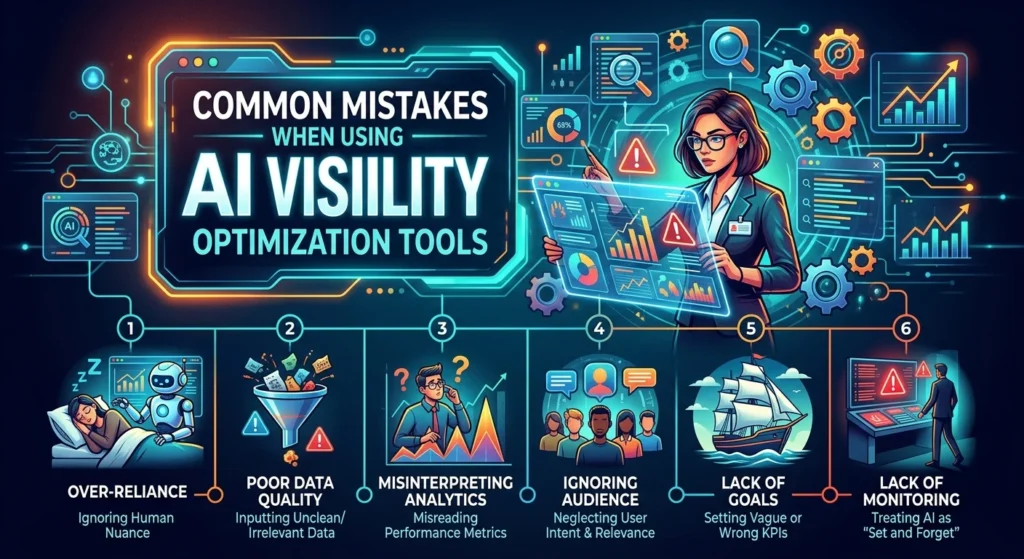
One common mistake is tracking too many random prompts. A large dashboard does not automatically mean better insights.
Start with questions that closely match your customers’ real search behavior. Group prompts by product, service, audience, location, and search intent.
Another mistake is focusing only on the visibility score. A score can be useful, but it does not explain everything. Always examine mentions, citations, competitors, topics, and changes over time.
Some businesses also expect identical AI answers every time. AI-generated results can vary based on system behavior, query wording, context, model updates, and other factors. Treat individual results as observations rather than permanent rankings.
Avoid trying to force your brand into every answer. That can lead to low-quality content and poor user experiences.
The best approach is to create accurate, useful, well-structured information and then use visibility tools to understand how effectively that information reaches AI-driven search experiences.
Practical Tips to Improve AI Search Visibility
Start by making your website easy to understand. Clearly explain who you are, what you offer, who you serve, where you operate, and why customers should trust you.
Create comprehensive content around important customer questions. Use descriptive headings, concise answers, supporting evidence, examples, original insights, and relevant internal links.
Keep important business information consistent across your website and other trustworthy online sources. Clear organization can help search systems better understand your brand and its relationship to relevant topics.
You should also update outdated content. AI visibility monitoring may reveal that competitors provide newer information or stronger explanations.
A simple improvement process is:
Track → Find gaps → Improve content → Strengthen supporting pages → Monitor again.
Do this consistently rather than making one large optimization effort and stopping.
Most importantly, write for people first. Helpful, accurate content creates stronger long-term value than content designed only to trigger an algorithm.
Latest AI Visibility Trends and Future Developments
AI search visibility is moving beyond simple brand mention tracking. Modern platforms increasingly focus on citations, competitive share of voice, prompt-level insights, entity relationships, sentiment, and content influence.
Another important trend is the expansion of AI-powered search experiences. Businesses may need to monitor multiple environments rather than relying on a single search platform.
Multimodal search could also become more important. AI systems can increasingly work with text, images, audio, video, and other forms of information. This means future visibility strategies may extend beyond written website content.
Automation is another major development. Instead of simply reporting that visibility declined, future platforms may provide deeper explanations and prioritized recommendations.
However, businesses should remain careful about automated recommendations. AI tools can make mistakes, and visibility measurements can change as search systems evolve.
For 2026 and beyond, the strongest strategy is likely to combine high-quality content, trustworthy brand information, technical SEO, strong entities, first-party data, and continuous AI visibility measurement.
How to Choose the Best AI Visibility Optimization Tool
The best AI visibility optimization tool is not necessarily the most expensive or the one with the longest feature list. It is the platform that provides reliable information for your specific goals.
Start by identifying your most important AI search questions. Then determine which AI platforms and markets matter to your business.
Next, compare tools based on prompt coverage, citation tracking, competitor analysis, historical reporting, integrations, usability, scalability, and cost.
For a beginner, choose a simple platform that is easy to understand. For an agency, prioritize project management and reporting. For an enterprise, focus on scale, automation, integrations, governance, and international coverage.
Run a practical test before buying. Track the same group of important prompts across shortlisted platforms and compare the quality of their reports.
Remember that no tool can guarantee AI recommendations or rankings. The purpose of these platforms is to provide visibility and actionable insights, not guaranteed placement.
The smartest long-term strategy is to use AI visibility tools as part of a broader search program. Combine their insights with excellent content, technical SEO, brand building, digital PR, and trustworthy information.
Conclusion
Choosing the best AI visibility optimization tools depends on what you need to measure and how you plan to use the data. Some platforms are ideal for basic brand monitoring, while others provide advanced prompt tracking, competitor analysis, citation insights, reporting, and integrations.
The most valuable tool is the one that turns AI search data into useful decisions. It should help you understand where your brand appears, where competitors are stronger, which sources AI systems use, and what content opportunities deserve attention.
AI visibility should also complement traditional SEO rather than replace it. Strong technical foundations, useful content, trustworthy information, relevant entities, and a clear brand identity remain important.
As AI search continues to evolve, businesses that measure visibility, learn from competitors, improve their content, and monitor changes consistently will be better prepared for the future of search.
FAQs
What are AI visibility optimization tools?
AI visibility optimization tools measure how brands, websites, products, and organizations appear in AI-generated search results. They can track mentions, citations, competitors, prompts, and visibility trends.
Which AI visibility optimization tool is the best?
There is no single best tool for every business. The right choice depends on your goals, budget, tracked prompts, AI platforms, reporting needs, and integrations.
Are AI visibility tools different from SEO tools?
Yes. Traditional SEO tools focus heavily on rankings, keywords, backlinks, and organic search performance. AI visibility tools focus more on how brands appear in AI-generated answers and recommendations.
Can free AI visibility tools be useful?
Yes. Free tools can help beginners understand basic AI search visibility. However, paid platforms usually offer more automation, historical tracking, prompts, competitors, reports, and integrations.
Why are citations important in AI search?
Citations can show which sources AI systems use when generating answers. Monitoring citations can help businesses understand which content earns visibility and identify opportunities to improve their own resources.
How can I improve my AI search visibility?
Create accurate and useful content, answer real customer questions, strengthen your brand information, maintain technical SEO, build trustworthy authority, and monitor AI visibility regularly.
Should small businesses use AI visibility optimization tools?
Yes, if AI-driven search is relevant to their customers. Small businesses can start with a simple and affordable tool and expand their monitoring as their online presence grows.
How often should AI visibility be monitored?
The ideal frequency depends on your industry and goals. Businesses in fast-changing markets may monitor more frequently, while smaller websites may review important prompts weekly or monthly.
Do AI visibility tools guarantee better rankings?
No. These tools provide measurement and insights, but they cannot guarantee rankings, mentions, citations, or recommendations from AI search systems.
Will AI visibility replace traditional SEO?
It is unlikely to completely replace traditional SEO. Instead, AI visibility is becoming another important part of search optimization alongside technical SEO, content quality, authority, and brand development.