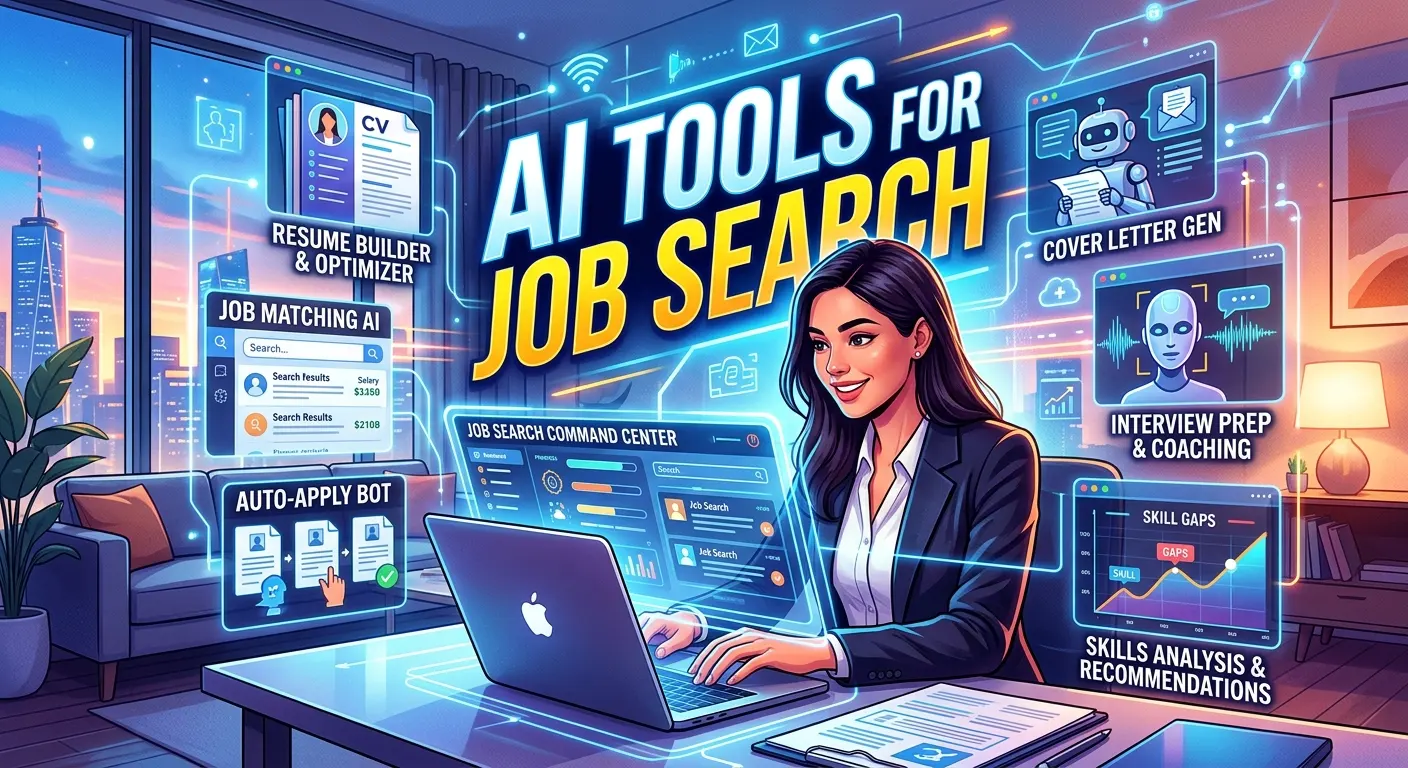
Finding the right job can take weeks or even months. You may need to search multiple job boards, customize resumes, write cover letters, prepare for interviews, and keep track of applications. AI tools for job search can make many of these tasks faster and more organized. They use artificial intelligence to help job seekers discover relevant opportunities, improve application materials, identify useful keywords, and prepare for interviews.
The biggest value of AI comes from combining automation, productivity, efficiency, and personalization. Instead of applying randomly, you can use AI to build a more focused job-search strategy. Some tools help analyze job descriptions, while others assist with resume writing, career planning, networking, and interview preparation. However, AI works best as a support system rather than a replacement for your judgment. The goal is to save time while creating better, more relevant applications.
What Are AI Tools for Job Search?
AI tools for job search are software applications that use artificial intelligence to support different parts of the job-hunting process. They can analyze job descriptions, suggest resume improvements, help write cover letters, identify relevant positions, and provide interview practice.
Traditional job searching often requires manually checking websites and adapting every application. AI can reduce some of this repetitive work. For example, a job seeker can provide a job description and ask an AI-powered career tool to identify important skills, qualifications, and keywords.
These tools can support both beginners and experienced professionals. A student looking for a first job may use AI to improve a resume, while an experienced professional may use it to organize applications and prepare for senior-level interviews.
The best approach is to use AI for research, organization, analysis, and drafting, while reviewing everything yourself before submitting an application.
How AI Job Search Tools Work
AI job search tools generally analyze information from resumes, job descriptions, career profiles, and user preferences. Depending on the tool, algorithms can identify similarities between your experience and the requirements listed in a job advertisement.
For example, imagine a job description asks for communication, project management, Excel, and customer service experience. An AI tool may compare those requirements with your resume and show which areas match strongly and which areas need improvement.
Some tools also use natural language processing to understand job descriptions beyond simple keyword matching. This can help identify related terms and transferable skills.
A practical workflow looks like this:
Find a job → analyze the description → compare your qualifications → improve your resume → customize your application → prepare for the interview → track the application.
AI can assist with several of these steps, but you should always verify important information and avoid submitting automatically generated content without editing it.
Key Features of AI Tools for Job Seekers
Different AI career platforms offer different features. One common feature is resume optimization. These tools can examine your resume and suggest changes to improve clarity, structure, relevance, and keyword alignment.
Another useful feature is job matching. AI can compare your skills and preferences with available job opportunities and help you focus on positions that appear more relevant.
Many platforms also provide cover letter assistance. Instead of starting from a blank page, you can use AI to create a first draft based on your experience and the position. You should then personalize the draft so it reflects your actual voice.
Other features may include:
- Job recommendation systems
- Resume keyword analysis
- Cover letter generation
- Interview question practice
- Career path suggestions
- Skill-gap analysis
- Application tracking
- Networking assistance
- Professional profile optimization
- Job description analysis
The most useful feature depends on your individual goal. Someone applying to many entry-level jobs may prioritize job matching and application organization, while an experienced professional may focus more on networking and interview preparation.
Benefits of Using AI for Job Search
One major benefit of AI is time savings. Searching through hundreds of job listings manually can become exhausting. AI-assisted tools can help narrow opportunities based on skills, experience, location, industry, or other preferences.
AI can also improve productivity by reducing repetitive writing tasks. A job seeker can create a basic resume and then adapt it for different roles instead of rewriting everything from scratch.
Another important advantage is personalization. A strong application should connect your experience with the employer’s needs. AI can help identify those connections.
AI can also support people who lack professional career guidance. A beginner may not know how to structure a resume or answer common interview questions. An AI career assistant can provide examples, explanations, and practice exercises.
However, AI does not guarantee employment. Your qualifications, communication, experience, application quality, and interview performance still matter. Use AI to improve your process rather than expecting it to make the entire decision for you.
AI Tools for Resume and CV Optimization
A resume is often one of the first things an employer sees. AI resume tools can help make your CV clearer, more focused, and better aligned with a specific position.
One useful strategy is to compare your resume with the job description. AI can help identify skills and phrases that are relevant to the position. You can then determine whether your resume honestly demonstrates those skills.
For example, suppose a job advertisement emphasizes customer communication, problem-solving, and sales support. If your previous experience includes these activities, your resume should describe them clearly rather than using vague statements.
AI can also help improve bullet points. Instead of writing a general statement such as “Responsible for helping customers,” you might describe the specific work you performed and the outcome when you have accurate information to support it.
Remember that accuracy is more important than keyword optimization. Never add a skill simply because an AI tool recommends it. Employers may test that skill during an interview.
AI Tools for Finding Relevant Job Opportunities
Finding relevant opportunities is another area where AI can help. Modern job platforms may use recommendation systems to suggest positions based on your profile, searches, skills, and previous activity.
AI-assisted job discovery can reduce the problem of searching through irrelevant listings. For example, someone interested in digital marketing may want opportunities involving SEO, content marketing, social media, analytics, or marketing automation rather than every job containing the word “marketing.”
AI can also help identify transferable opportunities. A person with customer service experience may have skills relevant to sales support, account management, community management, or customer success.
For better results, create a clear job-search profile. Include your actual skills, preferred industries, experience level, work preferences, and career goals.
Do not depend on a single platform. Search across reputable job boards, company career pages, professional networks, and industry-specific websites. AI recommendations should expand your search rather than limit it.
AI-Powered Cover Letters and Job Applications
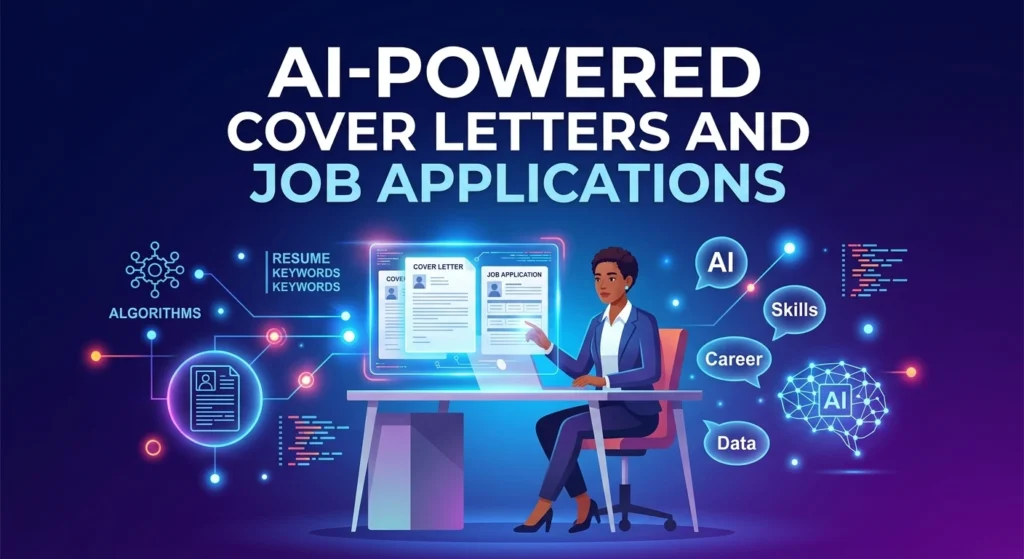
Writing a customized cover letter for every job can take significant time. AI can help create a starting draft using your experience and the requirements of a particular position.
The strongest results usually come from giving AI accurate information about your background and the role. You can ask it to focus on specific achievements, relevant skills, and reasons the position matches your career goals.
However, a completely generic AI-generated cover letter can sound repetitive. Employers may recognize applications that contain vague phrases and little personal information.
A better process is AI draft → personal editing → fact checking → final review.
Make sure every statement is true. Remove exaggerated claims and replace generic language with specific examples from your experience. Your final application should sound like a real person who understands the position.
AI Interview Preparation and Practice
Interviews can be stressful, especially for people applying for their first professional position. AI tools can provide a convenient way to practice common interview questions.
You can use an AI career assistant to generate questions based on a particular role. For example, a software-related position may require technical questions, while a customer service position may focus more on communication and problem-solving.
AI can also help you practice behavioral questions. A useful structure is situation, task, action, and result. This encourages you to explain what happened, what you were responsible for, what you did, and what happened afterward.
Another benefit is repetition. You can practice answering the same type of question several times until your response becomes clearer.
However, avoid memorizing AI-generated answers word for word. Interview preparation should improve your confidence, not make you sound robotic. Use AI for practice and feedback while keeping your actual responses natural.
AI Tools for LinkedIn and Professional Networking
Professional networking can play an important role in finding opportunities. AI can assist with improving professional profiles, writing networking messages, and identifying useful topics to discuss.
For example, an AI tool can review your professional summary and suggest ways to communicate your skills more clearly. It can also help organize your experience into a stronger career story.
Networking messages should remain personal. Sending the same AI-generated message to hundreds of people is unlikely to build meaningful relationships.
Instead, research the person or company and write a short message that explains why you are contacting them. AI can help polish the wording, but human context should remain at the center of networking.
AI can also help you brainstorm professional content ideas. Sharing useful knowledge, project lessons, industry observations, or learning progress can gradually strengthen your professional presence.
Free vs Paid AI Job Search Tools
Many AI career tools offer free features. These may include basic resume analysis, limited job recommendations, simple writing assistance, or a small number of interview exercises.
Free tools can be enough for beginners who are learning how the job-search process works. They also allow you to test whether a particular workflow is useful before spending money.
Paid tools may provide more advanced features, larger usage limits, detailed analytics, personalized recommendations, or additional career services. The value depends on how frequently you search for jobs and which features you actually need.
Before paying, ask yourself whether the tool solves a real problem. Do not buy a subscription simply because it says “AI.”
Compare the free functionality, subscription cost, privacy practices, cancellation terms, and actual features. A simple free tool combined with a strong personal workflow may be more useful than an expensive platform with features you never use.
AI Job Search Tools, Integrations, and Career Workflows
AI becomes more useful when it fits into a complete job-search workflow. Instead of using separate tools randomly, you can create a repeatable process.
For example, you might maintain your master resume in one document, search for jobs through several sources, use AI to analyze promising job descriptions, customize your resume, draft a cover letter, and record each application in a tracking system.
Some career tools may integrate with calendars, professional profiles, document platforms, or application tracking systems. Integrations can reduce repetitive tasks and help keep information organized.
A simple workflow could include:
Research → shortlist → analyze → customize → apply → track → follow up → prepare.
Keep your information organized and review every automated action. Automation is helpful when it removes repetitive work, but it should not cause you to send inaccurate applications or lose control over important career information.
Best AI Job Search Use Cases for Students and Beginners
Students and beginners can benefit significantly from AI career tools because they may have limited professional experience. AI can help translate school projects, volunteer activities, internships, freelance work, and personal projects into professional resume language.
For example, a student who created a website can describe relevant skills such as research, content creation, design, basic SEO, or project planning when those skills genuinely apply.
AI can also help identify entry-level career paths. Instead of searching for one exact job title, beginners can explore related roles based on their existing skills and interests.
Another useful application is learning. If a job repeatedly requires a skill you do not have, AI can help explain what that skill means and suggest a learning path.
The key is to use AI to discover opportunities and build skills, not to pretend you have experience that you do not have.
Pros, Cons, and Limitations of AI Job Search Tools
AI job search tools offer several advantages. They can save time, improve organization, provide personalized suggestions, support resume editing, and make interview practice more accessible.
They can also help reduce the blank-page problem. Instead of wondering how to start a resume summary or cover letter, you can generate a draft and improve it.
But there are limitations. AI recommendations can be imperfect. A system may misunderstand your experience or recommend jobs that look relevant but are not actually suitable.
Privacy is another consideration. Job seekers often enter resumes containing personal and professional information. Before uploading sensitive information, review the service’s privacy policy and understand how it handles submitted data.
AI-generated content can also become repetitive. If thousands of applicants use similar AI language, generic applications may become less distinctive.
The best solution is to treat AI as an assistant rather than an authority. Verify recommendations, protect your information, and make final decisions yourself.
Common Mistakes When Using AI for Job Hunting
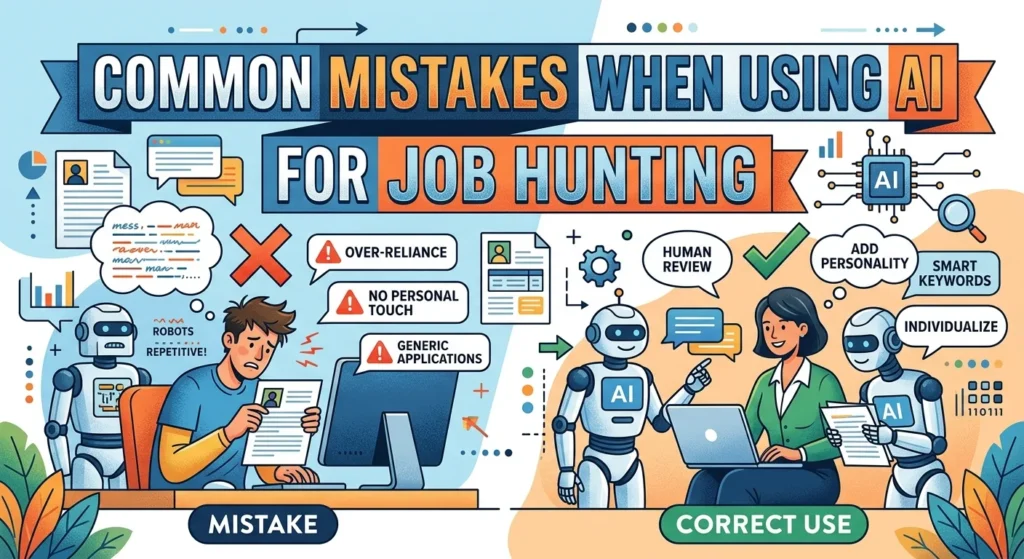
One common mistake is relying entirely on AI-generated applications. A resume may look polished but still fail to communicate your actual strengths.
Another mistake is keyword stuffing. Adding every keyword from a job description can make a resume unnatural and misleading. Use relevant terms only when they accurately describe your skills or experience.
Some people also apply to too many jobs without researching them. AI can make applications faster, but quantity does not automatically produce better results.
Another problem is failing to edit AI-generated writing. Employers want clear communication, not text that sounds like it came directly from a template.
Avoid entering unnecessary personal information into unfamiliar AI services. Think about privacy before uploading your resume, identification documents, contact details, or other sensitive information.
Finally, do not let AI make career decisions for you. Your interests, values, goals, financial needs, and personal circumstances require human judgment.
Latest AI Job Search Trends and Future Developments
AI-powered recruitment and job searching continue to evolve. Modern systems increasingly focus on skills rather than only traditional job titles. This can help connect people with opportunities that use transferable abilities.
Another major development is the growth of AI career assistants. Instead of using separate tools for every task, users may increasingly work with systems that support job discovery, resume customization, interview preparation, and career planning in one workflow.
AI search is also changing how people discover information. Job seekers may increasingly ask conversational AI systems for career recommendations rather than relying only on traditional search boxes.
At the same time, employers are becoming more aware of AI-generated applications. This means authenticity will become increasingly valuable. A strong application should show real experience, measurable achievements, relevant skills, and genuine interest.
Looking ahead, the strongest career technology will likely combine automation with human judgment. AI can process large amounts of information quickly, but people still need to evaluate opportunities and make important career decisions.
How to Choose the Right AI Tool for Your Job Search
Start by identifying your biggest problem. If your resume needs improvement, look for a resume-focused tool. If finding suitable positions takes too long, prioritize job discovery. If interviews are your biggest challenge, choose an interview-practice solution.
Check whether the tool supports your career level and industry. A platform designed for experienced technology professionals may not provide the same value to someone searching for a first part-time or entry-level job.
Look at usability as well. A tool that provides hundreds of complicated features may be less useful than a simple platform that solves your specific problem quickly.
Before choosing a paid service, review pricing, free limits, privacy information, cancellation conditions, and user feedback where available.
Most importantly, test whether the recommendations are actually useful. The best AI job search tool is not necessarily the tool with the most features. It is the one that improves your real job-search process.
Conclusion
AI tools for job search can make the modern job-hunting process faster, more organized, and more personalized. They can help with job discovery, resume optimization, cover letters, interview preparation, networking, career planning, and application tracking.
The most effective approach is not to let AI do everything. Instead, combine automation with your own experience and judgment. Use AI to analyze information, generate drafts, identify opportunities, and practice skills. Then review, personalize, and verify the final result.
Job seekers should also pay attention to privacy and authenticity. Never invent qualifications simply because an AI system suggests them. Protect sensitive information and make sure your applications accurately represent you.
As AI-powered career technology develops, the people who learn to use these tools responsibly may gain a productivity advantage. Use AI as a career assistant, keep human judgment in control, and focus on creating genuine value for employers.
FAQs About
What are AI tools for job search?
AI tools for job search are applications that use artificial intelligence to support activities such as finding jobs, optimizing resumes, writing application drafts, preparing for interviews, and organizing applications.
Can AI help me find a job faster?
AI can reduce repetitive work and help you identify relevant opportunities more efficiently. However, it cannot guarantee employment. Your skills, applications, networking, and interview performance remain important.
Can AI improve my resume?
Yes. AI can help identify unclear wording, relevant skills, resume keywords, formatting problems, and areas where your experience could be explained more effectively. Always verify AI suggestions before using them.
Are free AI job search tools useful?
Yes. Free tools can provide useful resume assistance, job-search ideas, writing support, and interview practice. Paid tools may offer additional features, but you should only pay for features that provide meaningful value.
Can AI write a cover letter for a job?
AI can create a cover letter draft based on your experience and a job description. You should edit the result, add accurate personal details, and make sure the final letter sounds natural.
Can AI prepare me for an interview?
Yes. AI can generate practice questions, simulate interview conversations, and help you identify areas where your answers could become clearer. Use it for practice rather than memorizing scripted responses.
Should I use AI for every job application?
Not necessarily. AI can help with repetitive tasks, but you should research each employer and customize important parts of your application. Quality and relevance are more important than sending the maximum number of applications.
Are AI job search tools safe to use?
Safety depends on the individual service. Before uploading a resume or personal information, review its privacy practices and avoid sharing unnecessary sensitive data. Use reputable services and keep control of your information.
Can AI guarantee that I will get hired?
No. AI can improve parts of your job-search process, but no legitimate AI tool can guarantee employment. Hiring decisions depend on many factors, including qualifications, experience, communication, competition, and employer requirements.
What is the best way to use AI for job searching?
A strong approach is to use AI for research, job matching, resume improvement, application drafting, interview practice, and organization while keeping human judgment involved in every important decision.
This article is structured for search intent, semantic SEO, featured snippets, and AI-powered search visibility while keeping the language beginner-friendly.