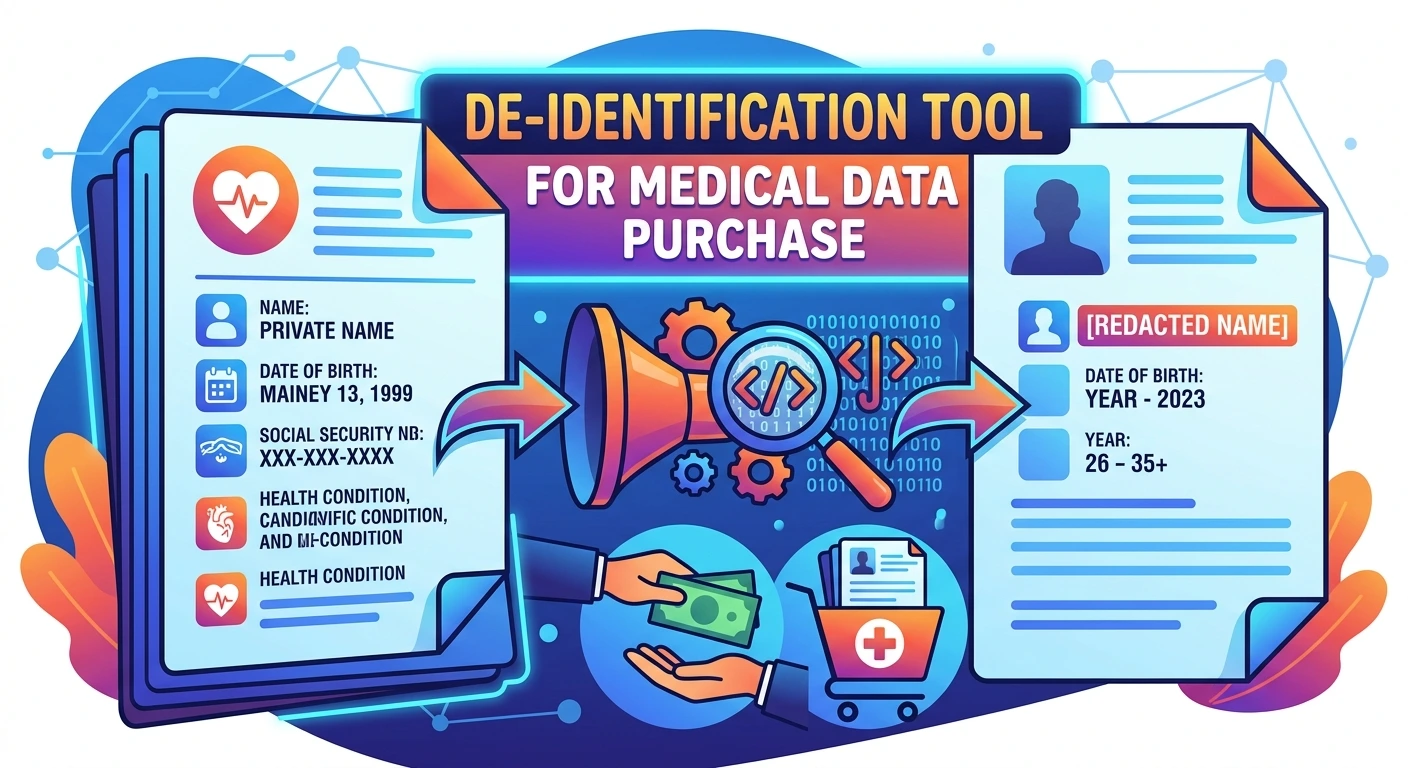
Medical organizations, research institutions, universities, and healthcare technology companies increasingly need to use data without exposing sensitive patient information. An AI de-identification tool for medical data purchase can help organizations automate parts of this process by identifying and transforming personally identifiable information (PII) and protected health information (PHI) in clinical records, research datasets, documents, and other healthcare content.
Modern AI-based systems can improve productivity, efficiency, automation, and data-handling workflows while helping teams prepare information for legitimate research and analytics. However, purchasing a de-identification platform requires more than comparing features and prices. Organizations should evaluate accuracy, privacy controls, regulatory requirements, integration options, auditability, security, and human review processes.
This guide explains what medical data de-identification tools do, how they work, what to evaluate before purchasing one, and how to choose an appropriate solution for a healthcare or research environment.
What Is an AI De-Identification Tool for Medical Data?
An AI de-identification tool for medical data is software designed to detect information that could identify a patient and transform, remove, or mask that information according to a defined privacy strategy. Common examples include names, addresses, telephone numbers, email addresses, identification numbers, dates, and other identifying details contained in medical records.
Traditional approaches often depend heavily on predefined rules and pattern matching. AI-based systems can add machine-learning or natural-language-processing capabilities that help recognize identifying information within less structured clinical text.
For example, a clinical note may contain identifying information in the middle of a sentence rather than inside a clearly labeled field. An AI system may analyze the context and identify that content as potentially sensitive. Organizations should still validate results because automated de-identification is not automatically perfect.
How AI Medical Data De-Identification Works
Most AI de-identification workflows begin by ingesting information from a supported source. Depending on the product, that source may include electronic health records, clinical notes, medical documents, research datasets, or other healthcare information systems.
The software then identifies potentially sensitive fields using techniques such as natural language processing, named-entity recognition, pattern detection, and contextual analysis. After detection, the system may remove, replace, generalize, or otherwise transform the information according to the selected policy.
A useful workflow can include several stages:
- Data ingestion
- Sensitive-information detection
- Entity classification
- Transformation or masking
- Quality checking
- Audit logging
- Human review when necessary
The exact method differs between vendors. Before purchasing, organizations should ask how the tool handles unusual medical terminology, free-text notes, dates, rare conditions, and information that could indirectly identify a person.
Why Healthcare Organizations Purchase De-Identification Software
Healthcare organizations may purchase de-identification technology to support legitimate data-processing activities while reducing exposure of patient identifiers. Research teams, analytics departments, healthcare technology providers, and academic institutions can all have different requirements.
One important benefit is workflow efficiency. Manually reviewing thousands of clinical documents can consume significant time. Automation can help teams process large volumes more consistently, although high-risk workflows may still require expert review.
De-identification can also support research and analytics workflows. A research organization may need a dataset with identifying information removed or transformed before authorized users can work with it.
However, de-identification does not mean that every dataset automatically becomes risk-free. Organizations must consider re-identification risk, data governance, access controls, contractual obligations, and applicable privacy laws.
Key Features to Look for Before Buying
When evaluating an AI de-identification product, accuracy should be one of the first considerations. A tool should demonstrate how effectively it detects relevant identifiers across structured and unstructured medical information.
Organizations should also examine configuration and policy controls. Different projects may require different treatment of dates, locations, names, medical record numbers, and other information.
Important features may include:
PHI and PII detection: The system should identify relevant categories of sensitive information.
Context-aware analysis: Medical text can be complicated, so contextual detection can be valuable.
Configurable transformation: Users may need options such as masking, replacement, removal, or generalization.
Audit logs: Organizations should be able to understand what processing occurred.
Human review workflows: Sensitive projects may require manual validation.
API access: Developers may need to integrate de-identification into existing applications.
Batch processing: Research organizations may need to process large datasets efficiently.
Security controls: Encryption, authentication, access management, and monitoring are important purchasing criteria.
Do not choose a platform simply because it has the largest feature list. Focus on the features that match your organization’s actual workflow.
Medical Data Use Cases for AI De-Identification
AI de-identification can support several healthcare and research scenarios. One common use case is preparing clinical text for authorized research and analysis.
Universities and research organizations may use de-identified information when developing statistical models or studying healthcare trends. Healthcare technology companies may also require privacy-aware data-processing workflows during approved product development activities.
Other potential use cases include:
- Clinical research
- Healthcare analytics
- Medical AI development
- Data quality projects
- Academic research
- Dataset preparation
- Clinical documentation analysis
- Healthcare software testing
- Population-level research
The appropriate use depends on the organization’s legal basis, policies, contracts, and applicable regulations. A de-identification tool should support governance rather than replace it.
AI De-Identification for Structured and Unstructured Data
Medical information exists in many formats. Structured information may contain clearly separated fields such as patient names, dates, medical record numbers, and contact information.
Unstructured information can be more difficult. Physician notes, discharge summaries, referral letters, and other free-text documents may contain identifiers in unpredictable locations.
This distinction matters when purchasing software. A platform that performs well on structured databases may not deliver the same results on clinical narratives.
Ask vendors for evidence covering the specific data formats your organization uses. If your project involves clinical notes, test the product with representative text before making a purchasing decision.
Security and Privacy Requirements for Medical Data Tools
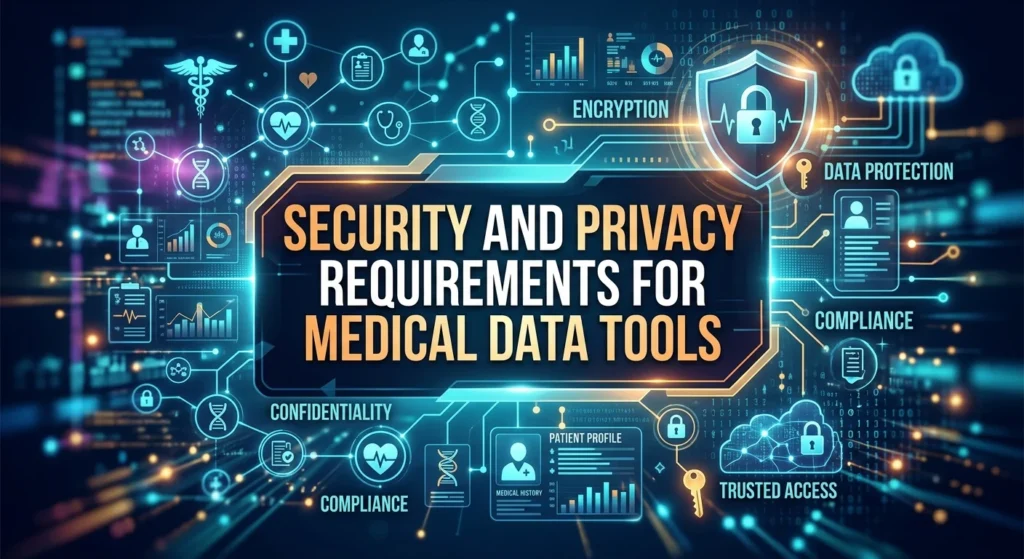
Security should be treated as a core purchasing requirement rather than an optional feature. Medical information is highly sensitive, so organizations should carefully investigate how a vendor stores, processes, transfers, and protects data.
Important areas include encryption, authentication, authorization, access controls, logging, retention policies, data isolation, and incident response procedures.
Organizations should also understand whether submitted information is retained by the vendor and whether it may be used for model training or other purposes. Contractual terms can be just as important as technical capabilities.
Before purchasing, request the vendor’s relevant security documentation and privacy terms. Depending on the organization and jurisdiction, teams may also need to evaluate contractual requirements related to healthcare privacy.
Compliance Considerations When Purchasing an AI De-Identification Tool
Compliance requirements vary by country, organization, and use case. In the United States, organizations handling protected health information may need to consider HIPAA requirements and applicable rules for de-identification.
HIPAA includes recognized approaches for de-identifying protected health information, including the Safe Harbor method and Expert Determination method. A software vendor should not simply claim that its product is “HIPAA compliant” without explaining what that statement means.
Organizations should evaluate the complete workflow rather than the software alone. Contracts, policies, access controls, security practices, data-processing arrangements, and validation procedures can all affect compliance.
For international projects, additional privacy frameworks may apply. Organizations should obtain appropriate legal or privacy advice for their specific circumstances rather than relying solely on a vendor’s marketing claims.
Free vs Paid AI De-Identification Tools
Free tools can appear attractive when an organization is testing a concept or building a prototype. They may provide basic functionality without requiring a large initial investment.
However, healthcare organizations should be careful when processing real medical information with free services. Free does not automatically mean private, secure, compliant, or appropriate for production healthcare data.
Paid enterprise products may offer stronger governance features, contractual support, dedicated environments, monitoring, APIs, technical support, and configurable workflows.
The right decision depends on the project’s requirements. A development team experimenting with synthetic or non-sensitive data may have different needs from a hospital processing real patient information.
Pricing Factors When Buying Medical Data De-Identification Software
Pricing for de-identification software can vary significantly. Vendors may charge based on data volume, documents, API calls, users, processing capacity, deployment model, or enterprise agreements.
Some providers may offer subscription pricing, while others may negotiate custom contracts for large healthcare organizations.
When comparing prices, calculate the total cost of ownership, not just the advertised subscription price. Consider implementation, integration, data migration, training, support, validation, monitoring, and ongoing administration.
A cheaper tool may become more expensive if it requires extensive manual correction or cannot integrate with existing systems. Conversely, an enterprise platform may provide better value when it substantially reduces repetitive processing work.
Integrations, APIs, and Healthcare Data Workflows
Integration can determine whether a de-identification tool becomes a useful part of an organization’s workflow or remains an isolated application.
Look for support for relevant APIs, databases, cloud environments, file formats, and healthcare systems. Depending on the use case, integration with data pipelines can allow de-identification to happen as part of an established processing workflow.
Technical teams should also evaluate API documentation, authentication methods, rate limits, error handling, monitoring, and scalability.
Before purchasing, create a simple workflow diagram showing where sensitive data enters the system, where de-identification occurs, where transformed data goes, and who can access each stage. This can expose integration and security requirements early.
How to Evaluate Accuracy and De-Identification Quality
Accuracy deserves special attention because both missed identifiers and unnecessary transformations can create problems.
A false negative occurs when identifying information remains undetected. A false positive occurs when the system incorrectly classifies non-identifying information as sensitive.
Organizations should ask vendors how they measure performance and whether they provide evaluation results on representative medical datasets. Testing should cover different specialties, document formats, writing styles, abbreviations, and unusual cases.
Human review can also play an important role. Automated tools can increase efficiency, but organizations should establish validation procedures appropriate to the risk of their specific project.
Pros and Cons of AI Medical Data De-Identification Tools
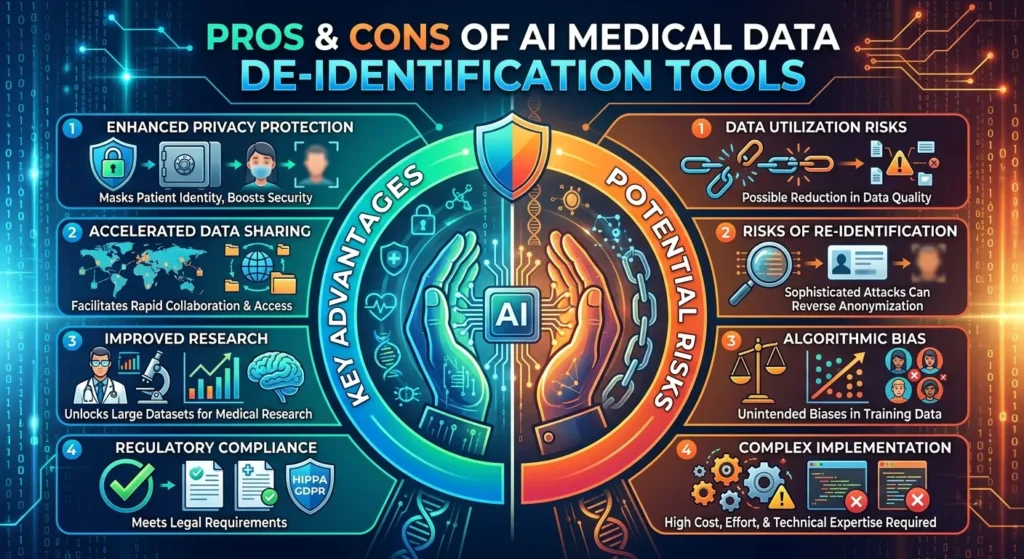
AI de-identification technology offers several advantages. Automation can reduce repetitive manual work and help teams process large quantities of information more efficiently.
AI can also provide contextual analysis that may be difficult to achieve with simple rules. Centralized workflows can improve consistency and make processing easier to monitor.
There are limitations, too. AI systems can make mistakes. Medical language is complex, and identifiers may appear in unexpected contexts.
Another consideration is vendor dependency. Once an organization builds workflows around a particular platform, switching providers may require technical work and validation.
The best approach is to view AI de-identification as a risk-management and data-governance component, not as a magical guarantee that data can never be re-identified.
Common Mistakes When Purchasing AI De-Identification Software
One common mistake is choosing a tool based only on marketing claims. Statements such as “AI-powered,” “enterprise-ready,” or “HIPAA compliant” do not provide enough information for a serious purchasing decision.
Another mistake is failing to test the software with representative data. A product may perform well in a demonstration but behave differently with your organization’s clinical terminology and document formats.
Organizations should also avoid ignoring the vendor contract. Review data retention, subprocessors, security responsibilities, breach notification, deletion procedures, and permitted data use.
Finally, do not assume that de-identification removes every privacy risk. Indirect identifiers and combinations of seemingly harmless information can sometimes increase re-identification risk.
Latest Trends and Future of AI Medical Data De-Identification
The future of medical data de-identification is likely to involve more sophisticated language models, stronger automation, improved evaluation methods, and tighter integration with healthcare data platforms.
AI systems are increasingly capable of understanding context rather than relying exclusively on simple patterns. This may improve detection of identifiers within complex clinical narratives.
Another important trend is the combination of AI automation with human oversight. Instead of treating automated processing as the final decision, organizations can build review workflows for uncertain or high-risk cases.
Future systems may also provide more transparent confidence scoring, better auditability, policy-based processing, and integration with broader privacy-preserving data environments.
For buyers, the key question should remain practical: Does the technology reduce workload while meeting the organization’s security, privacy, quality, and governance requirements?
Conclusion
Purchasing an AI de-identification tool for medical data is a strategic technology decision rather than a simple software purchase. The right platform can improve productivity, automate repetitive privacy-related workflows, support authorized research, and make large-scale data processing more manageable.
However, healthcare organizations should evaluate accuracy, security, compliance, integrations, pricing, auditability, data retention, and human review capabilities before selecting a vendor. Testing with representative datasets is especially valuable.
The strongest purchasing strategy combines AI automation with responsible data governance. Organizations should understand exactly what the software detects, how it transforms information, what risks remain, and how the complete workflow protects sensitive medical data.
FAQs About
What is an AI de-identification tool for medical data?
It is software that uses automated techniques such as natural-language processing and pattern detection to identify potentially sensitive patient information and transform or remove it according to a defined de-identification policy.
Why do organizations purchase medical data de-identification software?
Organizations may purchase these tools to automate privacy-related data processing for legitimate research, analytics, testing, and other approved healthcare workflows.
Is AI de-identification completely accurate?
No. AI systems can make mistakes, so organizations should evaluate accuracy and establish validation or human-review processes appropriate to the risk of their use case.
Is de-identified medical data always completely anonymous?
No. De-identification reduces identification risk, but organizations should consider residual and re-identification risks, especially when multiple datasets can be combined.
Should healthcare organizations use free de-identification tools?
Free tools may be useful for testing with non-sensitive or synthetic data, but organizations should carefully evaluate privacy, security, contractual terms, and regulatory requirements before processing real medical information.
What features should I compare before purchasing a de-identification tool?
Compare detection accuracy, supported data formats, transformation options, API access, integrations, security controls, audit logs, scalability, human review capabilities, vendor support, and pricing.
How much does medical data de-identification software cost?
Pricing varies by vendor and may depend on data volume, users, API usage, deployment model, processing requirements, and enterprise support. Request a quote based on your actual workload.
Can AI de-identification tools work with clinical notes?
Many AI-based systems are designed to process unstructured clinical text, but capabilities vary. Organizations should test products using representative clinical notes before purchasing.
Does buying a de-identification tool automatically make an organization compliant?
No. Compliance depends on the complete technical, organizational, contractual, and legal environment. Software can support compliance but does not automatically guarantee it.
What is the best way to choose an AI medical data de-identification tool?
Start by defining your data types, privacy requirements, processing volume, integration needs, security requirements, and budget. Then test shortlisted products with representative data and evaluate both technical performance and vendor terms.
If you want, I can also create a 130-character meta description, SEO title, URL slug, and 10 related keywords for this article.