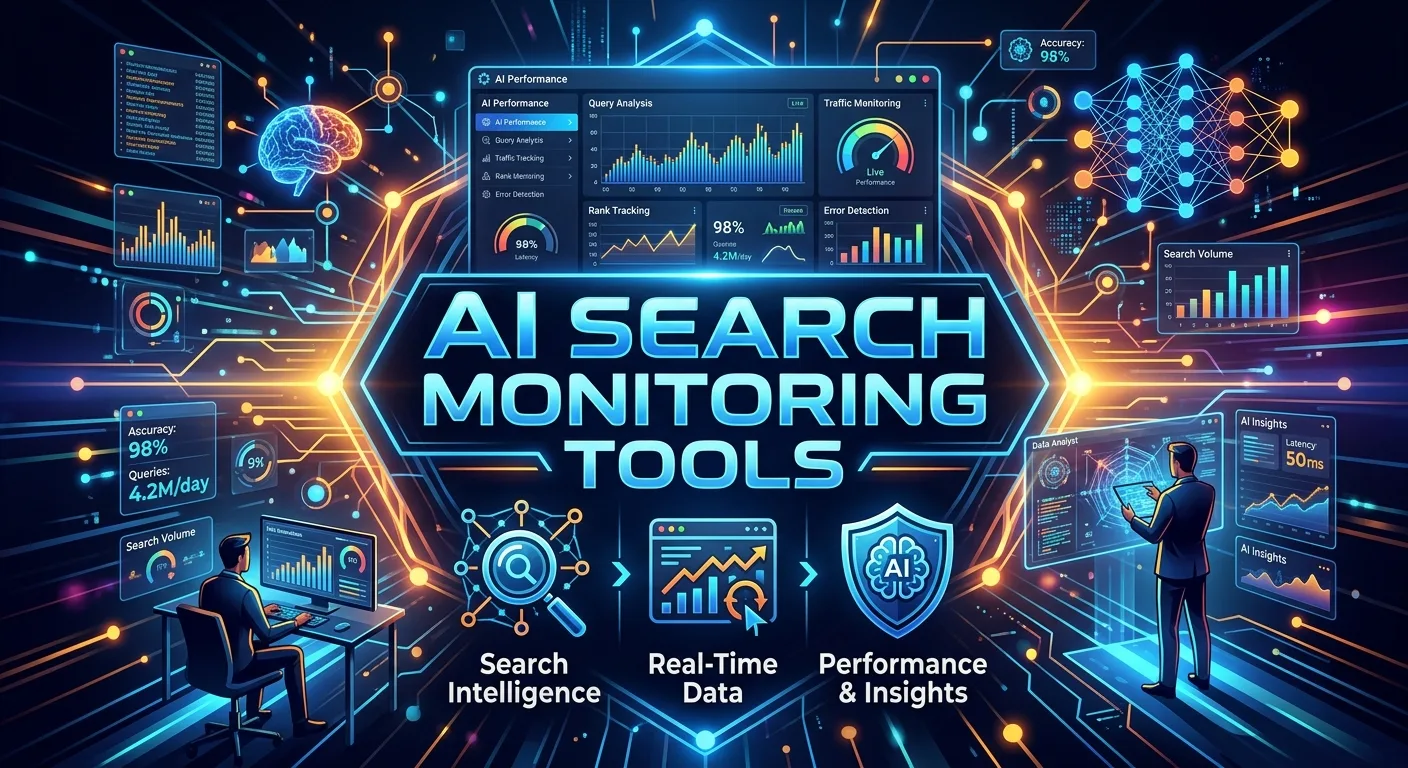
AI search monitoring tools help businesses understand how their brands, products, services, and content appear across AI-powered search experiences. Traditional SEO focuses heavily on rankings, clicks, keywords, and organic traffic. AI search monitoring adds another layer by tracking how systems such as ChatGPT, Google AI experiences, Microsoft Copilot, Perplexity, and other answer engines represent a brand or topic. These tools can reveal brand mentions, citations, competitors, visibility trends, prompts, sentiment, and content gaps.
As search behavior changes, marketers need more than conventional rank tracking. They need to understand whether AI systems recognize their expertise and recommend their business when users ask relevant questions. This guide explains how AI search monitoring works, what features matter, how to choose a platform, common mistakes to avoid, and how businesses can build an effective AI visibility strategy for 2026 and beyond.
What Are AI Search Monitoring Tools?
AI search monitoring tools are platforms designed to track how brands, websites, products, and topics appear in AI-generated search results. Instead of checking only traditional search engine positions, they analyze responses produced by generative search and answer engines.
For example, a company selling project management software might want to know whether AI systems recommend its product when someone asks, “What is the best project management software for a remote team?” A monitoring platform can repeatedly evaluate relevant prompts and record whether the company appears, which competitors appear, and which sources the AI cites.
This creates a new form of search intelligence. A brand may rank highly in conventional search while receiving little visibility in AI-generated answers. Conversely, a company with a smaller traditional search footprint might receive frequent AI recommendations because its content, reputation, or third-party references provide useful context.
AI monitoring therefore helps marketers understand how machines interpret their brand, not simply where a webpage ranks.
How Do AI Search Monitoring Tools Work?
Most AI search monitoring platforms start by collecting a set of relevant queries or prompts. These prompts represent the questions potential customers might ask AI search systems.
The platform then checks selected AI search experiences and records the resulting answers. Depending on the product, it may analyze brand mentions, citations, competitors, source domains, sentiment, ranking position, share of voice, and changes over time.
Suppose an online accounting platform creates 100 prompts around small-business accounting. The monitoring system might discover that the company appears in 32 responses, while three competitors appear in more than 60. It can then identify the sources repeatedly cited by those AI systems.
The workflow generally looks like this:
- Define important topics and customer questions.
- Create or import relevant prompts.
- Monitor AI-generated responses.
- Record brand and competitor mentions.
- Analyze citations and supporting sources.
- Identify visibility and content gaps.
- Improve relevant content and digital authority.
- Continue monitoring changes.
The process turns AI search from something marketers occasionally check manually into a measurable optimization channel.
Why AI Search Monitoring Matters for SEO in 2026
Search is becoming more conversational. People increasingly ask complete questions rather than entering short keyword phrases.
Instead of searching for “CRM software,” a potential buyer might ask an AI system, “Which CRM is best for a small B2B company with a five-person sales team?” The answer may include several recommendations without requiring the user to visit traditional search results.
That changes the meaning of visibility.
Traditional SEO asks, “Where does my page rank?” AI search monitoring asks, “Does the AI mention my business when customers ask relevant questions?”
This distinction is important because AI-generated answers can summarize information from multiple sources. A brand’s visibility may therefore depend on its own website plus reviews, industry publications, directories, news articles, documentation, community discussions, and other trustworthy references.
For SEO professionals, AI monitoring provides additional information about brand authority, topical relevance, citations, competitors, and search intent.
It does not replace conventional SEO. Instead, it complements it.
Key Features of AI Search Monitoring Tools
The strongest platforms usually provide several features that help marketers measure AI visibility.
Brand mention tracking shows how often a company, product, or person appears in AI-generated answers.
Citation monitoring identifies websites and pages that AI systems reference when generating responses. This can reveal which sources influence visibility within a particular topic.
Competitor tracking allows marketers to compare their visibility with competing brands. It can highlight prompts where competitors appear but the target brand does not.
Prompt tracking lets teams create a repeatable set of questions and monitor responses over time.
Share-of-voice analysis estimates how prominently a brand appears compared with competitors across a collection of queries.
Sentiment and positioning analysis can show whether an AI system describes a brand positively, negatively, neutrally, or in a particular context.
Historical reporting helps teams identify changes in AI visibility after publishing content, improving pages, earning mentions, or changing their digital strategy.
Advanced platforms may also offer content recommendations, citation-gap analysis, automated reports, alerts, integrations, and API access.
When evaluating tools, focus on features that help you make decisions rather than simply producing attractive dashboards.
Benefits of AI Search Monitoring for Businesses
The biggest benefit is visibility intelligence.
A company cannot improve AI search visibility effectively if it does not know how AI systems currently describe it. Monitoring creates a baseline.
Another benefit is competitor discovery. AI answers may reveal competitors that a marketing team does not consider direct competitors in conventional SEO. A business can then investigate why those companies receive recommendations.
AI monitoring can also identify content opportunities. If AI systems repeatedly cite a particular type of source when answering customer questions, marketers can study the underlying information gap.
For example, suppose AI responses about a software category repeatedly mention implementation guides, comparison pages, customer reviews, and technical documentation. A company with none of these assets may have a visibility problem that traditional keyword reports do not clearly reveal.
Monitoring also supports brand reputation management. If AI systems consistently misunderstand a product, associate it with outdated information, or describe an important feature incorrectly, the marketing team can investigate the underlying sources and improve authoritative information.
The result is a more complete picture of modern search visibility.
AI Search Monitoring Use Cases
AI search monitoring can support many types of organizations.
SaaS companies
Software businesses can track product recommendations, alternatives, comparison queries, and category searches. They can see which competitors appear when customers ask for solutions.
E-commerce brands
Retail companies can monitor product recommendations, shopping questions, category searches, and brand comparisons.
Agencies
SEO and digital marketing agencies can use AI monitoring to demonstrate changes in client visibility and provide competitive intelligence.
Local businesses
Restaurants, clinics, service providers, and other local companies can monitor whether AI systems recommend them for location-based questions.
Publishers
Publishers can investigate whether AI systems cite their articles and identify topics where their content has strong or weak visibility.
Personal brands
Consultants, creators, and professionals can monitor how AI systems describe their expertise and which sources influence their reputation.
The key is to create prompts that match real customer intent, rather than tracking random questions simply because they contain important keywords.
Free vs Paid AI Search Monitoring Tools
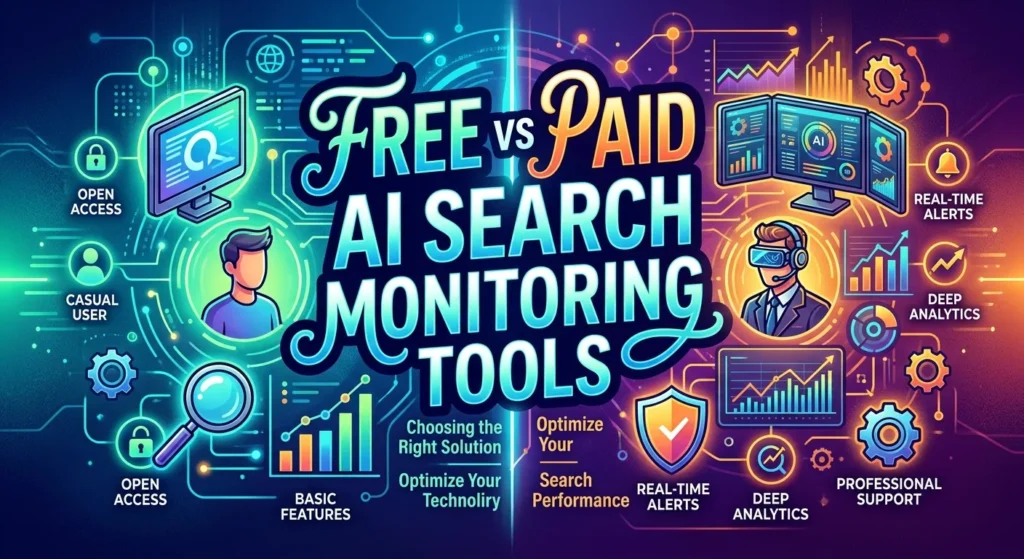
Free AI search monitoring options can be useful for beginners. A small business might manually track a limited set of prompts across several AI search systems and record the results in a spreadsheet.
This approach costs little but becomes difficult to maintain at scale.
Paid platforms generally automate prompt monitoring, historical tracking, competitor comparisons, citation analysis, reporting, and alerts. Some also provide larger prompt limits and team collaboration.
The right choice depends on the size of the project.
A freelancer managing one website may not need an enterprise platform. A large agency managing dozens of clients may need automated monitoring, scheduled reports, multiple users, integrations, and scalable prompt tracking.
Before purchasing, check how the tool counts prompts or monitored queries. Some services may impose limits based on projects, searches, users, AI platforms, or reporting frequency.
Do not buy a platform simply because it has a large feature list. Select the system that answers the business questions you actually need to solve.
AI Search Monitoring Pricing and ROI
Pricing varies widely across the AI search monitoring market. Some platforms offer free trials or limited plans, while advanced systems may use monthly subscriptions based on tracked prompts, projects, users, or monitoring frequency.
The most useful way to evaluate pricing is through return on investment.
Suppose a company spends money on content every month but cannot determine whether AI search systems recognize that content. Monitoring can provide evidence about whether visibility is improving.
Useful performance indicators include:
- AI brand mention frequency
- AI share of voice
- Citation frequency
- Competitor visibility
- Prompt coverage
- Positive versus negative brand descriptions
- Referral traffic where measurable
- Leads influenced by AI discovery
- Changes in branded searches
- Conversion activity associated with AI-originated visitors
Not every AI search interaction produces a traditional click. Therefore, businesses should avoid judging the entire channel solely through website traffic.
AI visibility can contribute to brand awareness, consideration, authority, and customer discovery even when the user does not immediately click.
AI Search Monitoring vs Traditional SEO Tools
Traditional SEO platforms remain essential. They measure keyword rankings, backlinks, organic traffic, technical problems, search volume, and other conventional SEO signals.
AI monitoring addresses a different layer.
Traditional rank tracking might tell you that your article ranks fourth for a particular query. AI monitoring can tell you whether an AI-generated answer mentions your company when users ask a more conversational version of the same topic.
The two approaches work best together.
For example, an SEO team could discover a valuable topic through keyword research, create a high-quality page, optimize its technical SEO, build relevant authority, and then monitor whether AI systems eventually reference the company for related questions.
This creates a broader measurement framework:
Traditional SEO measures search-result visibility. AI monitoring measures AI-answer visibility.
Neither should be treated as a perfect representation of customer behavior. Both provide signals that become more useful when combined with analytics, conversion data, customer research, and business outcomes.
How to Choose the Best AI Search Monitoring Tool
Start with the AI platforms you actually care about. Not every monitoring service tracks the same search environments or provides identical data.
Next, examine prompt flexibility. A good system should let you track natural customer questions, different search intents, product comparisons, informational queries, and branded searches.
Check how the platform handles citations. Citation data can be particularly valuable because it helps explain why a brand may or may not appear.
Competitor analysis also matters. Make sure you can compare your brand against relevant competitors rather than receiving only isolated brand metrics.
Look at reporting capabilities as well. If you manage SEO for clients, automated reports may save significant time.
Finally, evaluate data transparency. Ask how the platform collects results, how frequently it updates them, which AI environments it monitors, and how it handles changes in AI-generated responses.
The best tool is not necessarily the one with the biggest dashboard. It is the one that provides reliable, actionable information for your specific strategy.
How to Build an Effective AI Search Monitoring Strategy
Start by creating a prompt library.
Divide prompts into categories such as brand, product, category, comparison, problem-solving, informational, transactional, and local intent.
For example, a cybersecurity company might track:
- Best cybersecurity software for small businesses
- How should a small business protect customer data?
- Alternatives to major cybersecurity platforms
- Best tools for endpoint security
- Cybersecurity software comparison questions
Next, establish a baseline. Record current mentions, competitors, citations, and descriptions.
Then identify gaps. Perhaps competitors appear frequently while your brand rarely appears. Or perhaps your brand appears but the AI describes it inaccurately.
Investigate the information behind the answers. Look at your website, third-party publications, reviews, documentation, and other authoritative references.
Create or improve useful content based on real customer needs. Then continue monitoring.
Most importantly, do not optimize only for the monitoring dashboard. Optimize for people first. Useful, accurate, original content is more sustainable than trying to manipulate individual AI responses.
Common Mistakes When Using AI Search Monitoring Tools
One common mistake is tracking too few prompts. A single query cannot represent an entire category.
Another mistake is tracking only branded searches. If customers already know your company, brand monitoring may look healthy while non-branded discovery remains weak.
Marketers should also avoid obsessing over one AI response. Generative systems can produce different answers depending on wording, context, time, and system behavior.
Another mistake is treating every citation as a direct ranking factor. A citation can provide useful evidence, but AI systems use complex retrieval and generation processes. There is no universal formula that guarantees a specific citation.
Some teams also confuse visibility with revenue. A brand mention is valuable, but it does not automatically produce a sale.
Finally, businesses sometimes create large volumes of low-quality content specifically to increase AI mentions. That strategy can weaken user trust and create a poor long-term content ecosystem.
Focus instead on expertise, accuracy, originality, helpfulness, and strong digital reputation.
Latest AI Search Monitoring Trends
One of the biggest trends is the transition from simple mention tracking toward AI search intelligence.
Instead of asking only whether a brand appears, modern marketers increasingly want to understand the complete context: which competitors appear, which sources are cited, what attributes AI associates with each brand, and where visibility changes.
Another trend is greater integration between AI monitoring and conventional SEO workflows. Teams increasingly want one view covering traditional search rankings, content performance, brand visibility, citations, and AI-generated answers.
Automation is also becoming more important. Rather than manually checking prompts every week, businesses can receive alerts when competitors gain visibility, brand descriptions change, or important citations disappear.
Another developing area is AI referral analytics. As AI-generated answers increasingly influence discovery, marketers are looking for better ways to connect AI visibility with actual website visits, conversions, and customer journeys.
The market is also moving toward more sophisticated prompt segmentation. Instead of treating every question equally, platforms can analyze visibility across funnel stages, customer personas, products, regions, and search intent.
Future of AI Search Monitoring and AI Visibility

The future of AI search monitoring will likely involve deeper automation and more detailed context.
Monitoring platforms may increasingly combine brand intelligence, SEO data, customer research, competitor analysis, reputation monitoring, and AI answer analysis in a single workflow.
AI systems themselves will also evolve. Search experiences may become more conversational, personalized, multimodal, and action-oriented. Users may ask an AI system to research options, compare products, evaluate evidence, and help complete a purchase.
That means visibility will become more than appearing in a list.
A brand may need to become a trusted source that AI systems can understand and confidently recommend. This makes structured information, clear product documentation, credible third-party references, expert content, customer experiences, and consistent brand information increasingly valuable.
Marketers should therefore think beyond short-term AI optimization.
The long-term objective is to build a strong information ecosystem around the brand. When trustworthy sources consistently describe a company accurately and useful content answers real customer questions, the brand has a stronger foundation for visibility across changing search technologies.
Conclusion
AI search monitoring tools are becoming an important part of modern SEO and digital marketing because search is moving beyond traditional blue-link results. Businesses increasingly need to understand how AI systems discover, interpret, describe, and recommend their brands.
The most useful platforms can monitor brand mentions, prompts, competitors, citations, sentiment, share of voice, and visibility changes. They help marketers identify gaps that conventional rank tracking may not reveal.
However, monitoring alone does not create visibility. The real value comes from using the information to improve the entire digital presence. Businesses should create useful content, maintain accurate brand information, build credible authority, strengthen technical SEO, understand customer questions, and continuously evaluate AI-generated answers.
For beginners, manual monitoring can provide a useful starting point. Larger teams can benefit from automated platforms with historical reporting, competitor intelligence, integrations, and alerts.
As AI search continues to develop, the most successful strategy will focus on being genuinely useful and trustworthy rather than trying to manipulate AI systems. Monitoring provides the measurement layer, while excellent content and strong digital authority provide the foundation.
Frequently Asked Questions
What are AI search monitoring tools?
AI search monitoring tools track how brands, products, websites, and topics appear in AI-generated search answers. They can monitor mentions, citations, competitors, prompts, visibility, and other signals across supported AI search experiences.
Why do businesses need AI search monitoring?
Businesses need AI monitoring because customers increasingly use AI-powered search to discover information and products. Monitoring helps companies understand whether AI systems mention their brand and how they compare with competitors.
Are AI search monitoring tools the same as SEO tools?
No. Traditional SEO tools primarily measure search rankings, keywords, backlinks, technical SEO, and organic traffic. AI monitoring focuses on visibility and representation within AI-generated answers. The two categories complement each other.
Can AI search monitoring improve SEO?
AI monitoring can provide insights that support SEO strategy. It can reveal important customer questions, competitor visibility, citation patterns, and content gaps. However, simply monitoring AI answers does not directly guarantee higher traditional search rankings.
Are free AI search monitoring tools available?
Yes. Businesses can manually monitor prompts using free access to various AI search systems, although this approach becomes difficult to scale. Some specialized platforms also offer free trials or limited plans.
What should I monitor in AI search results?
Important signals include brand mentions, competitor mentions, citations, source domains, sentiment, product descriptions, recommendation frequency, and visibility across customer-intent prompts.
How often should I monitor AI search visibility?
The ideal frequency depends on the business and category. Competitive industries may benefit from regular automated monitoring, while smaller businesses can begin with weekly or monthly checks. Consistency matters more than checking every response constantly.
Can AI monitoring tell me why competitors appear instead of my brand?
It can provide useful clues. Citation analysis, content comparisons, competitor tracking, and prompt-level results can reveal patterns. However, AI systems do not expose a universal ranking formula, so monitoring should be treated as evidence for investigation rather than a guaranteed explanation.
Does AI search visibility affect website traffic?
It can. AI-generated recommendations may influence whether users visit a website, but not every AI interaction produces a click. AI visibility can also affect brand awareness and consideration, so businesses should evaluate it alongside traffic and conversion metrics.
What is AI share of voice?
AI share of voice is a measurement that estimates how prominently a brand appears compared with competitors across a selected group of AI search prompts. The exact calculation varies by monitoring platform.
What is the best AI search monitoring tool?
There is no universal best option. The right platform depends on your AI search coverage, prompt volume, competitor tracking needs, citation analysis, reporting requirements, integrations, budget, and business goals. Test tools against real customer questions before making a long-term decision.
Will AI search monitoring replace traditional SEO?
No. Traditional SEO remains important for websites and search visibility. AI monitoring adds another measurement layer as search experiences become more conversational and generative. A strong 2026 strategy should use traditional SEO and AI visibility monitoring together.