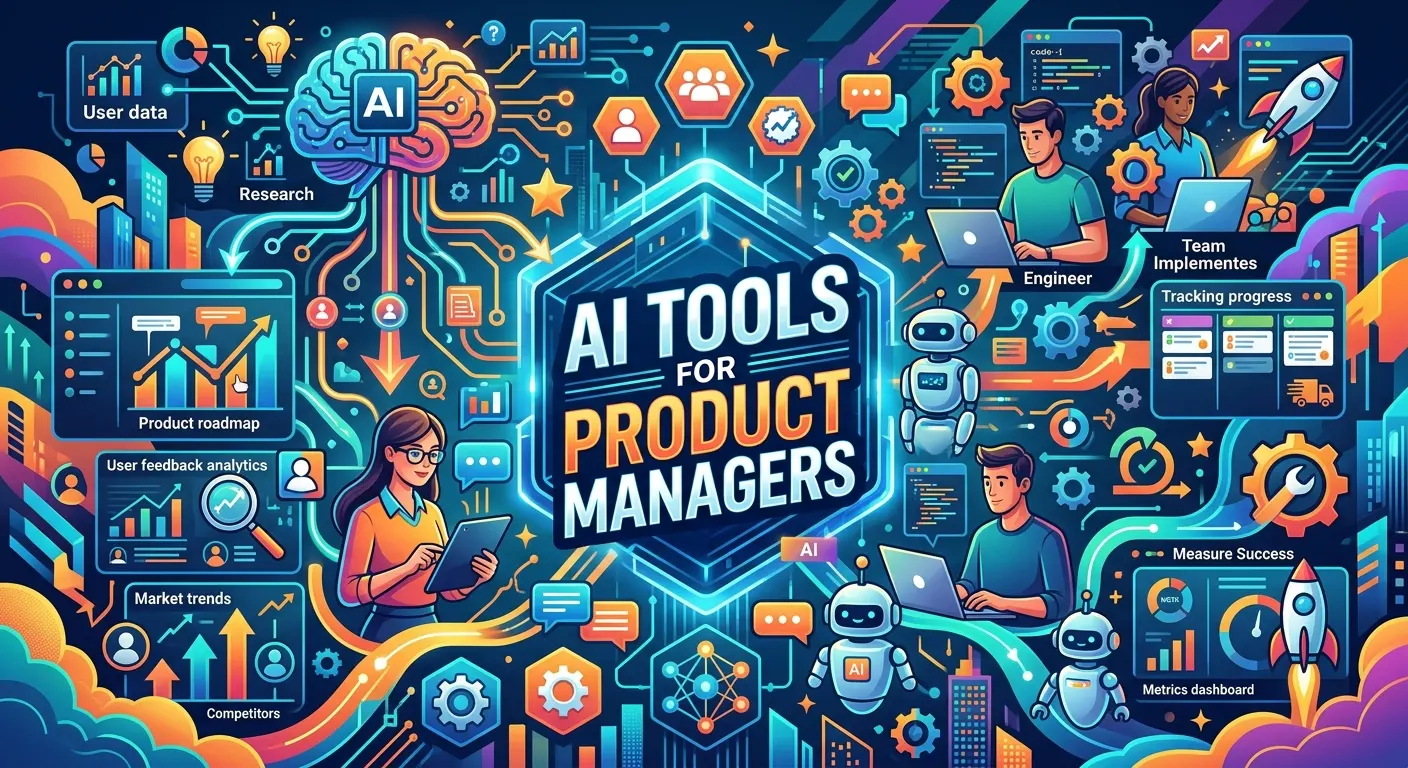
Product management involves research, strategy, prioritization, communication, planning, and constant decision-making. Product managers often need to understand customer needs, analyze market information, define requirements, coordinate with designers and developers, and measure whether a product is delivering value. AI tools for product managers can make many of these activities faster and more efficient.
Modern AI can support user research, product discovery, documentation, roadmap planning, data analysis, competitive research, meeting summaries, and content creation. The goal is not to replace product judgment. Instead, AI gives product managers a productivity advantage by reducing repetitive work and helping them process information more quickly. When used thoughtfully, these tools can improve innovation, efficiency, creativity, automation, collaboration, and real-world product outcomes from discovery through launch and beyond.
What Are AI Tools for Product Managers?
AI tools for product managers are software solutions that use artificial intelligence to support product management activities. They can help professionals collect and analyze information, generate ideas, write product documents, summarize discussions, prioritize opportunities, and identify patterns in customer or business data.
Traditional product management often requires switching between many applications. A product manager may use one application for project planning, another for customer feedback, another for analytics, and another for documentation. AI can make these workflows more efficient by helping organize information and automate parts of the process.
For example, a product manager could provide customer interview notes to an AI assistant and ask it to identify recurring pain points, feature requests, objections, and unanswered questions. The product manager can then review those findings and decide which insights deserve further investigation.
The most effective approach is to treat AI as a copilot for product management. AI can accelerate analysis and execution, but humans should remain responsible for product strategy, customer empathy, prioritization, and important business decisions.
How AI Tools for Product Managers Work
AI product management tools generally work by processing information and producing recommendations, summaries, drafts, classifications, or predictions. Depending on the platform, the underlying technology may include large language models, machine learning, natural language processing, predictive analytics, or other AI techniques.
A product manager might provide a product brief, customer feedback, business requirements, or research notes. The AI system analyzes the information and generates useful outputs. These could include user stories, acceptance criteria, product requirements, interview summaries, feature ideas, or research questions.
For example, imagine a team receives hundreds of customer comments about a mobile application. Manually reading and categorizing every comment could take considerable time. An AI system can help group comments into themes such as performance, usability, missing features, pricing, onboarding, and customer support.
AI can also work with structured information. Product teams may use AI alongside analytics platforms to identify trends in user behavior or explain unusual changes in key metrics. However, product managers should validate important conclusions against the underlying data.
AI works best when product managers provide clear context, reliable information, and specific objectives. Better inputs usually produce more useful outputs.
Key Features of AI Product Management Tools
The features available vary significantly between products, but several capabilities appear frequently across AI-powered product management platforms.
AI-powered writing assistance can help create product requirements, product briefs, user stories, release notes, meeting summaries, and internal documentation. This reduces time spent on repetitive writing while helping teams maintain clearer documentation.
Research and feedback analysis is another important feature. AI can summarize interviews, categorize customer feedback, detect recurring themes, and help identify potential opportunities.
Some platforms offer roadmap and prioritization assistance. These systems can organize initiatives according to business goals, customer impact, effort, strategic importance, or other criteria chosen by the team.
Other useful capabilities include:
- Product requirement generation
- User story creation
- Acceptance criteria suggestions
- Customer feedback analysis
- Competitive research assistance
- Meeting transcription and summaries
- Product analytics support
- Feature prioritization
- Risk identification
- Documentation automation
- Content generation
- Workflow automation
- Team collaboration
- Natural-language search
The strongest tools are not necessarily those with the largest number of features. Product managers should choose tools that integrate naturally with their existing processes and solve meaningful problems.
Benefits of AI Tools for Product Managers
One of the biggest benefits of AI is time savings. Product managers spend significant amounts of time writing documentation, summarizing meetings, reviewing feedback, preparing presentations, and organizing information. AI can accelerate many of these tasks.
AI can also improve productivity and consistency. A product manager can create repeatable workflows for meeting notes, customer feedback analysis, requirements documentation, and product updates.
Another major advantage is faster information processing. Product teams often deal with large amounts of qualitative and quantitative information. AI can help organize that information into useful categories, making it easier to investigate important issues.
AI can also support creativity. When a team is exploring a new product opportunity, AI can generate alternative concepts, customer scenarios, potential risks, and questions that the team may want to explore.
There are strategic benefits as well. By reducing administrative work, AI can give product managers more time for customer conversations, strategic thinking, stakeholder alignment, experimentation, and decision-making.
However, speed should never become the only goal. A fast but incorrect decision can be more expensive than a slower, carefully validated one.
AI Use Cases Across the Product Management Lifecycle
AI can support product managers at almost every stage of the product lifecycle. During product discovery, AI can help organize research, summarize interviews, analyze reviews, and identify recurring customer problems.
During planning, AI can help turn research insights into potential opportunities. It can assist with product briefs, user personas, user stories, requirements, and acceptance criteria.
During development, AI can help summarize team discussions, identify unresolved questions, prepare release notes, and keep documentation organized.
After launch, AI can support product analytics, customer feedback analysis, experiment evaluation, and support-ticket classification. Product managers can use these insights to identify areas that need improvement.
For example, suppose a SaaS company launches a new dashboard. After several weeks, the team receives thousands of support messages and product comments. AI can help classify the feedback and reveal that many users struggle with a particular workflow.
The product manager can then investigate the problem using actual user behavior and conversations before deciding whether a redesign, tutorial, or feature change is appropriate.
This creates a useful cycle:
Research → Discover → Prioritize → Build → Launch → Measure → Learn → Improve.
AI can assist throughout this cycle while the product manager remains accountable for the decisions.
AI for User Research and Customer Feedback Analysis
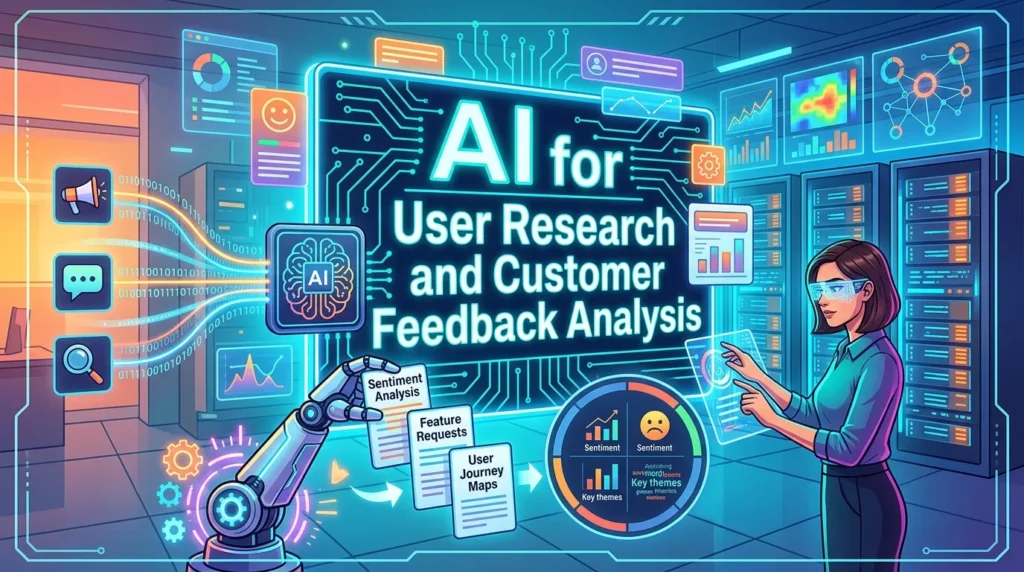
Understanding customers is one of the most important responsibilities of a product manager. AI can make qualitative research easier to process, particularly when teams collect large numbers of interviews, surveys, reviews, support conversations, or feedback submissions.
AI can summarize long interview transcripts and identify recurring topics. It can also help categorize comments according to themes such as customer goals, frustrations, feature requests, usability issues, and objections.
For example, a product team might interview 30 customers about a new workflow. Instead of relying only on individual notes, the team can use AI to identify common patterns across interviews and then manually review the original evidence behind those patterns.
This distinction is important. AI-generated summaries should guide investigation, not replace customer research.
Product managers should also avoid assuming that the most frequently mentioned request automatically deserves the highest priority. A request may be common but have limited business value, while a less common problem may affect an important customer segment.
The best workflow combines AI analysis with human interpretation, direct customer evidence, and product strategy.
AI for Product Roadmaps and Feature Prioritization
Roadmaps help product teams communicate where they are heading and why. AI can assist product managers by organizing potential initiatives and comparing them against defined criteria.
A product manager can give an AI system information about customer impact, strategic goals, expected business value, implementation complexity, dependencies, and risks. The system can help structure the information so the team can evaluate opportunities more consistently.
AI can also generate alternative prioritization scenarios. For example, one scenario might prioritize customer retention, while another focuses on revenue growth or reducing operational costs.
However, AI should not make final prioritization decisions automatically. Prioritization is a strategic responsibility, and many important factors cannot be reduced to a simple score.
A strong approach is to use AI to prepare the analysis and expose assumptions, then let the product team discuss trade-offs.
Ask questions such as:
- What evidence supports this opportunity?
- Which customer segment benefits?
- What business outcome could change?
- What assumptions remain uncertain?
- What would we learn from a small experiment?
- What dependencies could affect delivery?
These questions turn AI from a simple recommendation engine into a useful strategic thinking assistant.
AI for Product Requirements, User Stories, and Documentation
Writing product requirements can take considerable time. AI can help product managers transform rough ideas into structured documentation.
For example, a product manager might describe a feature in a few paragraphs and ask AI to organize the information into a product requirement document. The output could include the problem statement, target users, proposed solution, requirements, edge cases, dependencies, and success criteria.
AI can also help create user stories and acceptance criteria. Developers and testers can then review these outputs and identify missing details.
Documentation benefits from AI because product teams frequently need to update the same information in multiple places. AI can help create summaries, release notes, internal announcements, and customer-facing explanations from an approved source document.
Still, product managers should review all generated requirements carefully. AI may invent assumptions or overlook technical constraints.
The safest workflow is:
Human defines the problem → AI structures the draft → team reviews requirements → stakeholders approve → final documentation becomes the source of truth.
AI for Product Analytics and Decision-Making
Product analytics helps teams understand how customers use a product. AI can make large datasets easier to explore by allowing product managers to ask questions in natural language.
Instead of manually searching through multiple reports, a product manager may ask an analytics assistant to explain changes in activation, retention, conversion, or feature adoption.
AI can also help identify unusual patterns. For example, if a feature suddenly experiences a decline in usage, an AI system may highlight the change and suggest possible areas for investigation.
But product managers should be careful with automated explanations. Correlation does not automatically prove causation.
Suppose user retention drops after a new feature launches. That does not necessarily mean the feature caused the decline. Other factors such as seasonality, pricing changes, technical problems, acquisition changes, or external events may have contributed.
Use AI to identify questions and patterns, then validate those findings using reliable data and appropriate analysis.
AI for Product Strategy and Competitive Research
Product strategy requires understanding customers, competitors, technology, market conditions, and business goals. AI can accelerate parts of this research process.
AI can help summarize publicly available information, organize competitor features, identify common positioning themes, and generate research questions. It can also help product managers compare product experiences from a customer perspective.
For example, a product manager researching project management software might ask AI to organize publicly available information around collaboration features, integrations, pricing models, onboarding, and target customers.
However, competitive research requires source verification. AI systems can produce outdated or incorrect information, particularly when discussing rapidly changing markets.
Use primary sources whenever possible, such as official product documentation, company announcements, pricing pages, public filings, and direct customer evidence.
AI should accelerate research, not remove the need for research.
Free vs Paid AI Tools for Product Managers
Product managers can find both free and paid AI solutions. Free tools may be sufficient for brainstorming, writing, summarizing, basic research, and early experimentation.
Paid products often provide additional capabilities such as higher usage limits, team collaboration, integrations, enterprise security features, advanced analytics, specialized workflows, or administrative controls.
The right choice depends on your team’s needs. A solo product manager may not need an expensive enterprise platform if a general AI assistant already solves most of their daily problems.
Larger organizations may need stronger controls around security, permissions, data governance, compliance, integrations, and collaboration.
Before paying for a product, evaluate the actual business value. Ask:
How much time does it save? What quality improvement does it create? Does it integrate with our workflow? What risks does it introduce?
AI pricing can change over time, so check the provider’s current plans, usage limits, and feature restrictions before making a purchasing decision.
AI Integrations for Product Management Workflows

AI becomes more powerful when it connects with the tools product teams already use. Depending on the platform, integrations may connect AI with project management systems, documentation platforms, customer support software, analytics tools, CRM systems, communication applications, or development workflows.
For example, a support workflow could collect customer feedback, classify requests with AI, identify recurring themes, and send high-priority findings to the product team’s workspace.
A development workflow could use AI to turn approved requirements into structured user stories and then help generate release documentation when the work is completed.
Integrations can reduce repetitive copying and pasting. They can also create a more consistent flow of information between teams.
However, integration introduces additional considerations. Product teams should review permissions, data access, privacy, security, and reliability before connecting AI to sensitive systems.
A good integration should reduce friction without creating unnecessary complexity.
Pros, Cons, and Risks of AI for Product Managers
AI has clear advantages. It can accelerate research, improve documentation, reduce repetitive tasks, generate ideas, organize information, and help teams work more efficiently.
It can also improve accessibility. Product managers who are not strong writers, analysts, or researchers can use AI to structure information and develop a clearer first draft.
But AI has limitations. It can generate incorrect information, misunderstand context, repeat biases present in its inputs, or produce recommendations that sound convincing without strong evidence.
There is also a risk of over-reliance. If product managers begin accepting AI recommendations without investigation, teams may lose important critical-thinking habits.
Privacy and confidentiality also matter. Product teams frequently work with customer information, unreleased features, business strategy, and internal data. Sensitive information should only be shared with AI systems that have been appropriately reviewed and approved.
The best approach is to establish clear rules for what AI can handle independently and what requires human approval.
Common Mistakes Product Managers Make With AI
One common mistake is using AI without defining the problem first. If the product question is unclear, generating more content will not necessarily produce a better decision.
Another mistake is trusting AI-generated research without checking the evidence. AI can summarize information quickly, but product managers should inspect important source material before making major decisions.
Teams also sometimes use AI to create excessive documentation. More documents do not automatically create better product management. Documentation should support understanding and execution rather than become an administrative burden.
Another mistake is ignoring customer conversations. AI can analyze customer feedback, but it cannot replace the value of directly speaking with customers and understanding their motivations.
Finally, some teams measure AI success only by how quickly content is generated. A better measure is whether AI helps improve product outcomes, decision quality, customer understanding, and team productivity.
Use AI where it creates genuine leverage, not simply because it is available.
Latest AI Trends for Product Managers in 2026
AI product management is moving beyond simple writing assistance toward more integrated and context-aware workflows. Modern AI systems increasingly help professionals analyze information, connect knowledge, generate artifacts, and interact with business software using natural language.
One important trend is the development of AI product management copilots. These systems can potentially support multiple stages of the workflow instead of handling one isolated task.
Another trend is AI-assisted product discovery. Teams can combine customer feedback, support information, analytics, and market research to identify potential opportunities more quickly.
Multimodal AI is also becoming increasingly important. Product managers may work with text, screenshots, product recordings, diagrams, presentations, audio transcripts, and other formats within the same workflow.
There is also greater focus on AI governance and responsible product development. Teams increasingly need clear policies around privacy, security, model evaluation, human oversight, and the responsible use of customer data.
As these systems improve, the product manager’s role may become less focused on manually producing documents and more focused on asking better questions, validating assumptions, making strategic decisions, and guiding teams toward meaningful outcomes.
How to Choose the Best AI Tools for Product Managers
Start by identifying the specific problem you want to solve. Do you spend too much time summarizing meetings? Do you struggle to analyze customer feedback? Do you need help with product documentation? Are you trying to improve analytics or competitive research?
Once the problem is clear, compare tools based on accuracy, usability, integrations, security, customization, pricing, and workflow compatibility.
Avoid choosing a product simply because it uses the word “AI.” A traditional feature that solves your problem reliably may be more useful than an advanced AI feature that produces inconsistent results.
Test realistic scenarios before committing. Use your actual product management workflow and evaluate whether the tool saves time while maintaining quality.
Also consider your organization’s security requirements. If the tool will process customer data or confidential product information, investigate how that information is stored, processed, protected, and deleted.
Finally, measure the results. Track time saved, documentation quality, research speed, team adoption, decision-making improvements, and ultimately product outcomes.
The best AI tool is the one that creates repeatable value, not the one with the longest feature list.
Frequently Asked Questions About AI Tools for Product Managers
What are AI tools for product managers?
AI tools for product managers are applications that use artificial intelligence to support tasks such as product discovery, user research, documentation, prioritization, analytics, competitive research, and workflow automation.
How can AI help product managers?
AI can reduce repetitive work, summarize information, generate drafts, analyze customer feedback, organize research, support product analytics, and help teams explore ideas more quickly.
Can AI replace product managers?
No. AI can automate or accelerate many tasks, but product management still requires customer empathy, strategic judgment, leadership, communication, prioritization, and accountability.
Can AI create product requirements?
Yes. AI can turn a product idea or rough notes into a structured requirements draft, user stories, acceptance criteria, and related documentation. Human review remains essential.
Can product managers use AI for customer research?
Yes. AI can summarize interviews, categorize feedback, identify recurring themes, and help generate research questions. However, AI should complement rather than replace direct customer research.
Are AI product management tools free?
Some offer free plans or trials, while others require paid subscriptions. Enterprise products may have additional pricing based on users, usage, security requirements, or integrations.
What is the best AI tool for product managers?
There is no single best tool for every product manager. The right choice depends on whether your main need is research, writing, analytics, roadmap planning, customer feedback, project coordination, or automation.
Can AI help with product roadmaps?
Yes. AI can help organize initiatives, summarize supporting evidence, identify dependencies, and compare prioritization scenarios. Final roadmap decisions should remain with the product team.
Is it safe to put customer data into AI tools?
Not automatically. Product teams should review the tool’s privacy, security, data retention, permissions, and organizational policies before entering sensitive customer or company information.
How can product managers get better results from AI?
Give AI clear context, define the objective, provide reliable source material, and specify the desired output. Always review important results and add human judgment before using them in product decisions.
Conclusion
AI tools for product managers are becoming valuable assistants across the entire product lifecycle. From customer research and product discovery to requirements, roadmaps, analytics, competitive research, and documentation, AI can reduce repetitive work and help teams process information faster.
The biggest opportunity is not simply generating more documents or completing tasks more quickly. It is creating more time for the activities that require human judgment: understanding customers, defining meaningful problems, making strategic trade-offs, communicating vision, and building products that deliver genuine value.
Start small. Choose one repetitive workflow, test an AI solution, measure the results, and improve your process. As AI capabilities continue to develop, product managers who learn how to combine AI with strong product fundamentals will be better positioned to work efficiently while keeping quality and customer needs at the center of their decisions.