AI-powered search has changed how people discover brands, products, and information. Instead of clicking through a traditional list of search results, users can increasingly receive direct answers from platforms such as ChatGPT, Google AI Overviews, and Perplexity. This creates a new measurement challenge for marketers: ranking on a traditional search engine is not the same as being mentioned or cited inside an AI-generated answer
. ZipTie is designed to address that gap by monitoring how brands appear across AI search experiences and turning those observations into actionable optimization insights. According to ZipTie, its platform tracks mentions, sentiment, citations, competitors, and complete AI responses, while newer versions extend monitoring across seven major AI engines. (ZipTie.ai – AI Search Intelligence) For businesses adapting to generative engine optimization (GEO), understanding what ZipTie measures can help clarify where a brand is visible, where competitors appear instead, and which queries deserve attention.
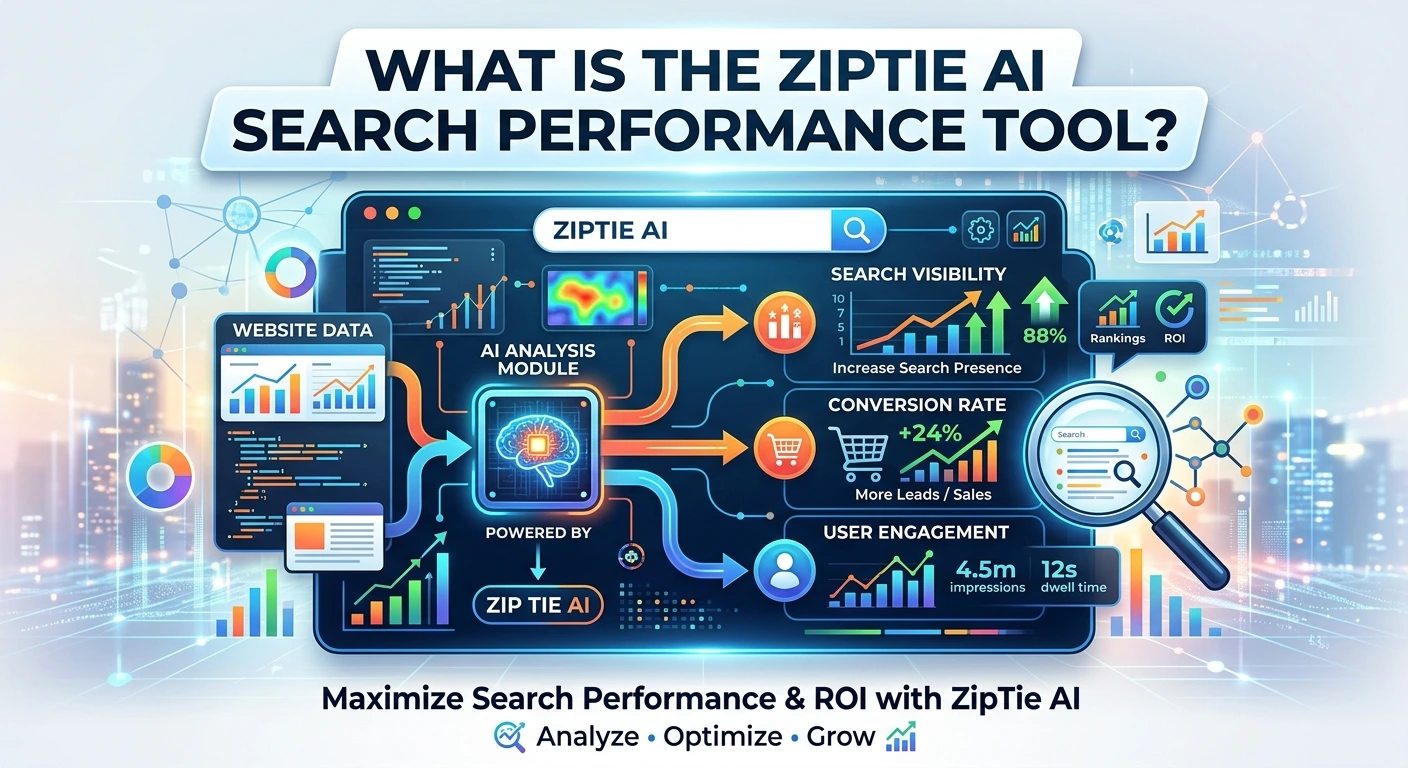
What Is the ZipTie AI Search Performance Tool?
ZipTie is an AI search intelligence and monitoring platform designed to measure brand visibility inside AI-generated search answers. Its purpose is different from a traditional keyword rank tracker. Instead of focusing primarily on where a website appears in conventional search results, ZipTie examines whether AI systems mention a brand, cite its website, describe it positively, or recommend competitors.
The platform originally focused on AI search monitoring and has expanded its coverage as the search landscape has changed. Its current product documentation says it monitors ChatGPT, Google AI Overviews, Perplexity, Google AI Mode, Microsoft Copilot, Bing AI Overview, and Google Gemini. (ZipTie.ai – AI Search Intelligence)
This makes ZipTie relevant to companies exploring AI search optimization, generative engine optimization, brand visibility, and answer-engine optimization. Rather than asking only, “What is my Google ranking?”, marketers can also ask, “Does AI recommend my brand when customers ask questions related to my category?”
That distinction is increasingly important because AI search can summarize information from multiple sources and present a direct recommendation rather than a conventional results page.
How ZipTie Measures AI Search Performance
ZipTie works by tracking selected prompts or queries and examining the answers generated by supported AI search engines. The platform captures information about how a brand appears within those responses.
According to ZipTie, its AI Success Score uses three primary signals: mention rate, mention sentiment, and citation rate. Mention rate measures how frequently the brand appears, sentiment evaluates how positively it is described, and citation rate measures how often the brand’s URLs are used as sources. (ZipTie.ai – AI Search Intelligence)
The platform also archives the actual AI responses behind its measurements. This is useful because AI responses can change from one search to another. A single response is therefore only one observation rather than a permanent ranking.
ZipTie says it addresses this variability by collecting repeated measurements over time. This allows users to distinguish longer-term visibility trends from individual changes in AI-generated responses. (ZipTie.ai – AI Search Intelligence)
Which AI Search Engines Does ZipTie Track?
ZipTie has expanded from its earlier focus on Google AI Overviews, ChatGPT, and Perplexity. Its current product information lists seven major AI search surfaces: ChatGPT, Google AI Overviews, Perplexity, Google AI Mode, Microsoft Copilot, Bing AI Overview, and Google Gemini. (ZipTie.ai – AI Search Intelligence)
Earlier ZipTie documentation described its core coverage as Google AI Overviews, ChatGPT, and Perplexity. That earlier coverage remains relevant for understanding the platform’s development, but its current product has broader engine coverage. (ZipTie.dev)
This multi-engine approach matters because AI platforms do not always produce identical answers. A company may appear frequently in one system while receiving less visibility in another.
For marketers, platform-level comparisons can therefore reveal where AI visibility is strong and where additional optimization may be needed.
ZipTie AI Success Score Explained
The AI Success Score is one of ZipTie’s central metrics. It provides a simplified way to evaluate performance across tracked prompts instead of requiring marketers to inspect every AI answer manually.
The score incorporates three core signals: how often the brand is mentioned, how positively it is described, and how often its website is cited. ZipTie says these measurements help create an optimization queue so users can identify underperforming queries. (ZipTie.ai – AI Search Intelligence)
This approach is useful because visibility alone does not tell the whole story. A brand might be mentioned frequently but described negatively, or it might receive positive mentions without being cited as a source.
A combined metric can therefore provide a broader picture. However, marketers should still inspect the underlying AI responses, because a numerical score cannot capture every important detail about context, accuracy, positioning, or customer intent.
Brand Mentions, Sentiment, and Citations
A brand mention occurs when an AI-generated response includes the name of a company or product. Tracking mentions helps determine whether an AI engine recognizes a brand as relevant to particular topics or questions.
Sentiment adds another layer. A brand appearing in an answer is not automatically beneficial if the response contains negative or misleading information. ZipTie therefore tracks whether the description is positive or negative. (ZipTie.ai – AI Search Intelligence)
Citations are also important. When an AI platform links to a website as a source, the website can gain direct visibility and potentially influence how users verify the answer.
These three signals should be interpreted together. Strong AI search visibility generally means being mentioned appropriately, described accurately, and supported by credible sources.
Competitive Benchmarking With ZipTie
AI search performance becomes more meaningful when compared with competitors. A brand may feel visible until it discovers that another company appears more frequently for the same customer questions.
ZipTie provides competitive benchmarking that shows when and how often competitors appear in AI-generated responses. Its documentation also distinguishes between citation leaders and mention leaders, helping users understand different forms of visibility. (ZipTie.dev)
For example, a competitor might receive many mentions but few citations, while another competitor might be frequently cited as an authoritative source. Those situations require different strategic responses.
Competitive analysis can therefore help marketers identify content gaps, authority gaps, topic opportunities, and queries where competitors have stronger AI visibility.
What Types of Queries Should You Track?
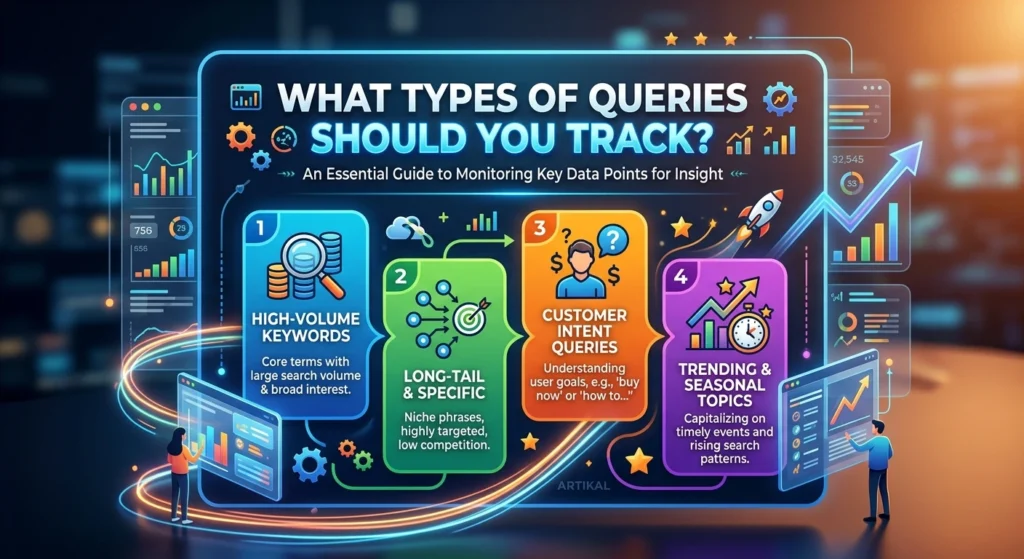
The quality of an AI search monitoring project depends heavily on the queries being tracked. Generic questions alone may not provide enough insight into the customer journey.
ZipTie recommends several query categories, including category-positioning queries, sentiment queries, competitor comparisons, and persona-specific variations. (ZipTie.dev)
A category query might ask which products are best for a particular use case. A comparison query might ask how one brand differs from another. A persona query can add context such as beginner, enterprise buyer, small business owner, or another relevant audience.
Tracking a mixture of query types creates a broader picture of brand visibility. Instead of measuring one keyword repeatedly, marketers can examine how AI systems respond across different intents and stages of the customer journey.
ZipTie Content Optimization Features
Monitoring alone does not solve an AI visibility problem. Marketers also need to understand what they can change. ZipTie’s content optimization feature is designed to connect monitoring data with recommendations.
The platform’s documentation describes a workflow in which users select a target query, submit relevant content for analysis, and receive recommendations based on gaps identified in the content. (ZipTie.dev)
This can help marketers improve content for both traditional search and AI-driven discovery. Instead of focusing only on keyword repetition, the process emphasizes information completeness, useful explanations, authority signals, and content quality.
The important principle is optimization for usefulness rather than manipulation. AI systems need reliable information to generate useful answers, so high-quality content should remain the foundation of any GEO strategy.
ZipTie Project Wizard and Query Discovery
Choosing the right prompts manually can take considerable time. ZipTie addresses this through a Project Wizard that helps identify questions potential customers may ask AI systems.
According to ZipTie, the wizard can read a website, conduct web research, and propose prompts involving categories, comparisons, personas, and other customer-oriented searches. (ZipTie.ai – AI Search Intelligence)
This can make initial setup easier, particularly for teams that are unfamiliar with AI search monitoring. Instead of starting with a large spreadsheet of guesses, users can begin with suggested prompts and refine the list.
The best results still come from human review. A business should remove irrelevant prompts and add questions that reflect its actual products, audience, markets, and customer journey.
ZipTie Integrations, API, and MCP Access
Modern marketing teams often need to connect different systems. ZipTie offers integration options designed for organizations that want to incorporate AI search data into broader workflows.
Its current product documentation describes Google Search Console integration, allowing classic search metrics such as clicks, impressions, top queries, and top pages to be viewed alongside AI search data. (ZipTie.ai – AI Search Intelligence)
ZipTie also advertises a public REST API and Model Context Protocol (MCP) access as add-ons. These interfaces can allow AI agents and other software systems to query ZipTie data programmatically. (ZipTie.ai – AI Search Intelligence)
This can be useful for advanced teams that want to combine AI visibility data with dashboards, reporting systems, internal analytics, or automated workflows.
ZipTie Pricing and Free Trial
Pricing can change, so the provider’s current pricing page should be checked before making a purchasing decision. At the time of research, ZipTie’s pricing page advertised a seven-day free trial with 25 daily prompts across ChatGPT, Google AI Overviews, and Perplexity, with no credit card required. (ZipTie.ai – AI Search Intelligence)
The current pricing model is usage-based rather than simply charging a fixed amount per employee. ZipTie says customers pay based on the prompts and AI engines they choose to monitor. Its listed preset plans included Starter, Professional, and Enterprise options. (ZipTie.ai – AI Search Intelligence)
This model can make sense for teams with different monitoring requirements. A small project may need only a limited set of prompts, while an enterprise organization could need broader engine, country, brand, and query coverage.
Before subscribing, compare the number of prompts, engines, monitoring frequency, add-ons, exports, API access, and content optimization features against your actual requirements.
Advantages and Limitations of ZipTie
One major advantage is specialization. ZipTie is designed specifically around AI search visibility rather than treating AI search as a small feature inside a traditional SEO platform.
Another benefit is the combination of monitoring, scoring, competitive benchmarking, response analysis, and optimization recommendations. This can make the platform more actionable than a dashboard that only reports visibility.
However, AI search itself is inherently variable. Different users can receive different results, and responses can change over time. ZipTie acknowledges this variability and uses repeated measurements to establish trends. (ZipTie.ai – AI Search Intelligence)
There is also a strategic limitation: no monitoring platform can guarantee that an AI system will mention or cite a particular brand. ZipTie measures and helps optimize visibility; it does not control the underlying AI search engines.
ZipTie vs Traditional SEO Tools
Traditional SEO platforms usually focus on metrics such as keyword rankings, organic traffic, backlinks, search volume, technical SEO, and website performance.
ZipTie addresses a different layer of visibility. It focuses on what happens after a user asks an AI-powered search system a question and receives a synthesized response.
The two approaches are not necessarily competitors. Traditional SEO can help a website become discoverable and authoritative, while AI search monitoring can reveal whether that authority translates into AI mentions and citations.
ZipTie itself describes its platform as complementary to traditional SEO rather than a replacement. Its current FAQ explains that the product is specialized in AI search and GEO while traditional SEO suites cover broader search optimization. (ZipTie.ai – AI Search Intelligence)
Common Mistakes When Using an AI Search Performance Tool
One mistake is tracking too few queries. If a company monitors only branded searches, it may miss category searches where potential customers are discovering alternatives.
Another mistake is focusing exclusively on the score. A score can reveal a trend, but the actual AI response explains why the score changed. Reviewing responses helps identify inaccurate descriptions, missing information, competitor recommendations, and citation patterns.
A third mistake is optimizing content only for AI visibility. Content should still serve human readers. Improving clarity, factual accuracy, structure, expertise, and usefulness creates a stronger foundation for both traditional and AI search.
Finally, marketers should avoid assuming that one successful AI response represents permanent visibility. AI results can change, so ongoing monitoring provides more useful information than a single snapshot.
How to Use ZipTie for a Practical GEO Strategy
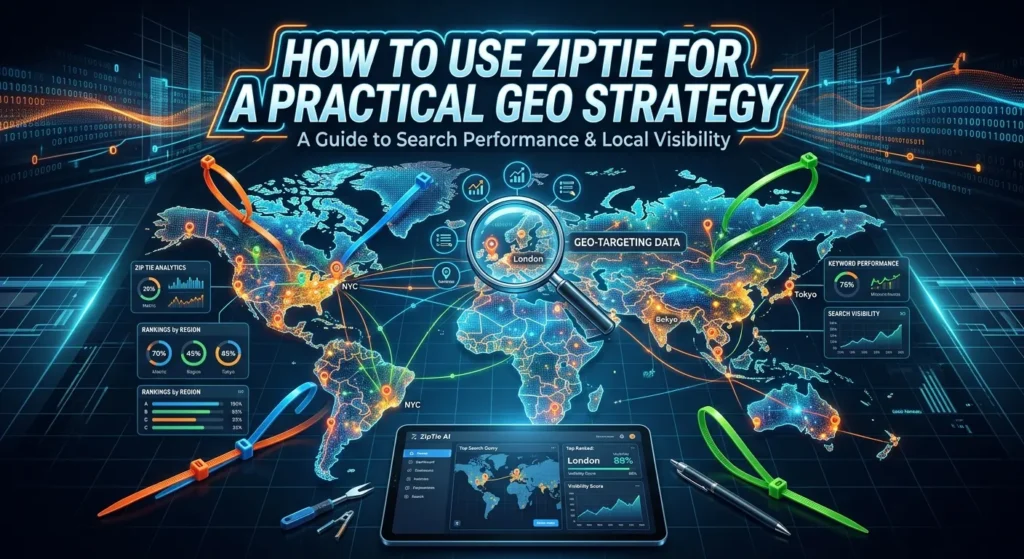
A practical workflow starts by defining business goals. Decide which products, services, audiences, markets, and customer questions matter most.
Next, build a diverse prompt set. Include category questions, comparison searches, problem-solving questions, persona-specific queries, and sentiment-oriented prompts. ZipTie’s query-generation features can help with this initial process. (ZipTie.dev)
Then establish a baseline. Record current mention rates, citation rates, sentiment, competitors, and AI Success Scores. This gives you a reference point before making content changes.
Finally, optimize strategically and measure again. Improve the pages and sources most relevant to underperforming queries, then monitor future results. The goal is a continuous cycle of measurement, improvement, and verification.
Future of AI Search Performance Tracking
AI search measurement will likely become more important as consumers increasingly use conversational systems for research and purchasing decisions.
Future tools may monitor more AI engines, provide deeper source analysis, connect AI visibility with conventional search analytics, and use automation to identify opportunities. ZipTie is already moving in this direction with expanded engine coverage, API access, MCP, source-impact analysis, and content generation features.
The underlying metrics may also become more sophisticated. Mentions and citations are useful, but marketers may increasingly care about recommendation position, answer accuracy, share of voice, source influence, conversion impact, and brand sentiment.
The most effective approach will remain balanced. AI visibility should be treated as another part of a broader digital strategy rather than a replacement for strong products, trustworthy information, useful content, and traditional search optimization.
Conclusion: Is ZipTie an AI Search Performance Tool Worth Understanding?
So, what is the ZipTie AI search performance tool? It is a specialized platform designed to monitor and analyze how brands appear inside AI-generated search answers. It measures signals such as brand mentions, sentiment, citations, competitors, and complete responses, and it can turn those measurements into optimization priorities. (ZipTie.ai – AI Search Intelligence)
Its value comes from addressing a measurement gap between traditional SEO and AI-powered search. A website can perform well in conventional search while still receiving limited visibility in AI-generated answers. ZipTie gives marketers a way to observe that difference.
The platform is particularly relevant for SEO teams, content marketers, agencies, brands, and businesses developing GEO strategies. Its monitoring, competitive analysis, content optimization, and integration capabilities can support a more systematic approach to AI search.
Still, no tool guarantees visibility. The strongest long-term strategy combines measurement with accurate information, authoritative sources, useful content, strong technical foundations, and continuous improvement.
FAQs About
What is ZipTie used for?
ZipTie is used to monitor brand visibility in AI search results, including mentions, sentiment, citations, competitor visibility, and AI-generated responses. (ZipTie.ai – AI Search Intelligence)
Which AI platforms does ZipTie monitor?
Current ZipTie product information lists ChatGPT, Google AI Overviews, Perplexity, Google AI Mode, Microsoft Copilot, Bing AI Overview, and Google Gemini. (ZipTie.ai – AI Search Intelligence)
What is an AI Success Score?
ZipTie’s AI Success Score combines mention rate, mention sentiment, and citation rate to help users identify which tracked queries deserve optimization attention. (ZipTie.ai – AI Search Intelligence)
Does ZipTie replace traditional SEO tools?
No. ZipTie focuses specifically on AI search intelligence and GEO, while traditional SEO platforms generally cover broader areas such as rankings, backlinks, technical SEO, and organic traffic. (ZipTie.dev)
Can ZipTie track competitors?
Yes. ZipTie provides competitive benchmarking and can show how often competitors appear in AI search responses compared with your brand. (ZipTie.dev)
Does ZipTie offer content optimization?
Yes. ZipTie describes a content optimization module that analyzes content against AI search requirements and provides recommendations for improving potential visibility. (ZipTie.dev)
Does ZipTie have a free trial?
At the time of research, ZipTie advertised a seven-day free trial with 25 daily prompts across three AI engines and no credit card requirement. Pricing and trial terms can change, so check the official pricing page for current details.
Can ZipTie connect with Google Search Console?
Yes. ZipTie currently advertises a read-only Google Search Console integration that can place traditional search metrics alongside AI search data.
Can AI search results change after ZipTie measures them?
Yes. AI-generated answers can vary between searches. ZipTie says it addresses this by collecting repeated measurements and analyzing trends rather than treating a single response as a permanent result.
Who can benefit from ZipTie?
SEO professionals, content teams, agencies, marketers, and businesses that want to understand and improve their visibility in AI-generated search answers can potentially benefit from the platform.