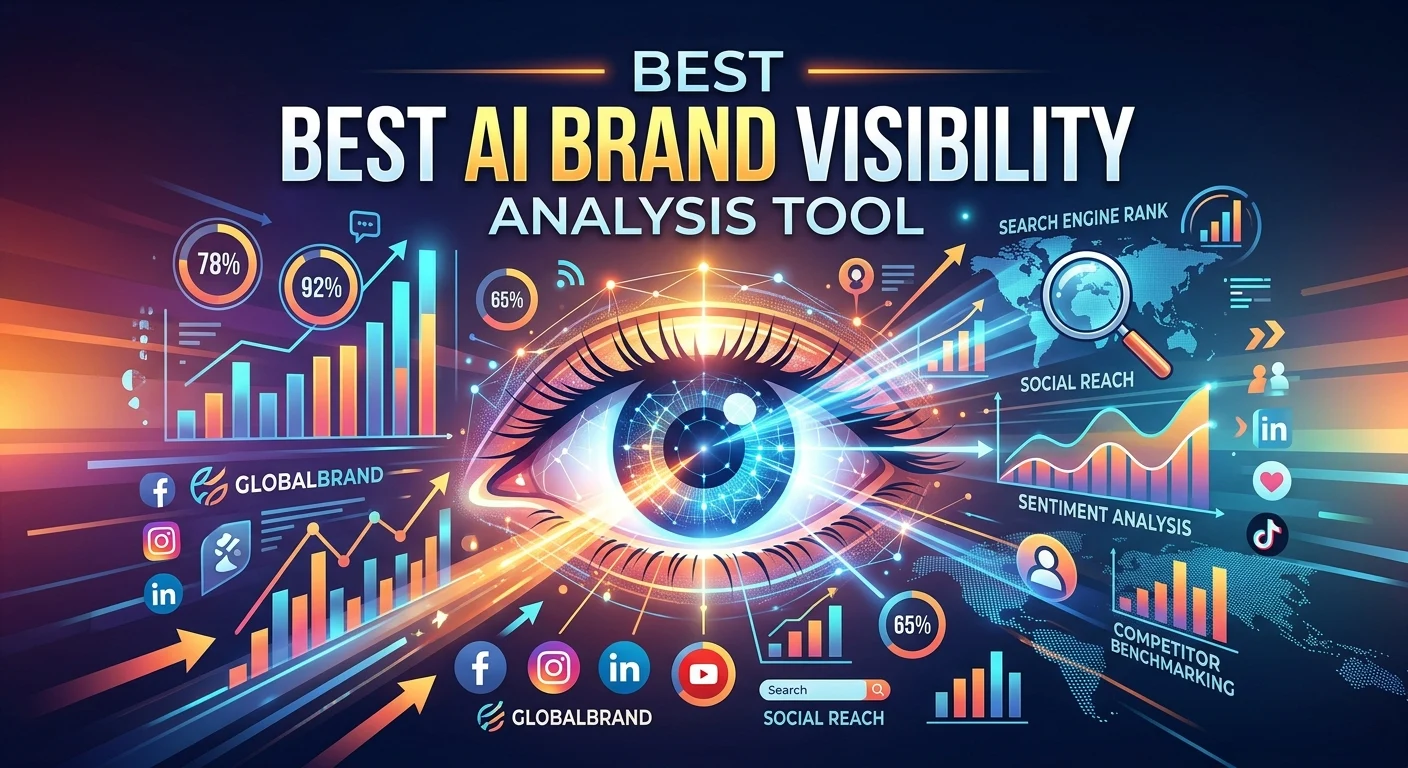
Brand discovery is changing as people increasingly use AI-powered search, conversational assistants, and answer engines to research products, companies, and services. A best AI brand visibility analysis tool can help businesses understand how often their brand appears in AI-generated answers, which sources influence those answers, how competitors are represented, and what opportunities exist to strengthen digital visibility. Unlike traditional SEO platforms that focus mainly on keyword rankings and organic traffic
, AI visibility analysis looks at brand mentions, citations, context, sentiment, query coverage, and competitive presence across AI search experiences. This can improve productivity by automating repeated checks, support efficiency through centralized reporting, and encourage creativity by revealing content opportunities. For marketers, agencies, SaaS companies, publishers, and growing businesses, AI brand visibility analysis provides practical data for adapting to the rapidly changing search landscape.
What Is an AI Brand Visibility Analysis Tool?
An AI brand visibility analysis tool is software that monitors how a brand appears in AI-generated search results and conversational answers. It can examine whether an AI system mentions a company, product, service, website, or other brand-related entity when users ask relevant questions.
Traditional SEO tools usually measure rankings, backlinks, organic traffic, keywords, and technical performance. AI visibility analysis focuses on a different question: How does AI-powered search understand and represent the brand?
For example, a project management company might monitor questions such as “What are the best project management tools for remote teams?” or “Which project management software is good for small businesses?” The analysis tool can identify whether the company’s product appears in responses and which competing products are mentioned.
Depending on the platform, reports may include brand mentions, citations, share of voice, competitors, sentiment, source domains, query performance, and historical trends.
How AI Brand Visibility Analysis Works
Most AI visibility platforms begin with a collection of prompts or search queries. These queries should represent real questions that potential customers might ask about an industry, product category, or specific problem.
The platform then checks AI-generated responses and analyzes the results. It may detect brand names, product mentions, cited webpages, competitor references, and descriptions associated with the company.
Some systems also categorize queries by search intent. Informational questions might be separated from comparison, commercial, transactional, or problem-solving queries.
A typical workflow looks like this:
Create relevant queries → collect AI responses → identify brand mentions → analyze citations → monitor competitors → measure trends → identify opportunities.
Because AI responses can vary, a single answer should not become the basis for a major business decision. Consistent monitoring across a stable set of relevant queries provides more useful insight.
Key Features of the Best AI Brand Visibility Analysis Tools
A strong platform should provide more than a simple list of brand mentions. The most useful tools organize AI search data into metrics that marketers can understand and act upon.
Brand mention tracking shows whether the target company appears in responses to relevant questions. Some platforms also analyze how prominently the brand appears.
Citation analysis identifies websites and pages that AI systems reference. This can reveal which sources contribute to visibility within a particular topic.
Competitor monitoring helps businesses understand which other brands appear in similar answers. This can reveal differences in topic coverage and digital authority.
Other useful features include:
- Prompt tracking
- AI search monitoring
- Share-of-voice measurement
- Sentiment analysis
- Citation tracking
- Source-domain analysis
- Competitor comparisons
- Historical visibility data
- Query clustering
- Brand positioning analysis
- Content gap detection
- Automated reports
- Custom dashboards
- Alerts
- API access
When comparing platforms, focus on the features that support your actual workflow rather than choosing a tool simply because it has the longest feature list.
Benefits of AI Brand Visibility Analysis
The biggest benefit is better visibility into AI-powered discovery. Traditional search rankings do not fully explain how a brand appears in conversational answers.
Automation is another major advantage. Marketing teams can monitor many prompts without manually repeating the same questions across multiple AI platforms.
The data can also support content strategy. If competitors frequently appear for a particular group of questions, marketers can investigate what information supports those mentions.
AI brand analysis can also reveal inconsistencies. A company may discover that AI-generated answers describe its product differently from how the company positions itself.
For agencies, visibility analysis can support client reporting. Instead of manually collecting observations, agencies can create structured reports showing changes in brand mentions, citations, competitors, and query coverage.
The practical value comes from turning data into action. A visibility report is most useful when it helps a team improve content, authority, brand communication, or customer discovery.
AI Brand Visibility vs Traditional SEO Tracking

Traditional SEO tracking measures performance within conventional search results. Common metrics include keyword positions, organic clicks, impressions, backlinks, and search traffic.
AI brand visibility analysis examines AI-generated responses. A brand can rank strongly for a traditional keyword yet receive limited visibility in conversational answers.
For example, a company might rank well for “best accounting software” but not appear when users ask an AI assistant, “What accounting software should a small online business use?”
AI systems can also synthesize information from multiple sources rather than simply presenting a list of webpages. This creates a different visibility environment.
That does not make traditional SEO obsolete. SEO and AI visibility analysis work best as complementary disciplines.
Traditional SEO can help build discoverability and authority, while AI visibility analysis helps businesses understand how those assets are represented in AI-powered search experiences.
Use Cases for AI Brand Visibility Analysis
AI brand visibility analysis can support a wide range of industries.
SaaS companies can monitor whether their products appear in software recommendations and category-related questions.
Ecommerce brands can investigate whether products or brands appear when users ask AI systems for recommendations, comparisons, or buying guidance.
Publishers can monitor whether their articles, research, and other resources receive citations in AI-generated answers.
Marketing agencies can track multiple clients and identify changes in brand visibility across different topics.
Professional service companies can monitor questions related to their expertise. A financial services company, for example, could track educational questions about financial planning, while a cybersecurity provider could monitor security-related queries.
Local businesses may also analyze conversational searches involving services and locations, although results can vary based on location and the AI platform.
The common objective is to understand where the brand appears, how it is described, and which information sources influence its visibility.
AI Citation Tracking and Brand Source Analysis
Citations can provide valuable context behind an AI-generated answer. When an AI system references a webpage, publication, documentation page, or other source, that source becomes part of the information ecosystem supporting the response.
An AI brand visibility analysis tool can help identify recurring citation patterns. For example, several AI answers about a particular topic might repeatedly reference industry publications and detailed research reports.
This information can guide content strategy. If authoritative sources consistently appear around a topic, a company can study what makes those resources useful and consider creating stronger original material.
Citation analysis can also reveal gaps. A brand may have strong product pages but lack educational resources that AI systems frequently reference.
However, businesses should avoid treating citation acquisition as a simple checklist. Quality, relevance, expertise, and trustworthiness matter more than collecting mentions from random websites.
The goal should be to develop an information ecosystem that gives AI systems accurate and useful material to understand the brand.
Competitor Analysis and AI Share of Voice
Competitor analysis can show how different brands appear across the same set of AI search queries.
Suppose a company tracks 200 questions related to its industry. The results may show that one competitor appears frequently for beginner questions, while another appears more often for enterprise-focused topics.
This information can reveal differences in brand positioning and content coverage.
Share-of-voice metrics can also provide a directional view of visibility. However, the methodology matters. Different platforms may calculate share of voice using different query sets, models, response structures, and weighting systems.
Therefore, businesses should not assume that a score from one platform directly equals a score from another.
Instead, use competitor analysis to investigate practical questions:
- Which topics generate competitor mentions?
- Which sources are frequently cited?
- Which customer questions are underrepresented?
- How are competitors described?
- Which content areas need deeper coverage?
This turns AI competitor monitoring into a strategic research process rather than a simple ranking exercise.
Free vs Paid AI Brand Visibility Analysis Tools
Businesses can begin AI visibility research without immediately purchasing specialized software. Manual monitoring can work for a small number of important questions.
A marketer might create 20 or 30 customer-focused prompts and periodically test them across relevant AI search systems. The results can then be recorded and compared.
This approach becomes difficult at scale. Manually checking hundreds of prompts takes considerable time and makes consistent measurement harder.
Paid platforms generally provide automated monitoring, larger prompt sets, competitor analysis, historical reports, citation tracking, dashboards, and alerts.
Pricing varies by provider. Some services may charge based on tracked prompts, brands, users, models, locations, or monitoring frequency.
A sensible approach is to start with high-value queries and test whether the data leads to useful decisions. If the insights justify the investment, a dedicated platform may become worthwhile.
Always verify current pricing directly with the provider because AI software plans can change frequently.
Integrations With SEO and Marketing Platforms
AI brand visibility data becomes more useful when combined with existing marketing data.
For example, marketers can compare AI visibility trends with traditional search rankings. A page might rank strongly in conventional search but receive few AI citations, creating an opportunity to investigate the difference.
Website analytics can provide another layer of context. If AI visibility increases but website traffic does not, marketers can examine whether AI answers provide enough context or whether users simply receive information without visiting the site.
Content teams can connect citation information with content performance. This can help identify topics where existing pages need stronger research, clearer explanations, or additional supporting evidence.
Agencies may benefit from reporting integrations and APIs that make it easier to combine AI visibility data with client dashboards.
Before selecting a platform, check API availability, data exports, supported integrations, permissions, security controls, and reporting flexibility.
The purpose of integration should be to reduce manual work and create better decisions, not simply add another dashboard to the technology stack.
Pros, Cons, and Limitations of AI Brand Visibility Analysis
AI brand visibility analysis offers several practical advantages.
Pros include:
- Automated AI search monitoring
- Faster brand research
- Competitor visibility insights
- Citation tracking
- Historical comparisons
- Query-level analysis
- Content opportunity discovery
- Scalable reporting
- Automated alerts
There are also limitations.
AI responses can change between runs. Different AI models can produce different answers to similar questions. Location, language, context, personalization, and model updates can also affect results.
This means AI visibility should not always be treated like a fixed search ranking.
Another limitation is incomplete coverage. No single platform necessarily monitors every AI system, every user question, or every possible response.
A visibility score also does not equal revenue. A brand mention may increase awareness without generating a website visit, lead, or sale.
The strongest approach combines AI visibility data with traffic, conversions, brand searches, customer feedback, and other business metrics.
Common Mistakes in AI Brand Visibility Analysis
One common mistake is tracking too few queries. A brand can appear for one question and disappear for another question with similar intent.
Another mistake is constantly changing the query set. Without a stable group of prompts, it becomes difficult to determine whether visibility actually improved.
Marketers can also become overly focused on a single score. A score can summarize performance, but it cannot explain every reason behind a change.
Ignoring citations is another missed opportunity. Knowing that a competitor appears frequently is less useful than understanding which sources and topics support those appearances.
Some companies also assume that publishing more content automatically improves AI visibility. Content volume alone does not create authority.
A better strategy is to create accurate, useful, well-supported resources that address real customer questions.
Businesses should also avoid artificial tactics designed only to manipulate AI responses. Long-term visibility depends on trustworthy information and a strong digital presence.
Best Practices for Improving AI Brand Visibility

Begin with real customer questions. Build a prompt library based on the problems, comparisons, and informational needs that your audience actually has.
Cover multiple stages of the customer journey. Include informational queries, product comparisons, solution searches, industry questions, and decision-focused prompts.
Create content that answers these questions clearly. Detailed guides, original research, expert explanations, case studies, documentation, and useful examples can strengthen topical authority.
Keep brand information consistent across the web. Product names, descriptions, company details, services, and expert information should remain accurate and up to date.
Analyze citations to understand which types of sources AI systems use. Do not simply copy competitors. Instead, identify what makes the cited information useful and authoritative.
Regularly review how AI systems describe your brand. If important information is missing or outdated, investigate the sources that may be contributing to that understanding.
Most importantly, optimize for people first. Helpful, trustworthy information creates a stronger foundation for both traditional search and AI-powered discovery.
Latest Trends and Future of AI Brand Visibility Analysis
AI brand visibility analysis is developing quickly as conversational search becomes a larger part of online discovery.
One major trend is the move from simple keyword tracking toward natural-language prompt monitoring. Customers often ask complete questions, so visibility tools increasingly need to understand conversational search intent.
Another trend is deeper citation intelligence. Marketers want to know not only whether their brand appears, but also which websites and pages influence AI-generated answers.
AI platforms are also moving toward more actionable recommendations. Future tools may identify content gaps, missing supporting evidence, inconsistent brand information, and opportunities for stronger authority.
Personalized AI search could make visibility even more complex. AI answers may increasingly depend on factors such as user context, location, preferences, and previous interactions.
This could change how businesses measure visibility. Instead of relying on one universal score, future platforms may analyze patterns across queries, audiences, models, contexts, sources, and time periods.
The long-term opportunity is not simply to make a brand appear more often. It is to make the brand accurately understood, clearly represented, and supported by trustworthy information.
FAQs About AI Brand Visibility Analysis Tools
What is an AI brand visibility analysis tool?
An AI brand visibility analysis tool monitors how brands, products, websites, and services appear in AI-generated search answers. It can track mentions, citations, competitors, query coverage, and other visibility signals.
Why is AI brand visibility important?
People increasingly use AI-powered search and conversational assistants to research companies, products, and services. Visibility analysis helps businesses understand whether their brand appears during these discovery journeys.
How is AI visibility different from Google rankings?
Google rankings measure webpage positions for specific search queries. AI visibility measures whether and how a brand appears within AI-generated responses and which sources support those answers.
Can AI brand visibility tools track competitors?
Yes. Many platforms allow businesses to monitor competitor mentions across selected prompts and analyze differences in visibility, citations, and topic coverage.
Are AI brand visibility tools free?
Some basic monitoring can be performed manually or through limited free resources. Dedicated platforms generally charge for automated monitoring, historical data, larger prompt sets, competitor tracking, and advanced reporting.
What is AI share of voice?
AI share of voice generally describes a brand’s visibility compared with other brands across a defined set of AI queries. The exact calculation can vary between platforms.
Can AI visibility guarantee more traffic?
No. Visibility can increase brand exposure, but it does not guarantee clicks, leads, or sales. Businesses should connect visibility measurements with broader performance data.
What should I monitor in an AI brand visibility tool?
Useful metrics include brand mentions, citation frequency, competitor appearances, query coverage, source domains, sentiment, and changes in visibility over time.
How often should AI brand visibility be checked?
Regular monitoring is useful, but consistency matters more than checking randomly. A stable query set and repeatable methodology make historical comparisons more meaningful.
How can a brand improve AI visibility?
Create accurate and useful content, answer real customer questions, demonstrate expertise, maintain consistent brand information, strengthen trustworthy sources, and monitor how AI systems represent the brand.
Conclusion
The best AI brand visibility analysis tool for a particular business depends on its goals, query volume, required AI coverage, reporting needs, integrations, and budget. There is no universal platform that fits every organization.
AI brand visibility analysis provides an important new layer of search intelligence. It can show whether a company appears in AI answers, how competitors are represented, which sources are cited, and where content or authority gaps may exist.
The strongest strategy combines this information with traditional SEO, website analytics, content marketing, digital PR, brand monitoring, and customer research.
As AI-powered search continues to evolve, businesses will need more than keyword rankings to understand digital discovery. Monitoring how AI systems find, interpret, cite, and describe a brand can help marketers make smarter decisions and build a stronger long-term online presence.