
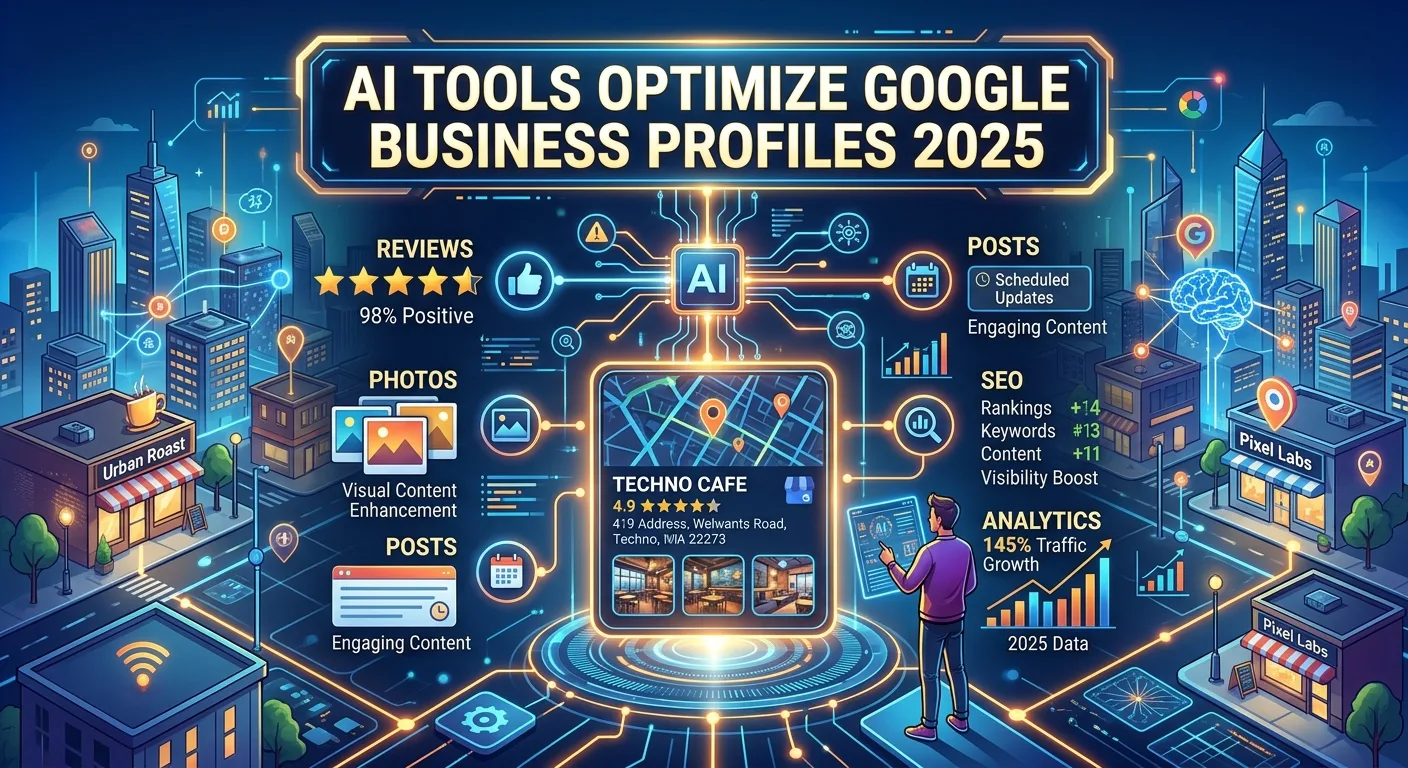
AI tools are changing how local businesses manage and optimize their Google Business Profiles. In 2025, businesses can use artificial intelligence to speed up tasks such as profile content creation, review analysis, keyword research, customer response management, competitor research, and local SEO monitoring. I
nstead of handling every task manually, marketers can use AI to improve productivity, efficiency, creativity, automation, and decision-making. For example, an AI tool can analyze customer reviews, identify recurring topics, suggest useful service descriptions, and help create consistent responses. It can also organize local search data and highlight areas that may need attention. However, AI works best as an assistant rather than a replacement for accurate business information and genuine customer engagement. The goal is to create a complete, useful, trustworthy profile that helps both searchers and local businesses.
What Are AI Tools for Optimizing Google Business Profiles in 2025?
AI tools for optimizing Google Business Profiles are software solutions that use artificial intelligence to help businesses improve their local search presence. They can assist with profile content, review management, keyword research, competitor analysis, reporting, and other local SEO activities.
A Google Business Profile gives customers important information about a local business, such as its name, category, location, hours, services, photos, website, reviews, and contact details. Keeping this information accurate is essential because customers often use local search results to decide which business to contact.
AI can make profile management more efficient by analyzing information and suggesting improvements. For example, a local restaurant might use AI to identify frequently mentioned menu items in customer reviews and use those insights to improve its service descriptions and content strategy.
However, AI should not be used to invent business information. Accuracy and authenticity should always come before automation. Businesses should verify every important detail before publishing AI-generated content.
How AI Helps Optimize a Google Business Profile
AI optimization usually begins with data collection. The tool may analyze the business profile, website, customer reviews, local search terms, competitors, and other available information.
The system can then identify potential opportunities. It might detect incomplete information, inconsistent descriptions, frequently mentioned services, unanswered reviews, or content topics that deserve attention.
For example, suppose a plumbing company receives many reviews mentioning emergency plumbing, water heater repairs, and leak detection. An AI system can identify these recurring themes and suggest content ideas based on genuine services the company already provides.
AI can also help automate repetitive tasks. A business owner may use it to draft review responses, create post ideas, summarize review sentiment, or organize local SEO reports.
A useful workflow is:
Collect data → analyze local search signals → identify opportunities → create recommendations → review manually → publish accurate information → monitor results.
This approach keeps AI involved while maintaining human oversight.
Key AI Features for Google Business Profile Optimization
Different AI local SEO platforms provide different capabilities, but several features are particularly useful for Google Business Profile management.
AI content generation can help businesses create drafts for Google Business Profile posts, service descriptions, promotional updates, and customer responses.
Review sentiment analysis can identify common positive and negative themes across customer feedback. Instead of reading hundreds of reviews manually, a business owner can quickly understand what customers appreciate and what problems appear repeatedly.
Keyword and topic analysis can help identify phrases associated with the business’s services and local search intent. These insights can guide profile content without forcing unnatural keyword repetition.
Competitor analysis can help businesses compare visible profile information, review activity, categories, services, and content patterns with other local businesses.
Other useful features may include:
- Local rank tracking
- Review monitoring
- AI-generated response drafts
- Profile audits
- Competitor monitoring
- Local keyword research
- Reporting dashboards
- Content suggestions
- Citation monitoring
- Automated alerts
The most valuable feature depends on the business’s specific local SEO needs.
Benefits of Using AI for Google Business Profile SEO
One of the biggest advantages of AI is time savings. Business owners can automate repetitive research and content tasks that might otherwise consume hours every week.
AI can also improve consistency. A business with multiple locations may struggle to monitor every profile manually. AI-powered systems can help organize information and identify areas that require attention.
Another benefit is faster review management. Customer reviews are important for understanding customer experiences, and timely responses can help businesses maintain active communication with customers.
AI can also turn large amounts of customer feedback into useful insights. For example, a hotel could discover that guests repeatedly praise its location but complain about parking. Management can use this information to improve customer communication and operations.
AI can support better decision-making, but businesses should focus on real customer needs rather than trying to manipulate rankings.
Google Business Profile AI Use Cases for Local Businesses
AI optimization can benefit many types of local businesses. Restaurants can analyze reviews, create post ideas, monitor competitors, and organize information about popular services or menu items.
Dental clinics can use AI to analyze questions and feedback related to appointments, treatments, and patient experiences. Home service companies can use AI to identify commonly requested services and improve local content.
Retail stores can use AI to monitor customer feedback, identify frequently discussed products, and maintain accurate business information.
Professional services such as law firms, accounting firms, marketing agencies, and real estate businesses can also use AI for local content research and review management.
Multi-location businesses may benefit even more because managing dozens or hundreds of profiles creates significant administrative work.
The important principle is simple: AI should support genuine local relevance. Businesses should only promote services, locations, offers, and attributes that accurately represent what they provide.
AI Review Management and Customer Response Optimization
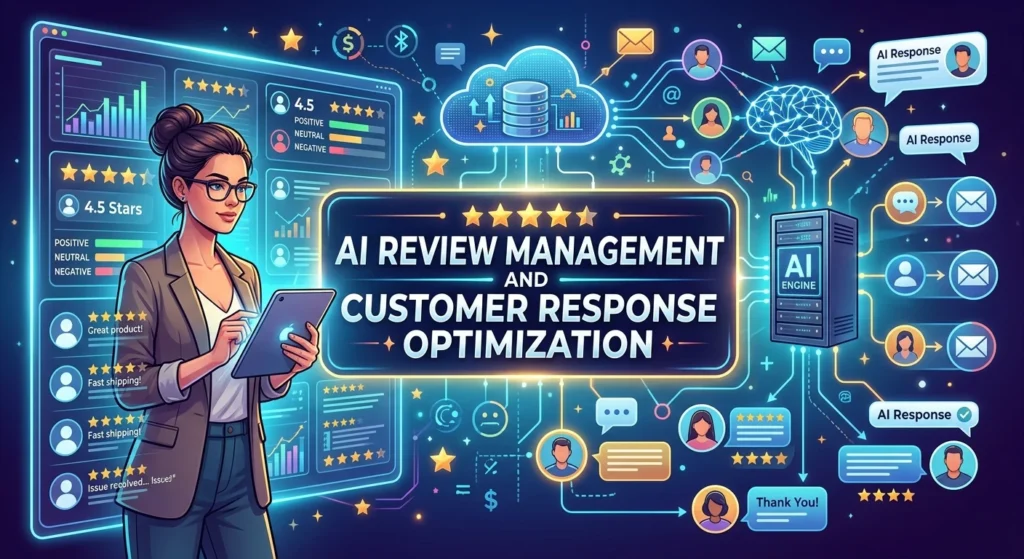
Customer reviews provide valuable information about how people experience a business. AI can help organize this information by analyzing sentiment and identifying recurring subjects.
For example, a restaurant might receive hundreds of reviews. AI can categorize feedback into topics such as food quality, service, cleanliness, atmosphere, pricing, and wait times.
This makes it easier for management to recognize patterns. If many customers mention slow service, the problem may require operational attention rather than simply better review responses.
AI can also generate draft responses to reviews. These drafts should be checked before publication because customer communication should sound genuine and appropriate to the specific situation.
For negative reviews, businesses should avoid argumentative or aggressive responses. A professional response can acknowledge the customer’s concern, provide appropriate clarification, and invite further discussion when necessary.
For positive reviews, responses can express appreciation without repeating the same generic sentence for every customer.
AI can accelerate review management, but authentic human oversight keeps the communication credible.
AI Keyword Research and Local Search Optimization
Local keyword research helps businesses understand how customers describe their services when searching online. AI can analyze related terms, questions, service categories, and search intent to generate useful topic ideas.
For example, a flooring company might discover related search concepts such as hardwood floor installation, vinyl flooring, laminate installation, floor repair, and flooring contractors in its service area.
These terms can inform website content, service pages, profile descriptions, and customer-focused educational content. However, businesses should avoid stuffing keywords into their Google Business Profile.
Natural language is more useful than awkward repetition. A profile should explain what the business does clearly and accurately.
AI can also help identify semantic relationships between services and customer questions. Instead of targeting only one exact phrase, a business can create useful content around related topics.
The objective is not to trick search engines. It is to help search engines and customers understand the business, its services, and its local relevance.
AI Competitor Analysis for Google Business Profiles
Competitor research can help businesses understand the local market. AI tools can organize information about competing businesses and identify patterns that may be difficult to notice manually.
A business might compare categories, service descriptions, review volume, customer feedback themes, photos, posting activity, and other publicly visible information.
For example, a local fitness center may discover that competing gyms receive frequent reviews mentioning personal training, flexible schedules, and beginner-friendly programs. Those insights can help the business understand customer expectations.
Competitor analysis should not become imitation. Copying another business’s content, branding, or claims can create quality and trust problems.
Instead, use AI to identify market gaps and customer needs. If competitors rarely explain a specific service clearly, creating genuinely helpful information about that service could provide value.
The strongest competitive advantage comes from better customer experience, accurate information, useful content, and genuine differentiation.
Free vs Paid AI Tools for Google Business Profile Optimization
Businesses can begin with free or low-cost AI tools. General AI assistants can help with brainstorming, review-response drafts, content ideas, keyword organization, and basic analysis.
Free tools may be enough for a small local business with one location and a manageable number of reviews. A simple workflow can combine a spreadsheet, Google Business Profile, analytics, and an AI writing assistant.
Paid local SEO platforms generally provide more specialized features. These may include automated profile monitoring, rank tracking, review management, competitor analysis, multi-location management, scheduled reporting, and workflow automation.
Pricing models vary. Some tools charge per location, user, feature, keyword, or month. Enterprise platforms may use customized pricing.
Before paying for software, identify the specific problem you want to solve. Do not pay for dozens of features that your business will never use.
A practical approach is to start with one measurable goal, such as reducing review-management time or improving local reporting.
Integrations With Local SEO, CRM, and Marketing Platforms
AI becomes more useful when it connects with other business systems. Integrations can reduce repetitive data entry and create a more organized local marketing workflow.
A local business may connect its profile-management system with CRM software, review platforms, analytics tools, scheduling systems, customer support software, or marketing automation platforms.
For example, customer feedback can move into a central system where AI analyzes recurring issues. Marketing teams can then use those insights when creating content or improving customer communication.
Multi-location businesses should pay particular attention to integrations because manually updating large numbers of profiles can become difficult.
Businesses should also review security and access controls before connecting customer information. Not every employee needs access to every system.
A good integration strategy should make work simpler, more accurate, and easier to monitor rather than creating another complicated layer of software.
AI Tools Compared With Manual Google Business Profile Optimization
Manual optimization still has an important role. Business owners understand their services, customers, locations, and operational details better than a generic AI system.
Manual work is especially important when verifying business information. Address details, operating hours, service areas, contact information, and business attributes should come from reliable sources.
AI provides advantages in scale and speed. It can analyze large amounts of text, identify patterns, generate drafts, and organize data much faster than manual processes.
For example, a business owner could manually read 500 reviews and create a summary. An AI system can potentially summarize the major themes much faster, allowing the owner to focus on the issues that need action.
The best approach is often AI-assisted local SEO.
AI handles repetitive analysis and drafting. Humans verify facts, make strategic decisions, communicate authentically, and ensure that published information represents the actual business.
Pros, Cons, and Limitations of AI Google Business Profile Tools
AI tools can provide significant benefits, but they also have limitations.
Advantages include:
- Faster local SEO research
- Automated review analysis
- Faster content creation
- Better organization
- Competitor monitoring
- Scalable profile management
- Reduced repetitive work
- Easier reporting
- More consistent workflows
One limitation is inaccurate AI output. AI can generate incorrect claims if it lacks reliable business information.
Another issue is generic content. If every local business uses similar AI-generated posts and responses, the content may become repetitive and less useful to customers.
There is also a risk of excessive automation. Publishing large amounts of low-value content does not automatically create a stronger local presence.
Businesses should also avoid relying on AI to guarantee rankings. No legitimate AI tool can guarantee a specific Google local ranking position.
AI should therefore support a broader local SEO strategy rather than become the entire strategy.
Common Mistakes When Using AI for Google Business Profiles
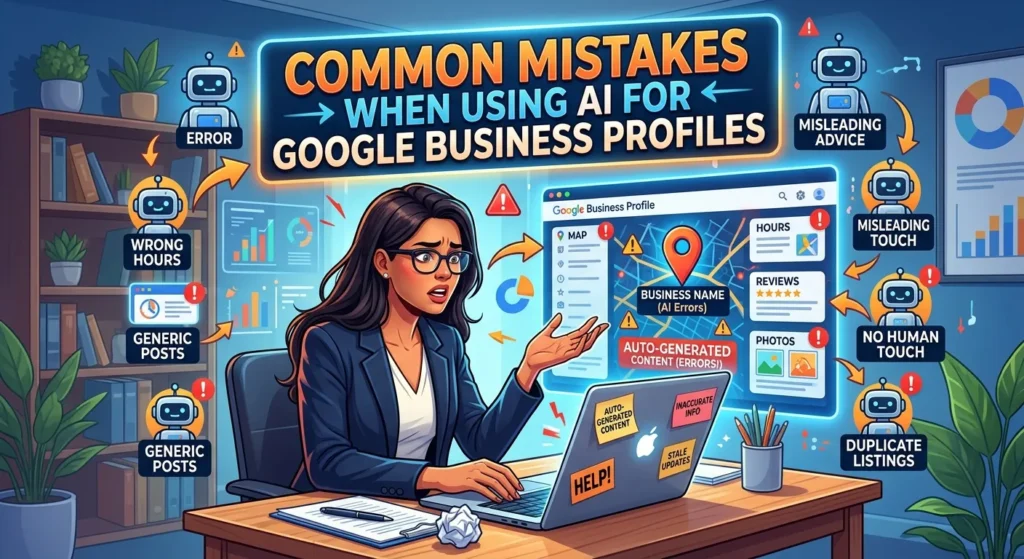
One common mistake is allowing AI to publish content without human review. This can result in inaccurate service claims, incorrect hours, outdated information, or unnatural customer responses.
Another mistake is keyword stuffing. Adding the same location and service keyword repeatedly can make profile content difficult to read.
Businesses may also generate fake or exaggerated reviews. This is a serious trust problem. Customer reviews should reflect genuine customer experiences.
Another common mistake is ignoring negative feedback. AI can identify complaints, but businesses must address the underlying operational problems when possible.
Some companies also focus entirely on competitors instead of customers. Competitor research is useful, but the goal should be to understand the market and improve the customer experience.
A better strategy is to verify facts, write naturally, monitor customer feedback, and use AI to improve real business processes.
Latest Trends in AI Local SEO and Google Business Profile Optimization
AI-powered local SEO is becoming more focused on data interpretation and workflow automation rather than simple content generation.
Generative AI can help businesses summarize reviews, create customer response drafts, identify content opportunities, and organize local SEO information.
AI search is also changing how people discover businesses. Customers may increasingly ask conversational questions rather than entering short keyword phrases.
This makes clear business information more important. Businesses should provide accurate services, location details, operating information, customer-focused answers, and trustworthy website content.
Another trend is predictive local marketing. AI can analyze historical performance and customer behavior to help businesses identify which content, services, or campaigns deserve attention.
Multi-location businesses are also likely to increase their use of centralized AI management systems.
Looking beyond 2025, AI tools are likely to become more integrated with local search analytics, reputation management, customer experience platforms, and conversational search.
Best Practices for Choosing and Using AI Tools for Google Business Profiles
Start by defining your goal. Do you need better review management, local keyword research, competitor analysis, reporting, or multi-location automation?
Choose a tool based on that specific requirement. A small business with one location may not need an expensive enterprise platform.
Always check whether the software provides meaningful data rather than simply generating large amounts of AI content.
Test AI-generated responses and content before publishing them. Make sure the wording sounds natural and reflects your brand.
Track useful performance indicators over time. These may include customer actions, calls, website visits, direction requests, bookings, review trends, and other meaningful business outcomes.
Do not judge success only by the number of AI-generated posts or keywords.
The best AI strategy combines accurate business information, helpful content, genuine reviews, strong customer service, local relevance, and continuous measurement.
FAQs About AI Tools to Optimize Google Business Profiles
What are AI tools for Google Business Profile optimization?
They are software tools that use artificial intelligence to help businesses manage local SEO tasks such as review analysis, content creation, keyword research, competitor monitoring, profile audits, and reporting.
Can AI improve Google Business Profile rankings?
AI can help businesses organize and improve their local SEO processes, but no tool can guarantee a specific Google ranking. Local visibility depends on many factors and should be approached through accurate information, relevance, customer experience, and other legitimate SEO practices.
Can AI write Google Business Profile posts?
Yes. AI can generate draft posts based on information provided by the business. The content should be reviewed to ensure that all claims, services, offers, and details are accurate.
Can AI respond to Google reviews?
AI can create response drafts and help analyze review sentiment. Businesses should review responses before publishing them so that communication remains accurate, personal, and appropriate.
Are free AI tools available for Google Business Profile SEO?
Yes. Businesses can combine general AI tools with free or limited local SEO resources for tasks such as brainstorming, content drafting, review analysis, and keyword organization.
Can AI manage multiple Google Business Profiles?
Some specialized platforms support multi-location management and automation. Businesses should check the specific platform’s features, permissions, integrations, and pricing before choosing a solution.
How does AI help with local keyword research?
AI can analyze related search phrases, customer questions, service terminology, and search intent. These insights can help businesses create clearer and more relevant local content.
Should businesses automate all Google Business Profile tasks?
No. Automation can save time, but important information and customer communication should receive human review. Businesses should prioritize accuracy and authenticity.
Can AI create fake Google reviews?
AI can technically generate text, but businesses should not use AI to fabricate customer experiences. Reviews should represent genuine interactions and real customer feedback.
What is the best AI tool for Google Business Profile optimization?
There is no single tool that is best for every business. The appropriate choice depends on factors such as business size, number of locations, review volume, reporting needs, integrations, and budget.
How often should a Google Business Profile be optimized?
Businesses should monitor their profile regularly and update information whenever services, hours, contact details, photos, or other important details change. Ongoing review monitoring is also useful.
Conclusion
AI tools for optimizing Google Business Profiles can make local SEO faster, more organized, and more data-driven. They can help businesses analyze reviews, research local topics, create content drafts, monitor competitors, manage multiple locations, and identify opportunities for improvement.
However, successful Google Business Profile optimization is not simply about generating more AI content. Accuracy, customer experience, genuine reviews, useful information, and local relevance remain essential.
The most effective approach is to use AI as a productivity assistant. Let it handle repetitive analysis and drafting while people verify information, make strategic decisions, and maintain authentic customer relationships.
As AI search and local discovery continue to develop beyond 2025, businesses that combine AI efficiency with trustworthy information and real customer value will be better positioned to build a strong and sustainable local search presence.