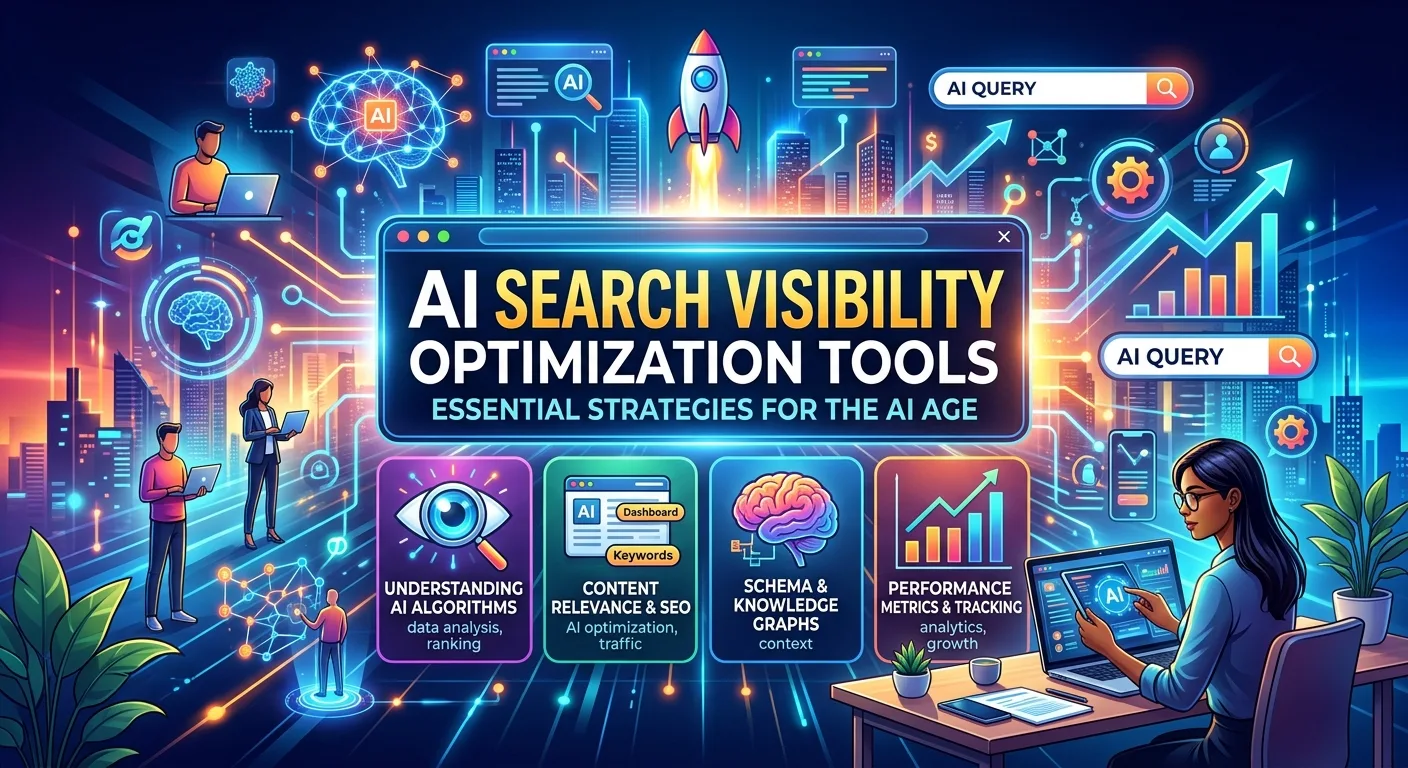
Search is changing quickly. People now discover information through traditional search engines, AI Overviews, conversational assistants, answer engines, and other AI-powered experiences. This shift makes ai search visibility optimization tools increasingly important for businesses that want their content, products, and brands to appear where modern users ask questions.
These tools help marketers monitor how AI systems understand and mention their content. They can track brand visibility, analyze citations, identify content gaps, compare competitors, and uncover opportunities to improve digital presence. Instead of relying only on traditional rankings, businesses can study their brand appears across emerging search experiences.
The best approach combines SEO, content quality, technical optimization, automation, analytics, and human expertise. When used correctly, AI visibility tools can improve productivity, support smarter decisions, and reveal opportunities that conventional rank tracking may miss.
What Are AI Search Visibility Optimization Tools?
AI search visibility optimization tools are software platforms designed to help businesses understand and improve how their websites, brands, products, or content appear in AI-powered search experiences. These experiences can include AI-generated answers, conversational search systems, AI summaries, and answer engines.
Traditional SEO tools mainly focus on keywords, backlinks, organic rankings, technical issues, and website traffic. AI visibility platforms add another layer by examining whether AI systems recognize a brand and whether those systems mention or cite relevant content when answering user questions.
For example, a company selling project-management software might traditionally track its ranking for “best project management software.” An AI visibility platform may instead test questions such as “What are the best project management tools for small teams?” and analyze which brands appear in the generated answers.
This creates a broader view of search performance. Ranking on a search results page is no longer the only visibility signal. Brand mentions, citations, source selection, contextual relevance, and presence across AI answers can also matter.
How AI Search Visibility Optimization Works
AI search visibility platforms typically begin by creating a collection of relevant search prompts. These prompts represent the questions potential customers might ask AI-powered search systems.
The tool then monitors responses and identifies whether the target brand or website appears. Depending on the platform, it may record brand mentions, citations, linked sources, competitors, sentiment, topics, and response patterns.
A simplified workflow looks like this:
Search prompts → AI responses → brand detection → citation analysis → competitor comparison → content recommendations → optimization → monitoring
The process can run repeatedly so marketers can identify changes over time. This matters because AI-generated responses can change as models, sources, indexes, and user queries evolve.
For example, suppose an online education company wants visibility for “best AI courses for beginners.” Its tool can monitor related prompts and determine whether the company appears in AI-generated recommendations. If competitors consistently receive citations while the company does not, the marketing team can investigate why.
The goal is not simply to force an AI system to mention a brand. Instead, marketers should improve the quality, relevance, authority, structure, and accessibility of information that AI systems can discover and understand.
Key Features to Look for in AI Search Visibility Software
Different platforms offer different capabilities, so businesses should examine the actual features before choosing a tool. A useful platform should provide more than a simple list of brand mentions.
One important feature is AI prompt monitoring. This allows marketers to track questions related to their products, services, industries, and topics. Strong tools let users organize prompts into categories so they can identify patterns rather than examine isolated results.
Another valuable feature is citation and source tracking. It can show which websites appear as sources in AI answers. This information helps marketers understand which types of pages and publications AI systems use when forming responses.
Competitor monitoring is also useful. A tool can reveal when competing brands appear in prompts where your brand does not. This does not automatically explain the reason, but it gives marketers a starting point for deeper research.
Other useful capabilities may include:
- Brand mention tracking
- Citation monitoring
- Competitor visibility analysis
- Prompt clustering
- AI response history
- Sentiment analysis
- Share-of-voice measurement
- Content gap identification
- Domain and URL tracking
- Reporting and dashboards
- API access
- Automated alerts
- Integration with analytics platforms
The most useful feature set depends on your business goals. A small website may need simple monitoring, while an enterprise marketing team may require large-scale prompt tracking and integrations.
Benefits of Using AI Search Visibility Optimization Tools
One major benefit is better visibility into a new layer of search behavior. Traditional analytics may show organic traffic and keyword rankings, but they do not necessarily explain how AI systems describe a brand.
AI visibility tools can help marketers identify whether their content appears in answers related to important topics. This creates opportunities to improve content before visibility problems become difficult to detect.
Another benefit is improved productivity. Instead of manually testing hundreds of questions across different AI search experiences, marketers can use automation to organize and monitor large collections of prompts.
These tools can also support competitive research. If competitors repeatedly appear in AI-generated recommendations, marketers can examine the sources behind those recommendations. They can then study content quality, topical coverage, authority signals, and other observable factors.
The technology can also support content strategy. Suppose a company discovers that AI systems frequently cite detailed comparison articles but rarely cite short promotional pages. That observation can influence future content planning.
However, AI visibility data should support human decision-making rather than replace it. A tool can identify patterns, but marketers still need to verify sources, understand their audience, and decide which recommendations make sense.
AI Search Visibility Use Cases for SEO and Content Teams
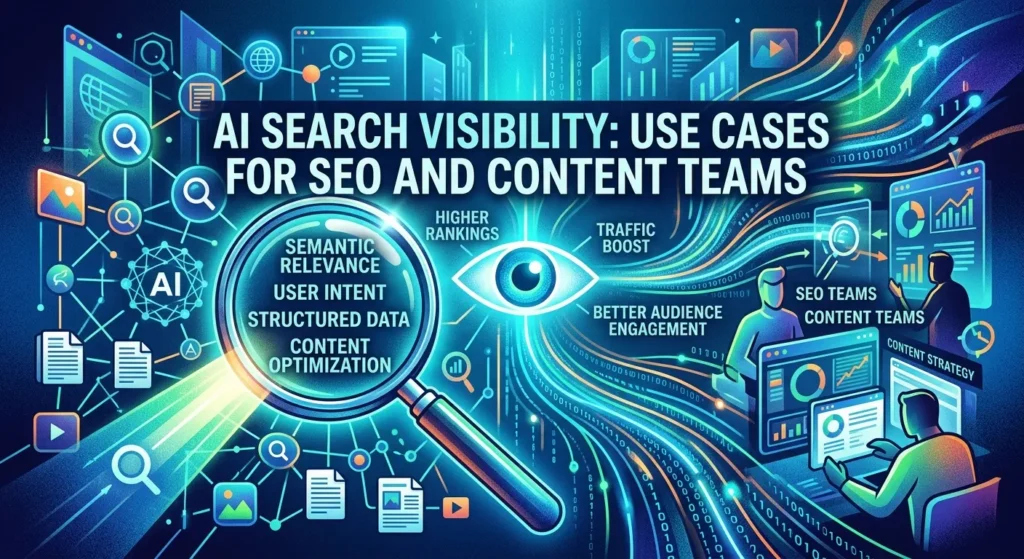
Content teams can use AI visibility platforms to discover which questions matter most to their audience. Instead of creating content only around traditional keyword volumes, they can examine broader conversational questions.
For example, a cybersecurity company could monitor prompts such as “How can a small business protect customer data?” or “What cybersecurity tools should a startup use?” The results may reveal topics that deserve detailed guides, FAQs, comparison pages, or educational resources.
SEO teams can also use these tools to investigate citation opportunities. If AI answers frequently reference particular types of websites, the team can study those sources and determine whether its own content provides comparable value.
Public relations teams may use AI visibility monitoring to understand how their company is represented in broader industry discussions. Product teams can monitor how AI systems describe product features and competitors.
E-commerce brands can track product-related questions, while local businesses can examine prompts involving services, locations, and customer needs.
Common use cases include:
- SEO strategy development
- Content planning
- Competitor research
- Brand monitoring
- Digital PR
- Product positioning
- E-commerce discovery
- Customer research
- Content gap analysis
- Executive reporting
- AI search experimentation
The strongest use cases connect visibility data with a specific business objective.
AI Search Visibility Metrics That Matter
Metrics help transform large amounts of AI search data into useful insights. However, marketers should avoid treating every metric as an official measure of success.
Brand mention rate measures how often a brand appears across monitored prompts. It can provide a useful directional signal about visibility.
Citation frequency measures how often a website or URL appears as a cited source. This can help content teams understand whether their pages are being used as supporting evidence.
Share of AI visibility can estimate how frequently a brand appears compared with competitors within a defined prompt set. The exact calculation varies by platform, so teams should understand the methodology before comparing results.
Another useful metric is prompt coverage. This measures how broadly a brand appears across different topic categories rather than focusing on one keyword.
Teams can also monitor:
- Citation domains
- Mention frequency
- Competitive visibility
- Prompt coverage
- Topic-level visibility
- URL-level citations
- Sentiment trends
- Visibility changes over time
- Content categories generating citations
The important point is context. A metric only becomes meaningful when the prompt set, time period, search environment, and measurement method remain consistent.
Free vs Paid AI Search Visibility Tools
Free tools can be useful for beginners, freelancers, small websites, and teams that want to experiment with AI search visibility. They may provide limited prompt checks, basic analysis, or manual research capabilities.
Paid platforms generally provide greater automation and scale. Depending on the product, they may support larger prompt libraries, historical tracking, competitor monitoring, reporting, team collaboration, integrations, and automated alerts.
A sensible starting point is to define the number of prompts you actually need to monitor. A website with 30 important questions may not require an expensive enterprise platform. A global company tracking thousands of prompts across markets may have very different requirements.
Before paying for a platform, check:
Prompt limits: How many questions can you monitor?
AI coverage: Which search experiences and models are included?
Historical data: Can you compare visibility over time?
Competitor tracking: Can you monitor competing brands?
Citation data: Does the platform show source URLs?
Export options: Can you download your data?
Integrations: Can you connect analytics, reporting, or workflow tools?
The right choice depends on scale, measurement needs, budget, and workflow complexity, not simply the number of features advertised.
Pricing Models and What Affects Cost
AI search visibility software can use different pricing structures. Some platforms charge according to the number of tracked prompts. Others may use projects, users, domains, locations, AI models, reporting features, or usage volume.
Entry-level plans may suit individuals and small marketing teams. Higher-tier plans can support larger organizations that need multiple projects, users, markets, and extensive historical data.
Pricing can also change as AI search monitoring becomes more sophisticated. A platform that monitors more AI environments or runs more frequent queries may have higher operating costs.
Before purchasing, calculate your actual requirements. For example, determine:
- Number of brands
- Number of domains
- Number of prompts
- Number of markets
- Number of competitors
- Required reporting frequency
- Number of users
- Required integrations
- Historical data requirements
Do not choose a platform solely because it has the highest number of features. Choose the system that produces actionable information your team can actually use.
Integrations With SEO, Analytics, and Marketing Platforms
Integrations can make AI visibility data more useful because they connect it with existing marketing information.
For example, combining AI visibility data with website analytics can help teams compare AI mentions with organic traffic trends. Connecting visibility monitoring with SEO workflows can make it easier to investigate pages that receive strong traditional rankings but weak AI visibility.
Some platforms may provide APIs or integrations with reporting systems. This can help agencies build client dashboards or automate recurring reports.
Useful integration categories include:
- SEO platforms
- Google Analytics
- Search performance tools
- Content management systems
- CRM platforms
- Business intelligence software
- Reporting dashboards
- Project management tools
- Marketing automation systems
Integration quality matters because disconnected data creates extra manual work. The best workflow turns raw visibility measurements into a repeatable optimization process.
How AI Visibility Tools Compare With Traditional Rank Tracking
Traditional rank tracking and AI visibility monitoring solve related but different problems.
Rank tracking usually measures where a webpage appears for a specific keyword in search results. AI visibility monitoring examines how brands, pages, and sources appear within AI-generated responses to conversational questions.
For example, a website might rank number three for a keyword but receive no mention in an AI-generated answer about the same topic. Another website might have modest traditional rankings while becoming frequently cited in AI responses.
This does not mean one measurement is automatically more important. Search behavior continues to include multiple discovery paths.
A modern SEO strategy can therefore combine:
Traditional SEO + technical SEO + content optimization + brand authority + AI visibility monitoring + analytics
Using both approaches gives teams a broader understanding of search performance.
Alternatives to Dedicated AI Visibility Platforms
A dedicated AI visibility platform is not the only way to research AI search performance. Smaller teams can start with manual testing and structured documentation.
For example, marketers can create a spreadsheet containing important customer questions. They can periodically test those questions in relevant AI search experiences and record brand mentions, competitors, and cited sources.
SEO research tools can also provide useful information about keywords, backlinks, content performance, and competitor strategies. Web analytics can reveal how users reach the website.
The limitation is scale. Manual research becomes difficult when hundreds or thousands of prompts need monitoring.
Alternatives include:
- Manual AI search testing
- Traditional rank trackers
- SEO content tools
- Website analytics
- Search performance platforms
- Competitive research tools
- Web crawling software
- Custom internal monitoring systems
A dedicated AI visibility platform becomes more valuable when monitoring frequency, prompt volume, historical analysis, and reporting requirements increase.
Best Practices for Improving AI Search Visibility
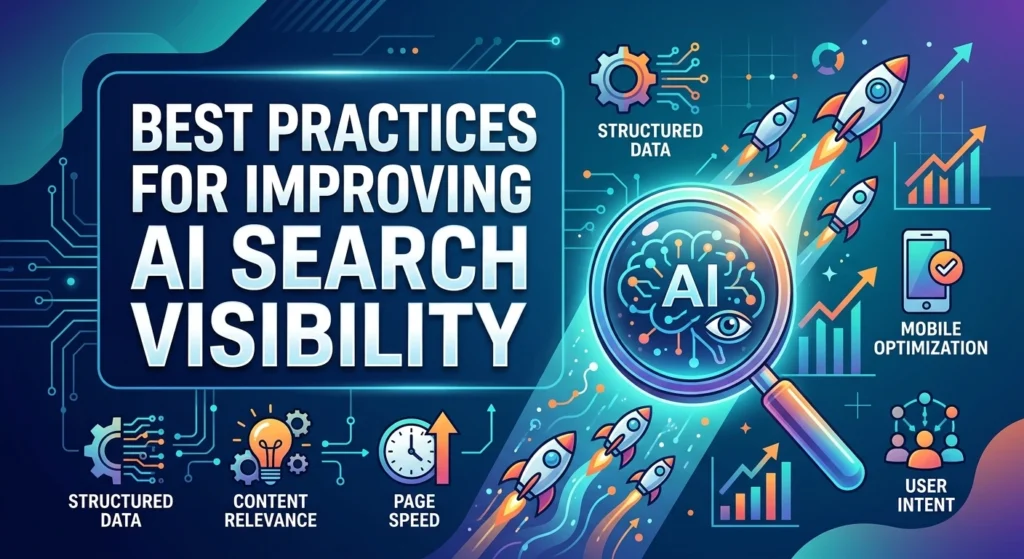
The foundation of AI search visibility remains high-quality information. Start by creating content that directly answers real user questions.
Use clear headings, concise explanations, relevant examples, original research, trustworthy references, and logical content structures. Make important information easy for both users and automated systems to understand.
Build topical depth instead of publishing dozens of shallow pages. A strong content ecosystem can include beginner guides, detailed tutorials, comparisons, FAQs, case studies, definitions, and supporting resources.
Maintain accurate business information across important digital properties. Consistent facts can help users and systems understand what your organization does.
Other practical recommendations include:
- Answer questions directly.
- Demonstrate first-hand expertise.
- Add original examples and research.
- Keep important pages updated.
- Strengthen internal linking.
- Improve technical accessibility.
- Use descriptive page titles.
- Structure content clearly.
- Support claims with reliable evidence.
- Monitor competitors without copying them.
- Track changes over time.
- Review AI-generated visibility data manually.
Most importantly, write for people first. Optimizing content purely around what an AI system might mention can create weak content that fails to satisfy real users.
Common Mistakes When Using AI Visibility Optimization Tools
One common mistake is treating AI visibility as a single universal ranking. AI systems can generate different answers depending on the query, context, model, sources, location, and time.
Another mistake is tracking too few prompts. A single question cannot represent an entire topic. Businesses should create a representative prompt set covering different stages of the customer journey.
Teams also sometimes focus entirely on brand mentions. A mention without useful context may not provide meaningful business value. Citation quality, relevance, accuracy, and user intent also deserve attention.
Other mistakes include:
- Assuming every AI response is stable
- Chasing individual mentions
- Ignoring traditional SEO
- Copying competitor content
- Publishing low-value AI-generated articles
- Ignoring technical SEO
- Using unclear measurement methods
- Comparing unrelated prompt sets
- Failing to verify AI-generated data
- Expecting instant results
A better approach is to treat AI visibility monitoring as an ongoing research and optimization process.
Latest AI Search Visibility Trends and Future Developments
AI search is moving toward more conversational, contextual, and task-oriented experiences. Users increasingly expect systems to synthesize information instead of simply displaying a list of links.
This creates new opportunities for businesses that produce authoritative, useful, well-structured information.
One important trend is multi-surface search visibility. Brands may need to understand how they appear across traditional search, AI summaries, conversational assistants, answer engines, and other discovery environments.
Another trend is greater emphasis on source quality. As AI systems become better at retrieving and synthesizing information, trustworthy sources, original research, recognizable expertise, and accurate documentation can become increasingly valuable.
AI visibility platforms may also become more sophisticated. Future tools could offer stronger prompt clustering, automated competitive insights, content recommendations, entity analysis, citation forecasting, and cross-platform reporting.
However, businesses should avoid assuming that today’s AI search behavior will remain unchanged. The technology is evolving quickly, so flexible measurement and continuous experimentation are more useful than rigid optimization formulas.
AI Search Visibility FAQs
What are AI search visibility optimization tools?
AI search visibility optimization tools monitor how brands, websites, products, and content appear in AI-powered search experiences. They can track mentions, citations, competitors, prompts, and visibility trends.
Why is AI search visibility important for SEO?
AI search visibility matters because users increasingly discover information through AI-generated answers as well as traditional search results. Monitoring both environments gives marketers a broader view of digital visibility.
Do AI visibility tools replace traditional SEO tools?
No. They address different measurements. Traditional SEO tools focus heavily on rankings, keywords, backlinks, technical performance, and organic search data, while AI visibility tools focus on AI-generated answers, mentions, citations, and related signals.
Are free AI search visibility tools available?
Some free or limited options exist, and businesses can also perform manual AI search research. Paid platforms generally provide greater automation, historical monitoring, prompt capacity, and reporting capabilities.
How can I improve my AI search visibility?
Create accurate, useful, original, well-structured content that directly answers user questions. Demonstrate expertise, maintain strong technical SEO, build topical depth, and monitor how your content appears across relevant search experiences.
What should an AI visibility tool track?
Useful measurements can include brand mentions, citations, source URLs, competitor visibility, prompt coverage, topic-level performance, and changes over time.
Can AI visibility tools guarantee higher rankings?
No. These tools can provide research and monitoring data, but they cannot guarantee rankings, citations, mentions, traffic, or visibility. Search and AI systems use complex and changing processes.
How often should businesses monitor AI search visibility?
The ideal frequency depends on the industry and business goals. Competitive or fast-changing industries may benefit from frequent monitoring, while smaller websites may use a less frequent schedule.
Is AI-generated content enough to improve AI visibility?
Not by itself. Content quality, originality, expertise, accuracy, usefulness, technical accessibility, and overall authority matter. Simply producing large amounts of AI-generated text does not guarantee visibility.
What is the difference between AI visibility and AI SEO?
AI visibility describes the measurement of how a brand or content appears in AI search experiences. AI SEO is the broader practice of improving content, technical signals, authority, and discoverability for search environments that include AI-generated results.
Conclusion
AI search visibility optimization tools are becoming an important part of modern search strategy. They help businesses move beyond traditional keyword rankings and investigate how brands, websites, and content appear in AI-powered discovery experiences.
The strongest strategy does not depend on one tool or one metric. Instead, it combines traditional SEO, high-quality content, technical accessibility, authoritative information, brand building, analytics, and AI visibility monitoring.
For beginners, the process can start simply: identify important customer questions, monitor relevant AI search experiences, record mentions and citations, study competitors, and improve the content that genuinely helps users.
As AI search continues to evolve, businesses that consistently measure visibility and improve the quality of their information will be better prepared for new discovery environments. The goal is not to manipulate AI answers. The goal is to create useful, trustworthy, discoverable information that deserves to be found and referenced.