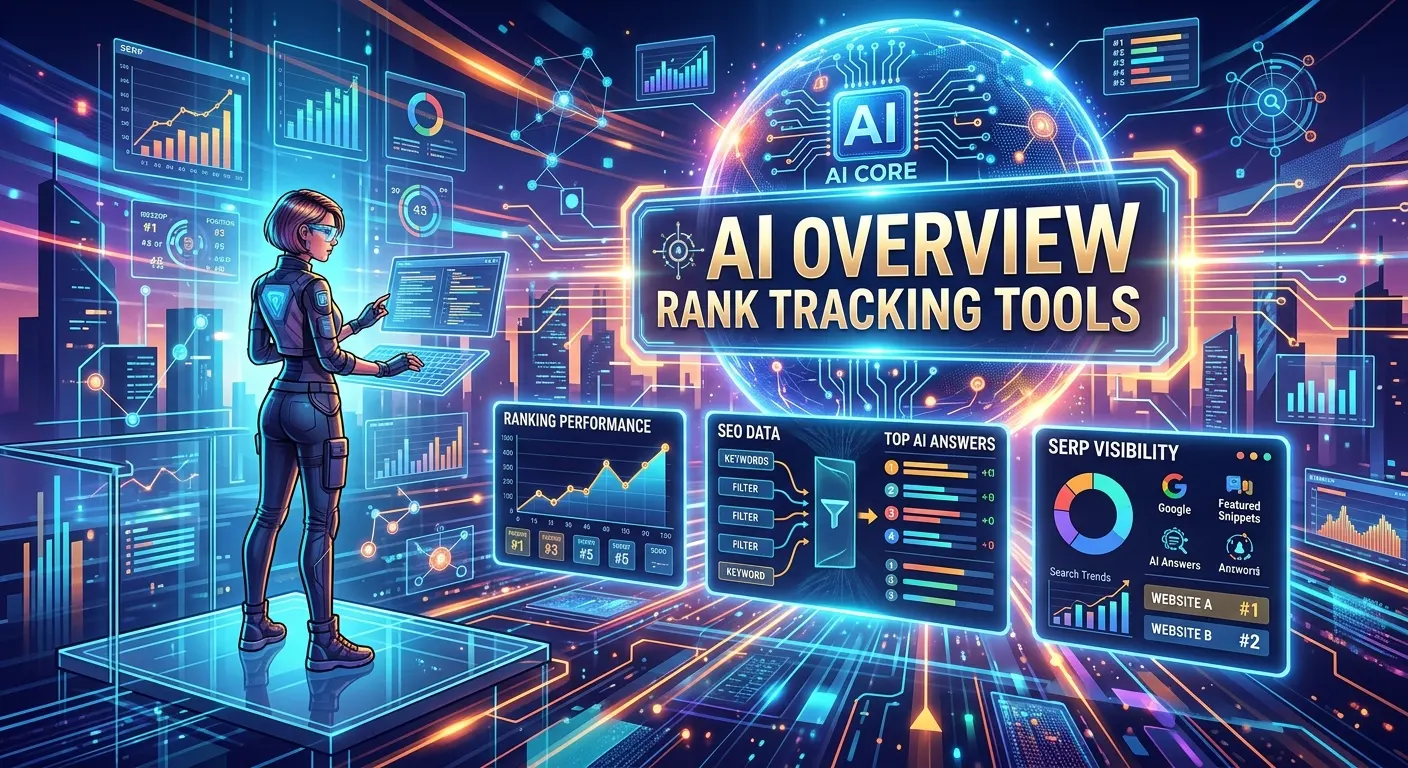
AI Overview rank tracking tools help SEO professionals understand how their content appears in Google’s AI-generated search experiences. Instead of focusing only on traditional blue-link rankings, these tools monitor AI Overviews, citations, mentions, URLs, queries, competitors, and visibility patterns. This gives marketers a broader view of search performance as users increasingly interact with AI-powered results.
The value goes beyond measurement. Good tracking can improve innovation, productivity, efficiency, creativity, and automation by showing which content earns visibility and where optimization opportunities exist. For example, a business can discover that its page ranks well organically but rarely appears as a cited source in AI answers. That insight can guide content improvements, entity coverage, internal linking, and authority-building efforts.
As AI search continues to evolve, tracking tools can help teams make decisions using real-world data rather than assumptions. They are becoming an important part of modern SEO workflows for businesses that want to understand visibility across traditional search and AI-driven discovery.
What Are AI Overview Rank Tracking Tools?
AI Overview rank tracking tools are SEO platforms or specialized monitoring systems designed to measure how websites, pages, brands, and competitors appear inside Google AI Overviews and related AI search experiences. Traditional rank trackers primarily monitor a webpage’s position in conventional search results. AI-focused tracking adds another layer by examining visibility within generated answers.
An AI Overview may summarize information from several sources and include links to supporting webpages. A website can therefore receive meaningful exposure even when its traditional ranking position does not tell the entire story. Tracking tools help identify these appearances and connect them with specific search queries.
A useful platform may monitor AI Overview presence, citation frequency, cited URLs, brand mentions, competitor visibility, query categories, and changes over time. These measurements help SEO teams understand how search behavior is changing.
For example, suppose an ecommerce website ranks fifth for a product-related query. Its page might not appear in the AI Overview, while a competitor ranking eighth could receive a citation. A traditional rank report would not fully explain this difference. AI visibility tracking can reveal it.
How AI Overview Rank Tracking Works
AI Overview tracking usually begins with a collection of target keywords. The tool periodically checks those queries and determines whether an AI-generated search result appears. If an AI Overview exists, the platform analyzes the available answer and associated sources.
Depending on the provider, the system may record whether a brand appears, which URL receives the citation, how often a domain is referenced, and which competitors appear alongside it. Some platforms also organize results by topic, location, device, or search intent.
The tracking process can be summarized simply:
Keyword collection → AI Overview detection → source identification → brand and competitor analysis → historical monitoring → optimization insights.
Search results can change frequently. An AI-generated answer may cite different websites at different times. This makes repeated monitoring more useful than a single manual search.
Automation is another major advantage. Instead of manually checking hundreds of searches, an SEO team can schedule monitoring and review changes through dashboards or reports.
Key Features to Look for in AI Overview Rank Tracking Software
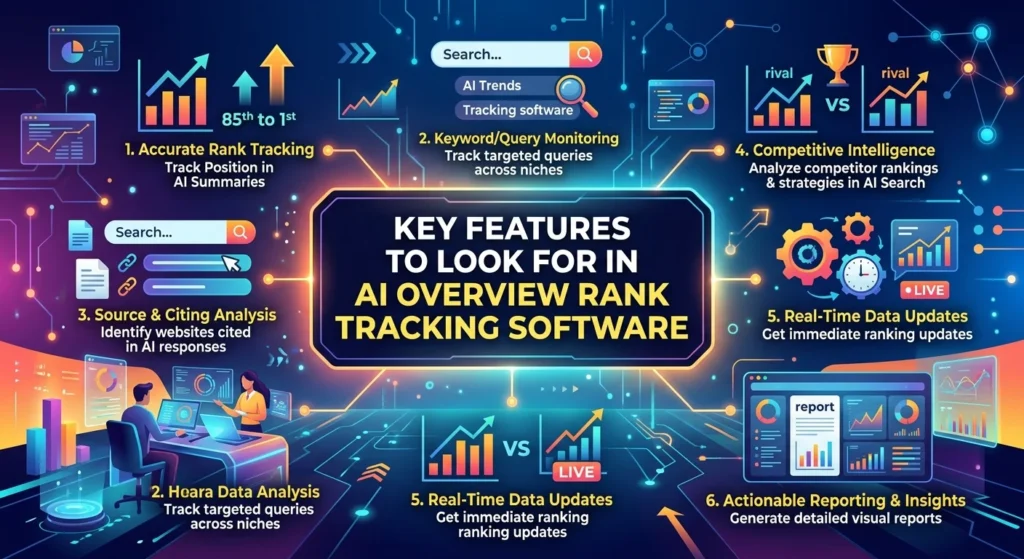
The most useful tools combine AI search monitoring with familiar SEO capabilities. Keyword tracking remains important because visibility needs to be connected to the searches that matter to a business.
Look for tools that monitor AI Overview presence, citations, linked pages, brand mentions, competitors, search volume, ranking changes, and historical trends. The ability to filter data by topic or search intent can make large datasets easier to understand.
Another valuable feature is citation-level analysis. Knowing that your brand appeared in an AI Overview is useful, but knowing exactly which page earned the citation is much more actionable. It allows content teams to study what makes a particular page suitable for AI-generated answers.
Reporting and export capabilities also matter. Agencies may need client reports, while internal teams may want dashboards connected to their existing SEO workflow.
Useful features include:
- AI Overview monitoring
- Keyword and query tracking
- Citation tracking
- Brand mention monitoring
- Competitor comparison
- Historical visibility data
- URL-level analysis
- Search intent filtering
- Automated reporting
- Data exports and integrations
Benefits of Tracking Google AI Overview Visibility
One of the biggest benefits is visibility beyond traditional rankings. Search is no longer limited to a list of ten blue links. AI-generated answers can influence which sources users notice and visit.
Tracking AI visibility can also reveal content opportunities. If competitors repeatedly receive citations for a particular topic, an SEO team can examine the underlying content structure, factual coverage, entities, and user intent.
Another benefit is improved decision-making. Rather than publishing content based solely on keyword rankings, teams can examine how their content performs across multiple search surfaces.
AI tracking can support several areas:
Content strategy: Identify topics where AI-generated results frequently cite external sources.
Competitive research: Discover which domains appear repeatedly for important queries.
SEO reporting: Add AI visibility metrics to traditional organic performance reports.
Content optimization: Identify pages that receive little AI visibility despite strong organic rankings.
Brand monitoring: Track how frequently a brand appears in AI-generated search experiences.
The practical benefit is simple: better visibility data can lead to better SEO decisions.
AI Overview Rank Tracking Use Cases for SEO Teams
SEO agencies can use AI Overview tracking to monitor visibility across multiple clients. Instead of manually checking searches, an agency can create keyword groups and monitor changes over time.
In-house marketing teams can use the same data to understand whether their content strategy produces AI search visibility. For example, a software company could monitor searches related to product categories, comparisons, integrations, and common customer questions.
Content writers can also benefit. If certain pages consistently earn citations, writers can study their structure and information coverage. This does not mean copying competitors. Instead, teams can identify useful patterns and create original content that satisfies the underlying search intent.
AI visibility tracking is especially useful for:
- SaaS companies
- Ecommerce websites
- Publishers
- Local businesses
- Affiliate websites
- SEO agencies
- Enterprise marketing teams
- Personal brands
- Content-driven businesses
The use case becomes stronger when the tool supports large keyword sets and historical comparisons.
AI Overview Tracking vs Traditional Rank Tracking
Traditional rank tracking answers a familiar question: Where does my webpage appear in conventional search results?
AI Overview tracking asks a different question: Does my website or content appear as a source within an AI-generated answer?
Both measurements can be valuable because they describe different parts of search visibility. A page might rank highly but receive limited AI citation visibility. Another page could have a lower conventional ranking while appearing as a cited source in an AI-generated result.
This means SEO teams should avoid treating AI visibility as a replacement for traditional rankings. Instead, consider it an additional measurement layer.
Traditional SEO metrics may include:
- Organic position
- Click-through rate
- Impressions
- Organic clicks
- Search visibility
- Traffic
AI search metrics may include:
- AI Overview presence
- Citation frequency
- Cited URLs
- Brand mentions
- Competitor citations
- AI visibility trends
Together, these measurements provide a broader understanding of modern search performance.
Free vs Paid AI Overview Rank Tracking Tools
Free tools can be useful for learning the basics of AI search visibility. They may allow manual checking, limited keyword monitoring, or basic search analysis. For a small website, this can provide an inexpensive starting point.
However, professional SEO campaigns often require larger keyword sets, historical data, automation, competitor monitoring, and reporting. These capabilities generally appear in paid plans or specialized platforms.
Before paying for a tool, consider how many keywords you need to track, how frequently results should be checked, how much historical data you need, and whether multiple users require access.
Do not choose software solely because it has the largest feature list. A simple tool that clearly answers your most important questions can be more useful than a complicated platform that produces large amounts of unused data.
A sensible approach is to start with a small keyword set. Test whether the tool’s data helps you make better decisions before expanding your subscription.
Pricing Factors for AI Overview Rank Tracking Platforms
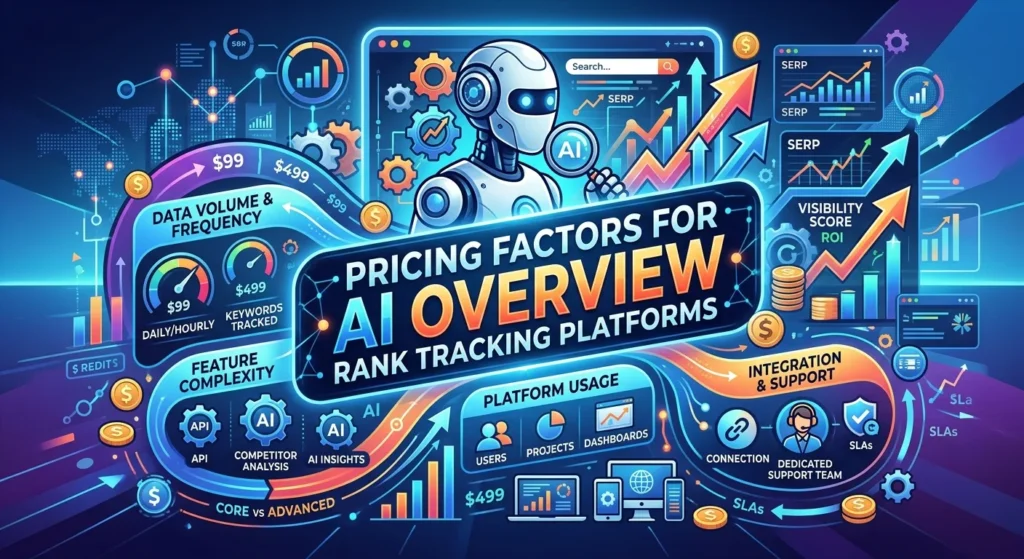
Pricing varies significantly between SEO platforms. Some providers package AI search tracking into broader SEO subscriptions, while others offer dedicated AI visibility products.
Important pricing factors can include keyword limits, tracking frequency, number of projects, users, locations, historical data, competitor monitoring, API access, reporting, and integrations.
A small website might need only a few hundred tracked queries. An agency managing many clients may require thousands or more. Therefore, the cheapest plan is not automatically the most suitable one.
When comparing pricing, calculate the cost per useful tracked query or project, rather than focusing only on the monthly subscription.
Also check whether AI Overview tracking comes with the standard subscription or requires an additional feature or higher-tier plan. Product packaging can change, so verify current pricing directly with each provider before purchasing.
Integrations and Reporting for AI Search Monitoring
Integrations can turn AI visibility data into a more useful workflow. SEO teams may want to connect tracking information with analytics platforms, reporting systems, spreadsheets, APIs, or existing SEO software.
For agencies, automated reports can save significant time. Instead of manually collecting screenshots and search results, teams can create recurring reports showing changes in AI visibility and traditional organic performance.
Useful integrations may include:
Analytics platforms: Help connect visibility changes with traffic and engagement.
SEO platforms: Combine AI visibility with keyword rankings, backlinks, and technical SEO data.
APIs: Allow companies to move tracking data into custom dashboards.
Reporting tools: Make it easier to share results with clients and stakeholders.
The most valuable integration is the one that reduces repetitive work and helps users connect AI visibility with measurable business goals.
AI Overview Rank Tracking Alternatives and Complementary Tools
No single tool necessarily covers every aspect of AI search optimization. Some platforms specialize in rank tracking, while others focus on AI visibility, brand mentions, content optimization, technical SEO, or competitive research.
A broader SEO stack may include traditional rank tracking, website analytics, crawling software, backlink analysis, content optimization, and AI search monitoring.
Manual search checks can also remain useful. Automated data shows patterns at scale, while human review can provide context. For important commercial queries, inspect the actual search experience to understand the wording, cited sources, answer format, and user intent.
A strong workflow therefore combines:
Automated monitoring + traditional SEO data + content analysis + human review.
This approach reduces dependence on any single metric.
How to Choose the Right AI Overview Rank Tracking Tool
Start by defining the business question. Do you want to monitor brand visibility, track citations, analyze competitors, measure content performance, or monitor a large keyword portfolio?
Next, evaluate data quality. A dashboard may look impressive, but the underlying data matters more. Test several important queries and check whether the platform captures the search experience you actually care about.
Consider usability too. A tool should help you understand what changed and why it matters, not simply display more numbers.
Before selecting a platform, check:
- Keyword limits
- AI Overview coverage
- Tracking frequency
- Geographic support
- Competitor monitoring
- Citation-level details
- Historical data
- Reporting features
- API availability
- Integrations
- Customer support
- Pricing and upgrade rules
A short trial can help reveal whether the platform fits your actual workflow.
Common Mistakes When Tracking AI Overview Rankings
One common mistake is treating AI visibility as a traditional ranking position. AI-generated results do not always behave like conventional ten-result search pages. A citation may appear in a generated answer without having a simple fixed “rank.”
Another mistake is tracking too many irrelevant keywords. Large datasets can create impressive dashboards while providing little useful information. Focus first on queries connected to real customers, products, services, problems, and business goals.
Teams may also make the mistake of checking results once and assuming the data will remain stable. AI search results can change. Historical monitoring provides a stronger picture than isolated observations.
Avoid optimizing only for AI visibility as well. Traditional organic traffic, conversions, technical health, user experience, and content quality still matter.
Finally, do not assume that appearing in an AI Overview automatically guarantees traffic or revenue. Visibility is an important signal, but business outcomes require broader measurement.
AI Overview SEO Trends to Watch in 2026
AI search is moving toward more conversational and context-aware experiences. Users increasingly ask complete questions rather than entering short keyword phrases. This makes search intent, topical depth, entity relationships, and clear information architecture increasingly important.
Another important trend is the growing need to monitor multiple search surfaces. Brands may need to understand visibility across traditional search, AI-generated answers, conversational search products, and other emerging discovery systems.
Content teams are also becoming more focused on information quality. AI systems need reliable sources to generate useful answers, which makes factual accuracy, original research, expert input, clear authorship, and strong source signals valuable parts of modern content strategy.
For SEO professionals, the trend is shifting from “What position do I rank at?” toward broader questions such as:
“Where is my brand visible?”
“Which pages are being cited?”
“What topics does AI associate with my brand?”
“Which competitors are being surfaced?”
These questions can produce more useful strategic insights.
Best Practices for Improving AI Overview Visibility
Start with content that directly answers the user’s question. Use clear headings, concise explanations, relevant entities, supporting evidence, and helpful examples.
Build topical depth rather than repeatedly publishing similar pages. A strong content ecosystem can cover a subject from beginner questions through advanced problems, comparisons, use cases, and practical implementation.
Make important information easy to understand. AI systems and human readers both benefit from clear language, logical structure, factual accuracy, and direct answers.
You can also strengthen internal linking. Connect related pages so search engines can better understand relationships between topics.
Other practical steps include:
- Keep important information current.
- Answer common questions directly.
- Add original insights where possible.
- Demonstrate relevant expertise.
- Improve page structure.
- Use descriptive headings.
- Avoid unnecessary keyword repetition.
- Strengthen internal links.
- Monitor competitors without copying them.
- Track AI visibility over time.
Most importantly, create content for people first. AI search optimization should support usefulness rather than replace it.
The Future of AI Overview Rank Tracking Tools
AI Overview rank tracking is likely to become more sophisticated as search experiences evolve. Future platforms may provide deeper analysis of citations, source selection, brand associations, query intent, answer context, and visibility across multiple AI search environments.
Automation will also become more important. Instead of simply reporting that visibility changed, advanced systems may help identify the pages, queries, competitors, and content characteristics associated with that change.
Another likely development is greater integration between traditional SEO and AI visibility platforms. Rather than maintaining separate dashboards, marketers may increasingly use unified systems that connect rankings, traffic, citations, mentions, technical health, and content performance.
The central measurement will continue to evolve. SEO teams will need to look beyond a single ranking number and understand the complete search journey.
For businesses, the long-term goal should remain practical: create valuable content, build trusted topical authority, monitor how search systems discover that content, and improve based on evidence.
Frequently Asked Questions About AI Overview Rank Tracking Tools
What are AI Overview rank tracking tools?
They are tools that monitor how websites, brands, and webpages appear in AI-generated search experiences such as Google AI Overviews. Depending on the platform, they can track citations, mentions, queries, competitors, and historical visibility.
Why should SEO professionals track AI Overviews?
AI-generated answers can change how users discover information. Tracking them provides additional visibility data that traditional keyword rankings may not capture.
Are AI Overview rankings the same as traditional Google rankings?
No. Traditional rankings measure webpage positions in conventional search results. AI Overview monitoring generally focuses on whether and how a source appears within an AI-generated answer.
Can free tools track AI Overviews?
Some free or limited tools can provide basic monitoring. Professional platforms usually offer broader keyword tracking, automation, historical data, reporting, and competitive analysis.
How often should AI Overview visibility be tracked?
The ideal frequency depends on the importance and volatility of the queries. High-priority commercial keywords may benefit from more frequent monitoring, while less important informational queries can be checked less often.
Can AI Overview tracking improve SEO performance?
Tracking itself does not improve rankings. However, the insights can help teams identify citation opportunities, content gaps, competitor patterns, and changes in search visibility.
What should I track besides AI Overview visibility?
Track traditional rankings, organic impressions, clicks, traffic, conversions, content performance, technical SEO, and relevant business outcomes. AI visibility works best as part of a broader measurement system.
Do AI Overview tracking tools replace rank trackers?
Usually, they complement traditional rank trackers. Conventional rankings and AI visibility measure different aspects of search performance, so many SEO teams benefit from monitoring both.
What makes content more useful for AI search?
Clear answers, strong topical coverage, factual accuracy, relevant entities, helpful structure, original information, good internal linking, and demonstrated expertise can all contribute to stronger search visibility.
Will AI search replace traditional SEO?
AI search is changing SEO, but traditional search optimization remains relevant. Businesses increasingly need to understand both conventional organic results and AI-generated discovery experiences.
Conclusion
AI Overview rank tracking tools are becoming an important part of modern SEO measurement. They help marketers move beyond traditional rankings and understand citations, AI visibility, brand mentions, competitors, and changing search behavior.
The best approach is not to chase a single AI metric. Instead, combine AI visibility data with traditional rankings, analytics, content quality, technical SEO, and business results.
As AI-powered search continues to develop through 2026 and beyond, organizations that monitor these changes can make more informed content decisions. The strongest strategy remains straightforward: create genuinely useful content, build topical authority, measure where that content appears, and continuously improve based on reliable evidence.