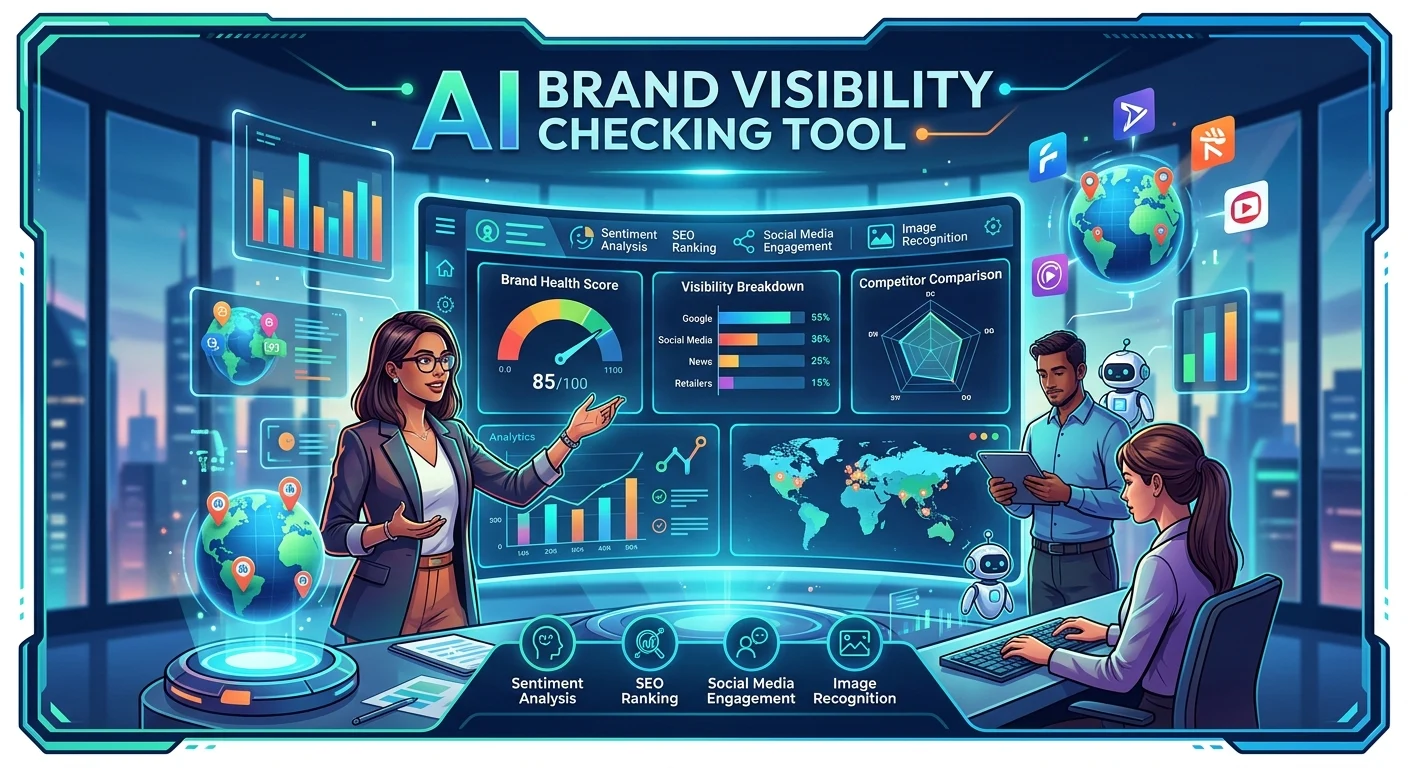
AI search is changing how people discover brands, products, services, and information. Instead of clicking through traditional search results, users can now ask AI systems for recommendations, comparisons, explanations, and buying advice. This makes AI brand visibility an increasingly important part of modern digital marketing. An ai brand visibility checking tool helps businesses understand whether their brand appears in AI-generated answers, how often it is mentioned, which competitors appear alongside it, and which sources influence those answers. Modern visibility platforms can track mentions, citations, share of voice, sentiment, and competitor performance across multiple AI search environments. (Unite.AI)
For marketers, this creates a more efficient way to measure brand discovery beyond conventional rankings. Instead of manually testing hundreds of prompts, a visibility tool can automate monitoring and turn scattered AI responses into useful performance data. The result is better productivity, efficiency, creativity, automation, and real-world decision-making for SEO and content teams.
What Is an AI Brand Visibility Checking Tool?
An ai brand visibility checking tool is software designed to monitor how a company, product, website, or brand appears inside AI-generated search answers. Depending on the platform, it may monitor systems such as ChatGPT, Google AI experiences, Perplexity, Gemini, Claude, and other AI answer engines. (Alhena)
The basic goal is simple: find out whether AI systems know, mention, recommend, describe, or cite your brand. A useful platform can go further by showing which questions trigger a brand mention, which competitors receive more visibility, and which websites are cited in the answers.
Traditional SEO usually focuses on keyword rankings, organic traffic, backlinks, and click-through rates. AI visibility adds another layer. A company can rank well in traditional search while receiving little attention in AI-generated recommendations. This is why marketers increasingly treat AI visibility as a separate measurement area.
How AI Brand Visibility Checking Works
Most AI visibility platforms begin with a collection of tracked prompts. These prompts represent questions real customers might ask about a category, product, service, or problem. The platform then checks selected AI search environments and records what appears in the responses.
For example, a software company could monitor questions such as “best project management tools for small teams” or “alternatives to popular project management software.” The system can then record whether the company appears, where it appears, which competitors are mentioned, and which sources are cited.
The exact methodology differs between platforms. Some primarily measure mentions and citations, while others analyze sentiment, share of voice, sources, or broader brand narratives. Research published in 2026 identifies prompt monitoring, SEO-integrated AI modules, and broader attention-measurement approaches as distinct categories within this developing market. (BAX)
Because AI answers can change, repeated measurement matters. Google itself notes that generative AI answers can contain mistakes and recommends checking important information against supporting sources. (Google Help)
Why AI Brand Visibility Matters for Modern Businesses
AI systems increasingly influence how people research products, compare companies, and discover information. Google has also expanded AI experiences in Search, including AI Overviews and AI Mode, creating additional opportunities for brands to be discovered through conversational search. (blog.google)
This means brand visibility is no longer limited to blue links. A potential customer may ask an AI system for the best product in a category and make an initial decision based on the brands presented in the answer.
AI visibility monitoring helps businesses understand this new discovery layer. Instead of guessing whether a brand appears, marketers can establish a baseline and monitor changes over time.
The most useful question is not simply, “Does AI mention us?” A stronger question is, “How does AI describe us compared with our competitors?” That difference can reveal positioning problems, content gaps, authority weaknesses, and opportunities for improvement.
Key Features to Look for in an AI Visibility Checker
A strong AI brand visibility checking tool should provide more than a single visibility score. The most useful platforms break performance into understandable measurements that marketers can actually act on.
Important features include prompt tracking, brand mention monitoring, competitor benchmarking, citation analysis, share-of-voice measurement, sentiment analysis, historical reporting, and multi-engine monitoring. Some platforms also identify content gaps and recommend actions based on the sources AI systems use. (Monde AI)
Another valuable feature is historical comparison. If your brand appears in 25% of relevant AI responses today and 35% several months later, you have a measurable trend. However, the number becomes more meaningful when the tracked prompt set and measurement methodology remain consistent.
For larger organizations, look for team access, reporting, exports, APIs, regional tracking, multiple projects, and enterprise security controls. These features become important when AI visibility monitoring moves from an experimental SEO project into a regular marketing process.
AI Brand Mentions, Citations, and Share of Voice
These three measurements are related but should not be treated as identical.
A brand mention tells you that an AI-generated response refers to your company or product. A citation indicates that a source was referenced or linked as supporting information. Share of voice compares your visibility against competitors across a defined collection of prompts.
For example, imagine that 100 relevant prompts are monitored. Your company appears in 30 responses, while a competitor appears in 50. Your raw mention rate would be 30%, while the competitor has 50%. That does not automatically mean the competitor is better. The context of each appearance still matters.
A brand could appear frequently because AI systems discuss it negatively or use it as an example of an outdated approach. Therefore, visibility should be evaluated alongside context, sentiment, citations, and relevance.
Benefits of Using an AI Brand Visibility Checker
The biggest benefit is measurement at scale. Manually asking AI systems dozens or hundreds of questions every week takes considerable time and makes consistent reporting difficult. Automated tools can organize the process and provide repeatable monitoring.
Another benefit is competitor intelligence. You can discover which brands repeatedly appear for the same customer questions. This may reveal competitors you rarely see in conventional keyword reports.
AI visibility tools can also improve content strategy. If AI systems repeatedly cite independent publications, comparison pages, industry resources, or specific educational content, marketers can study those sources and understand what information supports strong visibility.
Finally, visibility monitoring creates a feedback loop. Teams can publish or improve content, monitor changes, and evaluate whether visibility improves. This supports a more data-driven and efficient marketing workflow.
Use Cases for AI Brand Visibility Monitoring
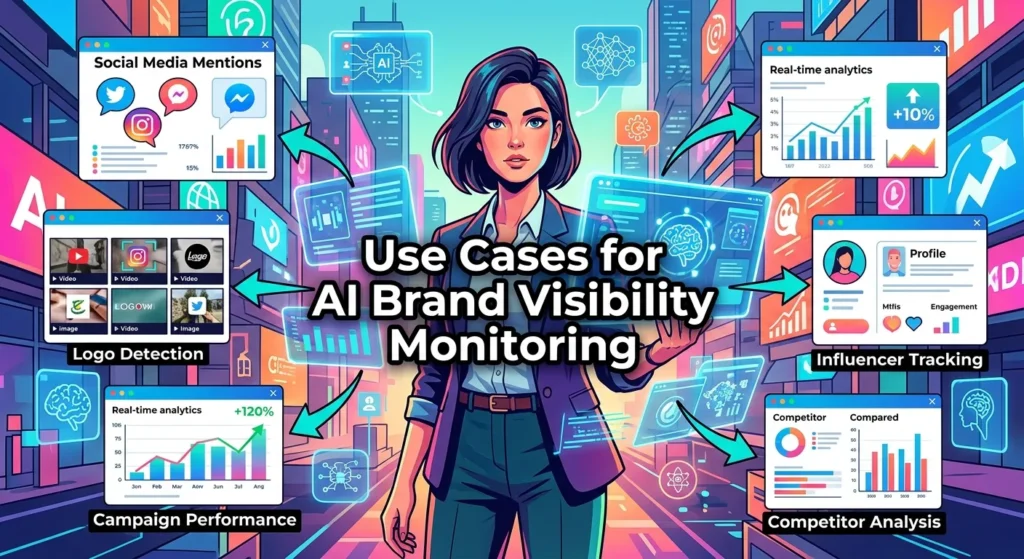
AI visibility tracking can help many types of organizations. SaaS companies can monitor software recommendations and competitor comparisons. Ecommerce brands can investigate product-related AI answers. Agencies can monitor multiple clients and provide recurring reports.
B2B companies can track questions that buyers ask during research. For example, a cybersecurity company could monitor prompts about security software, compliance platforms, or solutions for small businesses.
Content publishers can also use visibility data to understand whether their articles become sources for AI answers. This creates an opportunity to improve content authority, factual clarity, topical depth, and source credibility.
Another important use case is reputation monitoring. If AI systems consistently describe a company using outdated or inaccurate information, marketers can investigate which sources influence that description and work on clearer, authoritative information.
Free vs Paid AI Brand Visibility Checking Tools
Free methods can be useful when you are just starting. A small business can manually test a carefully selected group of customer questions across several AI search systems and record the results in a spreadsheet.
The problem is scale. Manual checking becomes difficult when you need hundreds of prompts, regular monitoring, competitor comparisons, historical trends, and consistent measurement.
Paid platforms generally add automation, dashboards, scheduled tracking, reporting, competitor analysis, and larger prompt capacity. Current 2026 market guides show a wide range of products, from relatively inexpensive monitoring tools to enterprise platforms with broader analytics and reporting capabilities. (AI Visibility Software)
The best approach is not automatically choosing the most expensive platform. Start with your business objective. If you only need basic monitoring, a lightweight solution may be enough. If AI visibility has become an important KPI across a large marketing organization, deeper analytics may justify a larger investment.
Pricing and ROI Considerations
AI visibility software pricing varies considerably because platforms differ in the number of prompts, AI engines, projects, users, refresh frequency, and reporting features they support. Published 2026 comparisons show tools ranging from low-cost monitoring services to higher-priced enterprise platforms. (AI Visibility Software)
Instead of asking only, “How much does the tool cost?” ask, “What business decision will this data improve?” That makes ROI easier to evaluate.
For example, suppose a company spends money creating content but has no idea whether AI systems recognize its brand. A visibility checker could identify which topics produce weak visibility and which sources competitors receive citations from. The resulting information may help the company allocate its content budget more effectively.
A useful ROI framework includes time saved, improved content decisions, competitor intelligence, brand discovery, reporting efficiency, and measurable visibility growth. Avoid treating a dashboard score as revenue by itself.
How to Choose the Right AI Brand Visibility Tool
Start by defining the platforms and customer questions that matter most to your business. Do not choose a tool simply because it tracks the largest number of AI engines.
Next, examine the measurement methodology. Ask how prompts are selected, how frequently they are tested, whether responses are repeated, and how visibility scores are calculated. Research into the 2026 AI visibility market emphasizes that sampling methodology can significantly affect the meaning of a dashboard metric. (BAX)
You should also evaluate competitor tracking, citation analysis, historical reporting, integrations, exports, and ease of use. A technically powerful platform is not useful if your marketing team cannot understand or act on its findings.
Finally, test the tool with your own real-world prompts. Use questions that customers actually ask rather than generic examples supplied by the vendor. This gives you a much better picture of practical value.
AI Visibility Tools vs Traditional SEO Tools
Traditional SEO tools focus heavily on keywords, rankings, backlinks, organic traffic, technical SEO, and website performance. These measurements remain important and should not be abandoned.
AI visibility tools answer a different question: What does an AI system say when someone asks a relevant question? They may track brand mentions, citations, competitors, sentiment, and AI-generated recommendations.
The two categories work best together. Strong technical SEO and useful content can support discoverability, while AI visibility monitoring shows how your brand performs in conversational search environments.
In other words, traditional SEO can help you understand where your website ranks, while AI visibility monitoring can help you understand whether AI systems include your brand in the answers people receive.
Integrations and AI Search Optimization Workflows
The value of an AI visibility checker increases when its data fits naturally into an existing marketing workflow. Useful integrations may include SEO platforms, analytics systems, reporting tools, content workflows, APIs, or exports.
A practical workflow starts with customer research. Build a prompt library based on real questions. Monitor those prompts regularly. Identify visibility gaps. Analyze the sources and competitors appearing in successful answers. Then use those insights to improve your website and broader content strategy.
After publishing improvements, continue monitoring the same prompts. This creates a measure → analyze → improve → measure cycle.
The goal is not to manipulate AI answers. Instead, focus on creating accurate, useful, trustworthy information that AI systems and human readers can understand and verify.
Common AI Brand Visibility Mistakes to Avoid
One common mistake is tracking too few prompts. A brand might look highly visible when tested against a narrow set of questions but perform poorly across broader customer needs.
Another mistake is focusing only on mention counts. A simple percentage cannot explain whether the mention is positive, accurate, relevant, or supported by credible sources.
Teams also make the mistake of changing their methodology every month. If your prompt set, engines, or measurement rules change constantly, historical comparisons become unreliable.
Finally, do not assume that improving AI visibility means stuffing keywords into content. Useful content, clear information, strong evidence, credible sources, technical accessibility, and genuine expertise provide a much stronger foundation for long-term search visibility.
Latest AI Brand Visibility Trends in 2026
The AI visibility market is expanding rapidly. Current 2026 research shows a growing ecosystem of dedicated AI visibility platforms, SEO suites with AI modules, and broader brand or attention measurement products. (BAX)
One important trend is the move from simple mention tracking to explanation and action. Marketers increasingly want to know not only whether a brand appeared but also why competitors appear, which sources influence AI answers, and what content gaps may exist. (llmvlab.com)
Another trend is broader platform coverage. Monitoring increasingly extends beyond one chatbot to multiple AI search experiences. This matters because different systems can produce different answers to similar questions.
Looking ahead, AI visibility measurement will likely become more connected with content strategy, SEO, brand intelligence, reputation management, and analytics. The strongest tools will need to provide reliable measurements rather than impressive-looking scores.
How to Improve Your AI Brand Visibility
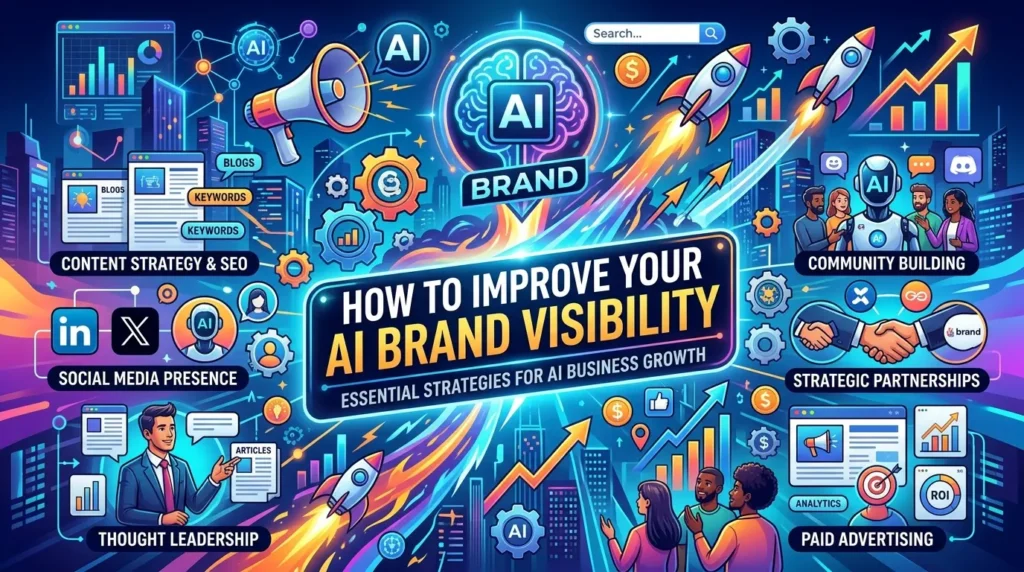
Start with clear brand information. Make sure your website explains what your company does, who it serves, which problems it solves, and how its products differ from alternatives.
Create content that directly answers customer questions. Use clear headings, concise explanations, original research where appropriate, expert insights, factual evidence, and useful examples.
Build authority beyond your own website as well. AI systems may use external sources when generating answers, so credible third-party coverage can matter. Visibility research increasingly emphasizes the importance of understanding which sources and citations appear alongside brands. (Unite.AI)
Most importantly, measure before making major changes. Establish a baseline, improve the information ecosystem around your brand, and then monitor the same prompt set over time. This makes your strategy more scientific and reduces guesswork.
Conclusion
An ai brand visibility checking tool gives marketers a practical way to understand how their brands appear in the rapidly changing world of AI search. Instead of relying only on traditional rankings, businesses can monitor mentions, citations, competitors, share of voice, sentiment, and the sources influencing AI-generated answers.
The best strategy is not to chase a single visibility score. Choose meaningful customer prompts, use consistent measurement, study competitors, improve useful and trustworthy content, and track results over time. AI search is still evolving, so the businesses that build a reliable measurement process now will be better prepared for future changes in how people discover brands.
FAQ: What is an AI brand visibility checking tool?
An AI brand visibility checking tool monitors whether and how a brand appears in AI-generated search answers. Depending on the platform, it can track mentions, citations, competitors, sentiment, and share of voice.
FAQ: Why should businesses track AI brand visibility?
People increasingly use AI systems for research, recommendations, and comparisons. Monitoring visibility helps businesses understand whether AI systems include their brand and how that brand is described.
FAQ: What does AI brand visibility measure?
Common measurements include brand mentions, citation frequency, share of voice, sentiment, competitor visibility, prompt-level performance, and historical trends.
FAQ: Can an AI visibility tool replace traditional SEO?
No. AI visibility monitoring and traditional SEO measure different aspects of digital discovery. They work best together as part of a broader search and content strategy.
FAQ: Are free AI brand visibility tools available?
Some platforms offer free assessments, limited plans, trials, or low-cost monitoring options. You can also perform a small manual audit before investing in dedicated software.
FAQ: Which AI platforms should a visibility checker monitor?
The ideal coverage depends on your audience. Common platforms monitored by current AI visibility products include ChatGPT, Google AI experiences, Perplexity, Gemini, and Claude. (Alhena)
FAQ: How often should I check AI brand visibility?
For most businesses, regular monitoring is more useful than occasional testing. Weekly or monthly tracking can reveal meaningful trends, while higher-frequency monitoring may make sense for fast-moving campaigns or competitive markets.
FAQ: What is AI share of voice?
AI share of voice compares how frequently your brand appears in relevant AI answers against competing brands within a defined prompt set.
FAQ: How can I improve my brand’s AI visibility?
Create accurate, useful, clearly structured content; strengthen your brand’s authority; answer real customer questions; improve technical accessibility; and monitor which sources AI systems use when discussing your category.
FAQ: Is AI brand visibility the same as AI SEO?
The concepts overlap, but they are not identical. AI brand visibility is a measurement of how your brand appears in AI-generated answers, while AI SEO or generative engine optimization generally refers to strategies used to improve discoverability within those environments.
This article is structured for 2026 search intent, semantic SEO, and AI-search discovery while keeping the content focused on practical business value.