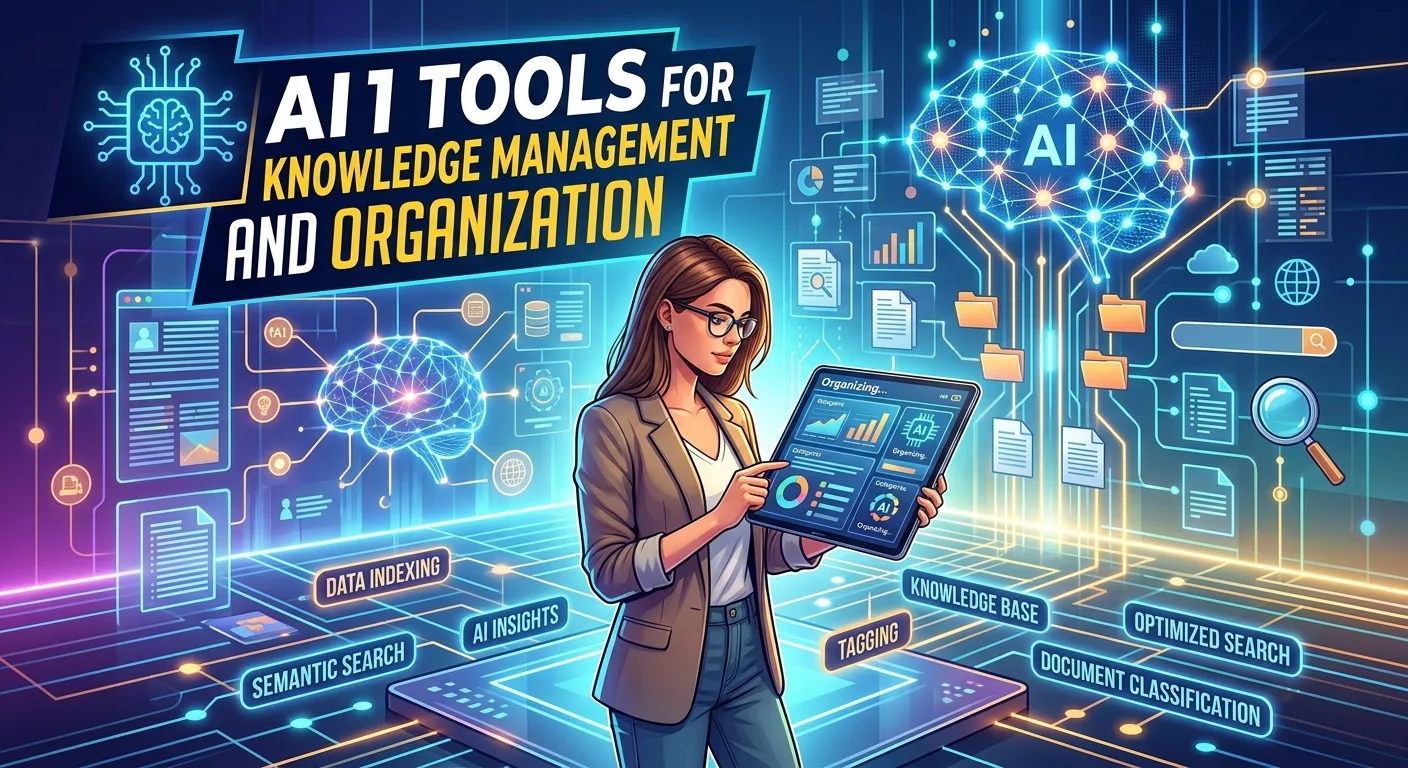
AI tools for knowledge management and organization are changing how individuals, teams, and businesses capture, organize, find, and use information. Modern organizations deal with enormous amounts of documents, emails, notes, meetings, research, customer information, project files, and internal knowledge. Without a structured system, valuable information can become difficult to find or easy to forget.
AI can help solve this problem by automatically categorizing information, summarizing documents, connecting related ideas, improving search, and turning scattered data into useful insights. These capabilities can improve productivity, efficiency, collaboration, creativity, automation, and decision-making. From small teams to large enterprises, AI-powered knowledge management can reduce information overload and make organizational knowledge more accessible. This guide explores how these tools work, their key features, benefits, use cases, pricing models, integrations, alternatives, common mistakes, current trends, and future developments.
What Are AI Tools for Knowledge Management and Organization?
AI tools for knowledge management and organization are software applications that use artificial intelligence to help people collect, structure, retrieve, summarize, and understand information.
Traditional knowledge management often relies on folders, spreadsheets, shared drives, databases, wikis, and manually maintained documentation. These systems can work well, but they require people to consistently organize information.
AI introduces automation into the process.
For example, an AI-powered knowledge platform may analyze a collection of documents and automatically identify topics, generate summaries, extract important information, or make content searchable through natural-language queries.
Instead of remembering exactly where a document was saved, a user might ask, “Where is the latest information about our customer onboarding process?” The system can search connected knowledge sources and return relevant information.
The goal is simple: make organizational knowledge easier to capture, find, understand, and use.
How Do AI Knowledge Management Tools Work?
AI knowledge management platforms typically combine several technologies, including natural language processing, machine learning, semantic search, generative AI, document processing, and sometimes retrieval-augmented generation.
First, information enters the system. This information could include documents, meeting notes, project pages, emails, FAQs, presentations, research files, or internal procedures.
The AI system processes the information and creates relationships between concepts. Semantic search allows the platform to understand the meaning behind a query instead of relying only on exact keyword matches.
For example, a traditional search might struggle if a document uses the phrase “employee orientation” while someone searches for “new staff onboarding.” An AI-powered search system may understand that the concepts are closely related.
A typical workflow includes:
- Capture information from different sources.
- Process documents and text.
- Classify information by topic or category.
- Index content for fast retrieval.
- Connect related knowledge.
- Search using natural language.
- Summarize relevant information.
- Generate useful answers or insights.
- Update knowledge as information changes.
The exact architecture differs between platforms, but the objective remains the same: turn unstructured information into accessible and actionable knowledge.
Why AI Knowledge Management Matters for Modern Organizations
Information overload has become a major productivity problem.
Employees may spend significant amounts of time searching through folders, chat messages, emails, documents, and project-management systems just to locate information that already exists.
This creates unnecessary work.
AI knowledge management tools can reduce this friction by providing centralized search and automated organization. Employees can spend less time looking for information and more time using it.
Knowledge management also helps organizations avoid losing valuable institutional knowledge. When experienced employees leave, important knowledge can disappear if it only exists in personal notes, conversations, or memory.
A structured AI knowledge system can help preserve approved documentation, processes, research, and lessons learned.
It can also improve collaboration. Teams can access shared information without repeatedly asking colleagues for the same answers.
Better knowledge access can lead to faster decisions, smoother workflows, and greater organizational consistency.
Key Features of AI Knowledge Management and Organization Tools
AI knowledge management platforms can provide a wide range of features.
Semantic search allows users to search using natural language and concepts rather than exact keywords.
Automatic summarization can reduce long documents, meeting transcripts, and research materials into concise summaries.
Document classification can automatically organize information based on topics, departments, projects, or other categories.
Knowledge extraction can identify names, dates, topics, decisions, tasks, and other important information.
AI question answering allows users to ask questions about approved organizational knowledge.
Knowledge graphs can connect related people, documents, projects, concepts, and entities.
Meeting intelligence can turn conversations into summaries, decisions, and action items.
Duplicate detection can help identify repeated or overlapping information.
Version awareness can help users distinguish current information from outdated material.
Permissions and access controls are essential for protecting confidential information.
The most useful platform is not necessarily the one with the largest feature list. It should provide accurate retrieval, reliable organization, useful automation, and appropriate security controls.
Benefits of AI Tools for Knowledge Management
The biggest advantage is often time savings.
Employees can spend less time searching for documents and more time completing meaningful work. AI can also summarize information quickly, making it easier to understand large amounts of material.
Another benefit is improved consistency. If employees can access the same approved procedures and documentation, teams are less likely to rely on outdated or conflicting information.
AI can also support faster onboarding. New employees can search internal documentation and receive explanations without depending entirely on colleagues.
Knowledge management can improve creativity as well. When research, ideas, examples, and previous projects are easy to discover, teams can build on existing knowledge instead of starting from zero.
AI tools can also improve organizational memory.
Important decisions, processes, and lessons learned can remain accessible after projects finish.
However, benefits depend on implementation. Poorly organized or inaccurate source information can produce poor results even when the AI system itself is sophisticated.
AI Knowledge Management Use Cases Across Different Industries
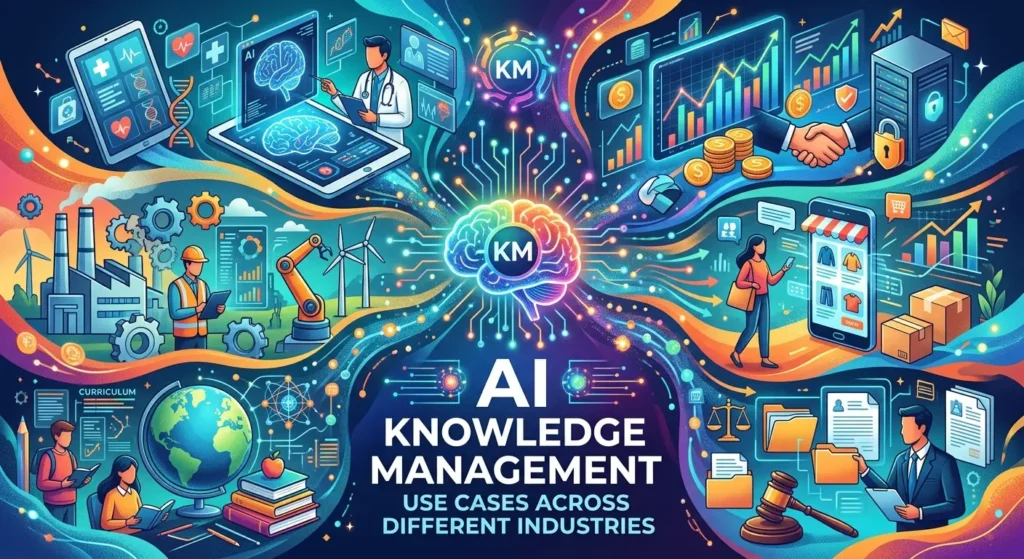
AI knowledge management has applications across many industries and departments.
Business and corporate teams
Companies can organize policies, procedures, project documentation, meeting notes, and internal research.
Customer support
Support teams can search product documentation and approved answers while helping customers.
Software development
Development teams can organize technical documentation, architecture decisions, troubleshooting information, and coding standards.
Education
Educational organizations can organize course materials, research, lesson plans, administrative documents, and institutional knowledge.
Healthcare administration
Organizations can use knowledge systems to organize approved administrative information and documentation, while maintaining strict privacy and access controls.
Legal and professional services
Teams can improve access to internal research, case documentation, templates, policies, and project knowledge.
Marketing
Marketing departments can organize campaign results, brand guidelines, customer research, content assets, and market intelligence.
Research teams
Researchers can use AI to summarize papers, connect related findings, organize notes, and retrieve relevant information.
The strongest use cases generally involve large amounts of information that people need to access repeatedly.
AI Search, Semantic Retrieval, and Knowledge Discovery
Traditional search depends heavily on keywords.
AI-powered knowledge systems increasingly use semantic retrieval, which focuses on meaning and context.
Suppose an employee asks, “What process do we follow when a customer wants to cancel a subscription?” The relevant documentation might use terms such as “account termination,” “subscription cancellation,” or “customer offboarding.”
Semantic retrieval can connect these concepts.
This makes knowledge discovery more natural.
Users can ask questions using everyday language instead of learning how a particular database is structured.
Some systems combine retrieval with generative AI. The retrieval layer identifies relevant information, while the AI model uses that information to produce a concise answer.
This approach can be useful, but organizations should still verify important answers.
For business-critical information, the system should ideally provide source references, document context, or links to the underlying material so employees can check the original information.
Free vs Paid AI Knowledge Management Tools
Free AI tools can be useful for individuals and small teams.
They may provide basic note organization, document summarization, AI search, or personal knowledge management features.
Free solutions are often enough for experimenting with AI-powered organization. They can help users understand what types of information they want to store and how they prefer to retrieve it.
Paid platforms usually offer more advanced capabilities, such as larger storage limits, team collaboration, enterprise integrations, advanced permissions, centralized administration, analytics, automation, and security features.
Businesses should compare pricing based on their actual needs.
A small team with a few hundred documents may not need an enterprise platform. A large company with sensitive information and thousands of employees may require advanced governance and access controls.
Before choosing a paid tool, evaluate storage, users, AI usage limits, integrations, security, administration, export options, and support.
Pricing and ROI of AI Knowledge Management Software
AI knowledge management pricing varies widely.
Some platforms charge per user each month. Others use storage limits, AI usage, workspace size, document volume, or enterprise contracts to determine pricing.
Cost should be evaluated alongside productivity gains.
Imagine a company with 50 employees where workers regularly spend time searching for internal information. If an AI knowledge system reduces that wasted time significantly, the productivity gain could justify the software cost.
Other potential returns include faster employee onboarding, fewer repeated questions, reduced documentation work, quicker customer support, and better reuse of existing knowledge.
Useful metrics include:
- Time spent searching for information
- Employee onboarding time
- Support resolution time
- Number of repeated internal questions
- Knowledge-base usage
- Search success rate
- Documentation coverage
- Employee productivity
- Customer satisfaction
- Time required to update documentation
The best ROI calculation focuses on business outcomes rather than the number of AI-generated summaries or searches.
Integrations for AI-Powered Knowledge Management
Integrations are extremely important because organizational knowledge rarely exists in one location.
Businesses may store information across cloud drives, document platforms, project-management systems, communication applications, CRM systems, email platforms, code repositories, and customer-support databases.
An AI knowledge management tool becomes more useful when it can securely connect to these sources.
For example, an organization might connect its project documentation, internal wiki, customer-support knowledge base, and approved policy documents.
Users can then search across multiple sources from one interface.
However, integration also creates security responsibilities.
Organizations should carefully control which systems the AI platform can access. Sensitive information should not become searchable by employees who do not have permission to view it.
Important considerations include authentication, role-based access, encryption, audit logs, data retention, permission synchronization, and administrative controls.
The best integration is not simply the one that connects the most applications. It is the one that connects the right sources without weakening information security.
How to Choose the Best AI Knowledge Management Tool
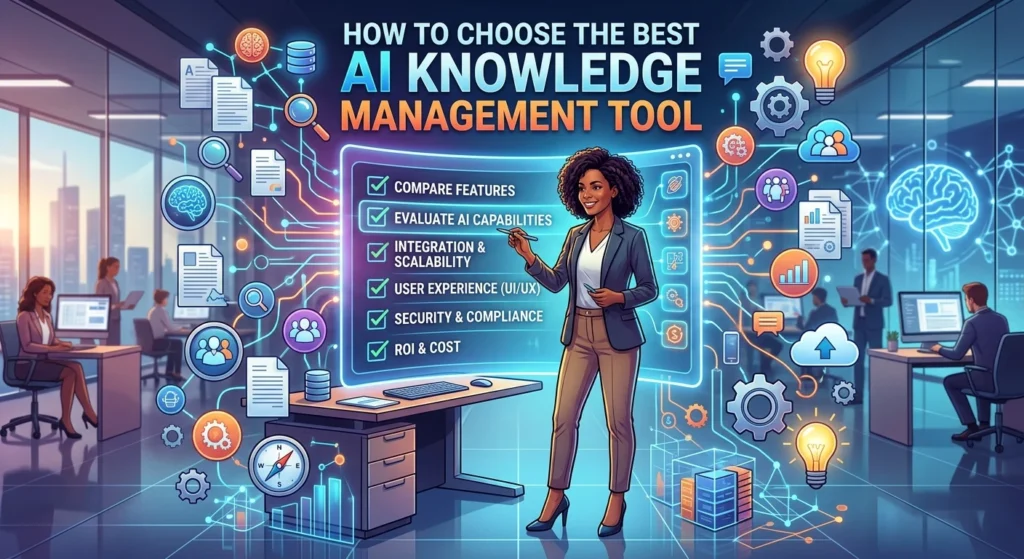
Start by identifying the problem.
Are employees struggling to find documents? Is onboarding too slow? Are teams repeatedly asking the same questions? Is important information scattered across multiple applications?
Your answer should determine the tool category you investigate.
Next, evaluate the type and volume of information.
A personal knowledge system may focus on notes and documents, while an enterprise platform may need to process millions of files and support thousands of users.
Search quality should receive special attention. Test the platform with real questions and real organizational information.
Security should also be a priority. Confirm how the provider handles your data and whether the system respects existing access permissions.
Check integrations with the tools your organization already uses.
Finally, evaluate usability.
A powerful knowledge platform has limited value if employees avoid using it.
Adoption matters as much as technology.
The best solution is one that people can understand, trust, and use regularly.
Best Practices for Organizing Knowledge with AI
Start with a clear information structure.
Even powerful AI systems perform better when source documents are accurate, current, and reasonably organized.
Create naming conventions and define ownership for important documentation. Every major knowledge area should have someone responsible for reviewing and updating information.
Use AI to summarize and classify content, but establish rules for important information.
For example, an organization could mark certain documents as official, draft, archived, or deprecated.
This reduces the risk of employees relying on outdated material.
Another best practice is to create a feedback loop. If users find an AI answer incorrect or incomplete, they should have a way to report the problem.
Regularly review search queries and failed searches. These can reveal missing documentation.
Most importantly, encourage employees to contribute useful knowledge.
AI can organize information, but people still create much of the knowledge that makes an organization valuable.
Common Mistakes in AI Knowledge Management
One common mistake is connecting every data source immediately.
More information does not always mean better knowledge. Irrelevant, outdated, duplicate, or low-quality material can make retrieval harder.
Another mistake is ignoring permissions.
Sensitive business information should only be available to authorized users. AI search must not become a shortcut around existing security policies.
Organizations should also avoid treating every AI-generated answer as fact.
AI systems can misunderstand context or produce incorrect conclusions. Critical information should be verified against authoritative sources.
Another mistake is failing to update knowledge.
An AI system cannot reliably provide current answers if its underlying information is outdated.
Organizations should establish clear ownership and review schedules.
Finally, avoid measuring success only by adoption numbers.
A large number of searches does not necessarily mean the system is useful. Better metrics include successful retrieval, reduced search time, fewer repeated questions, faster onboarding, and improved decision-making.
Latest Trends in AI Knowledge Management
One major trend is the shift toward natural-language knowledge interfaces.
Employees increasingly expect to ask questions in ordinary language instead of navigating complex folders and databases.
Another trend is multimodal knowledge management. Future systems can increasingly work with text, images, audio, video, presentations, diagrams, and other formats.
Meeting intelligence is also becoming more important. AI can turn conversations into searchable organizational knowledge by identifying decisions, action items, and important discussions.
Another trend is AI-powered knowledge discovery. Instead of waiting for users to search, systems may proactively surface relevant information based on projects, tasks, or current work.
Organizations are also paying greater attention to AI governance.
As AI systems gain access to internal information, businesses need clear policies around privacy, permissions, accuracy, retention, auditing, and responsible AI use.
The overall direction is moving from simple document storage toward intelligent organizational memory.
Future of AI Tools for Knowledge Management and Organization
The future of AI knowledge management will likely focus on deeper context and proactive assistance.
Instead of simply answering a question, an AI knowledge system may understand what a person is working on and surface relevant documents, previous decisions, experts, research, and related projects automatically.
Knowledge graphs may become more sophisticated, connecting information across departments and systems.
AI agents could also perform knowledge-management tasks such as identifying outdated documents, requesting reviews, detecting contradictions, and suggesting updates.
Another likely development is more personalized organizational search.
Different employees may receive different results based on their role, permissions, project responsibilities, and approved information sources.
Multimodal knowledge systems may allow organizations to search across documents, meetings, recordings, images, presentations, and videos using natural-language questions.
At the same time, governance will become increasingly important.
Organizations will need reliable methods for determining where AI answers came from, which sources were used, and whether employees have permission to access those sources.
The long-term goal is not simply to create a smarter search box.
It is to build an organizational knowledge layer that helps people discover, understand, and apply information safely and efficiently.
Conclusion
AI tools for knowledge management and organization can transform how people work with information. Instead of spending excessive time searching folders, reading lengthy documents, or repeatedly asking colleagues for answers, users can access knowledge through intelligent search, summaries, classifications, and conversational interfaces.
The biggest opportunities involve productivity, collaboration, information discovery, employee onboarding, customer support, research, documentation, and organizational memory.
However, successful implementation requires more than choosing an AI platform. Organizations need accurate source information, clear ownership, appropriate permissions, strong security, and processes for reviewing outdated material.
Free tools can work well for personal knowledge management and small experiments, while paid enterprise platforms may provide the integrations, administration, security, and scale required by larger organizations.
The most effective approach is to start with a specific problem, connect high-value information sources, establish governance, and measure real productivity improvements.
As AI becomes more capable, knowledge management will increasingly move from passive storage toward active, intelligent knowledge discovery. Organizations that build trustworthy and well-structured knowledge systems will be better prepared to make faster decisions, preserve institutional expertise, and work more efficiently in an AI-driven environment.
Frequently Asked Questions
What are AI tools for knowledge management?
AI knowledge management tools use artificial intelligence to organize, search, summarize, classify, connect, and retrieve information. They can help individuals and organizations manage documents, notes, research, policies, meeting records, and other knowledge.
How can AI improve knowledge management?
AI can reduce manual organization work, provide natural-language search, summarize large documents, identify related information, and make organizational knowledge easier to access.
Are AI knowledge management tools useful for small businesses?
Yes. Small businesses can use them to organize documents, customer information, processes, project knowledge, meeting notes, and internal resources without creating a complicated manual knowledge base.
What is semantic search in knowledge management?
Semantic search uses AI to understand the meaning and context of a query, rather than relying only on exact keyword matches. This can make it easier to find relevant information when different words describe similar concepts.
Can AI knowledge management tools replace employees?
No. These tools can automate repetitive information tasks, but employees remain important for creating knowledge, making decisions, verifying information, handling complex situations, and maintaining organizational context.
Are free AI knowledge management tools available?
Yes. Free plans and applications can provide basic note organization, document search, summarization, and personal knowledge-management capabilities. Advanced enterprise functionality generally requires paid software.
How much do AI knowledge management tools cost?
Pricing varies by provider. Common models include per-user subscriptions, storage-based plans, AI usage limits, document volume, and enterprise contracts.
What integrations should an AI knowledge management tool support?
Useful integrations depend on the organization, but common sources include cloud storage, document systems, project-management software, communication platforms, CRM systems, customer-support tools, email, and code repositories.
Is AI knowledge management secure?
Security depends on the platform and its configuration. Organizations should evaluate encryption, access controls, authentication, permission synchronization, data retention, audit logs, and provider data policies before connecting sensitive information.
How can businesses keep AI knowledge accurate?
Businesses should assign ownership to important documents, establish review schedules, identify outdated information, and provide mechanisms for employees to report incorrect or incomplete AI answers.
What is the difference between knowledge management and document storage?
Document storage primarily focuses on keeping files. Knowledge management focuses on making information organized, discoverable, understandable, and useful for decision-making and work.
Can AI search across multiple company systems?
Many modern platforms can connect to multiple information sources. The available integrations vary, and organizations should ensure that connected systems maintain appropriate user permissions.
What is the future of AI knowledge management?
The future is likely to include proactive knowledge discovery, AI agents, multimodal search, knowledge graphs, personalized information retrieval, automated documentation maintenance, and stronger AI governance.