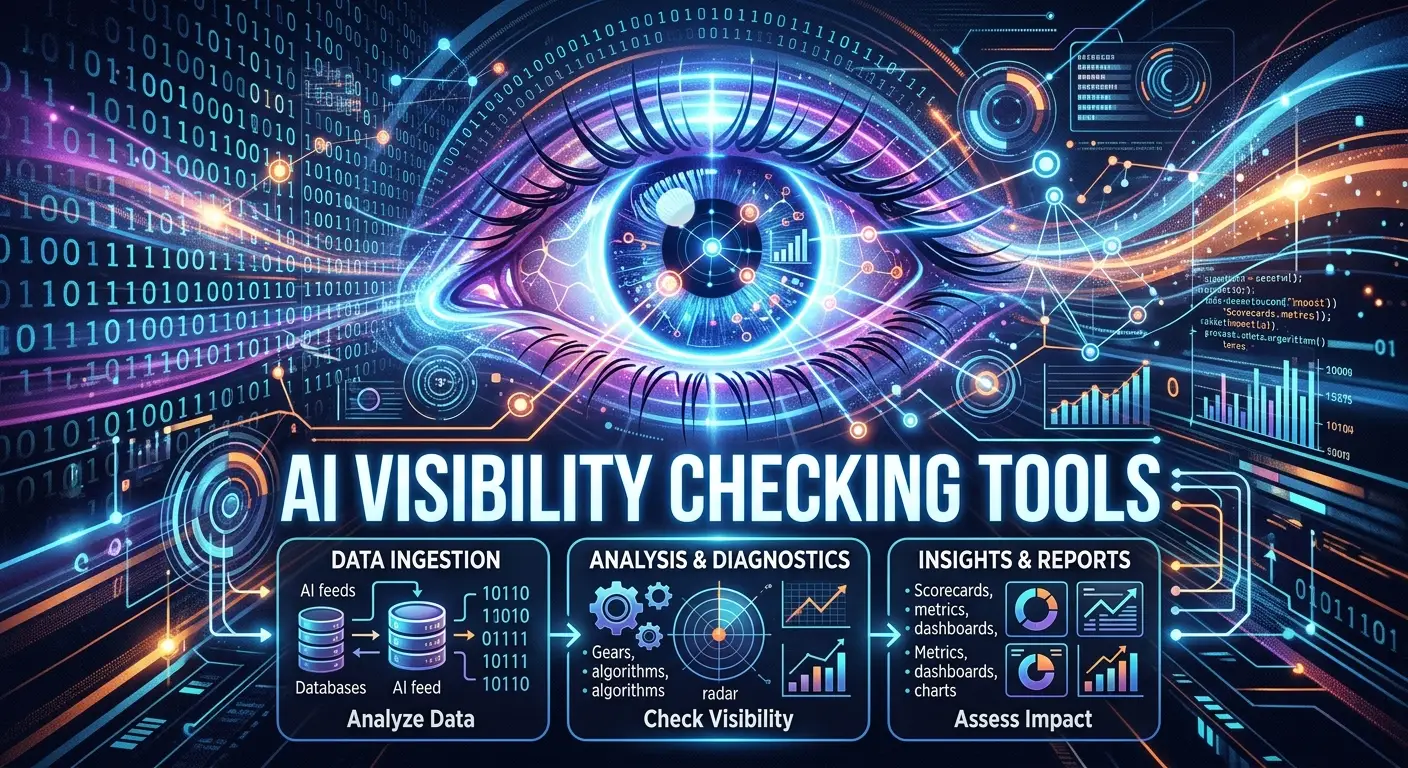
AI visibility checking tools help businesses understand how often their brands, products, websites, and content appear in AI-powered search experiences. As people increasingly use conversational systems and AI search engines to discover information, traditional keyword rankings no longer show the complete picture. These tools can monitor brand mentions, analyze citations, track competitor visibility, and reveal how AI systems describe a company.
This creates a new layer of search optimization focused on visibility, accuracy, authority, and brand presence. For marketers, SEO professionals, agencies, and businesses, AI visibility tracking can improve productivity by replacing manual checking with automated monitoring. It can also support creativity by revealing content gaps and new topics. The real value comes from turning AI search data into practical actions that improve discoverability and strengthen a brand’s presence across evolving search experiences.
What Are AI Visibility Checking Tools?
AI visibility checking tools are software platforms designed to measure how a brand, website, product, person, or topic appears in AI-generated search results and conversational answers.
Traditional SEO tools mainly focus on search engine rankings, keywords, backlinks, organic traffic, and technical SEO. AI visibility tools look at a different layer: whether AI systems mention a brand, what they say about it, which sources they cite, and how competitors appear in similar answers.
For example, a software company might want to know whether AI search systems mention its product when users ask, “What are the best project management tools for small businesses?” An AI visibility platform can run relevant queries and analyze the resulting answers.
These tools can provide useful information about brand mentions, citation sources, sentiment, competitors, query coverage, and visibility trends. The exact metrics vary between platforms, so businesses should understand what each tool actually measures before comparing results.
How AI Visibility Tracking Works
AI visibility platforms generally create a collection of relevant prompts or search queries. These queries represent the questions potential customers might ask AI systems about a particular industry, product, service, or topic.
The platform then checks AI-generated responses and looks for specific signals. These can include whether the target brand appears, how frequently it appears, where it appears in the response, and which websites the AI system cites.
Some platforms also analyze the language used to describe the brand. For example, an AI answer might describe a company as affordable, enterprise-focused, beginner-friendly, or suitable for a particular industry.
The basic process can be summarized as:
Create relevant queries → collect AI responses → detect brand mentions → analyze citations and competitors → track changes → identify opportunities.
Because AI outputs can vary between queries and over time, businesses should treat individual results as observations rather than permanent rankings.
Key Features of AI Visibility Checking Software
Different AI visibility platforms offer different capabilities, but several features are particularly useful.
Brand mention tracking helps businesses determine whether AI systems mention their brand when answering relevant questions. This is one of the simplest ways to measure AI search presence.
Citation tracking shows which websites AI systems reference when producing answers. This can reveal the sources that influence AI-generated responses and highlight opportunities for improving a brand’s authority.
Competitor monitoring allows marketers to compare their visibility with other companies appearing for similar prompts. The goal should be to understand differences in coverage rather than simply chase competitor mentions.
Other features may include:
- AI search query monitoring
- Share-of-voice measurements
- Brand sentiment analysis
- Citation analysis
- Source-domain tracking
- Competitor comparisons
- Prompt libraries
- Historical visibility reports
- AI answer snapshots
- Content recommendations
- Alert systems
- Multi-brand monitoring
- API access
- Agency reporting
The most useful feature set depends on whether the user is managing one brand, multiple websites, or an enterprise SEO program.
Benefits of AI Visibility Checking Tools
One major benefit is automation. Instead of manually asking AI systems hundreds of questions, marketers can use software to monitor a defined set of queries.
This saves time and makes repeated measurement easier. A marketing team can schedule regular checks and compare results over time.
AI visibility tracking can also reveal gaps that traditional SEO reports may not show. A website might rank well for a conventional keyword but still receive little or no visibility in AI-generated answers.
Another benefit is competitor intelligence. Businesses can discover which competitors appear frequently in AI answers and which sources are repeatedly cited.
AI visibility tools can also support content strategy. If AI systems frequently cite certain types of sources for a topic, marketers can study those patterns and create more useful, authoritative resources.
The strongest value comes from turning measurement into action. Visibility data is useful when it helps a business improve content, authority, brand positioning, or customer discovery.
AI Visibility vs Traditional SEO Rank Tracking
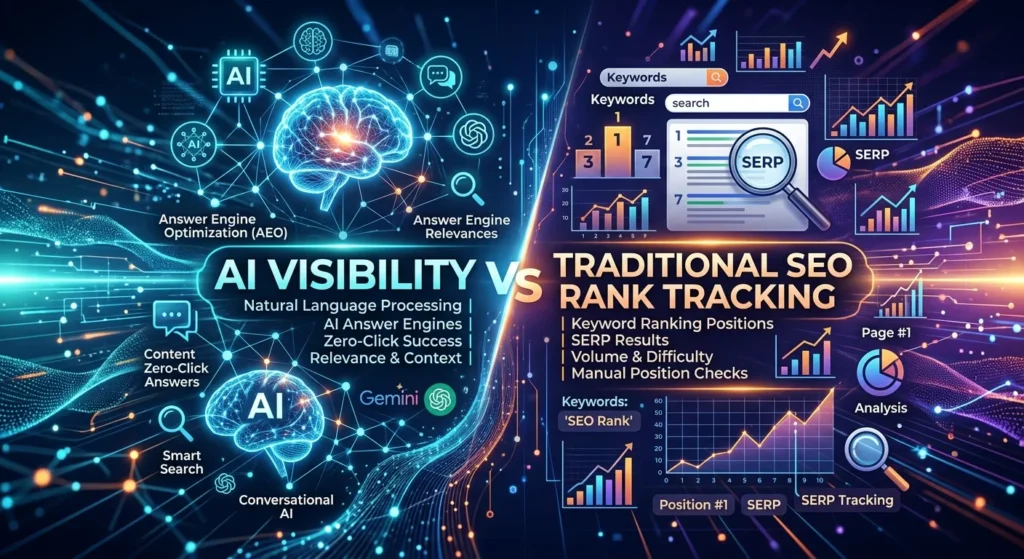
Traditional rank tracking measures where a webpage appears in search engine results for specific keywords. It can provide valuable information about organic search performance.
AI visibility measurement asks a different question: Does the brand or website appear when users ask AI systems relevant questions?
For example, a website could rank on the first page for “best accounting software” but not appear in an AI-generated answer for a similar conversational question.
This difference matters because users increasingly search using complete questions and natural language. AI systems may synthesize information from multiple sources rather than simply displaying a list of ranked webpages.
Traditional SEO therefore remains important, but AI visibility adds another measurement layer.
Businesses can use both approaches together:
SEO rankings → website traffic → AI mentions → citations → brand visibility → customer actions.
This broader view helps marketers understand how their digital presence performs across different search experiences.
Use Cases for AI Search Visibility Monitoring
AI visibility checking tools can support many different industries and marketing goals.
SaaS companies can monitor whether AI systems mention their software when users search for solutions in their category. They can also analyze which competitors appear alongside them.
Ecommerce brands can track product-related questions and discover whether AI-generated recommendations include their products or brand.
Agencies can use AI visibility platforms to monitor multiple clients, create reports, and identify opportunities for improving brand presence.
Publishers and content websites can analyze whether their articles receive citations in AI-generated answers. This can help them understand which content topics and formats appear to earn visibility.
Local businesses can also monitor conversational queries about services in specific areas, although results may depend heavily on location and the AI system being tested.
Across these use cases, the objective remains similar: understand how AI systems represent and discover a brand, then improve the underlying information ecosystem.
AI Visibility Metrics and What They Mean
AI visibility tools may use different terminology, so marketers should understand the underlying concepts rather than relying only on a single score.
Mention rate can represent how frequently a brand appears across a set of tracked prompts.
Citation rate can measure how often a brand’s website or other associated sources are cited.
Share of voice can describe a brand’s visibility relative to competitors within a defined query set.
Sentiment or tone may describe whether AI-generated responses present a brand positively, negatively, or neutrally.
Another useful metric is query coverage. This measures how broadly a brand appears across different topics, questions, customer needs, or use cases.
These metrics are not universal industry standards. One platform’s visibility score may not be directly comparable with another platform’s score.
For this reason, businesses should track consistent queries and methodology over time instead of treating different tools’ scores as interchangeable.
Free vs Paid AI Visibility Checking Tools
Some AI visibility checking resources provide free or limited monitoring. These can be useful for individuals and small businesses that want to understand the concept before investing in a dedicated platform.
Free methods can include manually testing a small collection of relevant prompts across AI search systems and recording the results. This works for basic experiments but becomes difficult as the number of queries increases.
Paid platforms generally offer automation, larger query sets, historical data, competitor tracking, scheduled monitoring, reporting, and additional analytics.
Pricing can vary according to the number of tracked queries, brands, locations, users, models, or features. Enterprise solutions may use custom pricing.
A good approach is to start with a focused test. Identify the questions your customers actually ask, monitor those questions consistently, and determine whether the resulting insights justify a paid platform.
Integrations With SEO, Analytics, and Marketing Platforms
AI visibility data becomes more useful when it connects with other marketing information.
Some platforms may provide APIs or integrations that allow AI visibility data to move into dashboards, reporting systems, spreadsheets, or marketing workflows.
For example, an SEO team could combine traditional ranking data with AI citation information. This can help identify pages that perform well in conventional search but receive limited AI visibility.
A content team could also combine AI visibility data with website analytics. If an important topic receives strong AI visibility but weak website engagement, the team can investigate the customer journey.
Agencies can benefit from automated reporting integrations that combine multiple data sources into client dashboards.
Before selecting a platform, check supported integrations, API availability, data export options, access controls, and reporting capabilities.
AI Visibility Tools for Brand and Competitor Analysis
AI visibility monitoring can reveal how AI systems position a brand compared with competitors.
Suppose three software companies compete in the same category. One brand might appear frequently when users ask for enterprise solutions, while another appears more often in beginner-focused questions.
This information can help marketers understand how their digital presence is being interpreted.
Competitor analysis should not simply focus on copying brands that appear more often. Instead, examine the sources, topics, product attributes, and content types associated with their visibility.
For example, a competitor might receive frequent citations because it has detailed educational resources, independent reviews, strong industry coverage, or authoritative documentation.
These observations can guide a content and authority strategy.
The goal is to understand why visibility occurs, not merely to imitate the visible result.
Pros, Cons, and Limitations of AI Visibility Checking Tools
AI visibility tools provide several advantages.
Pros include:
- Automated monitoring
- Faster AI search analysis
- Competitor visibility insights
- Citation tracking
- Historical reporting
- Query-level analysis
- Brand mention detection
- Content strategy insights
- Scalable measurement
However, these tools also have limitations.
AI-generated answers can change between runs. Different models may produce different responses to the same question. Location, personalization, language, model updates, and context can also influence results.
A visibility score may therefore provide useful directional information without representing an absolute measurement of all AI search activity.
Another limitation is incomplete coverage. No tool necessarily monitors every AI system, every user query, or every possible response.
Businesses should also avoid assuming that appearing in an AI answer directly equals traffic or sales. Visibility is an important signal, but it is not the same as business performance.
Common Mistakes When Measuring AI Search Visibility
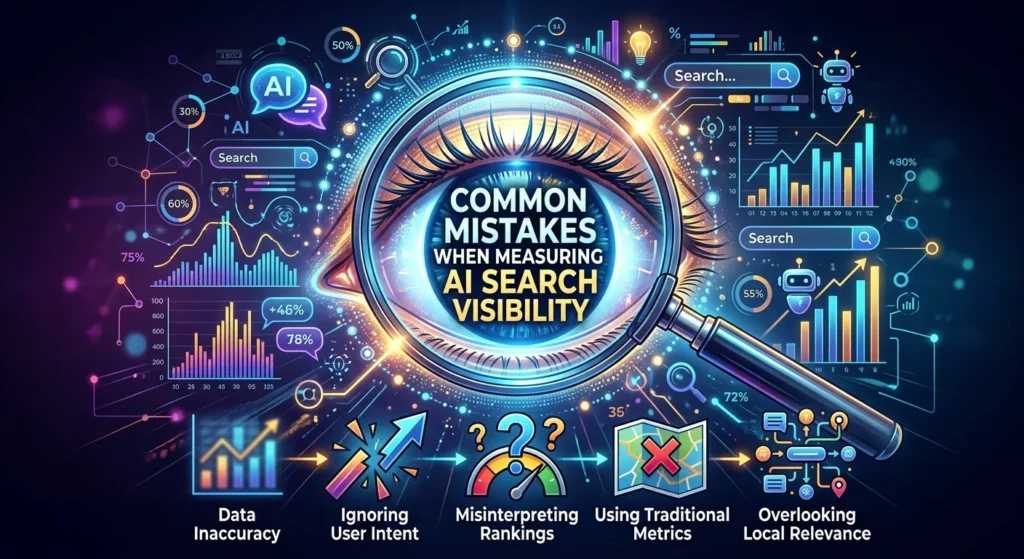
One common mistake is tracking too few queries. A brand may appear for one question but disappear for another closely related question.
Another mistake is changing the tracked queries every week. This makes historical comparisons difficult.
Businesses can also focus too heavily on one visibility score. A single number cannot explain why a brand appears or disappears.
Ignoring citations is another missed opportunity. Knowing which sources AI systems reference can provide valuable information about authority and content ecosystems.
Some marketers also assume that AI visibility automatically creates conversions. It does not. Businesses still need strong websites, useful products, clear messaging, good customer experiences, and effective conversion paths.
A better strategy is to build a stable query set, monitor multiple metrics, analyze citations, compare results over time, and connect visibility data with real business outcomes.
Best Practices for Improving AI Search Visibility
Start by creating content that directly answers real customer questions. Clear definitions, practical explanations, original research, useful examples, and trustworthy information can make content more valuable to both users and search systems.
Build topical depth rather than producing large quantities of shallow articles. A website that thoroughly covers a subject can provide stronger contextual information.
Strengthen the credibility of important claims. Cite reliable sources where appropriate, demonstrate expertise, and keep factual information current.
Make important information easy to understand. Clear headings, concise answers, structured content, and descriptive language can help both humans and automated systems interpret a page.
Also develop a consistent brand identity across the web. Business information, product descriptions, company details, and expert profiles should remain accurate and consistent.
Most importantly, optimize for people first. AI visibility should be a result of creating useful, trustworthy information rather than an attempt to manipulate AI-generated answers.
Latest Trends in AI Visibility Tracking
AI visibility measurement is expanding as conversational search becomes more important. Instead of monitoring only traditional search engines, businesses increasingly want to understand how they appear across AI assistants and AI-powered search experiences.
One major trend is more sophisticated prompt tracking. Tools are moving beyond a handful of keywords and monitoring natural-language questions that represent different customer journeys.
Another trend is deeper citation analysis. Marketers want to know not only whether a brand appears, but also which sources influence the answer and what information those sources provide.
Competitive intelligence is also becoming more detailed. Businesses can monitor changes in competitor mentions, category associations, and source coverage.
AI visibility platforms are also moving toward recommendations. Instead of simply showing that a brand has low visibility, future systems may identify content gaps, missing supporting evidence, or topics where additional authority could help.
These developments suggest that AI visibility tracking will increasingly become part of modern SEO, content strategy, reputation management, and brand intelligence.
Future of AI Visibility Checking and AI Search Optimization
The future of AI visibility measurement will likely involve more models, more natural-language queries, and more sophisticated analysis.
AI search systems may increasingly personalize answers according to context, location, preferences, and previous interactions. This could make visibility more dynamic than traditional keyword rankings.
Measurement platforms will therefore need stronger methods for handling variability. Instead of presenting one fixed ranking, tools may focus more on patterns, frequency, sources, context, and confidence.
AI visibility data may also become connected with broader marketing intelligence. Businesses could combine AI mentions with search traffic, brand searches, conversions, customer feedback, and sales data.
Another likely development is more automated recommendations. AI could analyze visibility patterns and suggest content updates, source development, public relations opportunities, or areas where a brand needs clearer information.
The long-term goal will not simply be to appear more often. It will be to ensure that AI systems have accurate, useful, and trustworthy information from which to understand and represent a brand.
FAQs About AI Visibility Checking Tools
What are AI visibility checking tools?
AI visibility checking tools monitor how brands, websites, products, and topics appear in AI-generated search results and conversational answers. They can track mentions, citations, competitors, and other visibility signals.
Why is AI visibility important?
People increasingly use AI-powered search experiences to discover information, products, and services. Measuring AI visibility helps businesses understand whether their brand appears in these experiences.
How is AI visibility different from SEO rankings?
Traditional SEO rankings measure webpage positions in search results. AI visibility measures whether and how a brand or source appears inside AI-generated answers.
Can AI visibility tools track competitors?
Yes. Many platforms can monitor competitor mentions and compare visibility across a defined set of queries. The exact capabilities vary by tool.
Are AI visibility checking tools free?
Some free methods and limited tools are available. Dedicated platforms typically charge for advanced monitoring, larger query sets, historical data, reporting, and competitor analysis.
What is AI search share of voice?
AI search share of voice generally describes how frequently a brand appears compared with competitors across a specific collection of AI queries. The exact calculation differs between platforms.
Can AI visibility tools guarantee more traffic?
No. Visibility measurement can show how often a brand appears in monitored AI answers, but it cannot guarantee traffic, leads, or sales.
What should I track in an AI visibility tool?
Useful metrics include brand mentions, citation frequency, query coverage, competitor visibility, sentiment or tone, cited sources, and changes over time.
How often should AI visibility be checked?
There is no universal schedule. Regular monitoring can help identify changes, but businesses should use a consistent methodology so results remain comparable.
How can I improve AI search visibility?
Create accurate, useful, authoritative content that directly answers customer questions. Build topical depth, maintain consistent brand information, strengthen trustworthy sources, and monitor how AI systems represent your brand.
Conclusion
AI visibility checking tools provide a new way to understand digital visibility beyond traditional search rankings. They help businesses monitor brand mentions, analyze citations, study competitors, measure query coverage, and understand how AI systems represent their products or services.
The technology is still evolving, so businesses should avoid treating any single AI visibility score as a universal measurement. Different models can produce different answers, and AI search behavior can change over time.
The most effective strategy combines AI visibility monitoring with strong SEO fundamentals, authoritative content, accurate brand information, customer-focused resources, and real business metrics.
As AI search continues to develop, visibility measurement will become increasingly useful for marketers and businesses that want to understand where their brand appears, how it is described, which sources influence AI answers, and what opportunities exist to build stronger digital authority.