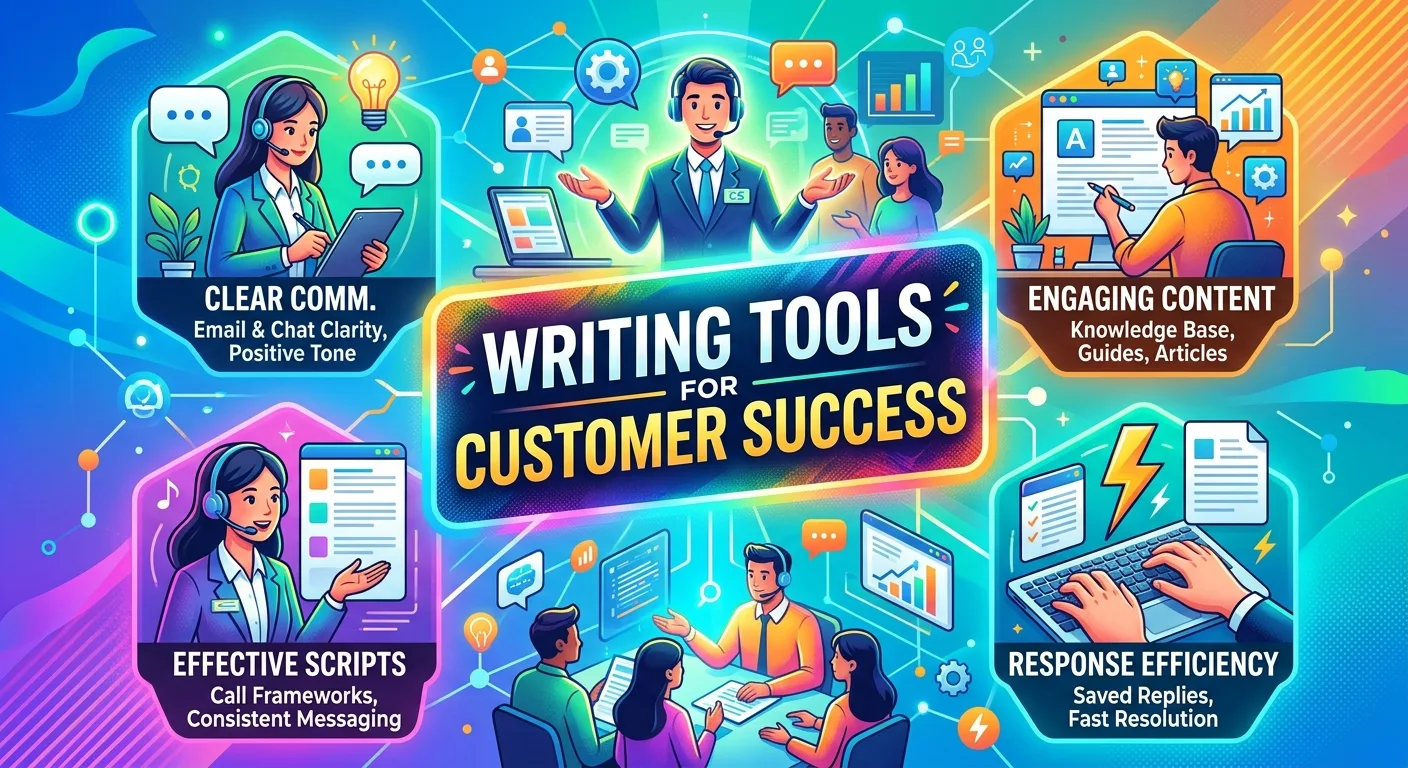
AI tools for customer success are changing how businesses support, understand, and retain their customers. Instead of relying only on manual support tickets, spreadsheets, and repetitive follow-ups, customer success teams can use artificial intelligence to analyze customer behavior, automate communication, identify risks, and deliver more personalized experiences.
These tools can improve productivity, efficiency, automation, creativity, and customer engagement across the entire customer lifecycle. For example, an AI platform can identify a customer who has stopped using a product, summarize their previous conversations, and alert a customer success manager before the account becomes at risk. AI can also help teams create onboarding content, answer common questions, analyze feedback, and predict potential churn. For companies managing hundreds or thousands of customers, these capabilities can create significant real-world value while allowing customer success professionals to spend more time on strategic relationships.
What Are AI Tools for Customer Success?
AI tools for customer success are software applications that use artificial intelligence, machine learning, natural language processing, predictive analytics, or generative AI to help businesses manage and improve customer relationships.
Customer success focuses on helping customers achieve their desired outcomes after they purchase a product or service. This can include onboarding, product education, account management, customer support coordination, retention, expansion, and relationship building.
Traditional customer success teams often spend considerable time reviewing customer data, writing follow-up messages, preparing reports, answering repetitive questions, and identifying accounts that may be at risk. AI can automate or accelerate many of these activities.
For example, an AI customer success platform can combine product usage data, support conversations, survey responses, account information, and engagement patterns. It can then generate a customer health score and highlight accounts that may require attention.
The goal is not simply to automate customer communication. The larger objective is to help customer success teams understand customers earlier, respond faster, and provide more relevant support.
How AI Customer Success Software Works
AI customer success software usually begins by collecting customer information from multiple sources. These sources can include CRM systems, customer support platforms, product analytics, email, surveys, billing systems, and communication tools.
The AI system analyzes this information to identify patterns. For example, it may recognize that a customer who previously used a product every day has suddenly stopped using an important feature.
The system can then create an alert for the customer success manager. Depending on the platform, it may also recommend an action, such as sending an onboarding guide, scheduling a meeting, or reviewing an unresolved support issue.
Generative AI adds another capability. It can summarize long conversations, create follow-up emails, prepare account reviews, and turn customer feedback into concise insights.
A simple AI-powered workflow might look like this:
Customer data → AI analysis → customer health assessment → risk or opportunity detection → recommended action → human review → customer engagement.
This approach helps teams move from reactive customer service toward proactive customer success management.
Key Features of AI Tools for Customer Success Teams
Modern AI customer success platforms can offer a wide range of capabilities. One of the most important is customer health scoring. AI can combine different signals to estimate whether an account appears healthy, stable, or at risk.
Another useful feature is automated customer segmentation. AI can group customers according to usage patterns, industry, lifecycle stage, engagement level, account value, or other characteristics.
Conversation intelligence is also becoming increasingly valuable. AI can analyze customer calls, emails, chats, and support conversations to identify common concerns, sentiment, product requests, and unresolved problems.
Generative AI features can help customer success managers write personalized messages, summarize meetings, prepare account plans, and create customer-facing documentation.
Important features may include:
- AI-powered customer health scores
- Churn risk prediction
- Customer segmentation
- Sentiment analysis
- Conversation summaries
- Automated follow-ups
- Customer onboarding automation
- Product usage analysis
- Feedback analysis
- Expansion opportunity detection
- Knowledge-base assistance
- CRM synchronization
- Customer success reporting
The right combination depends on the size and complexity of the customer success operation.
Benefits of AI Tools for Customer Success
One major advantage of AI is time savings. Customer success managers can spend less time performing repetitive administrative work and more time helping customers achieve meaningful outcomes.
AI can also improve response speed. When a customer asks a common question or shows a specific behavioral pattern, automated systems can help teams identify the situation quickly.
Another benefit is proactive risk detection. Instead of waiting for a customer to complain or cancel, AI can identify warning signals such as declining product usage, reduced engagement, negative feedback, or unresolved support issues.
Personalization is another important benefit. AI can analyze customer information and help create messages based on the customer’s industry, product usage, challenges, and lifecycle stage.
For example, a software company could use AI to identify customers who have not activated an important feature. Rather than sending the same generic email to everyone, the customer success team could send a targeted tutorial explaining that specific feature.
AI can therefore support better productivity, stronger customer engagement, faster decision-making, and more scalable customer success operations.
AI Customer Success Use Cases Across the Customer Lifecycle
AI can support customers from the moment they become prospects through onboarding, adoption, renewal, and expansion.
During onboarding, AI can identify what information a new customer needs and help create personalized onboarding messages. It can also detect customers who have not completed important setup steps.
During product adoption, AI can monitor usage patterns. If a customer consistently ignores a valuable feature, the system can recommend educational content or human assistance.
For retention, predictive analytics can identify accounts that show potential churn signals. Customer success managers can then investigate the situation before the customer makes a final decision.
AI can also support expansion. For example, usage patterns may indicate that a growing customer could benefit from additional features, seats, or services. The customer success team can review the opportunity and determine whether an expansion conversation makes sense.
Other use cases include:
- Customer onboarding
- Product adoption
- Customer education
- Renewal preparation
- Churn prevention
- Account reviews
- Customer feedback analysis
- Upselling and cross-selling
- Support collaboration
- Customer advocacy
The strongest implementations connect these use cases rather than treating them as separate AI experiments.
AI for Customer Health Scores, Churn Prediction, and Retention
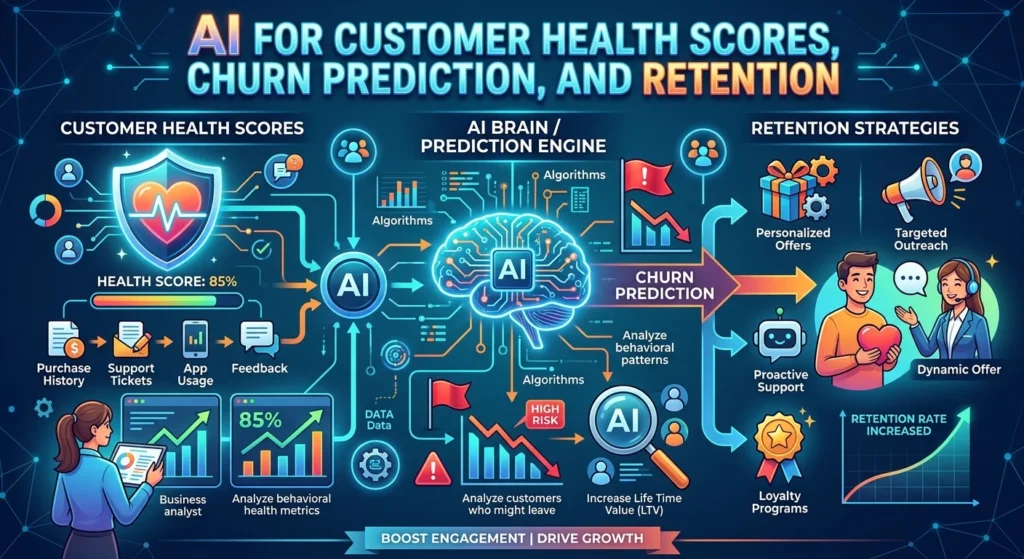
Customer health scoring helps teams understand account conditions using measurable signals. Traditional health scores may rely on manually selected rules, while AI can analyze larger datasets and identify more complex patterns.
Useful signals can include product usage, login frequency, feature adoption, support tickets, customer sentiment, survey responses, payment behavior, meeting attendance, and communication activity.
For example, a customer who has reduced product usage by a significant amount, submitted multiple unresolved complaints, and stopped attending scheduled meetings may receive a higher risk classification.
However, an AI prediction should not automatically determine what happens to the customer. Human review remains important, because unusual circumstances can produce misleading signals.
AI can also help identify positive signals. A customer who expands product usage, invites more team members, completes advanced training, and engages with premium features may represent a potential expansion opportunity.
The best customer health systems combine behavioral data, contextual information, AI predictions, and human judgment.
Free vs Paid AI Tools for Customer Success
Free AI tools can be useful for individuals and small customer success teams. A business might combine a free CRM plan with AI writing assistance, spreadsheets, basic automation, and customer feedback tools.
These solutions can help with simple tasks such as drafting emails, summarizing customer conversations, organizing feedback, or creating onboarding documents.
Paid customer success platforms typically provide deeper automation and centralized customer intelligence. They may include advanced health scoring, predictive analytics, integrations, workflow automation, reporting, and enterprise-level controls.
Pricing can vary significantly. Some platforms charge per user, while others may charge according to customer accounts, usage, contacts, features, or contract size.
Before purchasing a platform, businesses should calculate the expected value. Consider how much time the team spends on repetitive work and how much revenue could potentially be protected through better retention.
A useful strategy is to start with a focused use case, measure the results, and expand the AI workflow only after proving its value.
Integrations With CRM, Support, Analytics, and Business Systems
AI becomes more useful when it can access the right customer information. This makes integrations an important consideration when selecting customer success software.
Common integrations include CRM platforms, customer support systems, product analytics, billing software, email platforms, survey tools, communication applications, and knowledge bases.
For example, a customer success platform could pull account information from a CRM, product usage from an analytics platform, support history from a help desk, and billing information from a financial system.
AI can then analyze these combined signals and create a more complete customer profile.
APIs, webhooks, native integrations, and automation platforms can help connect different systems. Businesses should also review data permissions and security before connecting customer information.
A good integration strategy prevents customer success managers from switching between multiple systems just to understand one account.
AI Customer Success Tools Compared With Traditional Methods
Traditional customer success relies heavily on human expertise, spreadsheets, CRM notes, scheduled meetings, and manual account reviews. These methods can work effectively for smaller customer portfolios.
The problem appears when the customer base grows. Reviewing hundreds or thousands of accounts manually becomes difficult.
AI can analyze large amounts of information quickly. It can identify patterns that might take a human employee much longer to discover.
However, AI does not replace relationship-building. Customer success often depends on empathy, communication, negotiation, strategic thinking, and understanding the customer’s unique business situation.
For this reason, the most effective approach is usually AI-assisted customer success.
AI handles repetitive analysis and administrative work. Customer success professionals use the resulting information to make decisions, communicate with customers, solve complex problems, and build trust.
This division of work can create a more scalable customer success operation without removing the human element.
Pros, Cons, and Limitations of AI for Customer Success
AI customer success tools offer several important advantages.
Pros include:
- Faster customer data analysis
- Automated administrative tasks
- Earlier risk detection
- Personalized communication
- Scalable customer monitoring
- Faster reporting
- Better customer segmentation
- More consistent workflows
- Improved productivity
There are also limitations. AI depends heavily on the quality of the data it receives. If customer information is incomplete, outdated, or inconsistent, AI recommendations may become less reliable.
Another concern is over-automation. Customers may become frustrated if every interaction feels automated or impersonal.
AI predictions can also produce false positives and false negatives. A customer may appear at risk because of reduced usage even though they are completely satisfied.
Privacy and security are also important. Customer success platforms may process sensitive business information, conversations, and account data.
Businesses should therefore use AI as decision support rather than unquestionable authority. Teams should regularly review results and maintain appropriate human oversight.
Best Practices for Implementing AI in Customer Success
Start with a specific problem. Do not introduce AI simply because it is popular. Identify an area where the customer success team loses significant time or misses important signals.
Good starting points include customer conversation summaries, onboarding automation, customer health monitoring, feedback analysis, and repetitive follow-up tasks.
Next, establish clear success metrics. These could include reduced response time, improved onboarding completion, increased product adoption, reduced manual work, or improved renewal rates.
Clean your customer data before building complex AI workflows. Remove duplicates, correct inaccurate information, and establish consistent customer identifiers.
Train customer success employees on how the system works. Employees should understand what an AI recommendation means and when they should challenge or verify it.
Finally, continuously evaluate performance. AI systems should improve through feedback and real-world results, rather than being installed once and forgotten.
Common Mistakes When Using AI for Customer Success
One common mistake is automating everything. Customer success is fundamentally relationship-driven, so businesses should carefully choose which interactions require human involvement.
Another mistake is using too many disconnected AI tools. A collection of separate applications can create additional complexity instead of reducing it.
Businesses may also create customer health scores with too many irrelevant signals. More data does not automatically mean better predictions.
Ignoring customer feedback is another problem. AI may identify behavioral patterns, but customers themselves can explain why those patterns exist.
Some companies also expect immediate results. Successful AI implementation usually requires testing, data improvement, employee training, and workflow optimization.
A better approach is to start small, measure outcomes, learn from mistakes, and gradually expand automation.
It is also important to avoid using AI-generated messages without review when the communication involves sensitive customer situations, contract issues, complaints, or major account decisions.
Latest AI Customer Success Trends and Future Developments
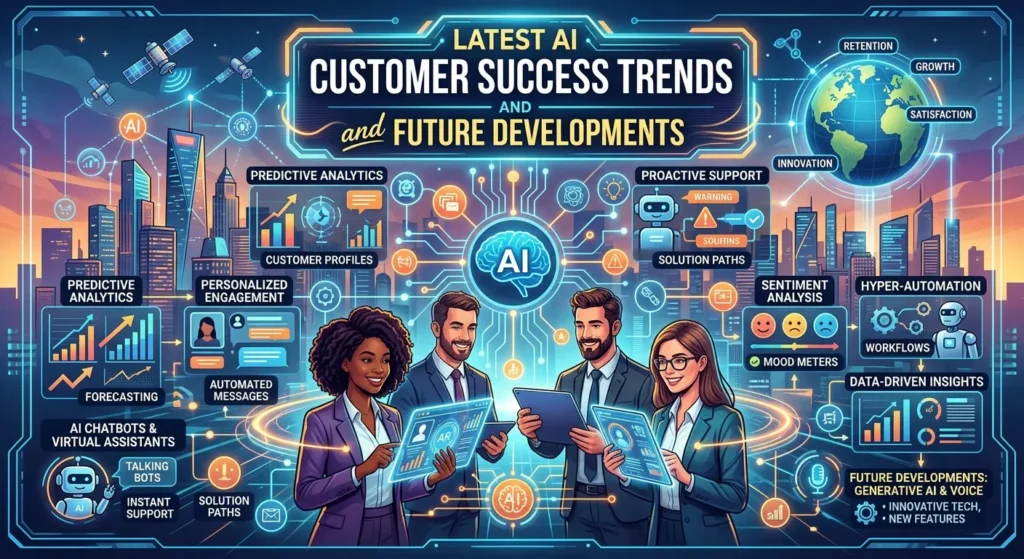
Generative AI is becoming a major part of customer success technology. Customer success managers can use AI assistants to summarize accounts, prepare meetings, draft communication, and identify important customer signals.
Predictive analytics is also becoming more sophisticated. Instead of looking at one metric, AI systems can analyze combinations of product usage, customer sentiment, support activity, and business information.
Another important trend is AI-powered customer success copilots. These systems can sit alongside customer success managers and provide recommendations while they work.
Automated customer education is another growing area. AI can help deliver personalized tutorials, product recommendations, and learning resources based on customer behavior.
Future systems may become more proactive. Instead of simply reporting that a customer is at risk, an AI system could explain the likely reason, suggest several possible actions, and prepare the necessary communication for human approval.
AI search and conversational interfaces may also influence customer success. Customers increasingly expect fast, contextual answers without navigating complicated documentation.
The long-term direction is likely to be more intelligent, connected, proactive, and personalized customer success automation.
How to Choose the Right AI Tools for Customer Success
The right AI customer success tool depends on your business size, customer volume, existing technology, and goals.
Start by identifying your most important customer success challenge. If churn is the biggest concern, prioritize predictive health scoring and risk detection. If onboarding is difficult, focus on onboarding automation and customer education.
Review the tool’s AI capabilities carefully. Ask whether the system provides explainable recommendations or simply produces scores without context.
Check integrations with your existing CRM, support platform, analytics tools, communication systems, and billing software.
Security should also be a major consideration. Review access controls, data processing, retention policies, compliance information, and vendor security practices.
Consider usability as well. A powerful platform that employees cannot easily understand may create more problems than it solves.
Finally, test the software before making a major commitment whenever possible. Use real customer scenarios and measure whether the tool actually saves time or improves customer outcomes.
FAQs About AI Tools for Customer Success
What are AI tools for customer success?
AI tools for customer success use artificial intelligence to help teams analyze customer behavior, predict risks, automate tasks, personalize communication, and improve customer retention and adoption.
How can AI improve customer success?
AI can analyze large amounts of customer data, identify potential problems earlier, automate repetitive tasks, summarize conversations, and help customer success managers deliver more personalized experiences.
Can AI predict customer churn?
AI can identify patterns associated with potential churn, such as declining product usage, negative feedback, or reduced engagement. However, predictions should be reviewed by customer success professionals.
Are AI customer success tools useful for small businesses?
Yes. Small businesses can use AI for practical tasks such as email drafting, customer feedback analysis, onboarding, conversation summaries, and basic customer health monitoring.
Can AI replace customer success managers?
AI can automate many repetitive tasks, but it does not fully replace the human skills required for relationship management, strategic conversations, negotiation, empathy, and complex problem-solving.
What data do AI customer success tools use?
Depending on the platform, AI may analyze product usage, CRM records, support tickets, customer feedback, surveys, billing information, emails, meetings, and engagement data.
Are free AI customer success tools available?
Free or limited AI features are available across various CRM, automation, analytics, and productivity platforms. However, advanced customer health scoring and predictive capabilities often require paid solutions.
What is an AI customer health score?
An AI customer health score is a data-driven assessment of an account’s overall condition. It can consider product usage, engagement, support activity, feedback, and other customer signals.
What should companies automate first?
Start with repetitive, measurable tasks such as conversation summaries, onboarding reminders, basic reporting, customer segmentation, and routine follow-ups.
How do I choose an AI customer success platform?
Consider your primary business problem, required AI capabilities, integrations, security, pricing, scalability, usability, and the quality of customer support provided by the vendor.
Conclusion
AI tools for customer success can help businesses move from reactive customer management toward a more proactive and data-driven approach. By analyzing customer behavior, automating repetitive tasks, identifying risks, and supporting personalized communication, AI can help customer success teams work more efficiently while serving customers more effectively.
The technology is most valuable when it supports people rather than trying to replace them. Customer success professionals still provide the empathy, strategic thinking, judgment, and relationship-building that technology cannot fully reproduce.
For businesses exploring AI, the best starting point is simple: identify one meaningful customer success problem, choose an appropriate tool, test it with real workflows, measure the results, and improve gradually. As generative AI, predictive analytics, automation, and customer intelligence continue to evolve, AI tools will become increasingly important for creating faster, smarter, and more personalized customer success experiences.