AI Overview SEO rank tracking tools help SEO professionals understand how websites appear in Google’s AI-generated search experiences. Traditional rank trackers tell you where a page appears in standard organic results, but AI search introduces another layer: which websites get mentioned, cited, or surfaced inside AI-generated answers.
This makes AI Overview monitoring valuable for modern SEO strategies. Businesses can use these tools to improve productivity, efficiency, automation, creativity, and content decision-making without relying entirely on manual searches. Instead of checking hundreds of queries individually, marketers can monitor important keywords, compare competitors, identify cited pages, and observe visibility changes over time.
For example, a page might rank well organically but rarely appear as a source in AI Overviews. Another competing page may receive frequent citations. Understanding this difference can reveal opportunities for better content structure, topical coverage, internal linking, and authority development.
As AI-powered search continues to evolve, tracking visibility across these experiences can help businesses adapt their SEO strategies using real search data.
What Are AI Overview SEO Rank Tracking Tools?
AI Overview SEO rank tracking tools are platforms designed to monitor how websites and brands appear in Google AI Overviews and other AI-driven search experiences. They extend traditional SEO tracking by examining search results that include AI-generated answers and associated source links.
Traditional rank tracking usually measures a webpage’s organic position for a keyword. AI Overview tracking focuses on additional signals such as AI-generated answer presence, source citations, brand mentions, cited URLs, competitors, and visibility trends.
This distinction matters because an AI Overview can provide users with a synthesized answer instead of requiring them to scan conventional search listings. A website that becomes a cited source may gain visibility even when its conventional ranking does not fully explain its exposure.
For example, imagine a travel website ranking seventh for a destination-related query. A different website ranking ninth could be cited inside the AI Overview. Traditional rank data would show one story, while AI visibility data would reveal another.
How AI Overview SEO Rank Tracking Works
Most AI Overview tracking systems begin with a set of target keywords or search queries. The platform checks those queries and determines whether an AI-generated result appears.
When an AI Overview is detected, the tool may analyze the sources included in the generated answer. Depending on the platform, it can record the domain, webpage URL, brand, competitors, query, and historical appearance.
A simplified workflow looks like this:
Keyword tracking → AI Overview detection → citation analysis → competitor monitoring → historical comparison → SEO optimization.
Automation makes this process much more practical. Instead of manually searching hundreds of keywords every week, an SEO professional can let software monitor selected queries and highlight meaningful changes.
However, AI-generated search results can change over time. Different searches, locations, devices, and search contexts may produce different results. Therefore, historical tracking provides more useful information than relying on a single observation.
Important Features of AI Overview SEO Rank Tracking Software
A good AI Overview tracking platform should provide more than a basic visibility number. Keyword monitoring and citation tracking are two fundamental capabilities because they connect AI search exposure with specific queries and pages.
Competitor monitoring is also valuable. If several competitors repeatedly appear in AI-generated answers while your website rarely appears, that pattern can identify an area worth investigating.
Another useful feature is URL-level analysis. Knowing that your domain appears is helpful, but knowing which specific page earned the citation is much more actionable. You can then study that page’s structure, topical coverage, evidence, and user experience.
Look for features such as:
- AI Overview detection
- Keyword and query tracking
- Citation monitoring
- Brand mention tracking
- Competitor analysis
- URL-level visibility
- Historical data
- Search intent filtering
- Automated reports
- Data exports
- API access
- SEO integrations
The ideal feature set depends on the size of your website and the complexity of your SEO program.
Benefits of Using AI Overview SEO Rank Tracking Tools
The biggest benefit is broader visibility measurement. Traditional rankings remain important, but AI search can expose users to information in a different format. Monitoring both surfaces provides a more complete picture.
These tools can also improve content strategy. Suppose a competitor receives frequent citations for questions related to your industry. You can analyze the type of information those pages provide and identify gaps in your own content.
Another benefit is efficiency. Automated monitoring can save hours of repetitive manual searches. Instead of collecting individual observations, marketers can use dashboards to identify patterns.
AI Overview tracking can support:
Content optimization: Find pages and topics with limited AI visibility.
Competitive research: Discover domains that appear frequently for important queries.
Brand monitoring: Measure how often a brand appears in AI-generated results.
SEO reporting: Add AI visibility signals to regular search performance reports.
Strategic planning: Identify topics where additional content or authority development may be useful.
The goal is not simply to collect more data. The goal is to turn that data into better SEO decisions.
AI Overview SEO Tracking Use Cases for Businesses
SEO agencies can use AI Overview tracking to monitor multiple clients without repeatedly checking search results manually. Keyword groups can be organized by client, topic, product, service, or search intent.
In-house marketing teams can use the same approach to monitor important commercial and informational queries. For example, a SaaS company could track searches involving product comparisons, software categories, integrations, common problems, and buying questions.
Ecommerce businesses can monitor product-related queries and category-level searches. Publishers can track informational topics and see which pages receive citations.
AI Overview tracking can be useful for:
- SaaS companies
- Ecommerce stores
- SEO agencies
- Publishers
- Local businesses
- Affiliate websites
- Technology companies
- Professional service businesses
For the best results, track queries connected to real customers rather than collecting thousands of unrelated keywords.
AI Overview Tracking vs Traditional SEO Rank Tracking
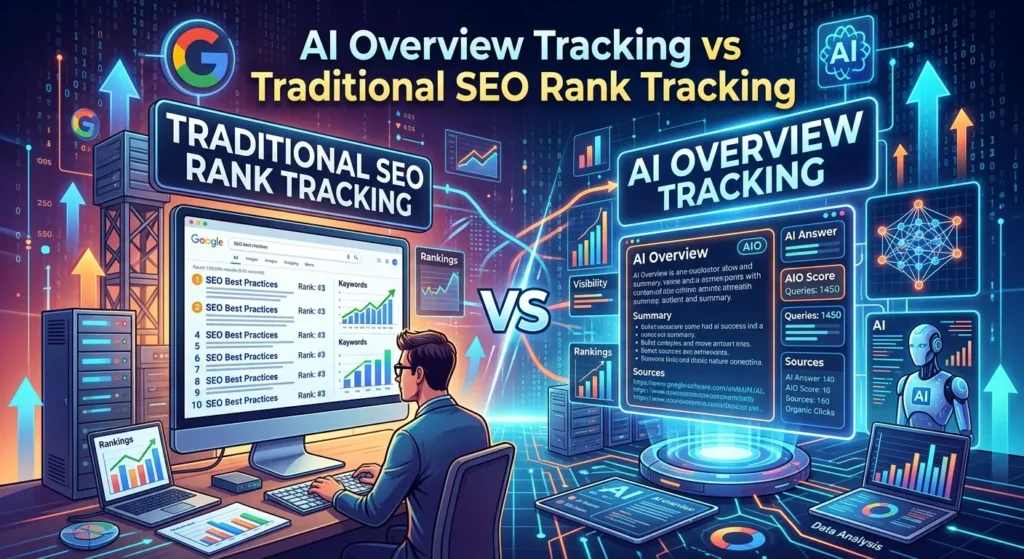
Traditional SEO rank tracking measures where a webpage appears in conventional organic search results. AI Overview tracking measures visibility within AI-generated search experiences.
Neither measurement tells the complete story by itself. A page can have a strong organic ranking but receive limited AI citation visibility. Conversely, a webpage may appear as a cited source without having the highest conventional ranking.
Traditional SEO tracking commonly includes:
- Organic keyword position
- Search impressions
- Organic clicks
- Click-through rate
- Traffic
- Ranking changes
AI-focused tracking may include:
- AI Overview presence
- Citation frequency
- Cited URLs
- Brand mentions
- Competitor citations
- AI visibility trends
The practical lesson is simple: AI Overview tracking should generally complement traditional SEO tracking rather than replace it.
Businesses can combine both datasets to understand how their content performs across different search experiences.
Free vs Paid AI Overview SEO Rank Tracking Tools
Free options can provide a useful introduction to AI search monitoring. Depending on the provider, free tools may offer limited keyword tracking, manual checking, or basic visibility information.
Paid platforms generally provide more advanced capabilities. These can include larger keyword limits, historical data, automated monitoring, competitor tracking, reporting, integrations, and API access.
Before choosing a paid plan, determine how much tracking you actually need. A small website may only need a focused set of high-value keywords. An agency managing many websites may require significantly larger limits.
A practical strategy is to start with a small group of important queries. Test whether the tool provides useful data before committing to a larger subscription.
Also check whether AI Overview tracking is included in the normal subscription or requires an additional plan. Software pricing and feature packages can change, so always verify current details directly with the provider.
Pricing Factors for AI Overview SEO Rank Tracking Platforms
AI search tracking pricing can vary considerably. Some providers include AI visibility features within broader SEO platforms, while others specialize in AI search monitoring.
Pricing may depend on keyword limits, projects, tracking frequency, locations, users, historical data, competitors, reports, API access, and integrations.
For example, an individual website owner might need only a few hundred tracked queries. An enterprise SEO department or agency could need thousands of queries across multiple projects.
Instead of looking only at the monthly subscription price, consider how much useful data you receive for the cost. A cheaper tool with poor coverage may provide less practical value than a slightly more expensive platform with reliable monitoring.
Always review the current pricing page, usage limits, trial conditions, and upgrade requirements before purchasing.
Integrations and Reporting for AI Search Visibility
Integrations can make AI search tracking much more useful. SEO teams may want to connect visibility information with analytics, reporting systems, SEO platforms, spreadsheets, or custom dashboards.
For agencies, automated reporting can reduce repetitive work. A report might show changes in AI visibility alongside traditional rankings and organic traffic.
API access can be especially useful for larger organizations. Developers can combine AI search data with internal systems and create custom monitoring workflows.
Useful integration categories include:
Analytics: Connect visibility changes with traffic and engagement.
SEO platforms: Combine AI visibility with rankings, backlinks, and technical data.
Reporting systems: Build recurring client or management reports.
APIs: Move data into custom applications and dashboards.
The best integration is not necessarily the one with the longest feature list. It is the one that reduces manual work and helps your team make better decisions.
AI Overview SEO Rank Tracking Alternatives and Complementary Tools
AI Overview tracking is only one part of modern SEO. Other tools can provide technical audits, backlink analysis, content optimization, keyword research, analytics, and conventional rank tracking.
Manual search analysis also remains useful. Automated tools can identify patterns at scale, but humans can inspect actual search experiences and understand context that a dashboard may not fully capture.
For example, an SEO professional might use an automated tool to discover that a competitor frequently receives citations. They can then manually inspect several queries to understand why that competitor’s content appears relevant.
A complete workflow can therefore combine:
AI visibility monitoring + traditional rank tracking + analytics + content analysis + technical SEO + human review.
This approach helps prevent overreliance on one metric.
How to Choose the Right AI Overview SEO Rank Tracking Tool
Start by defining what you want to measure. Your primary goal could be monitoring brand visibility, tracking citations, studying competitors, measuring content performance, or identifying AI search opportunities.
Next, test the tool using keywords that matter to your business. Do not rely only on demonstrations or feature lists. Actual query testing can reveal whether the data is useful for your market.
Data quality should receive particular attention. A polished dashboard is less valuable if it does not accurately capture the search experiences you care about.
Consider these factors:
- AI Overview coverage
- Keyword limits
- Tracking frequency
- Geographic targeting
- Competitor monitoring
- Citation details
- Historical data
- Reporting
- API access
- Integrations
- Ease of use
- Support
- Pricing
A short trial can help you determine whether the platform fits your workflow before you invest heavily.
Common Mistakes When Monitoring AI Overview SEO Rankings
One common mistake is assuming that AI Overviews work exactly like traditional rankings. AI-generated answers can contain several sources, and citation visibility may not translate into a simple fixed ranking position.
Another mistake is tracking too many irrelevant queries. More keywords do not automatically mean better insights. Start with queries connected to your products, services, customers, and strategic topics.
Teams may also check an AI Overview once and treat the result as permanent. AI search experiences can change, so repeated monitoring provides a stronger view of trends.
Another issue is focusing only on visibility. Being cited does not automatically mean a user will visit your website or become a customer. Connect AI visibility with clicks, engagement, conversions, and business outcomes where possible.
Finally, avoid creating content solely to manipulate AI systems. Helpful, accurate, original content provides a stronger foundation for sustainable search visibility.
Latest AI Overview SEO Tracking Trends for 2026

AI-powered search continues to move toward more conversational experiences. Users can ask detailed questions instead of entering short keyword phrases, which increases the importance of understanding search intent and context.
Another major trend is the expansion of visibility measurement. SEO professionals increasingly need to understand not just conventional rankings but also citations, brand mentions, generated answers, and visibility across different AI-powered search experiences.
Content quality is also becoming increasingly important. Websites that provide clear information, original insights, reliable evidence, useful examples, and strong topical coverage can give search systems more meaningful information to work with.
For marketers, the central questions are expanding from:
“What position do I rank at?”
to:
“Where is my brand visible?”
“Which pages are being cited?”
“Which competitors are appearing?”
“What topics does search associate with my website?”
These questions create a broader framework for modern SEO measurement.
Best Practices for Improving AI Overview SEO Visibility
Start by answering the user’s question clearly. Avoid making readers search through long introductions before reaching the information they need.
Use logical headings and short sections. Provide definitions, examples, steps, comparisons, and supporting details where they genuinely help.
Develop topical depth rather than producing many thin pages. A website that thoroughly covers a subject can create stronger relationships between related concepts and questions.
Internal linking can also help users and search engines discover related content. Connect supporting articles with relevant cornerstone pages.
Practical best practices include:
- Answer important questions directly.
- Keep information accurate and current.
- Demonstrate relevant expertise.
- Add original insights.
- Use descriptive headings.
- Strengthen internal linking.
- Avoid keyword stuffing.
- Improve page usability.
- Monitor important competitors.
- Track visibility changes over time.
- Connect SEO metrics with business outcomes.
Most importantly, do not forget the human reader. AI search optimization should support useful content rather than become an excuse for producing content without real value.
Future of AI Overview SEO Rank Tracking Tools
The future of AI Overview SEO tracking will likely involve more detailed visibility analysis. Platforms may increasingly analyze citation patterns, source selection, brand associations, search intent, content relationships, and visibility across multiple AI search environments.
Automation may also become more intelligent. Instead of simply telling marketers that visibility increased or decreased, future systems could help identify the queries, pages, competitors, and content characteristics associated with those changes.
Another important development is the integration of traditional SEO and AI search data. Instead of managing separate dashboards, SEO professionals may increasingly use unified systems that combine rankings, traffic, citations, mentions, technical signals, and content performance.
This shift means SEO measurement will become less dependent on one ranking number. Marketers will need to understand the broader search visibility ecosystem.
The long-term objective remains practical: create useful content, demonstrate expertise, build topical authority, monitor how search systems discover your information, and improve based on reliable evidence.
Frequently Asked Questions About AI Overview SEO Rank Tracking Tools
What are AI Overview SEO rank tracking tools?
They are SEO platforms that monitor website visibility within Google AI Overviews and other AI-powered search experiences. Depending on the platform, they can track citations, mentions, URLs, competitors, and historical changes.
Why should I track AI Overview visibility?
AI-generated answers can influence how users discover websites. Monitoring AI visibility provides additional information that traditional organic ranking reports may not show.
Are AI Overview rankings the same as Google rankings?
No. Traditional rankings measure positions in conventional search results. AI Overview tracking generally measures whether and how a source appears within an AI-generated answer.
Can I track AI Overviews for free?
Some providers offer free or limited monitoring. Advanced features such as larger keyword sets, automation, historical data, and reporting are commonly available through paid plans.
How often should I track AI Overview SEO performance?
It depends on your goals and keyword volatility. High-priority commercial queries may deserve more frequent monitoring, while less important informational searches can be tracked less often.
Can AI Overview tracking improve my rankings?
The tracking tool itself does not improve rankings. It provides data that can help you identify content gaps, citation opportunities, competitor patterns, and changes in search visibility.
Should I stop using traditional rank tracking?
No. Traditional rank tracking and AI Overview monitoring measure different aspects of search performance. Using both can provide a broader understanding of your website’s visibility.
What content is useful for AI search?
Clear, accurate, well-structured, original, and helpful content can provide strong value to both users and search systems. Relevant entities, useful examples, strong topical coverage, and good internal linking can also support discoverability.
Do AI Overview tools track competitors?
Many specialized platforms provide competitor monitoring. This can help identify domains and pages that frequently appear for your important queries.
Will AI Overviews replace traditional search results?
Search is evolving, but conventional organic results remain an important part of the search ecosystem. Businesses should monitor both traditional and AI-driven search experiences.
Conclusion
AI Overview SEO rank tracking tools give marketers a broader way to understand modern search visibility. Instead of focusing only on traditional keyword positions, businesses can examine AI citations, brand mentions, cited URLs, competitors, and visibility trends.
The most effective strategy is to combine these insights with traditional SEO metrics, analytics, technical optimization, and high-quality content.
As AI-powered search continues to develop through 2026 and beyond, visibility measurement will become increasingly important. Businesses that monitor how their content appears across changing search experiences can make more informed decisions about content and SEO.
Ultimately, the goal is not simply to appear in an AI-generated answer. The goal is to create trustworthy, useful information that deserves to be discovered, cited, and used by real people.