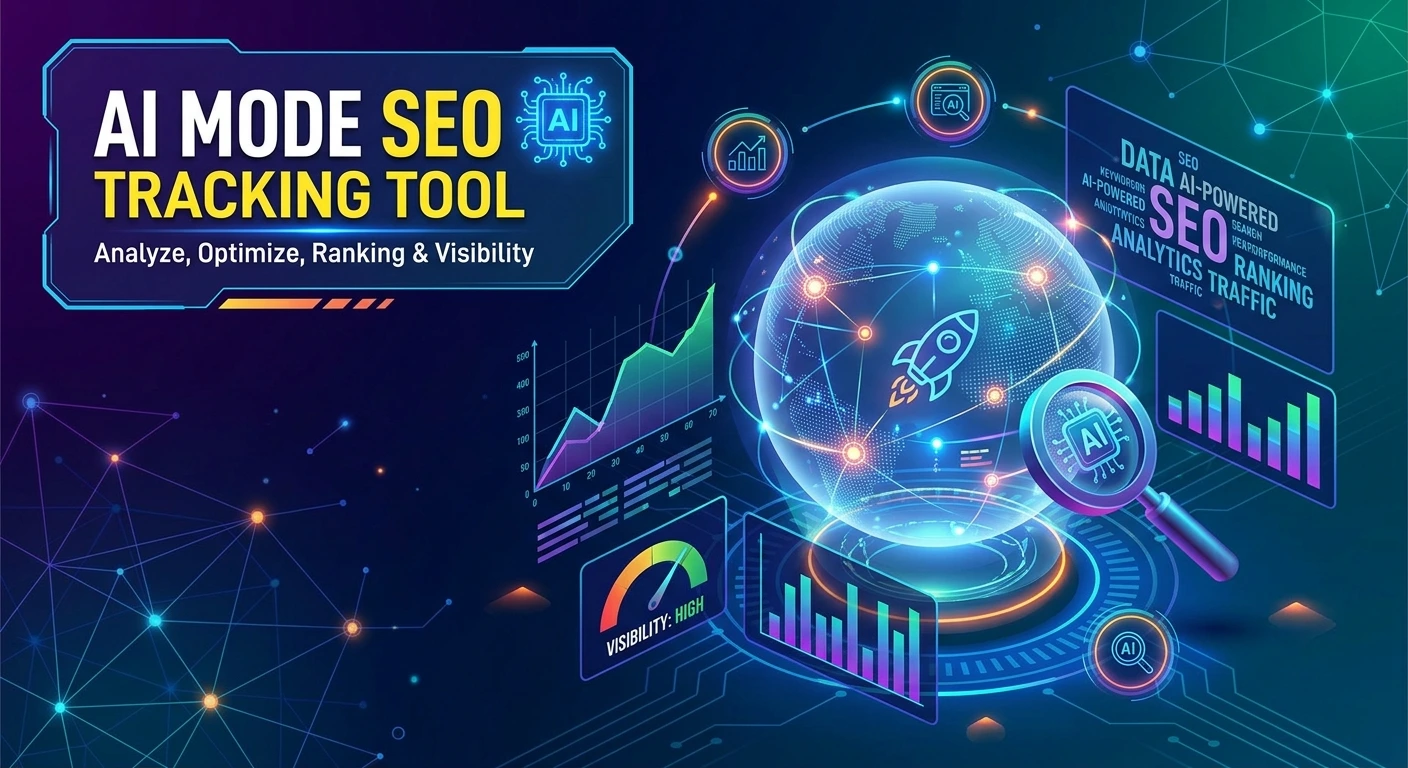
As search evolves, traditional SEO tracking is no longer enough. An ai mode seo tracking tool helps marketers understand how their content and brands appear across AI-powered search experiences, including AI-generated answers, summaries, and conversational search results. These tools bring innovation, productivity, efficiency, creativity, and automation into modern SEO workflows by turning complex visibility data into practical insights.
Instead of checking search results manually, marketers can monitor important queries, identify brand mentions, compare competitors, and discover content gaps. This can save time and support better content decisions. For businesses preparing for the future of search, AI-mode tracking also provides a way to connect traditional rankings with emerging AI visibility signals.
What Is an AI Mode SEO Tracking Tool?
An AI mode SEO tracking tool is software designed to monitor how websites, brands, products, or content appear within AI-powered search experiences. Traditional rank trackers mainly measure where a webpage appears in conventional search results. AI-focused trackers look beyond the classic blue-link ranking model.
Depending on the platform, an AI SEO tracking solution may monitor AI-generated answers, citations, brand mentions, referenced pages, search themes, competitor visibility, and changes in AI responses. This creates a broader picture of how a business is represented when users search with AI.
For example, imagine a company publishes an article about project-management software. A traditional tracker might show that the article ranks position five for a keyword. An AI tracking tool may additionally show whether the company gets mentioned when an AI search system answers questions related to project-management software.
This distinction matters because visibility does not always equal a traditional ranking. A brand can appear inside an AI-generated answer even when its website does not hold the first conventional position.
How AI Mode SEO Tracking Works
An AI mode SEO tracking workflow usually begins with a collection of target queries. These queries can include informational keywords, commercial searches, comparison questions, branded searches, and long-tail conversational prompts.
The platform then checks those queries against supported AI search environments or analyzes collected search-response data. It records relevant signals such as whether a brand appeared, which sources were cited, what competitors appeared, and how frequently certain domains were referenced.
The tool may repeat this process over time. Historical data allows marketers to identify changes rather than relying on a single observation. Tracking trends is more useful than looking at one isolated AI response.
For example, a marketing team could monitor questions such as:
- “What are the best SEO tools for small businesses?”
- “Which AI SEO tools track AI search visibility?”
- “How can ecommerce brands improve AI search visibility?”
- “What is the best rank tracking software?”
Over several weeks, the team can compare changes in mentions, citations, competitors, and content coverage.
Key Features to Look for in an AI SEO Tracking Tool
A useful platform should provide more than a simple visibility percentage. The most valuable systems connect AI search monitoring with actionable SEO information.
Look for query tracking, brand monitoring, citation analysis, competitor comparisons, historical reporting, keyword grouping, and automated alerts. These features can reduce repetitive research and make large datasets easier to understand.
Some advanced tools may also categorize AI responses by intent. For example, informational searches can be separated from commercial or transactional searches. This helps marketers understand where their visibility is strongest.
Important features may include:
- AI response monitoring
- Brand mention tracking
- Citation and source analysis
- Competitor visibility tracking
- Historical trend reports
- Keyword and prompt grouping
- Content-gap discovery
- Automated alerts
- Exportable reports
- API or third-party integrations
The exact features vary between providers, so always verify what each platform actually measures.
Benefits of Using an AI Mode SEO Tracking Tool
One major benefit is time savings. Manually searching hundreds of questions across different AI-powered search experiences can become repetitive. Automation can turn that process into a structured monitoring workflow.
Another benefit is better decision-making. Instead of asking whether a website is “doing well” in AI search, marketers can examine specific evidence. They can identify which topics generate visibility and which important queries remain uncovered.
AI tracking can also help teams discover competitors they might overlook in conventional SEO. A competitor that rarely appears above a website in traditional results may still receive frequent mentions or citations in AI-generated answers.
For content teams, this information can support decisions about:
- Which topics deserve new content
- Which existing pages need improvement
- Which questions remain unanswered
- Which competitors receive frequent citations
- Which brand claims need stronger supporting evidence
The goal is not simply to collect another SEO metric. The goal is to turn AI-search observations into useful content and marketing actions.
AI Mode Tracking vs Traditional Rank Tracking
Traditional rank tracking measures conventional search visibility. It commonly focuses on keyword positions, search engine results pages, local rankings, featured snippets, and related SERP features.
AI mode tracking examines a different layer of search. Instead of asking only, “Where does my page rank?” it can help answer questions such as, “Is my brand mentioned?” or “Which sources does an AI-generated answer reference?”
These approaches should not be treated as replacements for one another.
Traditional SEO remains important because search engines still use conventional results, while AI experiences increasingly influence how users discover information. A modern SEO workflow can therefore monitor both conventional rankings and AI visibility.
For example, a website might rank highly for a keyword but receive limited AI citations. Another website could have moderate traditional rankings but appear frequently in AI-generated answers. Monitoring both signals gives marketers more context.
AI Search Visibility, Citations, and Brand Mentions
AI search visibility describes how frequently and prominently a brand or website appears in AI-powered search experiences. Visibility can take several forms, including a direct brand mention, a citation, a linked source, or inclusion in a generated recommendation.
Citations are especially valuable because they can reveal which websites AI systems use as supporting sources. However, a citation does not automatically mean that the cited page is the “best” page or that the AI response is always correct.
Marketers should examine the context surrounding each citation. Ask whether the page provides accurate information, whether it directly answers the question, and whether the content demonstrates useful expertise.
Brand mentions also deserve attention. An AI system may mention a company without linking directly to its website. Tracking both mentions and citations can therefore provide a more complete picture of brand presence.
Use Cases for Businesses and SEO Teams
AI mode SEO tracking can support different types of organizations. Small businesses can use it to monitor important commercial questions without manually checking every search.
Large organizations can use it for brand monitoring across many markets, product categories, and content topics. Agencies can use it to create recurring reports for clients and identify opportunities for optimization.
Content teams can use AI tracking during content planning. Suppose a website sells accounting software. The team could monitor questions about accounting tools, bookkeeping software, tax workflows, invoicing, and business finance.
If competitors frequently appear in AI answers while the company’s pages rarely receive citations, that difference may highlight a content opportunity. The team can then review competing sources and improve its own pages with clearer explanations, stronger evidence, original insights, and better topical coverage.
Other use cases include:
- Enterprise SEO monitoring
- Agency reporting
- Brand reputation tracking
- Content strategy
- Competitor research
- Product visibility analysis
- Ecommerce search monitoring
- AI search experimentation
Free vs Paid AI Mode SEO Tracking Tools
Free tools can be useful for learning the fundamentals of AI search visibility. They may provide limited query checks, basic monitoring, or small datasets.
However, serious SEO monitoring often requires more data. Paid platforms may offer larger keyword limits, historical tracking, competitor comparisons, automated reporting, integrations, and more frequent updates.
Before paying for a platform, consider how often you need fresh data. A small website may only need to monitor a few dozen high-value questions. An agency managing multiple clients could require thousands of tracked queries.
A sensible approach is to start with a small monitoring set. Track your most important queries first. If the data leads to useful decisions, expand your coverage.
Do not choose a platform simply because it offers the largest number of tracked keywords. The quality of the data, supported AI search environments, reporting clarity, and practical usefulness matter just as much.
Pricing Factors and What to Evaluate
Pricing for AI SEO tracking platforms can vary considerably. Providers may charge based on tracked keywords, prompts, projects, users, query frequency, locations, AI platforms, or data volume.
Some tools offer monthly subscriptions, while others use usage-based or credit-based models. Enterprise plans can include custom limits, APIs, team permissions, and advanced reporting.
When evaluating pricing, calculate the cost per useful insight, not just the monthly subscription.
Ask:
- How many queries can I track?
- How frequently does the platform collect data?
- Which AI search experiences are supported?
- Can I monitor competitors?
- Does it provide historical data?
- Can reports be exported?
- Are API connections available?
- Are additional usage charges possible?
A cheaper tool may provide enough data for a small project. A larger SEO team may need deeper monitoring and automation.
Integrations With SEO and Marketing Workflows
Integrations can make an AI tracking platform more useful. Instead of keeping AI visibility data separate, marketers can connect insights with existing SEO, analytics, reporting, or content workflows.
Depending on the platform, integrations may include APIs, spreadsheets, reporting systems, analytics platforms, dashboards, or project-management tools.
For example, an SEO manager could export AI visibility data into a reporting dashboard. A content team could then compare AI citations with organic traffic and traditional keyword performance.
Automation becomes especially valuable when teams monitor hundreds or thousands of queries. The less time spent collecting data manually, the more time teams can spend interpreting it.
However, integrations should support decision-making rather than create unnecessary complexity. Only connect systems that your team will actually use.
Pros and Cons of AI Mode SEO Tracking
AI tracking provides several useful advantages. It can reveal visibility signals that traditional rank trackers may not capture. It can also reduce manual searches and provide historical evidence for strategic decisions.
Another advantage is competitive intelligence. By monitoring the same questions over time, marketers can observe which brands and sources repeatedly appear in AI-generated responses.
There are also limitations. AI responses can change between searches, locations, languages, accounts, and system updates. Different tools may therefore produce different measurements.
Another challenge is measurement standardization. Traditional ranking has a familiar position-based model. AI visibility can be more complex because an answer may contain several sources, mentions, or recommendations.
For this reason, AI tracking data should be treated as an important signal rather than an absolute measure of search success.
How to Choose the Right AI Mode SEO Tracking Tool
Start with your business objective. If your main goal is brand monitoring, prioritize mention and citation tracking. If your goal is SEO strategy, look for query-level visibility, competitor analysis, and historical trends.
Next, define the searches that matter most. Do not begin with thousands of random keywords. Build a focused list around your products, services, customers, competitors, and important informational topics.
Then test the platform using real questions.
Check whether the tool gives you information you can act on. A beautiful dashboard is useful only when the underlying data helps you make better decisions.
Consider these selection criteria:
Data coverage: Does the tool monitor the AI search environments you care about?
Tracking depth: Can you monitor individual prompts and historical changes?
Competitive intelligence: Can you compare your visibility with relevant competitors?
Reporting: Are reports understandable and easy to share?
Automation: Can the system collect and organize data without constant manual work?
Scalability: Can the tool grow with your website or client portfolio?
A short trial can often reveal more than a long feature list.
Best Practices for Improving AI Search Visibility
Using a tracking tool is only the first step. The real value comes from improving the content that the data identifies as weak or underrepresented.
Create content that directly answers real user questions. Use clear headings, concise explanations, original research, practical examples, and trustworthy supporting information.
Build strong topical coverage instead of producing dozens of shallow pages. AI systems need useful sources to reference, and comprehensive content can make it easier for search systems to understand a subject.
Also strengthen your website’s overall credibility. Clearly identify authors where appropriate, support important claims with reliable sources, keep information current, and demonstrate first-hand expertise.
A useful workflow looks like this:
Track → Analyze → Identify gaps → Improve content → Monitor again.
This creates a continuous optimization cycle rather than a one-time SEO project.
Common Mistakes When Tracking AI Search
One common mistake is focusing on a single visibility score. A score can simplify complex information, but it may hide the reasons behind a change.
Another mistake is tracking too many irrelevant prompts. A huge keyword list does not automatically create useful insight. Quality and relevance should come before volume.
Some marketers also confuse AI visibility with traffic. A brand mention inside an AI answer does not necessarily produce a website visit. AI visibility should therefore be considered alongside organic traffic, conversions, engagement, branded searches, and other business metrics.
Avoid making major content decisions from one AI response. Search systems can change their answers, sources, and wording. Look for repeated patterns across multiple observations.
Finally, do not copy AI-generated answers into your own website simply because they appear successful. Your content should provide original value, accurate information, useful evidence, and a better experience for readers.
Latest Trends and Future of AI SEO Tracking
AI search is moving toward more conversational and answer-focused experiences. Users increasingly ask complete questions instead of entering short keyword phrases.
This means SEO tracking will likely become more focused on topics, entities, prompts, citations, context, and brand representation, rather than keywords alone.
Another important development is multimodal search. AI systems can increasingly work with combinations of text, images, voice, and other information formats. SEO monitoring may therefore expand beyond traditional text-based queries.
Automation will also become more sophisticated. Future platforms may detect visibility changes, categorize causes, identify content gaps, and recommend specific pages for improvement.
However, marketers should avoid assuming that every new AI metric will become a permanent industry standard. Search technology changes quickly. The best long-term approach is to monitor meaningful business outcomes while adapting measurement methods as search evolves.
Conclusion: Building a Smarter AI SEO Tracking Strategy
An ai mode seo tracking tool can help businesses understand a new layer of search visibility that traditional rank tracking does not fully capture. By monitoring AI mentions, citations, competitors, prompts, and historical changes, marketers can gain useful insight into how their brands appear in AI-powered search.
The strongest strategy combines AI tracking with traditional SEO, high-quality content, technical optimization, trustworthy information, and real business metrics. Do not treat AI visibility as a replacement for conventional rankings. Use both perspectives to understand the complete search journey.
Start small. Track your most important questions, analyze which sources appear, identify content gaps, improve your pages, and monitor the results over time. Consistent measurement and useful content will remain more valuable than chasing individual algorithm changes.
As AI search continues to evolve through 2026 and beyond, businesses that build flexible measurement systems will be better prepared to understand where their visibility comes from and where new opportunities may exist.
Frequently Asked Questions About AI Mode SEO Tracking Tools
What is an AI mode SEO tracking tool?
An AI mode SEO tracking tool monitors how brands, websites, products, and content appear in AI-powered search experiences. It can track signals such as mentions, citations, sources, competitors, and query-level visibility.
Why is AI search tracking important for SEO?
AI search can present information differently from traditional search results. Tracking helps marketers understand whether their content is being referenced or mentioned when users ask relevant questions.
Can AI SEO tracking replace traditional rank tracking?
No. The two approaches measure different aspects of search visibility. Traditional rank tracking remains useful for conventional search results, while AI tracking focuses on AI-powered experiences.
Are free AI SEO tracking tools available?
Some providers offer free plans, trials, or limited monitoring features. Free options can be useful for experimentation, while larger SEO campaigns may require paid plans with higher limits and additional reporting features.
What should I track in AI search?
Start with your most important commercial, informational, branded, and competitor-related questions. Monitor brand mentions, citations, referenced URLs, competitor presence, and changes over time.
How often should AI search visibility be monitored?
The ideal frequency depends on your goals and how quickly your industry changes. Regular monitoring provides more useful trend information than occasional manual checks.
Does appearing in an AI answer guarantee website traffic?
No. A brand can appear in an AI-generated response without receiving a click. AI visibility should therefore be analyzed alongside traffic, conversions, engagement, and other business metrics.
How can I improve my AI search visibility?
Create accurate, useful, original content that directly answers user questions. Strengthen topical coverage, demonstrate expertise, support important claims, keep information updated, and monitor which pages and sources AI systems reference.
What is the difference between an AI citation and a brand mention?
A citation generally refers to a source or webpage referenced by an AI-generated answer. A brand mention means the brand appears in the response, whether or not the response provides a direct citation or link.
What will AI SEO tracking look like in the future?
AI SEO tracking is likely to become more conversational and context-aware. Future platforms may monitor topics, entities, citations, multimodal searches, brand representation, and changes across multiple AI-powered search experiences.